Citizens United v. Federal Election Commission (2010) | An Introduction to Constitutional Law
22 Jan 2020 Leave a comment
in comparative institutional analysis, constitutional political economy, law and economics, politics - USA, Public Choice Tags: constitutional law, free speech
The Good Friday Agreement at 20: what went wrong?
22 Jan 2020 Leave a comment

 The Good Friday Agreement (also known as the Belfast Agreement) is 20 years old today, but recent events in Northern Ireland have shown that power-sharing has proven a difficult exercise. Alan Whysall, who was involved in the negotiations that led to the Agreement as well as its implementation, examines what has gone wrong since the Agreement was signed. A second blog, to be published tomorrow, will discuss what can be done to get the Agreement back on track.
Today marks the 20th anniversary of the signing of the Good Friday Agreement, (‘the Agreement’), but the system of power-sharing government it established in Northern Ireland has not functioned for over a year. It was widely seen in Britain, as elsewhere, as a significant act of statesmanship, supported by both main parties. But it now appears at risk, as the Irish border becomes a critical issue in the Brexit negotiations.
What has…
View original post 1,927 more words
‘Taking the border out of politics’ – the Northern Ireland referendum of March 1973
22 Jan 2020 Leave a comment

In 1973, the UK government organised the country’s first referendum, on the subject of whether or not Northern Ireland should remain part of the UK. Now, as Brexit and its potential consequences make another border poll look like an increasing possibility, David Torrance looks back on the poll, its background, and its later constitutional significance.
Introduction
The first constitutional referendum in the history of the United Kingdom took place on 8 March 1973. It was held nearly four years after the beginning of ‘The Troubles’ – a sharp deterioration in the security and political situation in Northern Ireland.
What became known as the ‘border poll’ (although it was also called a ‘referendum’ or ‘plebiscite’, no one could quite agree on terminology) emerged as a means by which to ‘take the border out of politics’, or so it was hoped. In discussions with the Government of Northern Ireland (NIG)…
View original post 2,181 more words
Evolutionary psychology for the masses
22 Jan 2020 Leave a comment

UPDATE: Over at Pharnygula, P.Z. has his own take (negative) on Bering’s paper and the lax standards of evolutionary psychology. P.Z. notes that the “adaptive” results of the handgrip study cited by Bering have not in fact been replicated by other investigators. That calls the results into question, something that Bering conveniently omits from his piece.
_____________________
In the past week I’ve read two “pop” articles on evolutionary psychology. One, “Social Animal,” in the latest New Yorker, is by New York Times op-ed columnist David Brooks. It’s apparently an extract from an eponymous upcoming book. The piece is cleverly framed: it’s the account of a first date by two fictional people, “Harold” and “Erica,” in which all of their conversation, their gestures, and their subsequent courtship and marriage are couched in terms of evolutionary psychology, with Brooks describing the research backing up the story. Here’s…
View original post 1,849 more words
THE Simpsons and Wind ‘Energy’
22 Jan 2020 Leave a comment

 THE Simpsons and Medieval Tech | Climatism
“We get a tax credit if we build a lot of wind farms.
That’s the only reason to build them.
They don’t make sense without the tax credit.
–– Warren Buffett
“Renewable energy technologies simply won’t work;
we need a fundamentally different approach.”
–– Top Google engineers
“Suggesting that renewables will let us phase rapidly off fossil fuels
in the United States, China, India, or the world as a whole
is almost the equivalent of believing in the Easter Bunny and Tooth Fairy.
– James Hansen
(The Godfather of AGW alarmism / former NASA climate chief)
***
H/t Guy Takamatsu
HAPPY Hump Day!
A little gem to help you through the rest of the working week, courtesy of our favourite politically incorrect family – The Simpsons.
WATCH (2 mins) …
•••
UNreliables related :
View original post 240 more words
Craig Prescott: Harry and Meghan, Regency, Counsellors of State and a “Slimmed Down” Royal Family
22 Jan 2020 Leave a comment
Running short of counsellors of state


Introduction
On 19th January, after discussions within the Royal Family, it was announced that the Duke and Duchess of Sussex will step back from royal duties, no longer receive public funds, or ‘formally represent the Queen’. Neither will they use their HRH titles, and more generally they will not be classed as ‘working members of the Royal Family’. Instead, the Sussexes will pursue a new life in Canada, outside the structure of the Royal Family, although they have committed to continue to ‘uphold the values of Her Majesty’.
Not all the details of this arrangement have been finalised ahead of its implementation in the Spring and given that Prince Harry is sixth in the line of succession it may appear that there are few, if any, constitutional implications. However, this blog addresses perhaps the one constitutional issue that the Sussexes decision raises – Prince Harry’s position as a Counsellor…
View original post 1,801 more words
January 21, 1793: Execution of King Louis XVI of France and Navarre.
22 Jan 2020 Leave a comment

* 1793 – After being found guilty of treason by the French National Convention, Louis XVI of France is executed by guillotine.
Louis XVI (August 23, 1754 – January 21, 1793), born Louis-Auguste, was the last king of France and Navarre before the fall of the monarchy during the French Revolution.
Louis-Auguste de France, who was given the title Duc de Berry at birth, was born in the Palace of Versailles. One of seven children, he was the second surviving son of Louis, the Dauphin of France, and the grandson of Louis XV of France and Navarre and of his consort, Maria Leszczyńska. His mother was Marie-Josèphe of Saxony, the daughter of Prince-Elector Friedrich August II of Saxony, (also King Augustus III of Poland) and Maria Josepha of Austria.

In 1765, at the death of his father, Louis, Dauphin of France son and heir apparent of Louis XV, Louis-Auguste became…
View original post 407 more words
Housing unaffordability
22 Jan 2020 Leave a comment

The annual Demographia report on housing affordability across a range of English-speaking advanced countries was released earlier this week.
If you are a New Zealander who cares at all about efficiency, fairness (especially to the rising generation), functioning markets it makes pretty bleak reading. The focus of the analysis is on the ratio of median house prices to median household income. Here is ratio for the median urban market in each of the countries they look at
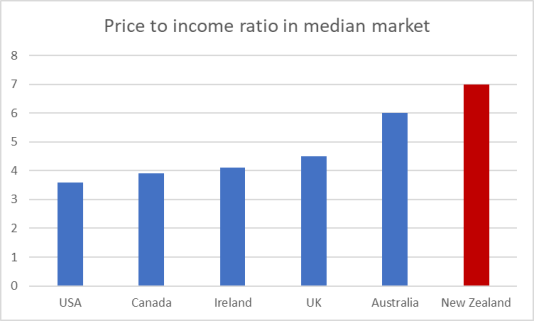
(They also look at the two city states Singapore (which is in the middle of the pack) and Hong Kong (which is off the charts, see below).
And here is a chart focused just on fairly large cities (>1 million people). I’ve shown the ten cities with the lowest price to income ratios, the ten with the highest ratios, and a selection (every ten or so rank places) of those in-between.
View original post 782 more words
10. Climate Policy Costs Unjustified for Future Minuscule Benefits
22 Jan 2020 Leave a comment
in applied welfare economics, energy economics, environmental economics, global warming Tags: climate alarmists
Finn Kydland on economic policy
22 Jan 2020 Leave a comment
in development economics, economic growth, economic history, economics of bureaucracy, Edward Prescott, entrepreneurship, Euro crisis, fiscal policy, global financial crisis (GFC), great recession, growth disasters, growth miracles, income redistribution, industrial organisation, inflation targeting, international economics, labour economics, law and economics, macroeconomics, monetary economics, property rights, Public Choice, public economics, rentseeking, Robert E. Lucas Tags: game theory, real business cycle theory


Recent Comments