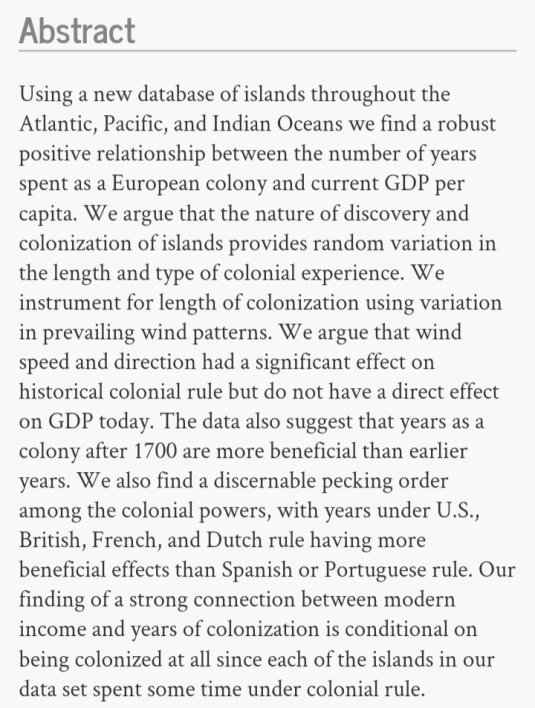
Colonialism and Modern Income: Islands as Natural Experiments by James Feyrer and Bruce Sacerdote
11 Oct 2019 Leave a comment
in comparative institutional analysis, constitutional political economy, defence economics, development economics, economic history, economics of bureaucracy, economics of crime, economics of education, economics of regulation, growth disasters, growth miracles, human capital, income redistribution, industrial organisation, international economic law, International law, law and economics, property rights, Public Choice, public economics, rentseeking Tags: Age of Discovery, age of empires, Age of exploration, British empire, economics of colonialism
A handy style guide
11 Oct 2019 Leave a comment
in economics of education, economics of media and culture



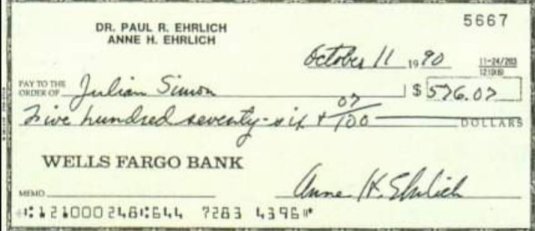
#OTD 1990
11 Oct 2019 Leave a comment
in economic history, energy economics, environmental economics Tags: pessimism bias
Why So Many Airlines are Going Bankrupt
11 Oct 2019 Leave a comment
in entrepreneurship, industrial organisation, survivor principle, transport economics Tags: creative destruction

Camille Paglia – Women should regard men with a mix of gratitude and rational fear
11 Oct 2019 Leave a comment
in discrimination, economics of crime, economics of education, economics of love and marriage, gender, health and safety, human capital, labour economics, labour supply, law and economics, occupational choice Tags: evolutionary psychology, political correctness, regressive left
More Sloppy Analysis from the New York Times
10 Oct 2019 Leave a comment

The New York Times is going overboard with disingenuous columns.
A few days ago, I pointed out the many errors in David Leonhardt’s column extolling the wealth tax.
I also explained back in August how Steven Greenhouse butchered the data when he condemned the American economy.
And Paul Krugman is infamous for his creative writing.
But Mr. Leonhardt is on a roll. He has a new column promoting class warfare tax policy.
Almost a decade ago, Warren Buffett made a claim that would become famous. He said that he paid a lower tax rate than his secretary, thanks to the many loopholes and deductions that benefit the wealthy.
…“Is it the norm?” the fact-checking outfit Politifact asked. “No.” Time for an update: It’s the norm now. …the 400 wealthiest Americans last year paid a lower total tax rate — spanning federal, state and local taxes — than any other…
View original post 481 more words
Uncommon Knowledge, with Author and Columnist Douglas Murray
10 Oct 2019 Leave a comment

In this issue of Uncommon Knowledge from the Hoover Institute, Peter Robinson is joined by British author and columnist Douglas Murray to discuss “The Death of Europe.” Important and chilling. You can just shove stuff to the side and avoid taking it on for so long, but at some point you have to take a hard look at what is, and decide what, if anything, you are willing to do or even can do about it. Do watch the whole thing, it is important.
Jeff King: The Prime Minister’s Constitutional Options after the Benn Act: Part II
10 Oct 2019 Leave a comment

 This is the second of a two-part discussion of this theme. The first part addressed the obligations under the Benn Act and the legal response to attempts to frustrate it; this second part addresses non-confidence motions, resignation and change of Government. Heading numbering is continued from Part 1.
5. Non-confidence procedure under the FTPA – the PM ‘squats’
Section 2 of the FTPA provides for an early election if a motion in the words ‘That this House has no confidence in Her Majesty’s Government” is passed in the Commons and another in the form ‘That this House has confidence in Her Majesty’s Government.’ does not pass within fourteen calendar days. In its 2010 Report (HL Paper 69) on the Fixed-term Parliaments Bill, the Constitution Committee concluded at [121] that the provision ‘does make it clear that an alternative government can be formed.’ The Explanatory Note to section 2(3) simply states…
View original post 2,295 more words
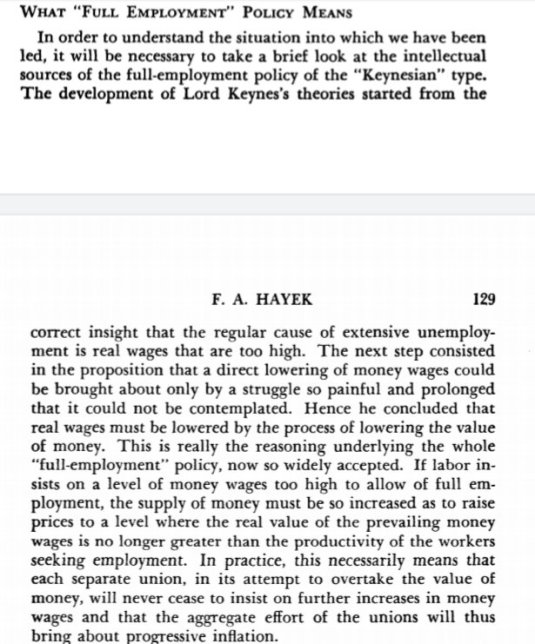
Hayek on the pre-Keynesian explanation for mass unemployment
10 Oct 2019 Leave a comment
in Austrian economics, business cycles, economic history, F.A. Hayek, great depression, history of economic thought, labour economics, labour supply, macroeconomics, monetary economics, unemployment Tags: Keynesian macroeconomics


Recent Comments