BBC Radio 4’s uncritical amplification of Ilhan Omar’s falsehood

Hadar Sela's avatarBBC Watch

Listeners to BBC Radio 4’s ‘The World Tonight’ are promised “in depth reporting, intelligent analysis and breaking news from a global perspective”. Here is what those listeners heard (from 03:39 here) in the news bulletin which opened the programme’s August 15th edition. [emphasis in bold added]

Newsreader: “Israel has banned two US Democrat Congresswomen from entering the country because they’ve been critical of its policies towards the Palestinians. Rashida Tlaib and Ilhan Omar had been expected to begin a tour of the Palestinian territories later this week. Ms Omar has accused the Israelis of implementing President Trump’s ban on Muslims. Tom Bateman reports from Jerusalem.”

Bateman: “The Congresswomen – Ilhan Omar, who was born in Somalia and grew up in the US, and Rashida Tlaib, who is of Palestinian descent – have both supported the movement to boycott Israel. They were due to visit the occupied West…

View original post 399 more words

Justice Thomas on the establishment of religion

From https://supreme.justia.com/cases/federal/us/588/17-1717/

Daron Acemoglu: Robotics, AI, and the Future of Work

Daniels talk to Carver

Lee Ohanian: Hoover, Roosevelt and the Great Depression

A close up of a cute baby kitten nursing

Dominion War 18 The Defector part 2

Robert Lucas on the welfare cost of inflation and of macroeconomic phenomenon

Image

Kittens under a bungalow waited for their mom, but she never came back.

Has feminism gone too far? — with Christina Hoff Sommers and Camile Paglia (1994) | THINK TANK

King John by Marc Morris (2015)

Simon's avatarBooks & Boots

I loved Marc Morris’s History of the Norman Conquest because it gave such a thorough explanation of the background, build-up, events and consequences of the most famous moment in English history, so I was looking forward to reading this book and it is certainly good – but not as good as the Conquest one, and I spent some time, as I read it, trying to figure out why.

1. The long historical build-up to John’s reign

I think the main reason is that the central feature of King John’s reign (1199 to 1216) is the complete collapse of the huge and elaborate ’empire’ created by his predecessors – Henry I (his grandfather), the great Henry II (his father) and King Richard, his swashbuckling brother.

The pressures John faced trying to hang on to the south (Aquitaine), the middle (Anjou) and the north (Normandy) of France, along with the large and…

View original post 5,618 more words

King Leopold’s Ghost by Adam Hochschild (1999)

Simon's avatarBooks & Boots

I can’t remember the last time a book made me feel this physically sick. About half way through another description of the murders, rapes, dismemberments, garrotings, hangings, torture and shootings carried out by members of the Force Publique which policed the forced labour system set up by King Leopold II in his colony in the Congo (1885 to 1909), I thought I might throw up.

Leopold II, king of the Belgians, and his genocide

If you like historical horror stories, you’ll love this book. It intertwines a biography of lonely unloved Leopold – aloof, shy king of the Belgians, ignored by his parents, separated from his wife – who conceived a great ambition to own a chunk of the dark continent, Africa, during the 1880s when it was being carved up by the the European powers.

Hochschild describes how, once he’d decided on the Congo to be his slice of…

View original post 2,145 more words

Bury the Chains: The British Struggle to Abolish Slavery by Adam Hochschild (2005)

In the 1780s, when the abolition movement got going, not just African slaves but maybe as many as three quarters of the world’s population was unfree.The abolition movement was the first mass civil society movement, not the product of a particular class or particular special interest group or trade – it joined all classes, all genders, all ages and all occupations across all the regions of Britain (‘Something new and subversive was making its first appearance: the systematic mobilisation of public opinion across the class spectrum.’ p.138)It was the first such campaign in human history that was not motivated by self-interest; none of the campaigners stood to gain anything and they, and the British population as a whole, stood to lose out economically – but nonetheless the righteousness of the cause outweighed self-interest.The abolition movement invented, or brought to perfection, a whole range of campaigning tactics which are still used around the world.

Simon's avatarBooks & Boots

In all of human experience there was no precedent for such a campaign. (p.97)

Executive summary

Abolition of slavery took place in two parts: abolishing the slave trade (1807) and abolishing slavery itself (1834).

1. Abolishing the slave trade 

After a whole century when anybody suggesting that African slavery be banned would have been considered a mad eccentric, the issue suddenly exploded into public consciousness in the years 1788 to 1793 when there was an extraordinary eruption of pamphlets, articles, petitions from every town and city in Britain, plays and polemics and debates in parliament, calling for the abolition of the slave trade.

It suddenly became the topic of the day and Hochschild is able to quote diarists and letter writers saying how heartily sick they are of every single dinner party or coffee house conversation being about nothing but abolitionism.

And then, just is the cause of abolition had…

View original post 4,388 more words

Slavery and Cartwright’s Case before Somerset

Krista Kesselring's avatarLegal History Miscellany

Posted by Krista J. Kesselring, 10 October 2018.

The case of James Somerset in 1772 is one of the most celebrated episodes in the history of English law. Despite the uncertainties about what, precisely, Justice Mansfield said, his decision in Somerset v Stewart was widely taken to mean that slavery would not exist in England. Even if Mansfield had only declared the illegality of the coerced removal of a slave from England, many people—including some enslaved people, in England, Scotland, and elsewhere—thought the decision affirmed that whatever the laws of other nations, whatever the laws of Britain’s own colonies, slavery had no place in England itself.[1] The 1772 decision turned, in part, on invocations by James Somerset’s counsel of Cartwright’s case, a purported decision in 1569 which declared the air of England too pure for slaves to breathe.[2]

The early case is frequently mentioned in the voluminous literature…

View original post 2,687 more words

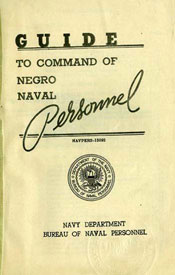
US Navy’s Guide to Commanding Negroes (1945)

lunchcountersitin's avatarAll Other Persons

In recognition of the challenges in dealing with Negroes, the US Navy developed a pamphlet titled Guide To Command of Negro Naval Personnel (NAVPERS – 15092) in 1945.

The Guide notes the following:

The mission of the Naval Establishment is the protection of our country, its possessions and its interests. It includes neither social reform nor support of the personal social preferences of its personnel. In the accomplishment of this mission it is mandatory that the training and ability of all Naval personnel be utilized to the fullest.

It must be recognized that problems of race relations do exist and that they must be taken into account in plans for the prosecution of the war. In the Naval Establishment they should be viewed however solely as matters of efficient personnel utilization.

In general, the same methods of discipline, training and leadership that have long proven successful in the Naval Establishment…

View original post 253 more words

Previous Older Entries Next Newer Entries

The War on Prices

Celebrating humanity's flourishing through the spread of capitalism and the rule of law

The Bleeding Heart Libertarian

Celebrating humanity's flourishing through the spread of capitalism and the rule of law

More Stories from the Stories I Publish!

Celebrating humanity's flourishing through the spread of capitalism and the rule of law

In My Tribe

Celebrating humanity's flourishing through the spread of capitalism and the rule of law

Coordination Problem

Celebrating humanity's flourishing through the spread of capitalism and the rule of law

Libertarian Land

Celebrating humanity's flourishing through the spread of capitalism and the rule of law

Arin’s Substack

Celebrating humanity's flourishing through the spread of capitalism and the rule of law

David Andolfatto

Celebrating humanity's flourishing through the spread of capitalism and the rule of law

Monetary Non-Neutrality

Celebrating humanity's flourishing through the spread of capitalism and the rule of law

Reason Magazine

Celebrating humanity's flourishing through the spread of capitalism and the rule of law

Coyote Blog

Celebrating humanity's flourishing through the spread of capitalism and the rule of law

Thoughts from the North

Celebrating humanity's flourishing through the spread of capitalism and the rule of law

Fardels Bear

A History of the Alt-Right

Vincent Geloso

Econ Prof at George Mason University, Economic Historian, Québécois

Bassett, Brash & Hide

Celebrating humanity's flourishing through the spread of capitalism and the rule of law

Truth on the Market

Scholarly commentary on law, economics, and more

The Undercover Historian

Beatrice Cherrier's blog

Matua Kahurangi

Celebrating humanity's flourishing through the spread of capitalism and the rule of law

Temple of Sociology

Celebrating humanity's flourishing through the spread of capitalism and the rule of law

Velvet Glove, Iron Fist

Celebrating humanity's flourishing through the spread of capitalism and the rule of law

Why Evolution Is True

Why Evolution is True is a blog written by Jerry Coyne, centered on evolution and biology but also dealing with diverse topics like politics, culture, and cats.

NoTricksZone

Celebrating humanity's flourishing through the spread of capitalism and the rule of law

Homepaddock

A rural perspective with a blue tint by Ele Ludemann

Kiwiblog

DPF's Kiwiblog - Fomenting Happy Mischief since 2003

The Dangerous Economist

Celebrating humanity's flourishing through the spread of capitalism and the rule of law

Watts Up With That?

The world's most viewed site on global warming and climate change

The Logical Place

Tim Harding's writings on rationality, informal logic and skepticism

Doc's Books

A window into Doc Freiberger's library

The Risk-Monger

Let's examine hard decisions!

Uneasy Money

Commentary on monetary policy in the spirit of R. G. Hawtrey

Barrie Saunders

Thoughts on public policy and the media

Liberty Scott

Celebrating humanity's flourishing through the spread of capitalism and the rule of law

Point of Order

Politics and the economy

James Bowden's Blog

A blog (primarily) on Canadian and Commonwealth political history and institutions

Science Matters

Reading between the lines, and underneath the hype.

Peter Winsley

Economics, and such stuff as dreams are made on

A Venerable Puzzle

"The British constitution has always been puzzling, and always will be." --Queen Elizabeth II

The Antiplanner

Celebrating humanity's flourishing through the spread of capitalism and the rule of law

Bet On It

Celebrating humanity's flourishing through the spread of capitalism and the rule of law

History of Sorts

WORLD WAR II, MUSIC, HISTORY, HOLOCAUST

Roger Pielke Jr.

Undisciplined scholar, recovering academic

Offsetting Behaviour

Celebrating humanity's flourishing through the spread of capitalism and the rule of law

JONATHAN TURLEY

Res ipsa loquitur - The thing itself speaks

Conversable Economist

In Hume’s spirit, I will attempt to serve as an ambassador from my world of economics, and help in “finding topics of conversation fit for the entertainment of rational creatures.”

The Victorian Commons

Researching the House of Commons, 1832-1868

Books & Boots

Reflections on books and art