The stupidity of Labour on assets
13 Nov 2025 Leave a comment
in applied price theory, history of economic thought, industrial organisation, politics - USA, privatisation Tags: Singapore
The Herald reports: Opposition leader Chris Hipkins is dismissive of Prime Minister Christopher Luxon saying the country needs a “mature” conversation around the potential sale of state-owned assets. “What would this government do when they’ve run out of things to sell?” Hipkins said, after Luxon spoke positively of a new Treasury report that calls for […]
The stupidity of Labour on assets
Revolution in Germany – Armistice in Austria I THE GREAT WAR Week 224
13 Nov 2025 Leave a comment
in defence economics, war and peace Tags: World War I
The International Military Tribunal for the Far East: The Quest for Justice in Postwar Asia
13 Nov 2025 1 Comment
in defence economics, economics of crime, International law, law and economics, laws of war, war and peace Tags: World War II

The International Military Tribunal for the Far East (IMTFE), also known as the Tokyo War Crimes Tribunal, was one of the most significant judicial efforts to hold individuals accountable for crimes committed during war. Established in the aftermath of World War II, the tribunal sought to prosecute the leading figures of Imperial Japan for crimes […]
The International Military Tribunal for the Far East: The Quest for Justice in Postwar Asia
The BBC’s Biggest Scandals
12 Nov 2025 1 Comment
in industrial organisation, television Tags: British politics, media bias

The BBC is one of the world’s most respected broadcasters and a pillar of British public life — which is exactly why its failures get so much attention when things go wrong. Below I’ve pulled together a chronological, readable guide to the BBC’s major scandals from the post-war period to the present. This is not […]
The BBC’s Biggest Scandals
Did Bill Gates Really Drop a Bomb on Climate Catastrophism?
12 Nov 2025 Leave a comment
in economics of climate change, economics of regulation, energy economics, environmental economics, environmentalism, global warming
Clearly, the global environmental movement is not backing off from climate catastrophism, no matter what Bill Gates says. With or without him, it’s going to step up the pressure.
Did Bill Gates Really Drop a Bomb on Climate Catastrophism?
The Value-Added Tax: A Recipe for More Spending…and More Debt: Part II
12 Nov 2025 Leave a comment
in economic history, fiscal policy, macroeconomics, Public Choice, public economics
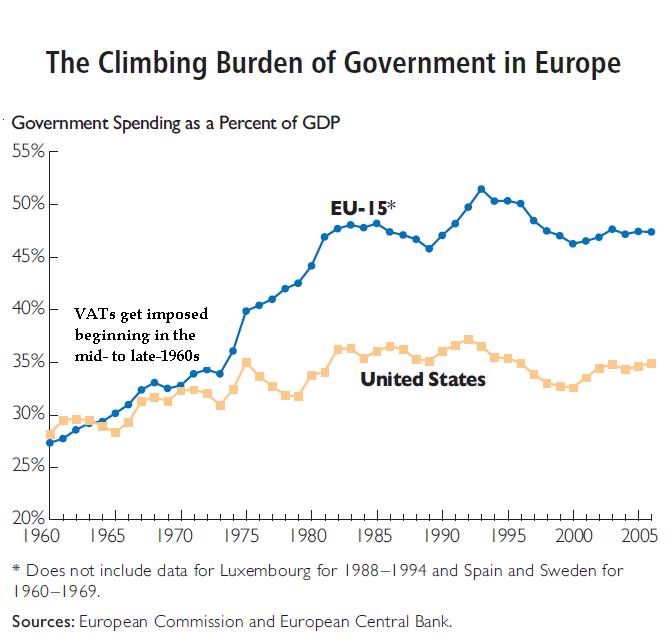
The case against the value-added tax (VAT) is not complicated. Simply stated, this hidden type of national sales tax was a key precursor for the expansion of the European welfare state. As you can see in the chart, the burden of government spending in Europe after World War II was similar to the size of […]
The Value-Added Tax: A Recipe for More Spending…and More Debt: Part II
The AI Revolution Will Bring Prosperity
12 Nov 2025 Leave a comment
in applied price theory, economic history, entrepreneurship, history of economic thought Tags: creative destruction
The growth of industry disrupted old economic patterns but produced undreamed-of wealthBy Phil Gramm and Michael Solon. Excerpts:”From the colossal changes wrought by the Industrial Revolution to the Digital Revolution of the last quarter-century, improvements in technology have created an array of jobs that far exceeded—in quantity and quality—the ones eliminated, elevating standards of living.””the…
The AI Revolution Will Bring Prosperity
Don Brash’s Oxford Union speech
11 Nov 2025 1 Comment
in defence economics, development economics, economic history, history of economic thought, law and economics, politics - New Zealand, property rights Tags: economics of colonialism
The House believes that the Sun should never have set on the British Empire Don Brash says – Mr/Madame President, I speak in opposition to the motion. But I also want to acknowledge at the outset that the British Empire did more good things for more people than any other empire in human history.
Don Brash’s Oxford Union speech
MPs and the Second World War
11 Nov 2025 Leave a comment
in defence economics, war and peace Tags: World War II

Ahead of Remembrance Day, and with 2025 marking 80 years since the end of the Second World War, Dr Kathryn Rix, Assistant Editor of our House of Commons, 1832-1945 project, follows up her series on MPs and the First World War by looking at the 23 MPs commemorated in the Commons chamber who died during […]
MPs and the Second World War
“Monsieur Klein” — Identity, Complicity, and Bureaucratic Terror
11 Nov 2025 Leave a comment
in defence economics, movies, war and peace Tags: France, Nazi Germany, The Holocaust, World War II

Alain Delon would have celebrated his 90th birthday today. Sadly, he passed away last year, leaving behind a legacy that forever shaped European cinema — and, to a certain extent, Hollywood as well. Known for his striking screen presence, enigmatic charm, and unforgettable roles, Delon stood as one of the true icons of 20th-century film. […]
“Monsieur Klein” — Identity, Complicity, and Bureaucratic Terror
*Violent Saviors*
11 Nov 2025 Leave a comment
in applied price theory, comparative institutional analysis, development economics, economic history, growth disasters, growth miracles, history of economic thought, international economics Tags: economics of colonialism 0
That is the new William Easterly book, and the subtitle is The West’s Conquest of the Rest. I liked this book very much, but found the title and also book jacket and descriptions misleading. I think of this work as a full-throated examination and study of the classical liberal anti-imperialist tradition. We have been needing […]
*Violent Saviors*
ANNAPOLIS GOES TO WAR: THE NAVAL ACADEMY CLASS OF 1940 AND ITS TRIAL BY FIRE IN WORLD WAR II by. Craig L. Symonds
10 Nov 2025 Leave a comment
in defence economics, war and peace Tags: World War II

(An aerial view of the U.S. Naval Academy, looking northeast, mid-1930s) In the tradition of Robert Timberg’s THE NIGHTINGALE’S SONG, Bill Murphy, Jr.’s IN A TIME OF WAR: THE PROUD AND PERILOUS JOURNEY OF WEST POINT CLASS 0F 2002, Rick Atkinson’s THE LONG GRAY LINE: THE AMERICAN JOURNEY OF WEST POINT CLASS OF 1966 and […]
ANNAPOLIS GOES TO WAR: THE NAVAL ACADEMY CLASS OF 1940 AND ITS TRIAL BY FIRE IN WORLD WAR II by. Craig L. Symonds
BBC Finds Presenter in Violation of Network Standards in Correcting “Pregnant People” Reference on Air
09 Nov 2025 Leave a comment
in discrimination, economics of education, gender, television Tags: free speech, media bias, political correctness, regressive left, sex discrimination

There is a controversy at the BBC over a correction made by presenter Martine Croxall on air when she changed a reference to “pregnant people” to “women.” The network later received 20 complaints and agreed that Croxall had violated network policies. (For full disclosure, I previously worked as the legal analyst for BBC).
BBC Finds Presenter in Violation of Network Standards in Correcting “Pregnant People” Reference on Air
 Utopia, you are standing in it!
Recent Comments