Passion & Power: Clever Communities Hate Industrial Wind Power And They Fight Back
12 Apr 2023 Leave a comment

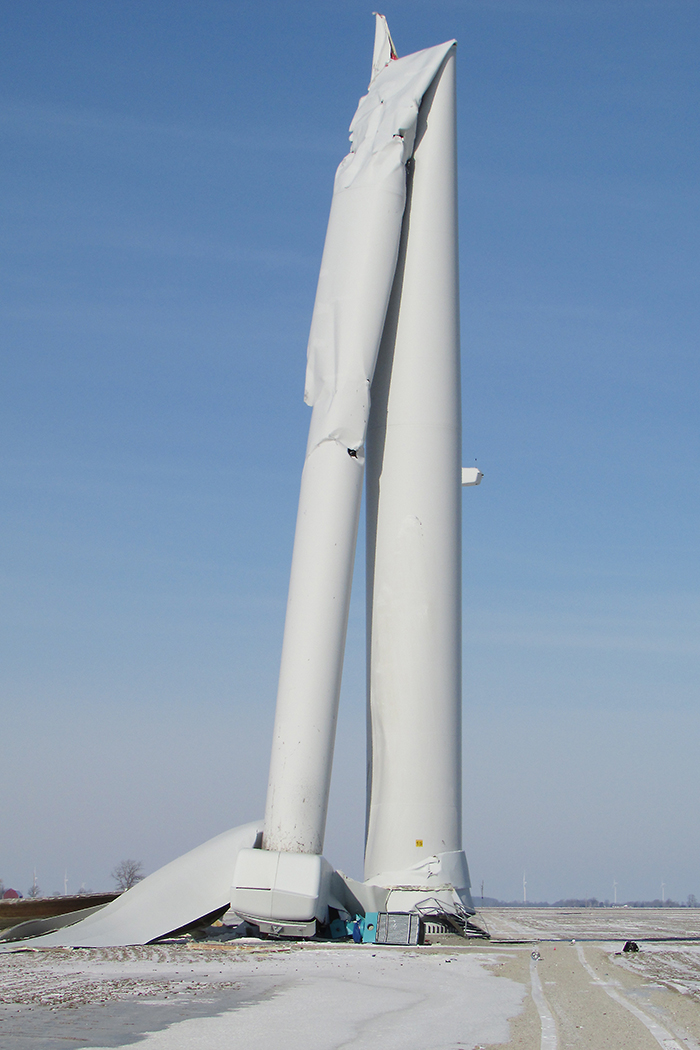
Rural communities are fighting back hard against the great wind power fraud, wherever the wind industry seeks to ply its subsidy-soaked trade.
Wherever wind farms have appeared – or have been threatened – big numbers of locals take a set against the monsters being speared into their previously peaceful – and often idyllic – rural communities.
Their anger extends to the goons that lied their way to development approval – and the bent officials that rubber-stamped their applications and who, thereafter, help the operators ride roughshod over locals’ rights to live in and enjoy the peace and comfort of their own homes and properties (see our post here).
As wind turbines are incapable of generating power on demand and wouldn’t last a second without massive subsidies, there is no ‘right’ place for them. Any power generation source that can’t deliver electricity on demand is pointless, so talk about appropriate…
View original post 941 more words
Norway’s Self-Destructive Wealth Tax
12 Apr 2023 Leave a comment

The economic argument against wealth taxation is very straightforward.
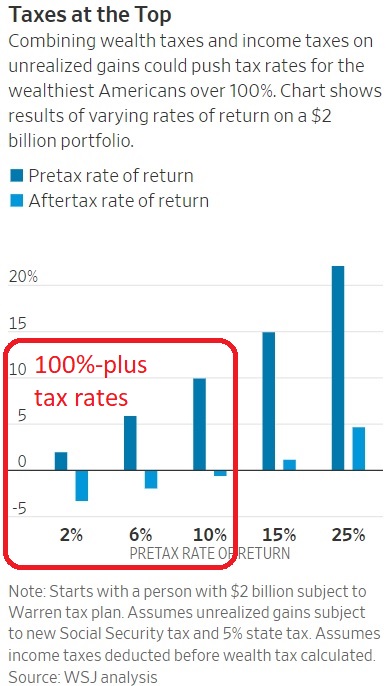 Such a levy is akin to a very high marginal tax rate on saving and investment.
Indeed, it’s quite possible that the effective tax rate would exceed 100 percent.
That definitely penalizes capital formation, which ultimately means workers will earn less money.
There’s also a practical argument against wealth taxation, which is based on the daunting challenge of revaluing assets every year.
There’s a competitiveness argument as well, and that’s our topic today.
Simply stated, rich people are not sheep, patiently waiting to be sheared. If their fiscal torture is too extreme, they will leave.
And this is not just theorizing.
In an article for the U.K.-based Telegraph, reports on how Norway’s higher wealth tax is backfiring.
Mr Røkke, an industrial tycoon with an estimated net worth of Nkr 19.6bn (£1.5bn), is among 50 billionaires and millionaires…
View original post 443 more words
The OECD’s minimum tax plan is dangerous showboating
12 Apr 2023 Leave a comment

On Wednesday, Liz Truss will use the Margaret Thatcher memorial lecture in Washington to call the Organisation for Economic Co-operation and Development (OECD) a “global cartel of complacency” whose high tax policies are holding back growth. I fear she is right.
In particular, Ms Truss will warn against the OECD’s plan for a minimum 15 per cent corporation tax rate for multinational companies, which is due to come into effect at the start of 2024. This plan is both wrong in principle and will be very hard to operate in practice.
To recap, 138 countries have now signed up to a global agreement which is designed to ‘modernise’ the international tax system. The main target is ‘profit shifting’, where companies book profits in jurisdictions where tax rates are lower.
This agreement has two elements, or ‘Pillars’. Under ‘Pillar 1’, the largest and most profitable multinationals will be required to pay…
View original post 907 more words
Creative destruction
12 Apr 2023 Leave a comment
in economic history, entrepreneurship Tags: creative destruction

Employment status of clergy
11 Apr 2023 Leave a comment

An important recent decision of the Court of Appeal in England and Wales, Sharpe v The Bishop of Worcester [2015] EWCA Civ 399 (30 April 2015) deals with the issue of the “employment status” of members of the clergy. Is a rector, or a priest, or a pastor, or an imam, an “employee”? If so, who exactly is their employer: the local congregation? the governing board of the congregation? a bishop? the local diocese? These are important issues which are mentioned in the case.The question may be important for a number of reasons: for example, for the rights of members of the clergy who believe they have been wrongly dismissed, or the rights of members of the public to take an action against the church or religious body, which may depend on the whether the cleric is an “employee” or not.
The answer offered in England will not be precisely the…
View original post 5,562 more words
Russia’s Combat Compliance Problem: Why Moscow Has Struggled in Bakhmut and Elsewhere
11 Apr 2023 Leave a comment
in defence economics, war and peace Tags: Ukraine
Ben Ferencz Nuremberg Einsatzgruppen Case #9 Opening
11 Apr 2023 Leave a comment
in defence economics, economics of crime, International law, law and economics, laws of war, war and peace Tags: Nazi Germany, The Holocaust, World War II
Women’s rights
11 Apr 2023 Leave a comment
in discrimination, economic history, gender, labour economics, labour supply, law and economics, poverty and inequality, property rights Tags: political correctness, regressive left, sex discrimination

Thatcher, Lawson, and Pro-Growth Tax Policy
11 Apr 2023 Leave a comment
As documented in Commanding Heights: The Battle of Ideas, Margaret Thatcher and Ronald Reagan saved their nations from economic malaise and decline.
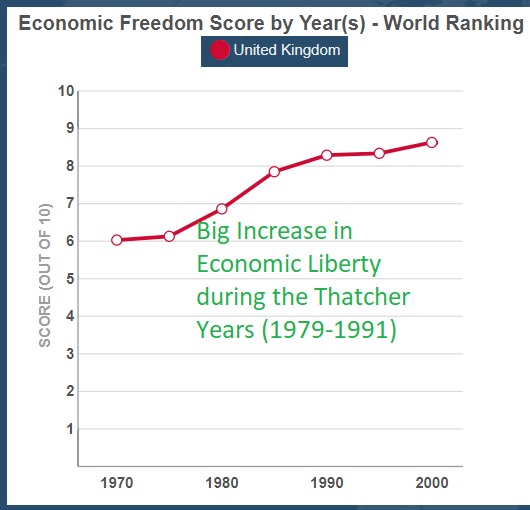 Today, let’s focus on what happened in the United Kingdom.
Economic liberty greatly increased during the Thatcher years.
She deserves the lion’s share of the credit for the U.K.’s economic rebirth and renaissance, but she also had the wisdom to appoint some very principled and very capable people to her cabinet.
Such as Nigel Lawson, who served as her Chancellor of the Exchequer (akin to a combined Treasury Secretary/OMB Director in the U.S.).
Lawson died last week, leading to many tributes to his role is resuscitating the U.K. economy.
The Wall Street Journal‘s editorial summarized his achievements.
…our problems are solvable, as they were a half century ago. One of those crucial problem solvers was British politician Nigel Lawson, who died this week at age 91…
View original post 482 more words
Medieval writings on lunar eclipses may help date volcanic eruptions
11 Apr 2023 Leave a comment

 During a total solar eclipse, the Sun’s corona and prominences are visible to the naked eye [image credit: Luc Viatour / https://Lucnix.be ]
A climate detective story.
H/T Paul Vaughan
– – –
When medieval monks were looking up at the night sky, writing down their observations of celestial objects, they had no idea that their words would be invaluable centuries later to a group of scientists in a completely different field: volcanology.
A new study published Wednesday in the peer-reviewed journal Nature explains how descriptions of lunar eclipses by monks and scribes were key in studying some of the largest volcanic eruptions on Earth, says CTV News.
Using a combination of these medieval writings and climate data stretching back centuries, researchers were able to clarify the date of around 10 volcanic eruptions that took place between the year 1100 and 1300.
View original post 635 more words
Why Did Fake French Dukes Attend British Coronations?
11 Apr 2023 Leave a comment

While reading Leopold G. Wickham Legg’s account of the Coronation Banquet in his English Coronation Records, I was struck by the following passage:
On the King’s left hand there are also three tables. At the first sit the “Dukes of Normandy and Aquitaine,” the King’s officers…[1]
I immediately wondered why the Dukes of Normandy and Aquitaine had their titles placed in scare quotes. My curiosity piqued, I did a bit of digging and stumbled upon something rather strange: they weren’t actual dukes at all. Today, we’re going to look at why a pair of fake French dukes attended British coronations for hundreds of years.
English monarchs claimed the French throne from the 14th century onward. When Charles IV of France died in 1328, he had no direct male heir. The English king, Edward III, was Charles’ nephew through Charles’ sister, Isabella. French law didn’t allow women to…
View original post 1,216 more words


Recent Comments