Battle of the Isonzo – Discord Among The Central Powers I THE GREAT WAR Week 86
18 Mar 2023 Leave a comment
in defence economics, war and peace Tags: World War I
Australians Pay Colossal Price For Wind & Solar ‘Transition’: Power Prices Jump 25-30%
18 Mar 2023 Leave a comment


In another, ‘we told you so’ moment, retail power prices in Australia will jump by 20% to 30% in June, following annual, double-digit increases every year, for the best part of a decade (see above).
$60 billion in subsidies (so far) to chaotically intermittent wind and solar was designed to wreck our conventional coal-fired power generation fleet, and true to purpose, that’s exactly what happened.
Now, politicians are working out cannot simply conjure up electricity out of nowhere; and you certainly can’t do it by praying to the wind and sun gods.
A few of them are retreating from their earlier plans to permanently shut down and wreck large coal-fired generating plants, recognising that the proles will be less than pleased. Pain a king’s ransom for power and then being left freezing in the dark is unlikely to be met with amusement among potential voters.
We’ll start with a…
View original post 1,095 more words
Political Drama: French Welfare State Showdown
18 Mar 2023 Leave a comment

I wrote last week about President Macron’s very modest effort to slow down the growth of the welfare state and started with a chart showing that France has the highest overall burden of government spending in the developed world.
The good news (relatively speaking) is that France is in third place, based on this chart from the OECD, when looking at the burden of government-provided retirement benefits.
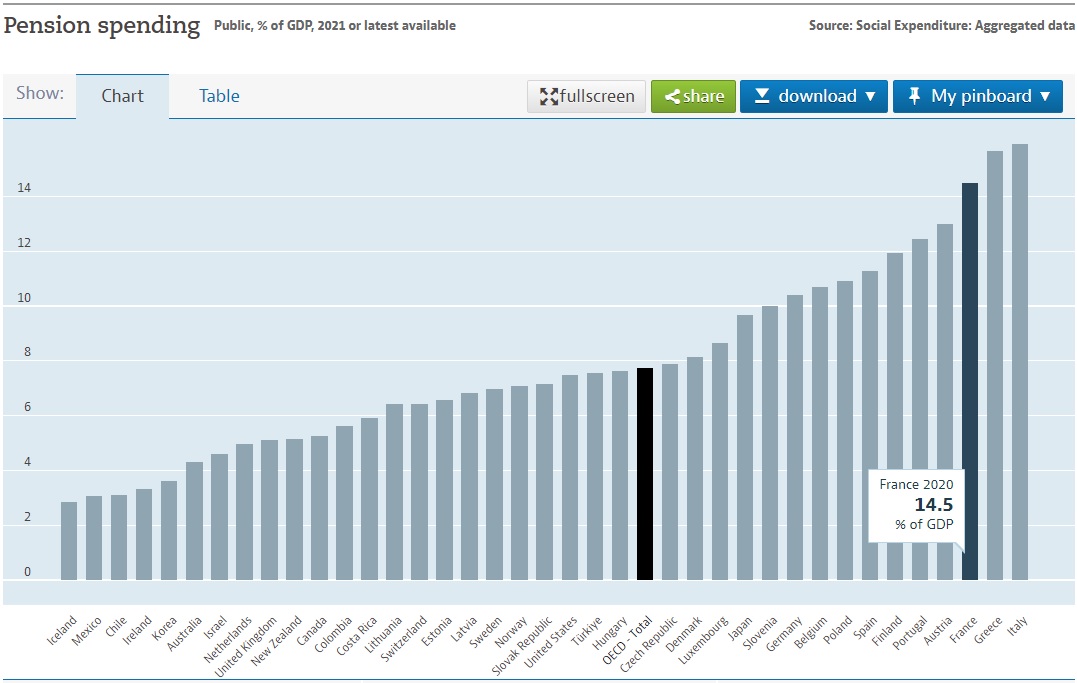
To be sure, having the third-highest burden of retirement spending is hardly something to celebrate. And it is not exactly a big achievement to be slightly less worse than Greece and Italy.
This is why President Macron is pushing to increase the retirement age from 62 to 64.
But French voters and French lawmakers have an entitlement mentality and Macron’s initiative was faltering. So the government used executive authority to unilaterally impose the law.
Needless to say, this has triggered a lot…
View original post 483 more words
Multiple Choice Question re Green Energy
18 Mar 2023 Leave a comment


Jack Hellner poses the issue in his American Thinker article. A single multiple choice question for the ‘green’ energy pushers. Excerpts in italics with my bolds and added images.
Here is one burning question for scientists, entertainers, journalists, politicians,
bureaucrats, and others who claim they can control the climate:
Which of the following has caused the reservoirs to fill up rapidly in California and elsewhere in the West?
A. The Paris Climate accord.
B. The misnamed “Inflation Reduction Act” in which the Democrats claimed they can control the climate by handing out huge amounts of money to “green” pushers.
C. All the United Nations gabfests where people fly in private jets to stump about the need to cut emissions.
D. Shuttering coal and natural gas utility plants.
E. Transitioning the peasants to cricket and mealworms as “food” to control cow flatulence.
F. Making people buy inefficient, expensive, impractical electric…
View original post 545 more words
Bjørn Lomborg & Russell Brand DEBATE Climate Change
18 Mar 2023 Leave a comment
in applied welfare economics, energy economics, environmental economics, global warming Tags: climate alarmism

End of free money brings the chickens home to roost
17 Mar 2023 Leave a comment

The shocks that occasionally batter the UK economy seem to be coming thicker and faster. The Global Financial Crisis (GFC) blew up in 2008. The Brexit vote followed eight year later. But we then only had to wait four years for Covid, and just two more for the cost-of-living crisis. At this rate we are already due another one.
A candidate has already emerged in the shape of a new financial crisis, again originating in the US. The GFC was prompted by a meltdown in the sub-prime mortgage market. This time the focus is on banks that mainly service the tech sector, notably the aptly-named Silicon Valley Bank.
The rosy view is that Silicon Valley Bank (SVB) was an outlier. There is something in this: the circumstances that led to its collapse may not have been unique, but they were at least relatively unusual.
In a nutshell, SVB took large…
View original post 1,172 more words


Recent Comments