Speaking of pseudoscience
09 Sep 2022 Leave a comment
in economics of education Tags: philosophy of science
Rodney Brazier: No Way to Pick a PM
08 Sep 2022 Leave a comment


And so the United Kingdom has a new Prime Minister, replacing one who, having besmirched the office, had been forced out. The Conservatives took almost eight weeks to choose Liz Truss. That saga resembled a presidential election, not least in the televised debates that were occasionally as unedifying as they were uninformative, and notoriously in some of the vicious briefings given by unnamed allies of the candidates about their opponents. Not for the first time the British parliamentary system surrendered the choice of premier to a small section of the British electorate. But their preference was not the same as that of Tory MPs, who had consistently voted for Rishi Sunak as their first choice.
It is for the political parties to decide how to elect their leaders. But should the votes of others than MPs be part of their electoral systems? I think not, and I never have…
View original post 2,069 more words
Krugman’s Anemic Defense of Bidenomics
08 Sep 2022 Leave a comment

Over the past few months, I’ve written a 7-part series on Bidenomics, reviewing the president’s record on issues such as subsidies, inflation, protectionism, household income, fiscal policy, red tape, and employment. 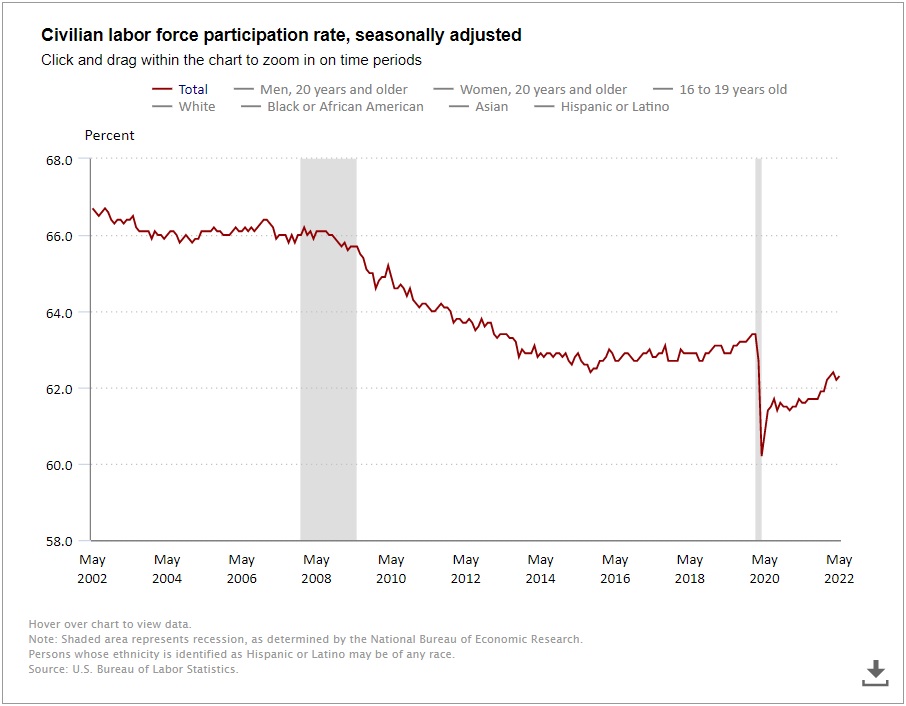
Regarding the last item, a big problem is that the share of the population with jobs (measured by either the labor-force participation rate or the employment-population ratio) has not recovered.
It hasn’t recovered to where it was before the pandemic and it hasn’t recovered to where it was before Obama took office.
That’s bad news. Our economy’s output (and our national income) depends on the quantity and quality of both labor and capital.
This does not reflect well on Biden.
But not everyone agrees. Paul Krugman has leapt to the President’s defense. He even claims that American workers are enjoying a “Biden boom.”
President Biden has presided over a huge employment…
View original post 382 more words
Beyond Wires and Pigeons – Communications in World War 1 I THE GREAT WAR Special
08 Sep 2022 Leave a comment
in defence economics, war and peace Tags: World War I
Bitter Reality: Unreliable Renewables Will See Germans Freezing In The Dark This Winter
07 Sep 2022 Leave a comment


Electricity is one of those things that is only fully appreciated when a hopeful user is deprived of it. Across Europe, the cultlike fixation on wind and solar has provided precisely the environment in which households and businesses are coming to sense just how important having power as and when they need it, really is.
Germany set the tone by squandering billions of euros on subsidies to wind and solar, trashing their forests and rural heartland, as well as their hitherto reliable and affordable power supply. What could possibly go wrong?
Power prices are rocketing into the stratosphere and, even before winter drives up demand, are being deprived of energy in a way that was unthinkable barely a decade ago. But such is life when you attempt to run on sunshine and breezes.
Here are a couple of reports on the inevitable renewable energy transition from the frontline.
Energy Shortages…
View original post 990 more words
Prime Minister Liz Truss and the short, unhappy fate of the ‘takeover leader’
07 Sep 2022 Leave a comment


Following her appointment as Prime Minister yesterday, Liz Truss has become the third Prime Minister in a row to take office directly as a result of a party leadership election. Ben Worthy explains that taking office in the middle of a parliament has historically not gone well for the incoming Prime Minister, with none of the last three ‘takeover Prime Ministers’ able to complete a full parliamentary term in office.
There are two routes to becoming Prime Minister in the UK. You can either win a general election or triumph in a party leadership election to become head of the largest parliamentary party when a predecessor leaves. As section 2.18 of the Cabinet Manual puts it:
Where a Prime Minister chooses to resign from his or her individual position at a time when his or her administration has an overall majority in the House of Commons, it is for the…
View original post 1,787 more words
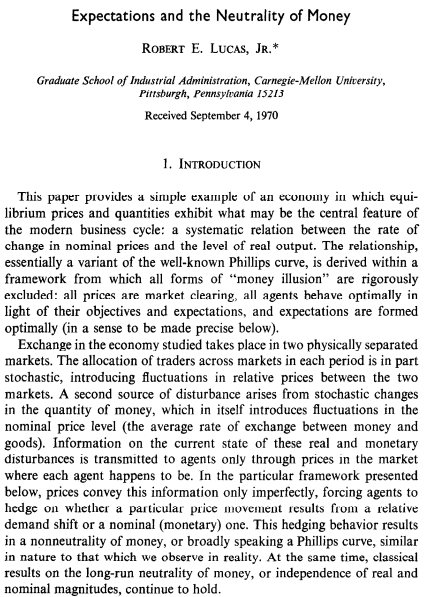
This paper attempts to resolve the paradox of Friedmanian monetary theory: “Money is a veil, but when the veil flutters, real output sputters.”
07 Sep 2022 Leave a comment
in business cycles, history of economic thought, macroeconomics, Milton Friedman, monetarism, monetary economics, Robert E. Lucas
Chile rejects “green” constitution
07 Sep 2022 Leave a comment

 Chilean lithium deposits [image credit: travelandleisure.com]
By a big majority, the people said no – that’s it. Ideology overload?
– – –
Chile rejected a new constitution on Sunday which, if accepted, would have significantly expanded environmental rights and recognised the urgency of climate action, says Climate Home News.
In a referendum, the South American nation rejected the proposed constitution by 62% to 38% in favour. Voting was mandatory.
As home to the world’s largest reserves of lithium, a key component of batteries for electric vehicles, Chile is of strategic importance in the global clean energy transition. This comes with social and environmental tradeoffs.
View original post 265 more words
The Glory of Capitalism, Captured in a Chart
07 Sep 2022 Leave a comment
Last week, I shared some great information from Superabundance, a new book that shows how economic liberty has made us much better off, as measured by how much more we can buy per hour worked.
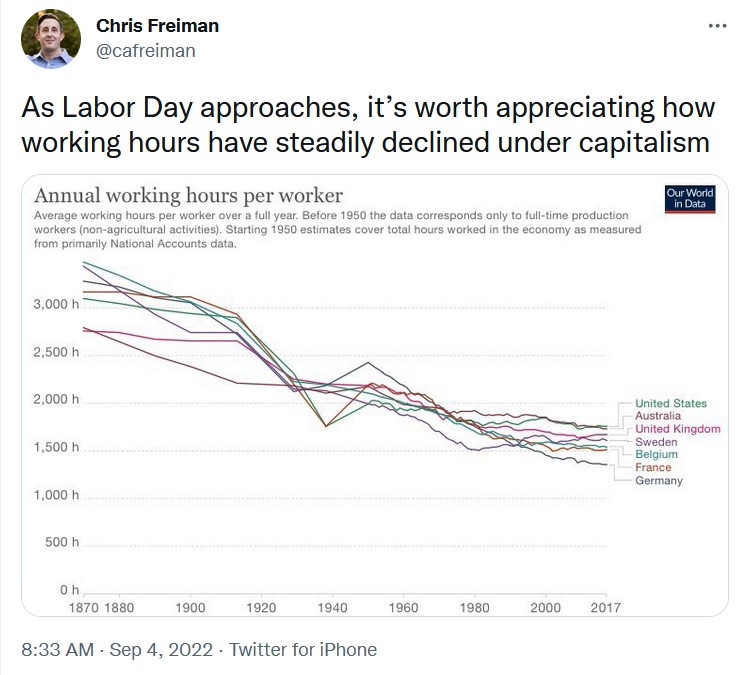
Today, let’s look at a related benefit of capitalism, which is that we don’t have to work nearly as many hours to achieve high living standards.
Here’s a tweet from Chris Freiman, a professor of philosophy at William & Mary University. As you can see, people in market-oriented nations work far fewer hours than they did 150 years ago. In some cases, hours worked per year have dropped by more than 50 percent.
When economists study these issues, they generally say the willingness of people to supply labor (whether to work and how much to work) depends on compensation. In other words, people give up leisure because they want money so they can consume.
View original post 299 more words


Recent Comments