
From http://www.finnkydland.com/papers/GavinKydlandPakko2007.pdf
Celebrating humanity's flourishing through the spread of capitalism and the rule of law
15 Aug 2022 Leave a comment
in business cycles, macroeconomics, monetary economics, public economics
15 Aug 2022 Leave a comment
The polytechnic sector has been getting a bad press in recent times.
Former Otago Polytechnic chief executive Phil Ker has demanded an apology from Education Minister Chris Hipkins for turning the country’s polytechnic education system into “a national disgrace”.
The Otago Daily Times has described the centralising of New Zealand’s 16 polytechnics into one grand organisation, Te Pukenga, as a “shambles”.
National’s Tertiary Education spokesperson and Invercargill MP Penny Simmonds says polytechnics in the South are being forced to cut millions from their budgets because the Government’s mega-merger polytechnic entity Te Pūkenga is in such a mess,
Among the more disturbing reports, new data shows one-third of first year polytechnic students quit their studies last year and some qualifications were unable to retain any learners at all.
Across the country, 12,642 equivalent full-time students began courses at polytechnics last year, but 4124 – or 32.6% – dropped out , according…
View original post 932 more words
15 Aug 2022 Leave a comment
Robert Kee (1919-2013) was already a veteran British broadcaster, writer, historian and journalist when his 1980 thirteen part series ‘Ireland: A Television History’ was first broadcast in Ireland and Britain.
The series was highly acclaimed as Kee followed Ireland’s complex history through the island’s development from pre-Christian times, to various uprisings down the centuries, explains the famine of 1845, the 1916 Rising, Independence and up to the late 1970s, with a specific emphasis on the creation of the modern independent republic and the roots of the Troubles. More importantly, the series presented many British viewers with their first detailed insight into the history of Irish politics, especially the issues surrounding sovereignty and identity in Northern Ireland. It could also be argued that the series did much the same for many Irish viewers too.
The series proved unexpectedly timely, since its broadcast coincided with increased tensions in Northern Ireland…
View original post 110 more words
15 Aug 2022 Leave a comment
in business cycles, macroeconomics, monetarism, monetary economics
15 Aug 2022 Leave a comment
in F.A. Hayek, Milton Friedman
15 Aug 2022 Leave a comment
in economics of media and culture
14 Aug 2022 Leave a comment
in applied welfare economics, business cycles, macroeconomics, monetary economics
14 Aug 2022 Leave a comment

The failure to advance nuclear power in this country to replace coal-fired plants being driven out of business by massive subsidies to wind and solar beggars belief. Everyone with half a brain is alive to the fact that chaotically intermittent and heavily subsidised wind and solar are responsible for Australia’s power pricing and supply calamity
Australian households and businesses are already feeling the pinch; retail power prices have rocketed, with much worse to come; energy hungry businesses are simply cut from the grid when the sun sets and special calm weather sets in.
And yet, Labor’s gormless Energy Minister, Chris Bowen pretends that the panacea to the renewables-driven disaster is more of the same. George Orwell would struggle to keep a straight face laying out the kind of political narrative being run by Bowen and his fellow travellers.
Nick Cater spells out a little of what Australians can look forward to under the Green-Labor Alliance.
Net-zero target an unaffordable risk
The Australian
Nick Cater
11 August 2022
View original post 1,198 more words
14 Aug 2022 Leave a comment
The central message of “Mitchell’s law” is certainly not something I concocted.
Economists and other policy experts have known for a couple of hundred years that politicians have a tendency to makes mistakes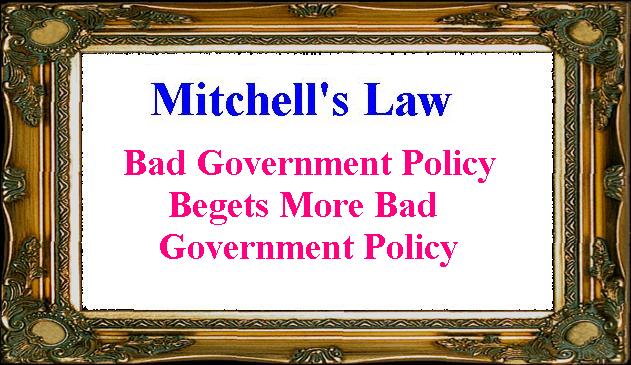 and then use the resulting damage as a justification for even more intervention.
I simply gave this phenomenon a name so I didn’t have to offer repeat explanations.
Over and over and over and over again.
Today we’re going to look at another example of politicians demanding more intervention to address a problem caused by previous interventions.
In an article for National Review, Michael Cannon has a very depressing explanation of how government has messed up the market for insulin.
…a proposal by congressional Democrats to mandate that private insurance companies cap out-of-pocket spending on insulin…neglects to address the way the government drives up the cost of insulin. Further intervention would make matters worse…
View original post 412 more words
14 Aug 2022 Leave a comment
You can download my full paper “If Wages Fell During a Recession” with Dan Houser from the Journal of Economic Behavior and Organization (only free until September 24, 2022).
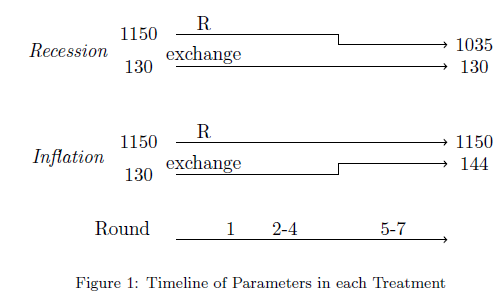
There is a simulated recession in our experiment. We ask what happens if employers cut wages in response. Although nominal wage cuts are rare in the outside world, some of our lab subjects cut the wages of their “employee”. Employees retaliated against nominal wage cuts by shirking, such that the employers probably would have been better off keeping wages rigid.
We also tried the same thing with an inflation shock that allowed the employer to institute a real wage cut without a nominal wage cut. The reaction to that real wage cut was muted compared to the retaliation against the obvious nominal wage cut.
View original post 372 more words
14 Aug 2022 Leave a comment

Delusional reliance on unreliable wind and solar is a reason that governments are interfering in consumers’ power usage. Pitched under the euphemism “demand management”, state-controlled power rationing is the natural consequence of attempting to run on sunshine and breezes.
When the sun sets and calm weather sets in, wind and solar power can’t be bought at any price. Increase the capacity of the unreliables connected to your grid and get ready for not only rocketing power bills, but routine power rationing.
Once upon a time, electricity was cheap and it flowed like running water. Civil and ordered society demanded it.
These days, smart meters keep an eye on your power usage with the state ready to pull the plug without warning and without notice, notwithstanding that you are ready, willing and able to pay your bill.
The ability to slash your power usage is an altogether insidious exercise of power…
View original post 1,425 more words
Celebrating humanity's flourishing through the spread of capitalism and the rule of law
Celebrating humanity's flourishing through the spread of capitalism and the rule of law
Celebrating humanity's flourishing through the spread of capitalism and the rule of law
Celebrating humanity's flourishing through the spread of capitalism and the rule of law
Celebrating humanity's flourishing through the spread of capitalism and the rule of law
Celebrating humanity's flourishing through the spread of capitalism and the rule of law
Celebrating humanity's flourishing through the spread of capitalism and the rule of law
Celebrating humanity's flourishing through the spread of capitalism and the rule of law
Celebrating humanity's flourishing through the spread of capitalism and the rule of law
Celebrating humanity's flourishing through the spread of capitalism and the rule of law
Celebrating humanity's flourishing through the spread of capitalism and the rule of law
Celebrating humanity's flourishing through the spread of capitalism and the rule of law
A History of the Alt-Right
Econ Prof at George Mason University, Economic Historian, Québécois
Celebrating humanity's flourishing through the spread of capitalism and the rule of law
Scholarly commentary on law, economics, and more
Beatrice Cherrier's blog
Celebrating humanity's flourishing through the spread of capitalism and the rule of law
Celebrating humanity's flourishing through the spread of capitalism and the rule of law
Celebrating humanity's flourishing through the spread of capitalism and the rule of law
Why Evolution is True is a blog written by Jerry Coyne, centered on evolution and biology but also dealing with diverse topics like politics, culture, and cats.
Celebrating humanity's flourishing through the spread of capitalism and the rule of law
A rural perspective with a blue tint by Ele Ludemann
DPF's Kiwiblog - Fomenting Happy Mischief since 2003
Celebrating humanity's flourishing through the spread of capitalism and the rule of law
The world's most viewed site on global warming and climate change
Tim Harding's writings on rationality, informal logic and skepticism
A window into Doc Freiberger's library
Let's examine hard decisions!
Commentary on monetary policy in the spirit of R. G. Hawtrey
Thoughts on public policy and the media
Celebrating humanity's flourishing through the spread of capitalism and the rule of law
Politics and the economy
A blog (primarily) on Canadian and Commonwealth political history and institutions
Reading between the lines, and underneath the hype.
Economics, and such stuff as dreams are made on
"The British constitution has always been puzzling, and always will be." --Queen Elizabeth II
Celebrating humanity's flourishing through the spread of capitalism and the rule of law
Celebrating humanity's flourishing through the spread of capitalism and the rule of law
WORLD WAR II, MUSIC, HISTORY, HOLOCAUST
Undisciplined scholar, recovering academic
Celebrating humanity's flourishing through the spread of capitalism and the rule of law
Res ipsa loquitur - The thing itself speaks
In Hume’s spirit, I will attempt to serve as an ambassador from my world of economics, and help in “finding topics of conversation fit for the entertainment of rational creatures.”
Researching the House of Commons, 1832-1868
Reflections on books and art




Recent Comments