Dividend Taxation in Europe and the United States
06 Apr 2022 Leave a comment

Modern tax systems tend to have three major deviations from good fiscal policy.
- High marginal tax rates on productive behavior like work and entrepreneurship.
- Multiple layers of taxation on income that is saved and invested.
- Distortionary loopholes that reward inefficiency and promote corruption.
Today, let’s focus on an aspect of item #2.
The Tax Foundation has just released a very interesting map (at least for wonks) showing the total tax rate on dividends in European nations, including both the corporate income tax and the double-tax on dividends.
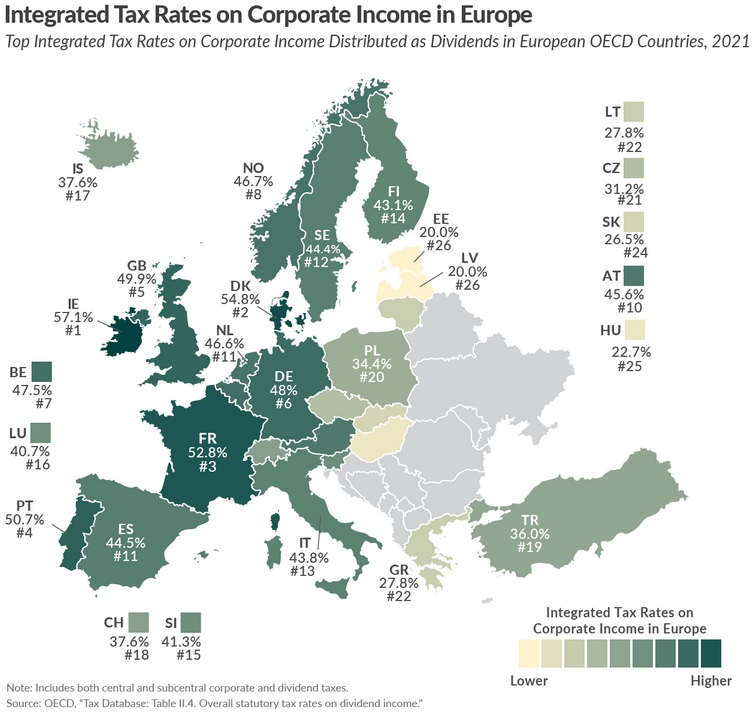
Because it has a reasonably modest corporate income tax rate, some of you may be surprised that Ireland has the most onerous overall burden on dividends. But that’s because there are high tax rates on personal income and households have to pay those high rates on any dividends they receive (even though companies already paid tax on that income).
It’s less…
View original post 444 more words
Robert Walpole, Prime Minister of Great Britain. Part II
06 Apr 2022 Leave a comment

Rise to power
Soon after Walpole returned to the Cabinet, Britain was swept by a wave of over-enthusiastic speculation which led to the South Sea Bubble. The Government had established a plan whereby the South Sea Company would assume the national debt of Great Britain in exchange for lucrative bonds. It was widely believed that the company would eventually reap an enormous profit through international trade in cloth, agricultural goods, and slaves.
Many in the country, including Walpole himself (who sold at the top of the market and made 1,000 per cent profit), frenziedly invested in the company. By the latter part of 1720, however, the company had begun to collapse as the price of its shares plunged.In 1721 a committee investigated the scandal, finding that there was corruption on the part of many in the Cabinet.
Among those implicated were John Aislabie (the Chancellor of the Exchequer), James Craggs…
View original post 684 more words
China continues to laugh at Western “Green Energy” foolishness
05 Apr 2022 Leave a comment


Bigger energy bills and decreasing reliability of energy supply are the only guaranteed results of climate-obsessed policies.
– – –
With an energy cost crisis now striking Europe and to a lesser extent the U.S., some cracks have begun to appear in the “net zero” utopian dreams being pursued almost universally by Western politicians, says the Manhattan Contrarian.
Nevertheless, at this writing, the rapid elimination of use of fossil fuels, supposedly to fight “climate change,” remains official government policy throughout Europe, at the federal level in the U.S., in most blue American states, and as well in Canada, Australia and New Zealand.
View original post 269 more words
Tutino and Zarazaga on why the fiscal theory of the price level is so compelling! Quantity theory struggles to explain the sudden end of hyperinflations and the failure of previous stabilisation attempts
05 Apr 2022 Leave a comment
in economic history, history of economic thought, macroeconomics, monetarism, monetary economics, unemployment

Totally Rotten: Dodgy Government Deal Exposes Grand-Scale Wind Industry Corruption
05 Apr 2022 Leave a comment


The wind industry sets the benchmark for systemic government corruption; backslapping, gladhanding and bottomless bags of cash are just the beginning.
And, when it comes to bent corporate/government dealings no Australian State does it better than Queensland. Whether it’s the constant sunshine or something in the water, who knows?
But there is absolutely no contest to the Labor government’s ability to look after its own, particularly when favours are needed to get thoroughly un-commercial wind and solar power projects off the ground.
The connections are insidious; the deals are dodgy and the players come straight out of mafia central casting.
Former lord mayor Jim Soorley was previous consultant to windfarm company that later got $150 million Queensland government power deal
ABC
Rory Callinan
11 Mar 2022
Former lobbyist Jim Soorley chaired state-owned corporation CS Energy when it agreed to purchase $150 million worth of power from a wind farm company…
View original post 1,197 more words
The English Revolution and the History of Majority Rule
05 Apr 2022 Leave a comment

In our latest blog we’re returning to the ‘Recovering Europe’s Parliamentary Culture, 1500-1700’ project. Since autumn 2021, we have been working with the University of Oxford and the Centre for Intellectual History at the University of Oxford to put together series of blogs that explore European Parliamentary Culture. The series is focused on the Early Modern period – roughly 1500-1700 – but they have ranged more widely, seeking to bring in some scholars of the more recent past to provide different perspectives and insights that might stimulate new thinking. We’re reposting some of the blogs here, with thanks to the CIH and to our colleagues who have commissioned, edited and authored the blogs. To find out more about the exciting programme of work and conferences over the coming year, head to the CIH website.
This blog was originally posted on 13 December, written byWilliam J…
View original post 593 more words
IPCC scientists say it’s ‘now or never’ to limit warming — but such powers don’t exist?
05 Apr 2022 Leave a comment
 Summertime [image credit: BBC]
What evidence is there that such powers do exist? An air of unreality is palpable here, with talk of extreme dangers and use of decimal point temperature statements while brushing aside all uncertainties. Endless alarmism creates fatigue, not the fear they crave.
– – –
UN scientists have unveiled a plan that they believe can limit the root causes of dangerous climate change, says BBC News.
A key UN body says in a report that there must be “rapid, deep and immediate” cuts in carbon dioxide (CO2) emissions.
Global emissions of CO2 would need to peak within three years to stave off the worst impacts.
Even then, the world would also need technology to suck CO2 from the skies by mid-century.
View original post 244 more words
The Case Against Price Controls, Part III
05 Apr 2022 Leave a comment
In Part I of this series, Professor Don Boudreaux explained the folly of price controls, and Professor Antony Davies was featured in Part II.
Now let’s see some commentary from the late, great, Milton Friedman.
As Professor Friedman explained, the economics of price controls are very clear.
When politicians and bureaucrats suppress prices, you get shortages (as all students should learn in their introductory economics classes).
 Sometimes that happens with price controls on specific sectors, such as rental housing in poorly governed cities.
Sometimes it happens because of economy-wide price controls, as we saw during Richard Nixon’s disastrous presidency.
In all cases, price controls are imposed by politicians who are stupid or evil. That’s blunt language, but it’s the only explanation.
Sadly, there will never be a shortage of those kinds of politicians, as can be seen from this column in the Wall Street Journal by Andy Kessler.
View original post 580 more words
If skilled labour is being kept out of the workplace for unreasonable reasons then that’s an opportunity for someone else to gain that labour on the cheap. Which is exactly what Dame Steve Shirley did
05 Apr 2022 Leave a comment
in applied price theory, discrimination, economic history, entrepreneurship, gender, human capital, industrial organisation, labour economics, labour supply, occupational choice, survivor principle Tags: entrepreneurial alertness, offsetting behaviour, sex discrimination, unintended consequences


Recent Comments