George Selgin on the Fed 12/06/2010
03 Dec 2021 Leave a comment
in applied price theory, applied welfare economics, Austrian economics, business cycles, economic history, global financial crisis (GFC), great depression, great recession, history of economic thought, macroeconomics, monetarism, monetary economics Tags: monetary policy
Curb Your Enthusiasm – Larry gets annoyed by crying woman (Fatwa funeral)
03 Dec 2021 Leave a comment
in television, TV shows
Will Supersonic Travel Ever Return?
03 Dec 2021 Leave a comment
in economic history, entrepreneurship, environmental economics, Music, transport economics
Energy Matters: Why Wind & Solar Make Trivial Contribution to World’s Energy Needs
02 Dec 2021 Leave a comment


Notwithstanding the $billions in subsidies directed to wind and solar, their joint contribution to energy demand amounts to little more than a rounding error.
Oil and gas still account for more than 80% of world energy demand and talk about an ‘inevitable transition’ to an all wind and sun powered future, remains just that.
Energy matters, and what truly matters is that it’s available all day, every day, irrespective of the weather. Which is precisely why wind and solar will never amount to meaningful power sources.
Here’s a few numbers from the team at Jo Nova explaining why.
After 26 COP meetings we are a Fossil Fueled World: Coal, oil gas give us 80% of the energy on Earth
Jo Nova Blog
Jo Nova
5 November 2021
This is what Decarbonization Failure looks like:

After three decades of effort, twenty-six glorious international COP meetings, six IPCC reports, and the installation…
View original post 125 more words
Webinar: John H. Cochrane on the role of central banks
02 Dec 2021 Leave a comment
in budget deficits, business cycles, economic growth, economic history, Euro crisis, financial economics, fiscal policy, global financial crisis (GFC), great recession, history of economic thought, inflation targeting, macroeconomics, monetary economics
The Economic History of the 20th Century
02 Dec 2021 Leave a comment

It’s not often (actually, only once) that I share a video lasting nearly two hours. But this video – revolving around the intellectualrivalry between pro-market Hayek and pro-intervention Keynes – is an excellent summary of 20th-century economic policy.
We learn about the growth of socialism and communism during and after World War I.
This then led economists from the Austrian school – including Hayek – to explain why that approach (genuine socialism, meaning government ownership, central planning, and price controls) was doomed to failure.
But other forms of intervention and redistribution gained new adherents, especially when Keynes argued that the Great Depression was the fault of capitalism (for what it’s worth, I think the video fails to include analysis on how the New Deal actually lengthened and deepened the downturn).
Unfortunately, the Keynesian narrative dominated and the video informs us that the people of the…
View original post 362 more words
Who (or What) Deserves Credit for Germany’s Post-War Economic Miracle?
02 Dec 2021 Leave a comment
A couple of years ago, to help build the case against socialism, I showed how West Germany enjoyed much faster growth and much more prosperity than East Germany.
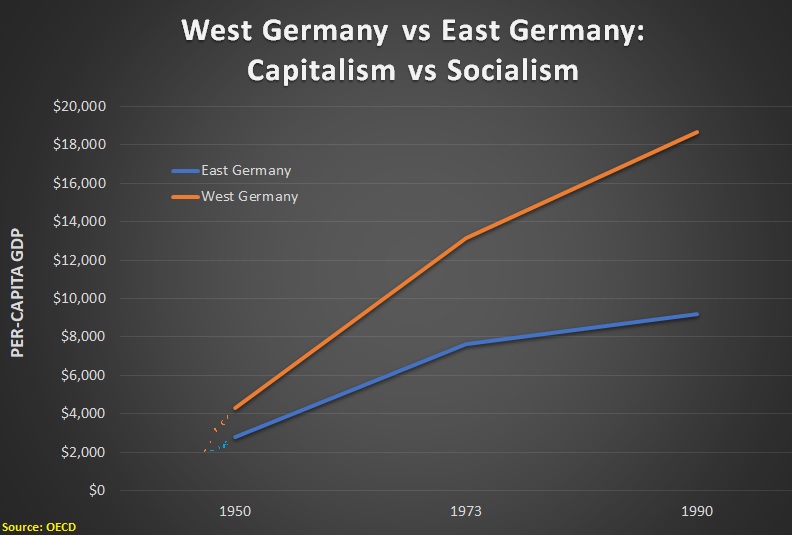 The obvious lesson to be learned from this example of “anti-convergence” is that market-oriented economies out-perform state-controlled economies.
I want to revisit this topic because I recently dealt with someone who claimed that government spending via the Marshall Plan deserves the credit for West Germany’s post-war economic renaissance.
What does the evidence say? Was foreign aid from the United States after World War II a key driver (for Keynesian or socialist reasons) of the West German economy.
The answer is no.
Professor David Henderson explained the role of the Marshall Plan for Econlib.
After World War II the German economy lay in shambles. …less than ten years after the war people already were talking about the German economic miracle…
View original post 752 more words
The Hanoverians: George III (1760-1820)
02 Dec 2021 Leave a comment

“Born and educated in this country, I glory in the name of Briton,” declared the new king to the House of Representatives upon his succession. George III was proud to announce he was the first British-born king since the reign of the Stuarts. He was also the first Hanoverian monarch to speak native English, in fact, George III never even visited Hanover during his lifetime. He viewed himself as a man of the people, a noble and virtuous patriot-king, an Englishman to the core, although his opponents rarely missed an opportunity to brand him an alienating tyrant hell-bent on subverting the constitution. Indeed it is common today to associate George III with tyranny, particularly in the United States. Perhaps the sobering effects of several centuries has muted this controversial king’s legacy to some degree, but a growing modern revisionist reassessment of George III’s legacy is not enough to overcome his…
View original post 2,555 more words
Andrew Geddis and Sarah Jocelyn: Is the NZ Supreme Court Aligning the NZBORA with the HRA?
02 Dec 2021 Leave a comment


The New Zealand Bill of Rights Act 1990 (NZBORA) and the United Kingdom’s Human Rights Act 1998 (HRA) share common constitutional DNA. Both are “parliamentary bills of rights” that eschew a judicial power to invalidate rights-infringing legislation. However, the two rights instruments historically have diverged in a couple of important ways regarding the form of post-enactment judicial rights review of legislation that they are taken to authorise. First, the HRA, s 4 confers on the courts an express power to issue a formal declaration that a parliamentary enactment that cannot be interpreted consistently with certain rights contained in the Convention is incompatible with that rights instrument. The NZBORA, by comparison, is almost completely silent as to the judicial remedies available in a case involving a breach of its rights guarantees. Second, the UK courts have adopted an approach to interpreting potentially Convention inconsistent legislation using the HRA, s…
View original post 2,589 more words
Rosa
02 Dec 2021 Leave a comment


Sometimes a hero is not a general who leads his troops into battle, or a surgeon who performs an impossible operation, sometimes it is just an ordinary woman who refuses to give up her seat in a bus.
Today 66 years ago Rosa Parks was arrested for refusing to give up her seat in the colored section, to a white passenger, after the white section was filled.
Lets never forget heroes like Rosa Parks.

By refusing to give up her seat to a white man on a Montgomery, Alabama, city bus in 1955, black seamstress Rosa Parks (1913—2005) helped initiate the civil rights movement in the United States. The leaders of the local black community organized a bus boycott that began the day Parks was convicted of violating the segregation laws. Led by a young Rev. Dr. Martin Luther King Jr.

The boycott lasted more than a year, during which…
View original post 211 more words
Expelling students from religious schools based on sexual orientation?
02 Dec 2021 Leave a comment

Current press reports suggest that the Federal Government is contemplating a change to the provisions of the Sex Discrimination Act 1984 which allow religious schools to operate in accordance with their religious commitments, in the area of decisions about students. This is being proposed to allay fears that the recently introduced Religious Discrimination Bill will impact on LGBT students. (See here for my overview of the Bill.) Just to be clear, I think this is a terrible idea- the Australian Law Reform Commission already has a reference on this issue and they should be allowed to complete their work by taking into account all the issues. But I make a few comments on the proposal anyway.
The provision in question is s 38(3) of the SDA, which allows religious schools to make decisions in relation to students in accordance with their religious commitments, and for that not to amount to…
View original post 358 more words


Recent Comments