Is falsifiability essential to science?

whyevolutionistrue's avatarWhy Evolution Is True

The two articles I want to discuss today are fascinating, for they raise a problem that’s now vexing many scientists (especially physicists)—the problem of testability. (Thanks to reader Mark H. for calling my attention to them.)

It all goes back to the philosopher Karl Popper (1902-1994). Popper’s views about what made a theory “scientific” were immensely influential. They’re summed up in the Wikipedia piece on him:

A theory in the empirical sciences can never be proven, but it can be falsified, meaning that it can and should be scrutinized by decisive experiments. If the outcome of an experiment contradicts the theory, one should refrain from ad hoc manoeuvres that evade the contradiction merely by making it less falsifiable.

In other words, a theory that can’t in principle be shown to be wrong isn’t a scientific theory. But I disagree with that characterization, and the one from Wikipedia, in two ways.  First, a…

View original post 2,389 more words
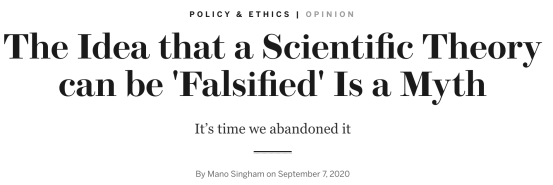
Can scientific theories be falsified? One scientist says no

whyevolutionistrue's avatarWhy Evolution Is True

The provocative title of the Scientific American Article below, by physicist Mano Singham, is, I think, deeply misleading.  The idea that science progresses by eliminating incorrect explanations, which is what falsification is all about, seems to me not only a good strategy, but one that’s historically worked very well. To say it’s a myth is not even wrong.

But let’s hear why Singham says that falsification can’t work. Click on the screenshot to read his piece.

Before we get to Singham’s argument, we notice that we can immediately think of scientific theories that have been definitively falsified. One is that the Earth is flat. That has been falsified by any number of observations, and now nobody except loons accepts a flat planet. Alternatively, the Genesis story of creation, once a “scientific” explanation for the origin of life and, especially, humans, has also been falsified, also by any number of observations. …

View original post 1,271 more words

Book Review: ‘Pacific Crucible: War at Sea in the Pacific, 1941-1942 (Volume I of the Pacific War Trilogy)

Alex Diaz-Granados's avatarA Certain Point of View, Too

(C) 2011 W.W. Norton & Company

★★★★★

On November 14, 2011, W.W. Norton & Company published Pacific Crucible: War at Sea in the Pacific, 1941-1942, the first volume of Ian W. Toll’s Pacific War Trilogy. In twelve chapters and an epilogue which take up 493 pages of narrative, Toll covers the first six months of the Pacific War that pitted the Japanese Empire against the combined forces of the United States and the British Empire, as well as the small Dutch military contingent based in what was then the Netherlands East Indies – modern day Indonesia – from the surprise attack on Pearl Harbor (December 7, 1941)  to the fate-changing Battle of Midway (June 4-6, 1942) and its immediate aftermath.

By writing Pacific Crucible, Toll, whose first book of naval history Six Frigates: The Epic Story of the Founding of the U.S. Navy won the Samuel…

View original post 1,767 more words

Why do Millionaires hate Billionaires?

Priceless

Tom Hunter's avatarNo Minister

I was pondering this question the other day while observing a hilarious interchange between two such people, Robert Reich and Elon Musk.

Reich is in many ways a creature of the distant past. An old-style American Boomer “liberal” economist who strongly pushes old-fashioned ideas like boosting the minimum wage, empowering unions, and so forth. I only know of him because he was Secretary of Labour in Bill Clinton’s first Presidential term (1993-1997). He was disappointed to find that Clinton’s famous “triangulation” strategy for winning re-election in 1996 meant that Reich’s economic ideas around labour were never implemented to the extent he wanted.

Since then he has maintained a steady patter of pushing these ideas through books and articles. He’s also on Twitter and as an example of how the world has changed, he may have been surprised to find that modern Robber Barons of our age are not…

View original post 97 more words

Why conspiracy theories are rational to believe

The Best of Monty Python on The Dick Cavett Show

Fiat Value in the theory of value – an ADEMU lecture by Edward C Prescott

Jordan Peterson on @BillMaher

Titles And Honours – Lucentio

karl popper vs. the identification people

fabiorojas's avatarorgtheory.net

Truth be told, I think Popper would have approved of the identification effort. How could the person who advanced falsification not have approved of an attempt to address endogeneity and unobserved variables? But most people ignore an important aspect of Popper’s beliefs about scientific theories. He also thought that theories deserve special attention if they make unexpected predictions. Thus, falsification was very powerful if combined with creative derivation of hypotheses.

Now, identification is not in any way contrary to that view. Instrumental variables, or any other technique addressing identification, can be used to test  unexpected hypotheses. However, real scientific practice is about trade offs. Should I spend my time on theory building or some other activities? My view of the identification craze isn’t that it’s wrong. My view is that it’s “end game.” In other words, identification is a luxury when you have an abundance of data and a pretty clear…

View original post 86 more words

Dogmatic falsification of science

Ken's avatarOpen Parachute

Karl PopperAn important element of the scientific method is that hypotheses must be testable, potentially falsifiable, to be scientific. That we build theories by testing hypotheses and rejecting them if proved wrong by experiential evidence. And not just hypotheses. Prevailing theories are also constantly open to potential falsification, testing against new evidence and changing to incorporate new findings.

The concept of falsification in science was popularised by Karl Popper.

But who does this testing?

It’s not a matter of personal responsibility. A scientist who advances a new hypothesis is not just left alone to try to falsify it. After all, scientists are human too. They have their own emotions, biases, beliefs and preconceived ideas. They are just a susceptible as anyone else to adopting a blinkered approach to any such testing. In fact, most scientists probably look for experimental procedures which would show their pet hypothesis in a favourable…

View original post 518 more words

The Doors – Light My Fire

Opinion: Can the government breach the Brexit Withdrawal Agreement?

Jordan Peterson: The fatal flaw in leftist American politics | Big Think

Nearly half of British public say they will never buy an electric car over charging fees

Previous Older Entries Next Newer Entries

Coordination Problem

Celebrating humanity's flourishing through the spread of capitalism and the rule of law

Libertarian Land

Celebrating humanity's flourishing through the spread of capitalism and the rule of law

Arin’s Substack

Celebrating humanity's flourishing through the spread of capitalism and the rule of law

David Andolfatto

Celebrating humanity's flourishing through the spread of capitalism and the rule of law

Monetary Non-Neutrality

Celebrating humanity's flourishing through the spread of capitalism and the rule of law

Reason Magazine

Celebrating humanity's flourishing through the spread of capitalism and the rule of law

Coyote Blog

Celebrating humanity's flourishing through the spread of capitalism and the rule of law

Thoughts from the North

Celebrating humanity's flourishing through the spread of capitalism and the rule of law

Fardels Bear

A History of the Alt-Right

Vincent Geloso

Econ Prof at George Mason University, Economic Historian, Québécois

Bassett, Brash & Hide

Celebrating humanity's flourishing through the spread of capitalism and the rule of law

Truth on the Market

Scholarly commentary on law, economics, and more

The Undercover Historian

Beatrice Cherrier's blog

Matua Kahurangi

Celebrating humanity's flourishing through the spread of capitalism and the rule of law

Temple of Sociology

Celebrating humanity's flourishing through the spread of capitalism and the rule of law

Velvet Glove, Iron Fist

Celebrating humanity's flourishing through the spread of capitalism and the rule of law

Why Evolution Is True

Why Evolution is True is a blog written by Jerry Coyne, centered on evolution and biology but also dealing with diverse topics like politics, culture, and cats.

NoTricksZone

Celebrating humanity's flourishing through the spread of capitalism and the rule of law

Homepaddock

A rural perspective with a blue tint by Ele Ludemann

Kiwiblog

DPF's Kiwiblog - Fomenting Happy Mischief since 2003

The Dangerous Economist

Celebrating humanity's flourishing through the spread of capitalism and the rule of law

Watts Up With That?

The world's most viewed site on global warming and climate change

The Logical Place

Tim Harding's writings on rationality, informal logic and skepticism

Doc's Books

A window into Doc Freiberger's library

The Risk-Monger

Let's examine hard decisions!

Uneasy Money

Commentary on monetary policy in the spirit of R. G. Hawtrey

Barrie Saunders

Thoughts on public policy and the media

Liberty Scott

Celebrating humanity's flourishing through the spread of capitalism and the rule of law

Point of Order

Politics and the economy

James Bowden's Blog

A blog (primarily) on Canadian and Commonwealth political history and institutions

Science Matters

Reading between the lines, and underneath the hype.

Peter Winsley

Economics, and such stuff as dreams are made on

A Venerable Puzzle

"The British constitution has always been puzzling, and always will be." --Queen Elizabeth II

The Antiplanner

Celebrating humanity's flourishing through the spread of capitalism and the rule of law

Bet On It

Celebrating humanity's flourishing through the spread of capitalism and the rule of law

History of Sorts

WORLD WAR II, MUSIC, HISTORY, HOLOCAUST

Roger Pielke Jr.

Undisciplined scholar, recovering academic

Offsetting Behaviour

Celebrating humanity's flourishing through the spread of capitalism and the rule of law

JONATHAN TURLEY

Res ipsa loquitur - The thing itself speaks

Conversable Economist

In Hume’s spirit, I will attempt to serve as an ambassador from my world of economics, and help in “finding topics of conversation fit for the entertainment of rational creatures.”

The Victorian Commons

Researching the House of Commons, 1832-1868

The History of Parliament

Articles and research from the History of Parliament Trust

Books & Boots

Reflections on books and art

Legal History Miscellany

Posts on the History of Law, Crime, and Justice

Sex, Drugs and Economics

Celebrating humanity's flourishing through the spread of capitalism and the rule of law

European Royal History

Exploring the Monarchs of Europe