How Expert Are Expert Stock Pickers?
22 Sep 2016 Leave a comment
in economics, financial economics Tags: active investing, passive investing
Index Funds: The 12-Step Recovery Program for Active Investors
19 Aug 2016 Leave a comment
in economics, financial economics Tags: active investing, efficient markets hypothesis, hedge funds, passive investing
Has ethical investing ever beaten the market? @GreenpeaceNZ
29 Jul 2016 Leave a comment
in environmentalism, financial economics Tags: active investing, efficient markets hypothesis, entrepreneurial alertness, ethical investing, passive investing
VFTSX is the Vanguard social investing index fund – a fund that invests in an index made up of ethical investing funds.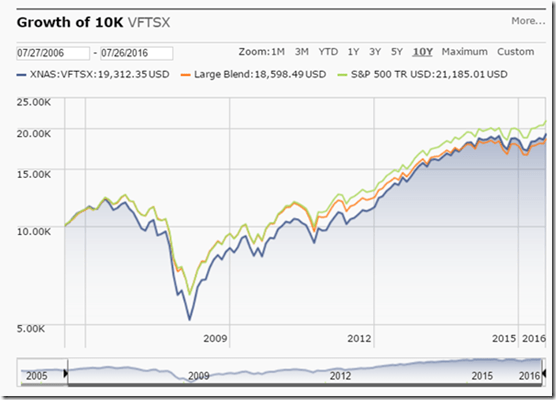
Source: VFTSX Vanguard FTSE Social Index Inv Fund VFTSX Quote Price News.
Has the Vice Fund ever not outperformed the share market?
28 Jul 2016 3 Comments
in fisheries economics Tags: active investing, efficient markets hypothesis, entrepreneurial alertness, ethical investing, passive investing
The Vice Fund is a mutual fund investing in companies that have significant involvement in, or derive a substantial portion of their revenues from the tobacco, gambling, defense/weapons, and alcohol industries. A primary focus of stock selection is the ability to pay and grow dividends.

Source: VICEX USA Mutuals Barrier Investor Fund VICEX Quote Price News.
Paul Samuelson on everything you need to know about the efficient markets hypothesis
31 May 2016 Leave a comment
in applied price theory, fisheries economics Tags: active investing, efficient markets hypothesis, entrepreneurial alertness, passive investing, Paul Samuelson


The growth of passive investment funds continues
16 Apr 2016 Leave a comment
in economic history, entrepreneurship, financial economics Tags: active investing, efficient markets hypothesis, Index linked funds, passive investing

Source: These Charts Show the Astounding Rise in Passive Management – Bloomberg.
https://twitter.com/pmarca/status/718341190123458560

Source: The Financial Industry Is Having Its Napster Moment – Bloomberg.
@RusselNorman @JulieAnneGenter a hedge fund specialises in shorting renewable energy shares @Greenpeace
03 Feb 2016 Leave a comment
in defence economics, economic history, economics of regulation, energy economics, entrepreneurship, environmental economics, financial economics, global warming Tags: active investing, disinvestment, entrepreneurial alertness, ethical investing, Fossil Fuels, green rentseeking, hedge funds, passive investing, renewable energy, solar power, Vice Fund, wind power

Just as the Vice Fund specialises in investing in tobacco, alcohol, gaming and defence shares, Cool Futures Funds Management is starting-up to specialise in betting against global warming by shorting green stocks:
…instead of renewables being our energy future, they’re betting on the subsidies drying up and the whole industry collapsing; instead of fossil fuels being left in the ground as “stranded assets”.
An example of the nice little earners this hedge fund can come across is anticipating when particular investors will want to disinvest from fossil fuels.
When institutional investors ranging from universities to sovereign investment funds such as the New Zealand Superannuation Fund seek to disinvest from fossil fuels, that will be a good time to buy cheap shares.The
If bureaucrats were any good at picking winners, they would be hedge funds managers
30 Jul 2015 Leave a comment
in applied price theory, comparative institutional analysis, economics of bureaucracy, entrepreneurship, financial economics, human capital, industrial organisation, labour economics, managerial economics, occupational choice, organisational economics, rentseeking, survivor principle Tags: active investing, corporate welfare, efficient markets hypothesis, entrepreneurial alertness, hedge funds, industry policy, passive investing, picking winners, The fatal conceit, The pretence to knowledge
Page 32 of "An Illustrated Guide to Income" more economic #dataviz at: bit.ly/12SEI9p http://t.co/HYm0II2UNI—
Catherine Mulbrandon (@VisualEcon) May 08, 2013
Page 33 of "An Illustrated Guide to Income" more economic #dataviz at: bit.ly/10M7lqR http://t.co/FcmaqZWB32—
Catherine Mulbrandon (@VisualEcon) May 09, 2013
The hedge fund industry held $2.9 trillion of assets in June. Exchange-traded funds did better econ.st/1DdXgWS http://t.co/CK2foqMOpw—
The Economist (@EconEconomics) August 01, 2015
Entrepreneurial alertness in index-linked passive investing front-running
11 Jul 2015 Leave a comment
in entrepreneurship, financial economics Tags: active investing, arbitrage, efficient markets hypothesis, entrepreneurial alertness, passive investing, Speculation
There's an easy way to game the stock market, and it's getting easier by the day bloom.bg/1NNmHPs http://t.co/GFtBhKH2fo—
Bloomberg Business (@business) July 08, 2015
The traders are simply buying stocks before they’re added to the indexes that, by definition, index funds must track.
As the popularity of index investing soars to new heights, the emergence of index front-running is raising fundamental questions about so-called passive investment strategies, as well as how indexes are compiled and the role the funds themselves play in elevating costs.
By one estimate, it gouges owners of funds tracking the Standard & Poor’s 500 Index to the tune of $4.3 billion a year, a sum that can double or even triple the cost of such investments…
Take American Airlines Group Inc., which joined the S&P 500 after markets closed on March 20. Because the addition of the carrier was announced four days earlier, nimble traders had plenty of time to get in front of the less fleet-footed. American jumped 11 percent over the span.
The cost was ultimately borne by index funds, which sparked an $8 billion buying frenzy in the two minutes right before the close — an amount equal to more than two weeks of the stock’s typical volume…
Paul Samuelson on the acceptance of the efficient markets hypothesis by Wall Street
04 Jul 2015 Leave a comment

The US share market since 1900
10 Jun 2015 Leave a comment
in business cycles, economic growth, economic history, entrepreneurship, financial economics, macroeconomics Tags: active investing, efficient market hypothesis, entrepreneurial alertness, passive investing
Here’s how Warren Buffett sees the stock market read.bi/1HsUe1p http://t.co/Zm6fDTYpf9—
BI Chart of the Day (@chartoftheday) April 23, 2015
Should the New Zealand superannuation fund try to beat the market?
09 Jun 2015 Leave a comment
in entrepreneurship, financial economics, politics - New Zealand Tags: active investing, ageing society, demographic crisis, efficient markets hypothesis, entrepreneurial alertness, New Zealand superannuation fund, old age pensions, passive investing, retirement savings
Most mutual funds still can't beat their benchmark read.bi/1GkTig1 http://t.co/r7ezoDGJbV—
BI Chart of the Day (@chartoftheday) June 03, 2015
Greg Mankiw: Why I invest in index funds
09 May 2015 Leave a comment
in applied price theory, economic history, entrepreneurship, financial economics Tags: active investing, efficient markets hypothesis, entrepreneurial alertness, Greg Mankiw, passive investing
Buy and hold with a vengeance
24 Apr 2015 Leave a comment
in financial economics Tags: active investing, passive investing
A fund that hasn't chosen any new stocks since 1935 is beating 98% of its competitors uk.businessinsider.com/voya-corporate… http://t.co/I2KTMrRkti—
BI UK Finance (@BIUK_Finance) March 03, 2015
 Utopia, you are standing in it!
Recent Comments