
Source: Chart: The Largest Companies by Market Cap Over 15 Years.
Celebrating humanity's flourishing through the spread of capitalism and the rule of law
24 Oct 2016 Leave a comment
in economic history, entrepreneurship, fisheries economics Tags: Apple, creative destruction, Microsoft
05 May 2016 Leave a comment
in human capital, industrial organisation, labour economics, labour supply, occupational choice, survivor principle Tags: Apple, CEO pay, creative destruction, entrepreneurial alertness, Facebook, Google, Microsoft, superstar wages, superstars, top 1%, Twitter, Uber, Yahoo
I am surprised to see that Yahoo is in business much less competing for top talent. Microsoft is in decline too. Apple does not pay people as much as everybody else.
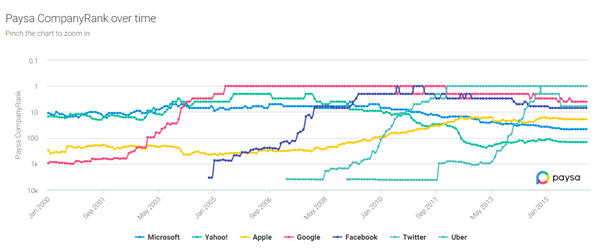
Source: Paysa Company Rank | Paysa.
Some other colours seem to duplicate so you will have to work out which is which by when they exploded in hiring top talent.
03 Apr 2016 Leave a comment
in fisheries economics, industrial organisation, survivor principle Tags: Apple, creative destruction, Facebook, Microsoft, Twitter
I did not know Yahoo was still in business.

02 Jan 2016 Leave a comment
in economic history, economics of media and culture, entrepreneurship, industrial organisation, survivor principle Tags: amazon, Apple, corporate headquarters, Google, start-ups
01 Jan 2016 Leave a comment
in economic history, entrepreneurship, industrial organisation, survivor principle Tags: Apple, creative destruction
16 Nov 2015 Leave a comment
in applied price theory, applied welfare economics, entrepreneurship, industrial organisation, politics - USA Tags: Apple, creative destruction, entrepreneurial alertness, Left-wing hypocrisy, Leftover Left, superstar wages, superstars, top 1%, Twitter left, Walmart
23 Jul 2015 Leave a comment
in entrepreneurship, financial economics Tags: Amazon on, Apple, creative destruction, entrepreneurial alertness, Facebook, Google, Microsoft
PayPal is now worth more than Netflix, eBay, and Twitter by @eugenekim222 businessinsider.com/paypal-now-wor… @pmarca http://t.co/M3IbfNlTi0—
Evan Kirstel (@evankirstel) July 20, 2015
28 Apr 2015 Leave a comment
in economic history, technological progress Tags: Apple, creative destruction, innovation, Steve Jobs
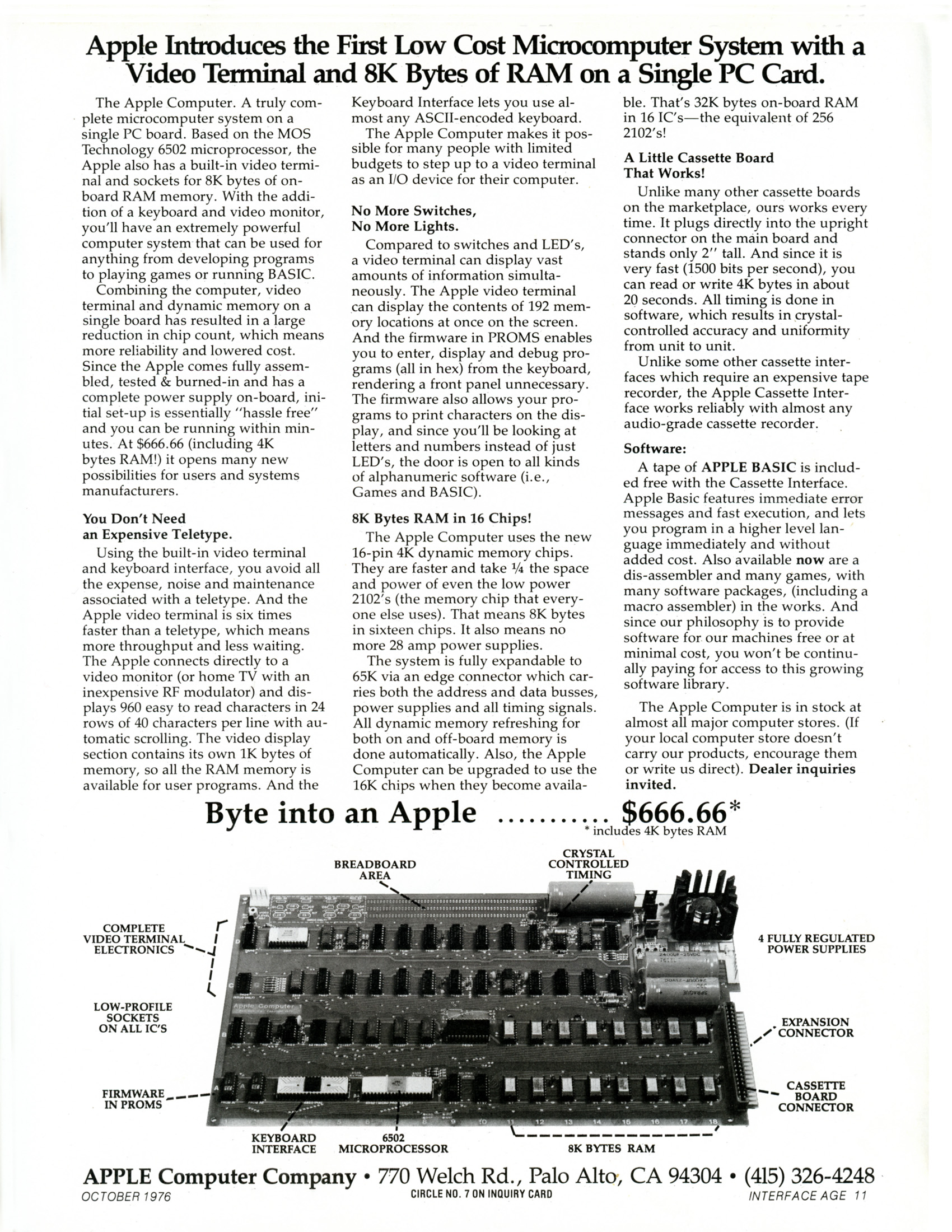
In 1976, high school friends Steve Wozniak and Steve Jobs built their first computer — the Apple 1. http://t.co/pl9US5FPBI—
ClassicPics (@History_Pics) April 27, 2015
21 Apr 2015 Leave a comment
in economic history, entrepreneurship, financial economics, industrial organisation, survivor principle Tags: Apple, creative destruction, entrepreneurial alertness, Steve Jobs
People really forget how awesomely powerful IBM was in the 1980s: @evankirstel http://t.co/TkpuU5sAXg—
Marc Andreessen (@pmarca) April 04, 2015
05 Feb 2015 Leave a comment
15 Mar 2014 1 Comment
in cricket, entrepreneurship, human capital, labour economics Tags: Apple, Bill Gates, CEO pay, cricket, Dennis Lillee, Kerry Packer, regulatory capture, Steve Jobs, superstars, top 1%
Dennis Lillee was paid £1,200 to tour England in 1972 for five months. He was paid the same to tour for three months in 1975. Now a world-class fast bowling coach, he would probably not get out for bed for £1,200

When Kerry Packer bid for the Australian cricket rights in the 1970s, he offered $500,000 per year. That was about ten times what the ABC was paying at the time
The Australian cricket TV rights sold for over $500 million in 2013 for a 5-year deal.
Today’s international cricketers are millionaires – widely respected and beloved members of the top 1% of income earners. Most think it is great that top sports people make millions over their career. No plans for the Occupy Wall Street crowd to occupy the MCG, Wimbledon or the Olympics to complain about superstar sports salaries and prizes.
Lillee and other top athletes, celebrities, actors, musicians and entertainers are all paid much more for much the same reason that CEOs, money market managers, top lawyers and tech entrepreneurs are paid much more than in the past.
They are superstars who are able to leverage their talent through communications technology advances on a national and global level. They can apply ‘their talent to greater pools of resources and reach[ing] larger numbers of people thus becoming more productive and higher paid’.
Why is Steve Jobs strangely immune from top 1% envy despite his cheapness and meanness to others while Bill Gates is reviled as some sort of monopolist despite his giving most of his wealth away?
Was Jobs worth his pay? Apple shares went up and down in billions on news of Steve Jobs’s health.
When Hewlett Packard’s CEO Mark Hurd resigned unexpectedly, the value of HP shares dropped by about $10 billion! This makes his $30 million in annual compensation a bargain for his shareholders. Oracle’s shares rose 6% on word of Mr. Hurd’s hiring as co-president on an annual base salary of $950,000 and being eligible for up to a $10 million annual bonus. Perhaps he is under-paid?
See Kaplan, Steven N., and Joshua Rauh. 2013. It’s the Market: The Broad-Based Rise in the Return to Top Talent, Journal of Economic Perspectives 2013 for more.
Celebrating humanity's flourishing through the spread of capitalism and the rule of law
Scholarly commentary on law, economics, and more
Beatrice Cherrier's blog
Celebrating humanity's flourishing through the spread of capitalism and the rule of law
Celebrating humanity's flourishing through the spread of capitalism and the rule of law
Celebrating humanity's flourishing through the spread of capitalism and the rule of law
Why Evolution is True is a blog written by Jerry Coyne, centered on evolution and biology but also dealing with diverse topics like politics, culture, and cats.
Celebrating humanity's flourishing through the spread of capitalism and the rule of law
Celebrating humanity's flourishing through the spread of capitalism and the rule of law
A rural perspective with a blue tint by Ele Ludemann
DPF's Kiwiblog - Fomenting Happy Mischief since 2003
Celebrating humanity's flourishing through the spread of capitalism and the rule of law
The world's most viewed site on global warming and climate change
Tim Harding's writings on rationality, informal logic and skepticism
A window into Doc Freiberger's library
Let's examine hard decisions!
Commentary on monetary policy in the spirit of R. G. Hawtrey
Thoughts on public policy and the media
Celebrating humanity's flourishing through the spread of capitalism and the rule of law
Politics and the economy
A blog (primarily) on Canadian and Commonwealth political history and institutions
Reading between the lines, and underneath the hype.
Economics, and such stuff as dreams are made on
"The British constitution has always been puzzling, and always will be." --Queen Elizabeth II
Celebrating humanity's flourishing through the spread of capitalism and the rule of law
Celebrating humanity's flourishing through the spread of capitalism and the rule of law
WORLD WAR II, MUSIC, HISTORY, HOLOCAUST
Undisciplined scholar, recovering academic
Celebrating humanity's flourishing through the spread of capitalism and the rule of law
Res ipsa loquitur - The thing itself speaks
Celebrating humanity's flourishing through the spread of capitalism and the rule of law
Researching the House of Commons, 1832-1868
Articles and research from the History of Parliament Trust
Reflections on books and art
Posts on the History of Law, Crime, and Justice
Celebrating humanity's flourishing through the spread of capitalism and the rule of law
Exploring the Monarchs of Europe
Cutting edge science you can dice with
Small Steps Toward A Much Better World
“We do not believe any group of men adequate enough or wise enough to operate without scrutiny or without criticism. We know that the only way to avoid error is to detect it, that the only way to detect it is to be free to inquire. We know that in secrecy error undetected will flourish and subvert”. - J Robert Oppenheimer.
The truth about the great wind power fraud - we're not here to debate the wind industry, we're here to destroy it.
Celebrating humanity's flourishing through the spread of capitalism and the rule of law
Celebrating humanity's flourishing through the spread of capitalism and the rule of law
Economics, public policy, monetary policy, financial regulation, with a New Zealand perspective
Celebrating humanity's flourishing through the spread of capitalism and the rule of law
Restraining Government in America and Around the World

 Utopia, you are standing in it!
Recent Comments