23 Apr 2016
by Jim Rose
in economics of crime, law and economics, occupational choice
Tags: Australia, career criminals, crime and punishment, criminal deterrence, deportations, economics of immigration, law and order
When a non-citizen spends 10 of his 40 odd years in Australia behind bars, most recently in 2011, the only question that should be posed is why was not he deported much earlier?

Source: Former criminal deported and separated from family after 40 years in Australia | Stuff.co.nz.
He is a career criminal who deserves no sympathy. He is the author of his own misfortunes in being separated from his family in Australia. Sympathy should go to his many victims, not to him.
More fool him when he spent 9 months in immigration detention because he chose to appeal his deportation. The criterion for automatic cancellation of Australian visas for criminals is accumulating 12 months in prison. That is a low threshold for automatic deportation unless the minister grants a waiver.
With 10 years behind bars, his appeal had no chance of success. He was a career criminal Australia could well be shot off.
13 Apr 2016
by Jim Rose
in discrimination, economic history, gender, human capital, labour economics, labour supply, politics - Australia, politics - New Zealand, politics - USA, poverty and inequality
Tags: Australia, British economy, gender wage gap
13 Mar 2016
by Jim Rose
in budget deficits, economic history, fiscal policy, macroeconomics, politics - New Zealand, politics - USA, public economics
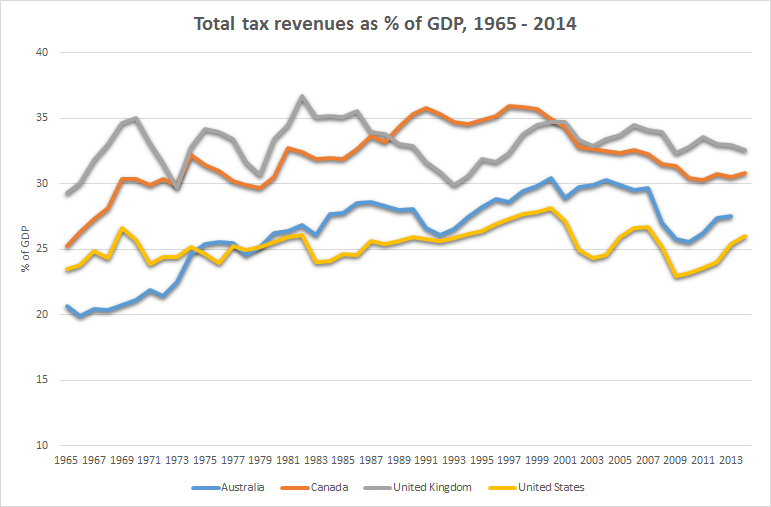
Tags: Australia, growth of government, size of government
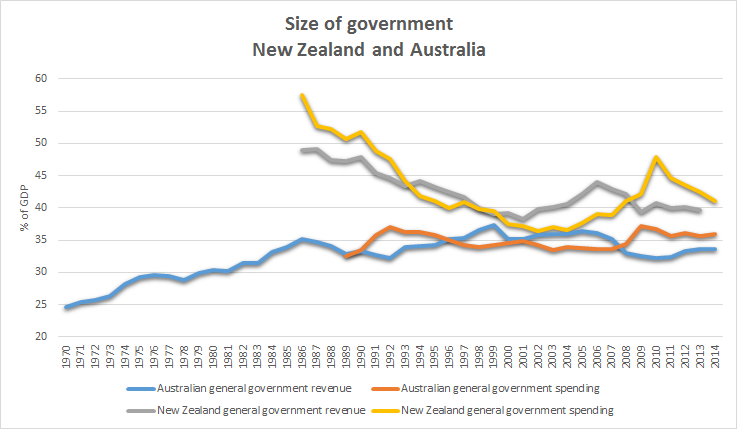
I do not trust the numbers for New Zealand prior to the early 1990s released by the OECD. New Zealand simply did not have a tax structure including a GST in the double digits back then to support estate of that size. Nonetheless, the size of government in New Zealand is systematically larger than in Australia, a richer country which can afford a large government and generous welfare state.
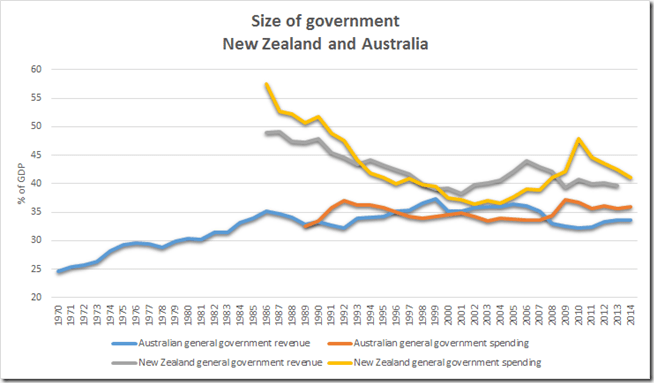
Source: General government – General government revenue – OECD Data and Data extracted on 12 Feb 2016 08:45 UTC (GMT) from OECD.Stat from OECD Economic Outlook November 2015.
10 Mar 2016
by Jim Rose
in labour economics, labour supply
Tags: Australia, British economy, Canada, Denmark, France, Germany, Japan, Sweden, taxation and labour supply, working hours
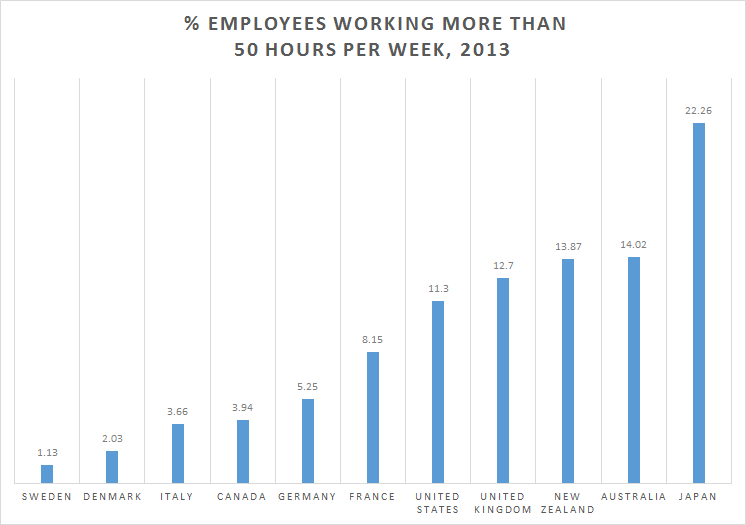
Them Continentals certainly are a bit work-shy especially the Nordics. All of them are pretty much afraid to put in a long week. Then again they do face rather high taxes on labour so what would you expect? The Japanese are still working themselves to death.
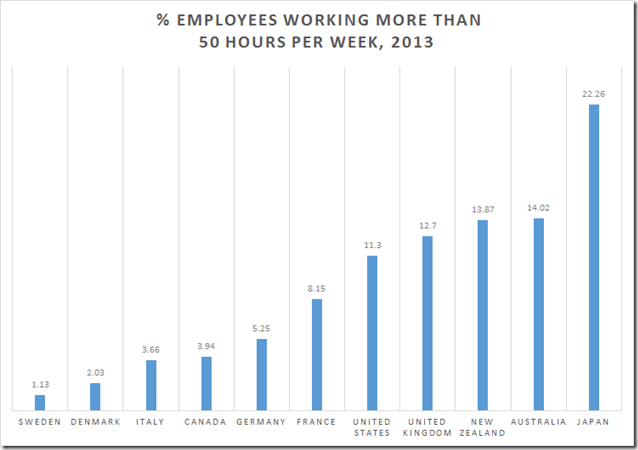
Data extracted on 09 Mar 2016 22:25 UTC (GMT) from OECD.Stat – OECD Better Life Index 2015.
05 Mar 2016
by Jim Rose
in economics of love and marriage, fiscal policy, gender, labour economics, labour supply, law and economics, politics - Australia, politics - New Zealand, politics - USA, public economics
Tags: Australia, British economy, Canada, Denmark, effective marginal tax rates, family tax benefits, family tax credits, France, Germany, in-work tax credits, Italy, poverty traps, rational irrationality, social insurance, Sweden, taxation and labour supply
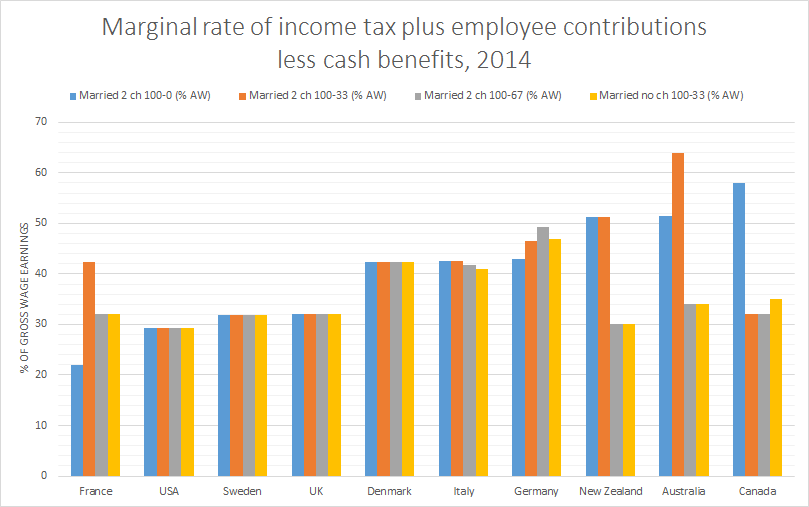
Some countries including New Zealand and Australia do not give ordinary families much of an incentive to earn more. Effective marginal tax rates on low income families is one of the few times that the Left discovers supply-side economics.
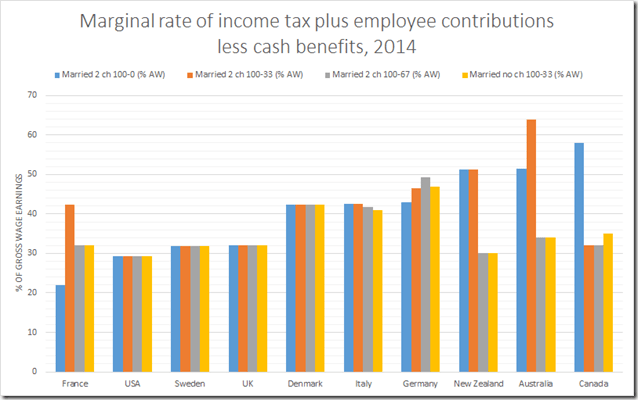
Source: Taxing Wages 2015 – OECD 2015.
05 Mar 2016
by Jim Rose
in fiscal policy, politics - Australia, politics - New Zealand, politics - USA, public economics
Tags: Australia, British economy, Canada, Denmark, family taxation, France, Germany, Italy, social insurance, Sweden, taxation and labour supply
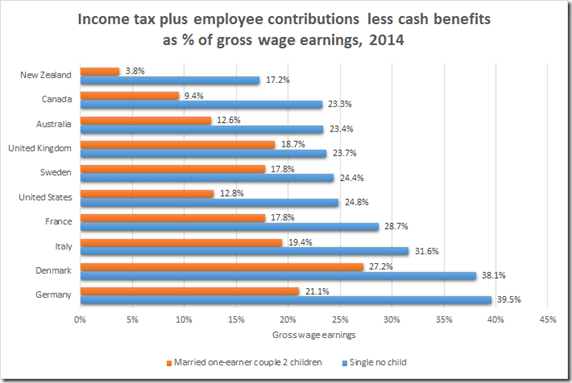
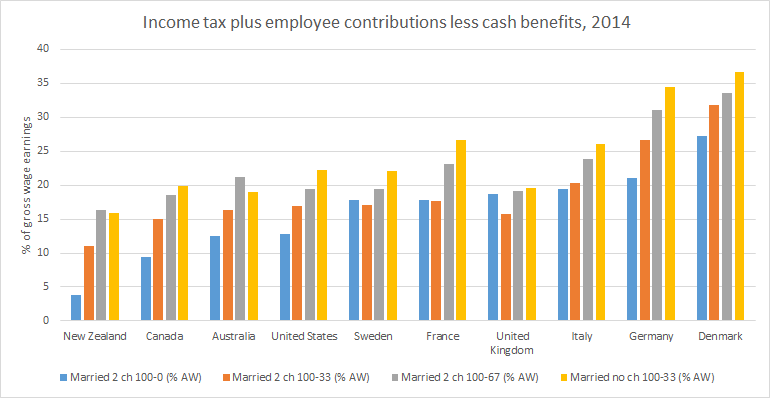
Those sensitive and caring northern European welfare states do tax families rather heavily even after accounting for family cash benefits.
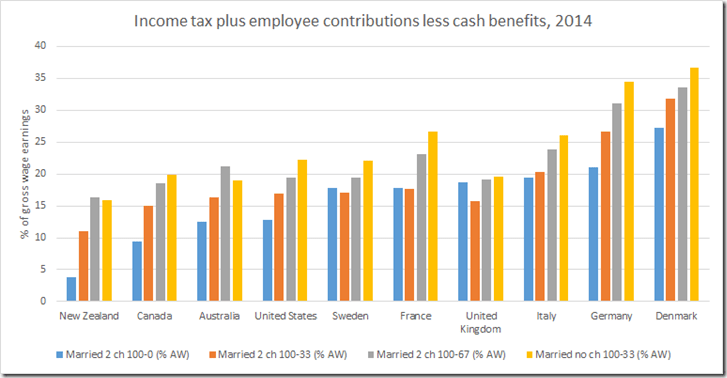
Source: Taxing Wages 2015 – OECD 2015.
04 Mar 2016
by Jim Rose
in fiscal policy, politics - Australia, politics - New Zealand, politics - USA, public economics
Tags: Australia, British economy, Canada, Denmark, France, Germany, Italy, social insurance, Social Security, Sweden, taxation and labour supply
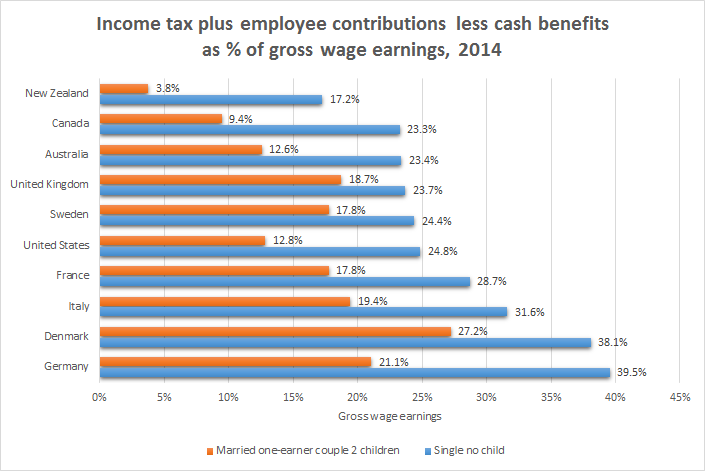
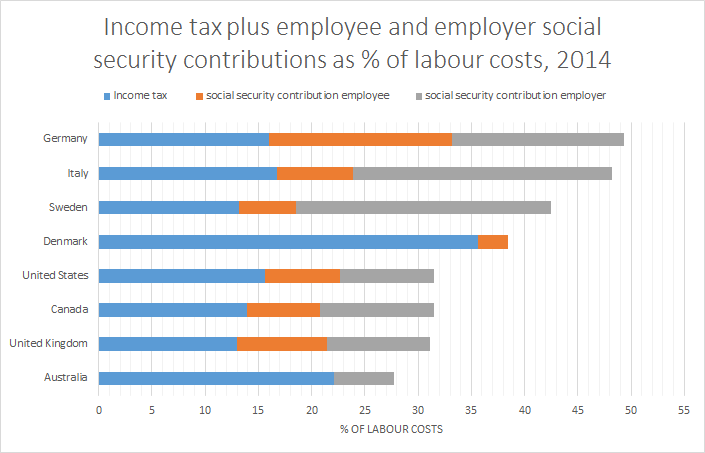
Those much admired northern European welfare states tax families and individuals much more than do the Anglo-Saxon welfare states.
Source: Taxing Wages 2015 – OECD 2015.
04 Mar 2016
by Jim Rose
in fiscal policy, politics - Australia, politics - New Zealand, politics - USA, public economics
Tags: Australia, British economy, Canada, Denmark, Germany, Italy, social insurance, Social Security, Sweden, taxation and labour supply
03 Mar 2016
by Jim Rose
in fiscal policy, public economics
Tags: Australia, British economy, Canada, Denmark, Germany, Italy, social insurance, Social Security, Sweden, taxation and labour supply
12 Feb 2016
by Jim Rose
in economic growth, economic history, fiscal policy, macroeconomics, politics - Australia, politics - New Zealand, public economics
Tags: Australia, growth of government, lost decades, size of government, Sweden
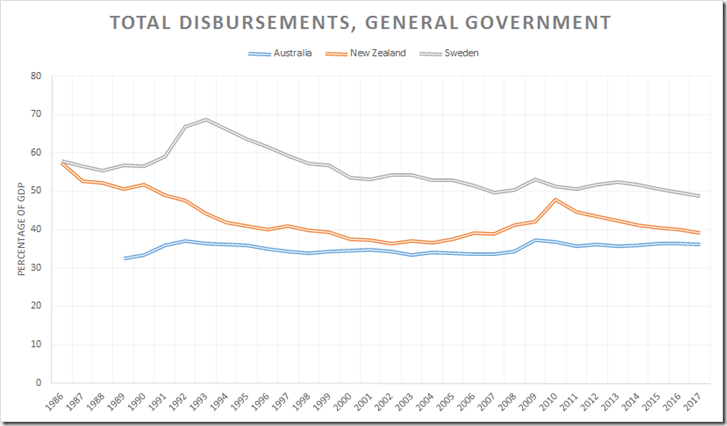
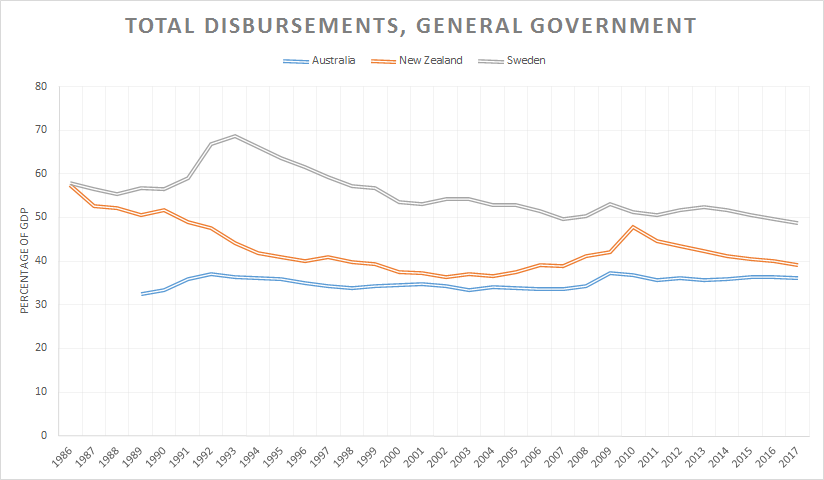
I came across this data showing that New Zealand and Sweden had the same sized public sectors in the mid-1980s some years ago. The data could not be found again for a long time in the OECD statistical databases. One reason was the OECD changed its name to general disbursements.
Data extracted on 12 Feb 2016 08:45 UTC (GMT) from OECD.Stat.
The size of the public sector in Australia has not changed much for 30 odd years. The public sector has been in a long decline in Sweden and New Zealand since peaks as a percentage of nominal GDP in the late 1980s and early 1990s respectively.
I know of no comments on the large size of the New Zealand public sector as measured by general government expenditure in the late 1980s. Its contribution to the stagnant economic growth of that time is worth exploring.
02 Feb 2016
by Jim Rose
in economic history, politics - Australia, politics - New Zealand, politics - USA, Public Choice, rentseeking
Tags: agricultural subsidies, Australia, Canada, cultural economics, Japan

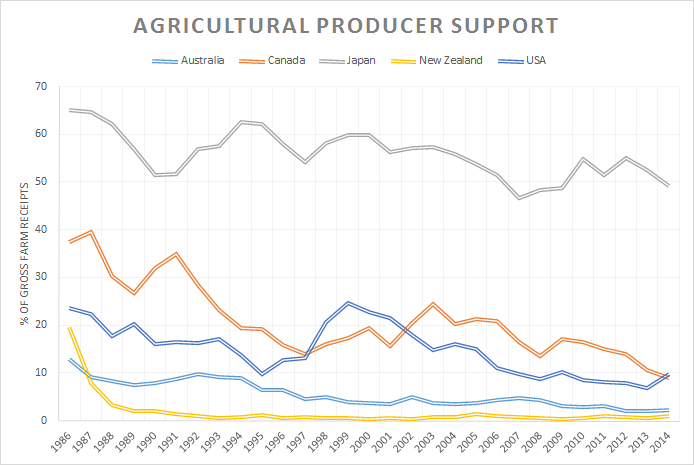
Source: Agricultural policy – Agricultural support – OECD Data.
Agricultural support is defined as the annual monetary value of gross transfers to agriculture from consumers and taxpayers arising from government policies that support agriculture, regardless of their objectives and economic impacts.
Previous Older Entries Next Newer Entries


 Utopia, you are standing in it!
Recent Comments