Left of @uklabour to blame for Thatchernomics

Thatcher was able to implement her policies because the Labour Party of the 1980s failed to offer a credible alternative government. In the 1983 general election, Labour ran on policy such as

After barely upholding the social democratic alliance in 1983, British labour did slightly better after four more years of Maggie Thatcher. Labour won 30% of the vote in 1987, up from 27%. in 1983 The social democratic alliance drop down from 25% to 22%

image

One reason was clever responses are national security  in the 1987 election such as this

On 24 May, Kinnock was interviewed by David Frost and claimed that Labour’s alternative defence strategy in the event of a Soviet attack would be “using the resources you’ve got to make any occupation totally untenable”.

In a speech two days later Mrs. Thatcher attacked Labour’s defence policy as a programme for “defeat, surrender, occupation, and finally, prolonged guerrilla fighting… I do not understand how anyone who aspires to Government can treat the defence of our country so lightly.”

In 1992, Labour still lost the election by a landslide despite 13 years of Thatcher good and ended its commitment to unilateral nuclear disarmament, high taxes and old-style nationalisation. Go left, go left so damaged the labour brand that a new generation of leaders was required.

The British electorate had every chance to vote for a hard left Labour in the 1980s. It rejected it resoundingly and almost voted in the social democratic alliance as the main opposition party.

What Britain spends on the EU

Image

The Brexit vote is about the supremacy of Parliament

Why did voters vote to Leave or Remain? @JulieAnneGenter @Income_Equality

There were few difference across the political spectrum as to why voters voted to Remain or Leave. This is according to Lord Ashcroft’s survey on referendum day of over 12,000 voters.

Source: How the United Kingdom voted on Thursday… and why – Lord Ashcroft Polls

Labour and Tory voters voted to leave to regain control over immigration and sovereignty.

Labour and Tory voters who wanted to remain thought the EU and its single market was a good deal not worth putting at risk. It is all about identity politics, not inequality.

Vote Leave voters are a grumpy lot who think things have been getting worse for 30 years:

Leavers see more threats than opportunities to their standard of living from the way the economy and society are changing, by 71% to 29% – more than twice the margin among remainers…

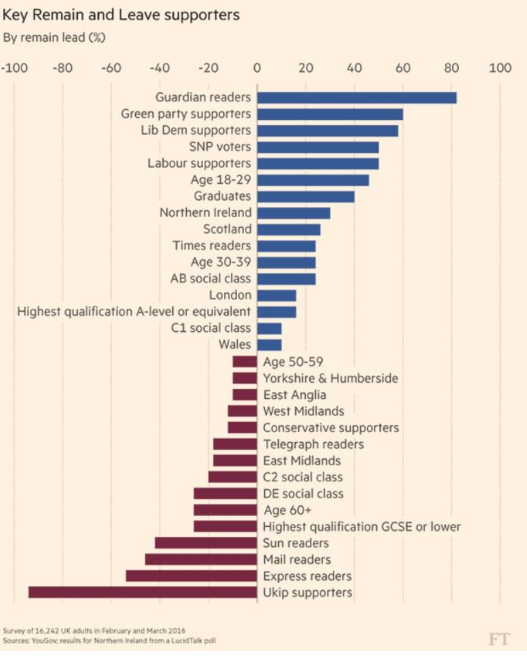
By large majorities, voters who saw multiculturalism, feminism, the Green movement, globalisation and immigration as forces for good voted to remain in the EU; those who saw them as a force for ill voted by even larger majorities to leave.

@JulieAnneGenter @NZGreens @LewisHoldenNZ @DanHannanMEP’s best single case for #Brexit

Patrick Minford explains ‪#‎Brexit‬

“Yes, Minister” on the Brexit Referendum

Source: “Yes, Minister” on the Brexit Referendum

Who is voting for #Brexit

image

Image

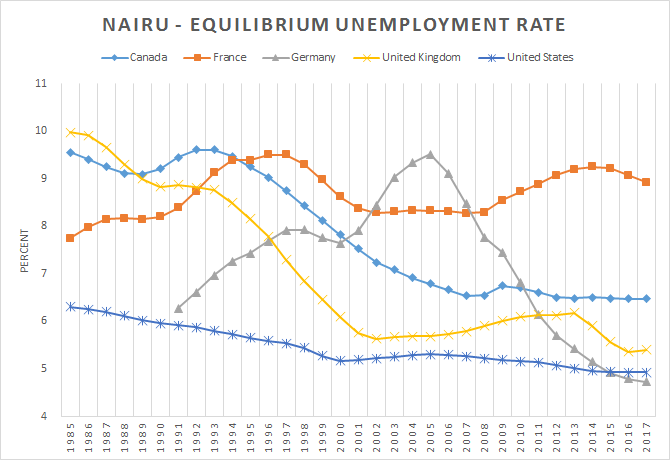
Equilibrium unemployment rate: USA, UK, France, Germany, Canada & Australia, 1985-2017

I do admire the way in which the USA has been able to have a steadily falling equilibrium unemployment rate since 1984 through thick and thin. The Great Recession had no impact on the US equilibrium unemployment rate. Not only has the largest member been able to do this, the OECD host country (red squares) has had a pretty steady natural unemployment rate too all things considered.

image

Source: OECD Economic Outlook June 2016 Data extracted on 01 Jun 2016 12:40 UTC (GMT) from OECD.Stat

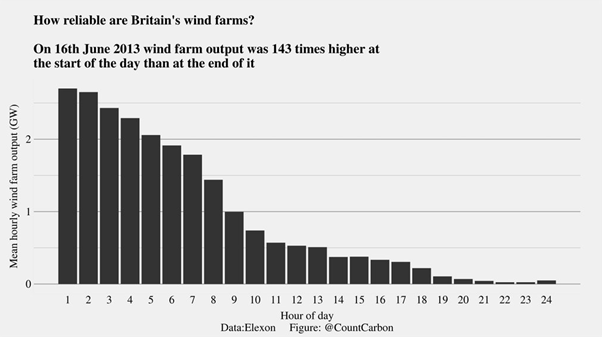
Wind farm output can vary by more than a factor of 100 in a single day!

image

Image

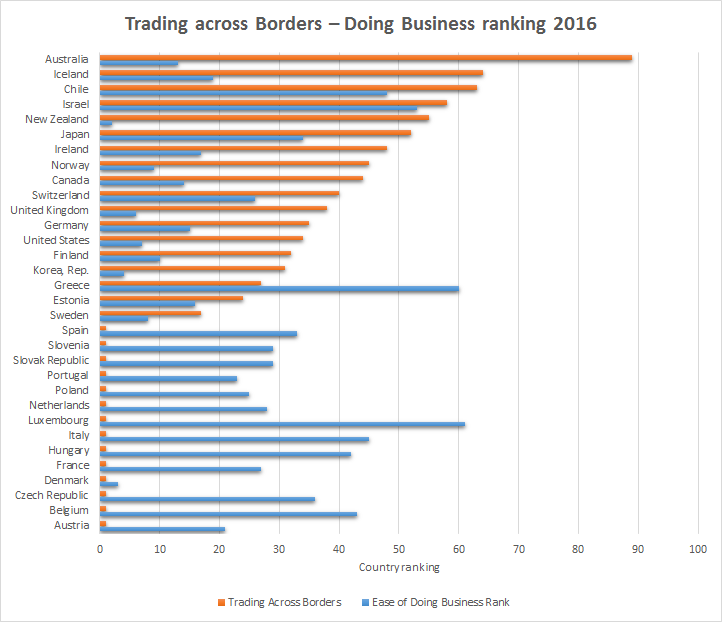
Trading across Borders Doing Business ranking 2016 – high income OECD countries

What did Australia do wrong to have the worst ranking of the high income countries for doing business across borders. New Zealand is not much better. The British are not benefiting as much as they could from the common market. Being in continental Europe must have advantages except if your Germany.

image

Source: Historical Data – Doing Business- World Bank Group.

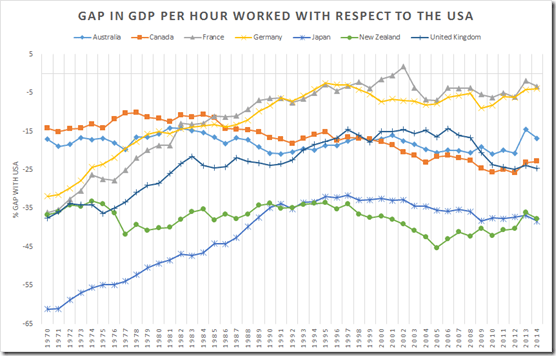
Gap in GDP per Australian, Canadian, French, German, Japanese, New Zealander and British hour worked with the USA

This data tells more of a story than I expected. Firstly, New Zealand has not been catching up with the USA. Japan stopped catching up with the USA in 1990. Canada has been drifting away from the USA for a good 30 years now in labour productivity.image

Data extracted on 28 May 2016 05:15 UTC (GMT) from OECD.Stat from OECD Compendium of Productivity Indicators 2016 – en – OECD.

Australia has not been catching up with the USA much at all since 1970. It has maintained a pretty consistent gap with New Zealand despite all the talk of a resource boom in the Australia; you cannot spot it in this date are here.

Germany and France caught up pretty much with the USA by 1990. Oddly, Eurosclerosis applied from then on terms of growth in income per capita.

European labour productivity data is hard to assess because their high taxes lead to a smaller services sector where the services can be do-it-yourself. This pumps up European labour productivity because of smaller sectors with low productivity growth.

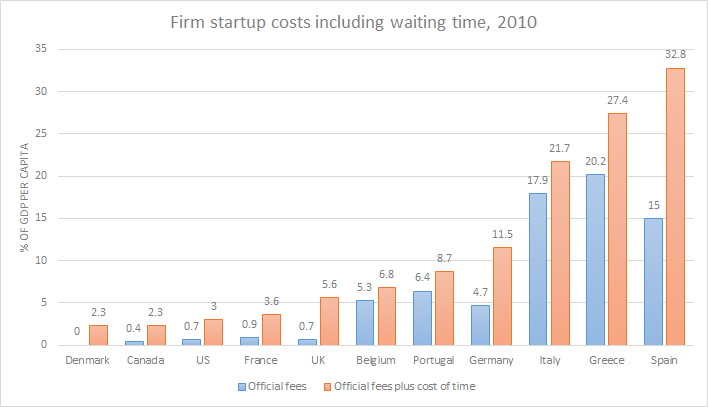
Waiting for the permits to come in: business start-up fees and lost output waiting in Europe and North America

Expediting the processing of permits can actually make quite a difference to firm start-up costs even in countries with few barriers to starting up a business.

image

Source: Markus Poschke (2011) Entry regulation: Still costly | VOX, CEPR’s Policy Portal.

Note: The value of time is set to a business day’s output per day of waiting time at 22 business days per month.

The Economics of #Brexit

@The_TUC confirm that motherhood penalty has nothing to do with employer discrimination @CHSommers

image

Source: Trades Union Congress – The Motherhood Pay Penalty.

The British Trades Union Congress (TUC) has released the preliminary findings of research into the 1970 Birth Cohort Study. The union research into the gender wage gap finds that

The overall gender pay gap of 34 per cent for this cohort of full-time workers who were born in 1970. This gap is largely due to the impact of parenthood on earnings – the women earning less and the men earning more after having children.

Mothers in the 1970 Birth Cohort Study who are in full-time work earn 11 per cent less than full-time women without children at age 42. When factors such as education, region and occupational social class are taken into account, this motherhood pay penalty in full-work falls to 7 per cent.

This finding by the union research into the 1970 birth cohort is no surprise. For 40 years at least now it has been known that having children and and spacing those children over a longer period carries a career penalty for women.

Recent work finds that the motherhood penalty is larger for those women pursuing careers where long hours or rigid hours is required and if they wish to combine careers and motherhood. Much of that research is led by Claudia Goldin.

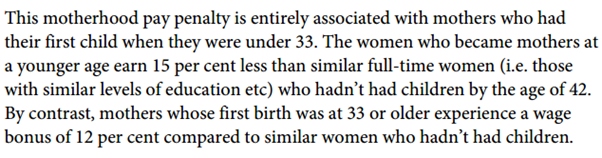
It is difficult for employers to discriminate against women if the gender wage gap is not only driven by motherhood but also by having their first child past the age of 33. Male chauvinistic employers simply do not have the necessary information about whether women are mothers and and whether they had their first child before or after the age of 33.

For employer discrimination to drive the gender wage gap, these male chauvinist employers must know:

  • whether female applicants are mothers, and
  • the age of female applicants who are mothers when they had their first child.

This information on the age of  first motherhood is essential for employer discrimination to be driving the gender wage gap. This information about the age of first motherhood must be in the hands of the employer so that they do not shortlist and do not promote women who are mothers before age 33.

It would be handy to know why why these male chauvinistic employers have such strong prejudices against women who are mothers before the age of 33 but have few prejudices against women who are mothers after age  33.

Another piece of useful information is how do male chauvinist employers get their hands on the partnership status of mothers when they had their first child. As the Trades Union Congress found

There is a bonus of 12 per cent for being in a couple when women had their first child.

If the gender wage gap is due to employer discrimination rather than the choices by women about motherhood, there seems to be a 12% wage bonus for single mothers who can successfully lie to male chauvinist employers about whether they are in a stable relationship when they had their first child.

Keeping up appearances for the sake of the children has a whole new meaning if there is 12% wage bonus in it if male chauvinist employers can be fooled. There is a wage bonus of several times that if mothers can keep their children secret from their discriminating employer.

When there is a marriage bar in the Australian Public Service, there were instances where women kept their children or marriages secret to avoid being sacked. One woman had four children before she decided to make an honest man of the father. She lost her job.

Previous Older Entries Next Newer Entries

Bassett, Brash & Hide

Celebrating humanity's flourishing through the spread of capitalism and the rule of law

Truth on the Market

Scholarly commentary on law, economics, and more

The Undercover Historian

Beatrice Cherrier's blog

Matua Kahurangi

Celebrating humanity's flourishing through the spread of capitalism and the rule of law

Temple of Sociology

Celebrating humanity's flourishing through the spread of capitalism and the rule of law

Velvet Glove, Iron Fist

Celebrating humanity's flourishing through the spread of capitalism and the rule of law

Why Evolution Is True

Why Evolution is True is a blog written by Jerry Coyne, centered on evolution and biology but also dealing with diverse topics like politics, culture, and cats.

Down to Earth Kiwi

Celebrating humanity's flourishing through the spread of capitalism and the rule of law

NoTricksZone

Celebrating humanity's flourishing through the spread of capitalism and the rule of law

Homepaddock

A rural perspective with a blue tint by Ele Ludemann

Kiwiblog

DPF's Kiwiblog - Fomenting Happy Mischief since 2003

The Dangerous Economist

Celebrating humanity's flourishing through the spread of capitalism and the rule of law

Watts Up With That?

The world's most viewed site on global warming and climate change

The Logical Place

Tim Harding's writings on rationality, informal logic and skepticism

Doc's Books

A window into Doc Freiberger's library

The Risk-Monger

Let's examine hard decisions!

Uneasy Money

Commentary on monetary policy in the spirit of R. G. Hawtrey

Barrie Saunders

Thoughts on public policy and the media

Liberty Scott

Celebrating humanity's flourishing through the spread of capitalism and the rule of law

Point of Order

Politics and the economy

James Bowden's Blog

A blog (primarily) on Canadian and Commonwealth political history and institutions

Science Matters

Reading between the lines, and underneath the hype.

Peter Winsley

Economics, and such stuff as dreams are made on

A Venerable Puzzle

"The British constitution has always been puzzling, and always will be." --Queen Elizabeth II

The Antiplanner

Celebrating humanity's flourishing through the spread of capitalism and the rule of law

Bet On It

Celebrating humanity's flourishing through the spread of capitalism and the rule of law

History of Sorts

WORLD WAR II, MUSIC, HISTORY, HOLOCAUST

Roger Pielke Jr.

Undisciplined scholar, recovering academic

Offsetting Behaviour

Celebrating humanity's flourishing through the spread of capitalism and the rule of law

JONATHAN TURLEY

Res ipsa loquitur - The thing itself speaks

Conversable Economist

Celebrating humanity's flourishing through the spread of capitalism and the rule of law

The Victorian Commons

Researching the House of Commons, 1832-1868

The History of Parliament

Articles and research from the History of Parliament Trust

Books & Boots

Reflections on books and art

Legal History Miscellany

Posts on the History of Law, Crime, and Justice

Sex, Drugs and Economics

Celebrating humanity's flourishing through the spread of capitalism and the rule of law

European Royal History

Exploring the Monarchs of Europe

Tallbloke's Talkshop

Cutting edge science you can dice with

Marginal REVOLUTION

Small Steps Toward A Much Better World

NOT A LOT OF PEOPLE KNOW THAT

“We do not believe any group of men adequate enough or wise enough to operate without scrutiny or without criticism. We know that the only way to avoid error is to detect it, that the only way to detect it is to be free to inquire. We know that in secrecy error undetected will flourish and subvert”. - J Robert Oppenheimer.

STOP THESE THINGS

The truth about the great wind power fraud - we're not here to debate the wind industry, we're here to destroy it.

Lindsay Mitchell

Celebrating humanity's flourishing through the spread of capitalism and the rule of law

Alt-M

Celebrating humanity's flourishing through the spread of capitalism and the rule of law

croaking cassandra

Economics, public policy, monetary policy, financial regulation, with a New Zealand perspective

The Grumpy Economist

Celebrating humanity's flourishing through the spread of capitalism and the rule of law

International Liberty

Restraining Government in America and Around the World