Infant mortality has fallen from 9.4 to 3.9 per 1,000 live births over the last three decades ow.ly/PDqKf http://t.co/uj2lspVGox—
(@ONS) July 15, 2015
The Great Escape continues in infant mortality
03 Oct 2015 Leave a comment
in economic history, health economics Tags: British economy, child mortality, infant mortality, The Great Escape
Inequality in the UK
02 Oct 2015 Leave a comment
Stiglitz, Piketty – Jeremy Corbyn’s star ‘advisers’ are, like him, wrong about UK inequality: specc.ie/1OZZPPi http://t.co/seDpZIVRy1—
Fraser Nelson (@FraserNelson) September 27, 2015
UK state spending (and tax haul) adjusted for inflation
29 Sep 2015 Leave a comment
in economic history, fiscal policy, macroeconomics Tags: British economy, growth of government, size of government
By popular demand, UK state spending (and tax haul) adjusted for inflation… http://t.co/IPyvksrpgj—
Fraser Nelson (@FraserNelson) September 15, 2015
Cross-sectional versus lifetime inequality in the UK
26 Sep 2015 Leave a comment
in economic history, economics of education, human capital, labour economics, poverty and inequality Tags: British economy
Why inequality is actually much lower in Britain than it at first seems economist.com/blogs/freeexch… http://t.co/uwjqsfan6A—
Charles Read (@EconCharlesRead) September 23, 2015
The decline of the traditional British family
26 Sep 2015 Leave a comment
in economic history, economics of love and marriage Tags: British economy, British history, British politics, economics of fertility, economics of the family, family demographics, marriage and divorce, single families, single mothers
https://twitter.com/ONS/status/624500831023407104/photo/1
Almost half of all babies (47.5%) are now born outside marriage/civil partnership ow.ly/PDqCi http://t.co/aVqG1GAqMA—
(@ONS) July 15, 2015
Real GDP per working age British, Dane and Swede 1950 – 2012, PPP
24 Sep 2015 Leave a comment
in economic history Tags: British disease, British economy, Common market, customs unions, Denmark, European Union, Margaret Thatcher, Sweden, Swedosclerosis
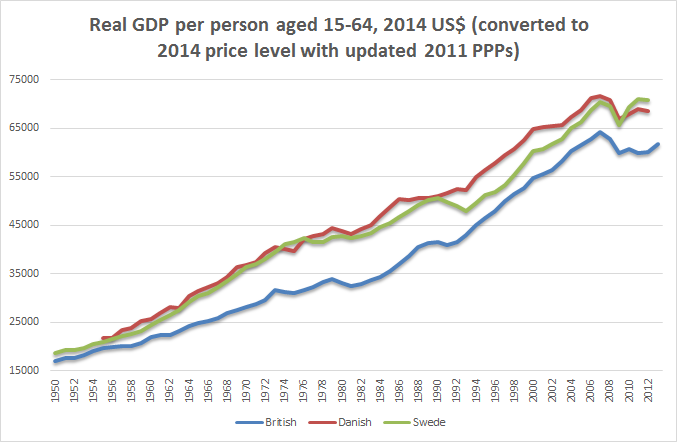
Source: Computed from OECD StatExtract and The Conference Board. 2015. The Conference Board Total Economy Database™, May 2015, http://www.conference-board.org/data/economydatabase/
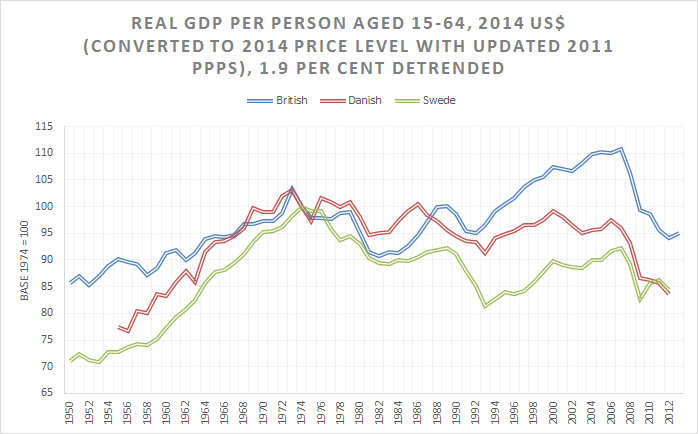
Source: Computed from OECD StatExtract and The Conference Board. 2015. The Conference Board Total Economy Database™, May 2015, http://www.conference-board.org/data/economydatabase/
The data is detrended at 1.9% per year – the trend rate of growth for the USA in the 20th century. A rising line means growth greater than 1.9% for that year, a falling line means growth of less than 1.9% for the year. A flat line is growth of 1.9% for that year.
Britain, Sweden and Denmark all grew quickly up until the 1970s in a period known as post-war catch up.In the 1970s and early 1980s, there was the British disease. The 1970s to the early 1990s was Swedosclerosis. There was a boom in the British economy subsequent to the economics of Mrs Thatcher.
Cancer survival rates in the UK
20 Sep 2015 Leave a comment
in economic history, health economics Tags: British economy, British history, cancer survival rates, life expectancies, National Health Service, The Great Escape
https://twitter.com/ONS/status/621975325405282304/photo/1
Breast cancer mortality has fallen substantially ow.ly/PJmzJ http://t.co/85eMjk6chD—
(@ONS) July 17, 2015
Colorectal cancer has increased more among males than females ow.ly/PJm19 http://t.co/lxbSYV9CmH—
(@ONS) July 17, 2015
CORRECTION: Lung cancer risen for females and fallen for males ow.ly/PJnjC http://t.co/E78ztvXzCd—
(@ONS) July 17, 2015
Sharp increase in prostate cancer since the 1990s ow.ly/PJlKO http://t.co/mR1L4ojh87—
(@ONS) July 17, 2015
Lung cancer more common among females than males ow.ly/PJlXj http://t.co/IjOfEyejMT—
(@ONS) July 17, 2015
What is Little England
18 Sep 2015 Leave a comment
in liberalism Tags: British culture, British economy, British history, British politics, growth of government, meddlesome preferences, nanny state, rational ignorance, rational rationality, size of government
Some confusion about what I mean by "liberal social democracy" and why it applies to Britain. An explanation: http://t.co/VqzAnVJyOB—
Jeremy Cliffe (@JeremyCliffe) August 17, 2015
Quick recap on why Corbyn not signing the anthem is in fact an important issue @OwenJones84 @mehdirhasan @JohnRentoul http://t.co/xQAPGAG2Of—
Paco Killr (@PacoKillr) September 17, 2015
@jeremycorbyn incomes of the poorest increased most under Blairism @UKLabour
13 Sep 2015 2 Comments
in economic history, labour economics, Marxist economics, poverty and inequality Tags: British economy, Leftover Left, Tony Blair, Trish Labor Party, welfare state
Under Tony Blair the incomes of the UK's poorest families increased by more than under any other Prime Minister. http://t.co/8Uh8GBqbRB—
Tom Forth (@thomasforth) September 12, 2015
US and UK Real Housing Price Index, 1975 – 2015
13 Sep 2015 Leave a comment
in economic history, economics of regulation, politics - USA, urban economics Tags: British economy, British politics, housing affordability, housing prices, land supply, land use planning, NIMBYs, zoning

Source: International House Price Database – Dallas Fed
Note: The house price index series is an index constructed with nominal house price data. The real house price index is an index calculated by deflating the nominal house price series with a country’s personal consumption expenditure deflator.
Trends in the British gender wage gap by age band
10 Sep 2015 Leave a comment
in discrimination, economic history, economics of education, gender, human capital, labour economics, labour supply Tags: British economy, gender wage gap
Since 1975 average UK earnings for full-time employees have more than doubled after accounting for inflation
10 Sep 2015 Leave a comment
in applied welfare economics, economic history, labour economics, labour supply, poverty and inequality Tags: British economy, The Great Enrichment

Marginal tax rates of 2-income couples with 2 children in USA, UK, Australia and New Zealand since 2000
23 Aug 2015 Leave a comment
in economic history, economics of love and marriage, labour economics, labour supply, politics - Australia, politics - New Zealand, politics - USA, public economics Tags: Australia taxation and labour supply, British economy, marriage and divorce
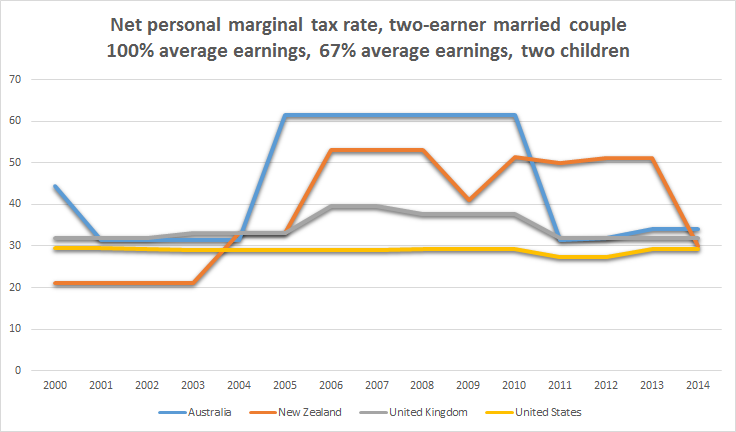
Source: OECD StatExtract.
Marginal tax rates of a nuclear family in USA, UK, Australia and New Zealand since 2000
22 Aug 2015 Leave a comment
in economic history, economics of love and marriage, labour economics, labour supply, politics - Australia, politics - New Zealand, politics - USA Tags: Australia, British economy, marriage and divorce, taxation and labour supply
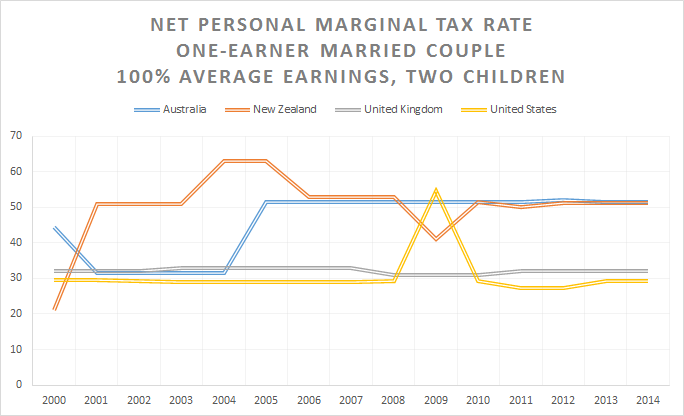
Source: OECD StatExtract.
 Utopia, you are standing in it!
Recent Comments