Half of Canada lives south of the red line, or 45.7 degrees north.
(via bit.ly/1MRF9cG) http://t.co/QTzV5cquj1—
Max Roser (@MaxCRoser) September 27, 2015
Most of Canada lives near the border
15 Oct 2015 Leave a comment
in population economics Tags: Canada, economics of borders, NAFTA
Why 41% of Americans wanted a fence on their northern border
01 Oct 2015 Leave a comment
in economics of crime, economics of media and culture, law and economics, politics - USA Tags: Canada, economics of immigration, Justin Bieber
@justinbieber #MUGSHOT http://t.co/ZuYwmdipIy—
Miami Beach Police (@MiamiBeachPD) January 23, 2014
Canadian life expectancies by age and gender since 1990
23 Aug 2015 Leave a comment
in economic history, health economics, population economics Tags: Canada, life expectancies, The Great Escape

Source: Life Expectancy by Age in selected Country from 1990 to 2013 | Health Intelligence.

Source: Life Expectancy by Age in selected Country from 1990 to 2013 | Health Intelligence.
Over-qualification rates in jobs in the USA, UK and Canada
19 Aug 2015 2 Comments
in economics of bureaucracy, economics of education, human capital, job search and matching, labour economics, labour supply, occupational choice, politics - USA, Public Choice Tags: British economy, Canada, compensating differentials, job shopping, offsetting behaviour, on-the-job training, search and matching, The fatal conceit, The pretense to knowledge
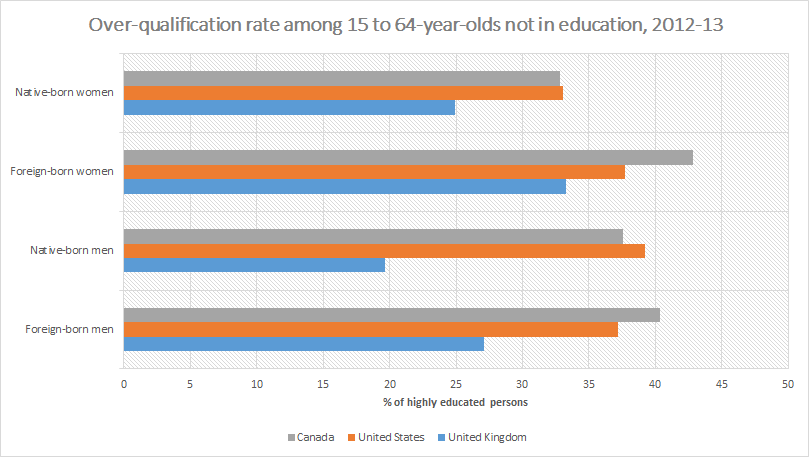
In the UK, foreign-born are much more likely to be over qualified than native born highly educated not in education with less difference between men and women. More men than women are overqualified for their jobs in the UK. Over qualification is less of a problem in the UK than in the USA and Canada.
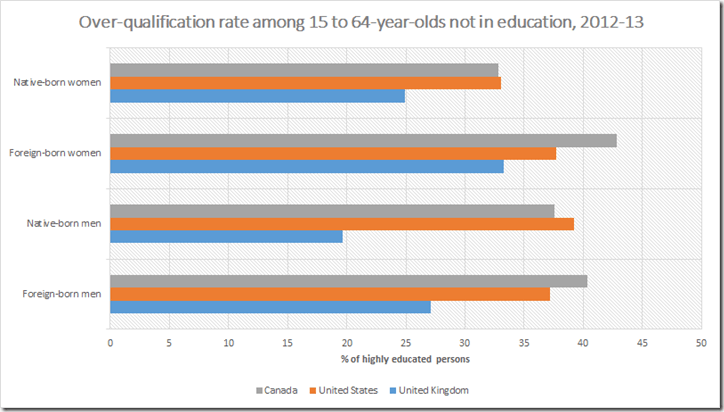
Source: OECD (2015) Indicators of Immigrant Integration 2015: Settling In.
In the USA and Canada, there are few differences between native and foreign born men in over-qualification rates. Foreign-born women tend to be more over-qualified than native born women in the USA and more so in Canada. Many more workers are overqualified for their jobs in the USA and Canada as compared to the UK.
There are large differences in the percentage of people with tertiary degrees and the education premium between these three countries that are outside the scope of this blog post. These trends may explain differences in the degree of educational mismatch.
It goes without saying that the concept of over-qualification and over-education based mismatch in the labour market is ambiguous, if not misleading and a false construct.
To begin with, under human capital theories of labour market and job matching, what appears to be over-schooling substitutes for other components of human capital, such as training, experience and innate ability. Not surprisingly, over-schooling is more prominent among younger workers because they substitute schooling for on-the-job training. A younger worker of greater ability may start in a job below his ability level because he or she expects a higher probability to be promoted because of greater natural abilities. Sicherman and Galor (1990) found that:
overeducated workers are more likely to move to a higher-level occupation than workers with the required level of schooling
Investment in education is a form of signalling. Workers invest so much education that they appear to be overqualified in the eyes of officious bureaucrats. The reason for this apparent overinvestment is signalling superior quality as a candidate. Signalling seems to be an efficient way of sorting and sifting among candidates of different ability. The fact that signalling survives in market competition suggests that alternative measure ways of measuring candidate quality that a more reliable net of costs are yet to be discovered.
A thoroughly disheartening chart if you're a graduate in the UK i100.io/mpDbJAl http://t.co/mv9izA0mbc—
i100 (@thei100) August 20, 2015
Highly educated workers, like any other worker, must search for suitable job matches. Not surprisingly, the first 5 to 10 years in the workforce are spent in half a dozen jobs as people seek out the most suitable match in terms of occupation, industry and employer. Some of these job seekers who are highly educated will take less suitable jobs while they search on-the-job for better matches. Nothing is free or instantly available in life including a good job match.
A more obvious reason for over qualification is some people like attending university and other forms of education for the sheer pleasure of it.
Anyone who encounters the words over-qualified and over-educated should immediately recall concepts such as the pretence to knowledge, the fatal conceit, and bureaucratic busybodies. As Edwin Leuven and Hessel Oosterbeek said recently:
The over-education/mismatch literature has for too long led a separate life of modern labour economics and the economics of education.
We conclude that the conceptional measurement of over-education has not been resolved, omitted variable bias and measurement error are too serious to be ignored, and that substantive economic questions have not been rigorously addressed.
The Canadians are coming! The Canadians are buying up our land! What has @NZGreens to say about that?
17 Aug 2015 Leave a comment
in economics of regulation, entrepreneurship, financial economics, politics - New Zealand Tags: Australia, Canada, China, FDI, Japan, Left-wing hypocrisy, left-wing popularism, New Zealand Greens, right-wing popularism
Canada was the largest source of foreign investment during the period, as its pension fund bought 18 properties in a portfolio from AMP and increased its stake in Kaingaroa Forest.
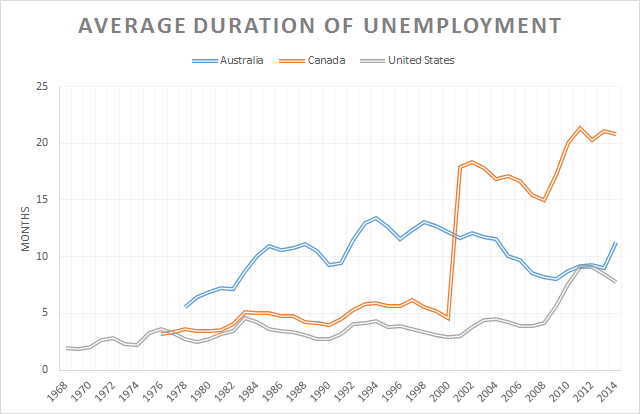
Average duration of unemployment, USA, Canada and Australia, 1968 – 2014
08 Aug 2015 Leave a comment
in business cycles, economic history, global financial crisis (GFC), great recession, job search and matching, labour economics, labour supply, macroeconomics, unemployment Tags: Australia, Canada, unemployment rates
Source: OECD StatExtract.
I have no information as to why there is a sudden surge in the Canadian unemployment duration rate in 2001.
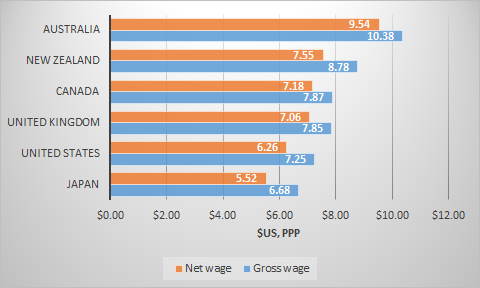
Tax rates on labour income across the OECD area
02 Aug 2015 Leave a comment
in labour economics, labour supply, politics - Australia, politics - New Zealand, politics - USA, public economics Tags: Australia, British economy, Canada, France, Germany, taxation and labour supply
How high is the US #tax burden on labor? Here's an OECD comparison tax.foundation/1KojUv9 by @samcjordan_ @kpomerleau http://t.co/fSAT8ut52z—
Tax Foundation (@taxfoundation) July 24, 2015
Equilibrium unemployment rates in Canada, USA and UK, 1962 – 2016
18 Jul 2015 Leave a comment
in business cycles, job search and matching, labour economics, labour supply, macroeconomics, unemployment Tags: British economy, Canada, equilibrium unemployment rate, natural unemployment rate
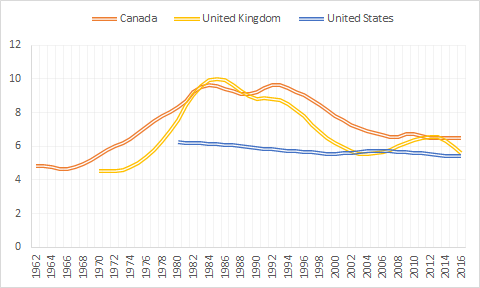
Figure 1 suggests a lot more structural change in the Canadian and British labour market in the 1970s and 1980s.
Figure 1: equilibrium unemployment rates, Canada, USA and UK, 1962 – 2016
Source: OECD Economic Outlook June 2015 via OECD StatExtract.
Nothing much at all seems to have happened to the equilibrium unemployment rate in the USA since the OECD first started calculating it. I doubt that so that will be subject of a future blog. Namely, the large changes in natural unemployment rates in the post-war period, largely to demographic changes such as the baby boom.
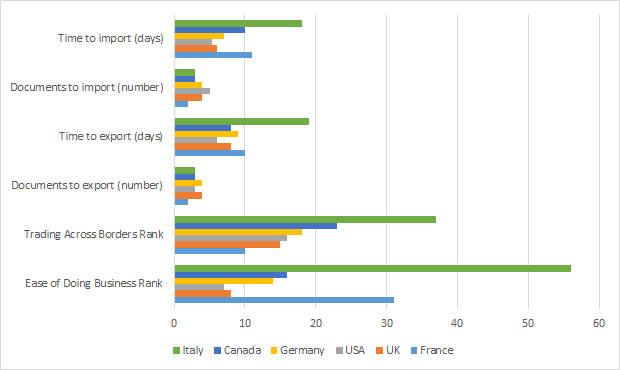
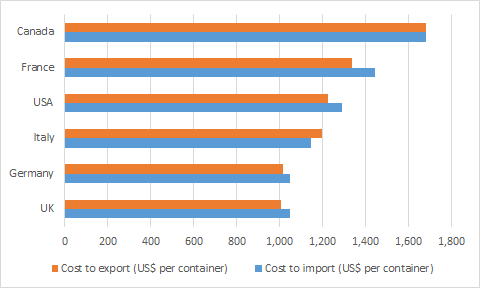
NAFTA v. the Common Market: trading across the French, German, Italian, British, Canadian and US borders – World Bank Doing Business rankings compared
17 Jul 2015 Leave a comment
in economics of regulation, industrial organisation, international economics, politics - USA Tags: border costs, British economy, Canada, Common market, Common markets, customs unions, EU, France, free trade areas, Germany, Italy, NAFTA, trade costs
Figure 1: World Bank Doing Business rankings and sub rankings for trading across the French, German, Italian, British, Canadian and US borders, 2014
Source: World Bank Doing Business database; note: cost of importing and exporting not included.
Figure 2: World Bank Doing Business rankings – cost of importing and exporting across the French, German, Italian, British, Canadian and US borders, 2014
Source: World Bank Doing Business database; note: cost of importing and exporting not included.
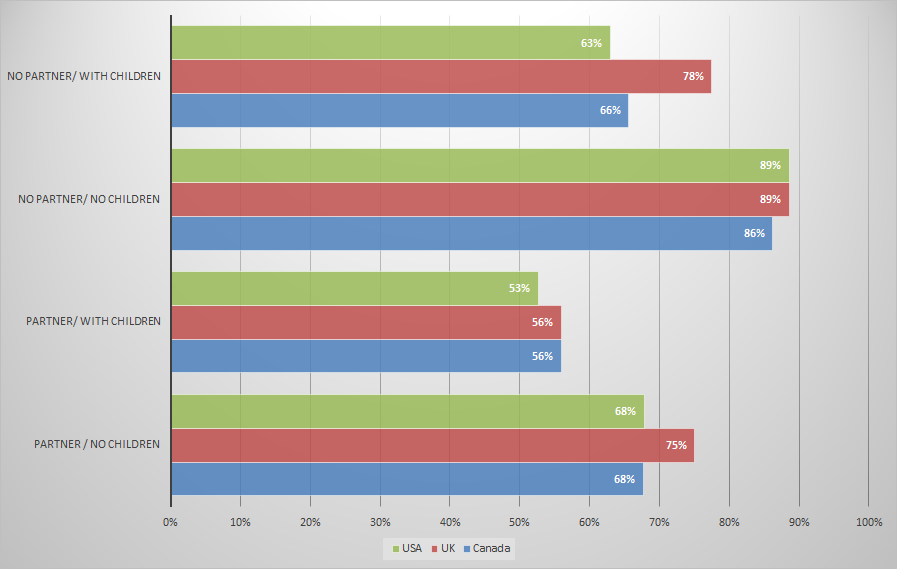
Females/male earnings ratio by partner status and motherhood – USA, UK, Canada
12 Jul 2015 Leave a comment
in discrimination, economics of love and marriage, gender, labour economics, labour supply, law and economics, occupational choice, politics - USA, poverty and inequality Tags: asymmetric marriage premium, British economy, Canada, gender wage gap, marriage and divorce, motherhood penalty
Figure 1: Female/male earnings ratio by partner status and motherhood, 2004
Source: LIS Cross-National Data Center in Luxembourg – Wave VI; individuals with positive earnings only. .
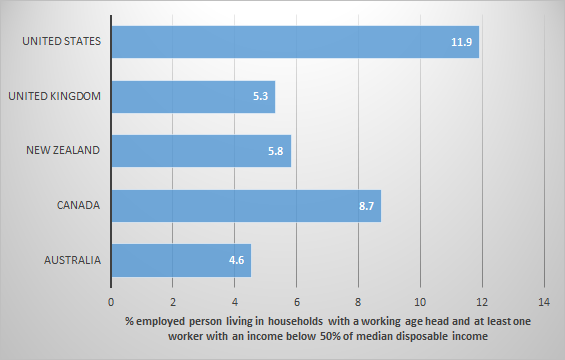
Poverty rates by age of youngest child – USA, UK, Canada and Australia
11 Jul 2015 Leave a comment
in economics of love and marriage, labour economics, labour supply, law and economics, politics - Australia, politics - USA, poverty and inequality, welfare reform Tags: Australia, British economy, Canada, child poverty, family poverty, marriage and divorce, single mothers, single parents
Figure 1: poverty rates by age of youngest child, 2004
Doing Business in the USA and Canada – World Bank rankings compared
10 Jul 2015 Leave a comment
in applied welfare economics, economics of bureaucracy, economics of regulation, law and economics, politics - USA, property rights, Public Choice Tags: Canada, doing business, rule of law, World Bank
Figure 1: Doing Business in the USA, Canada, World Bank rankings, 2014
Source: Doing Business – Measuring Business Regulations – World Bank Group.
It’s easier to do business in the USA and Canada because of the difficulties with construction permits and getting electricity and few more problems with enforcing contracts and registering property. It is easy to open a business in Canada.
War Plan Red: The 1930 US War Department plan to invade Canada
03 Jul 2015 Leave a comment
in defence economics, economic history, politics - USA, war and peace Tags: Canada
War Plan Red: The 1930 US War Department plan to invade Canada – bit.ly/1srJcxW via @ezraklein http://t.co/ai3A96nY34—
Brilliant Maps (@BrilliantMaps) December 14, 2014
Recent Comments