
Common response to new technology: "Commercial Use In Doubt"
08 May 2016 Leave a comment
in economic history, industrial organisation, survivor principle, technological progress Tags: creative destruction, economics of television, entrepreneurial alertness, pessimism bias
John Sculley on the ‘myth’ of home computer market “it doesn’t exist”
08 May 2016 Leave a comment
in economic history, entrepreneurship, industrial organisation, survivor principle Tags: creative destruction, pessimism bias
Creative destruction in top ICT company pay
05 May 2016 Leave a comment
in human capital, industrial organisation, labour economics, labour supply, occupational choice, survivor principle Tags: Apple, CEO pay, creative destruction, entrepreneurial alertness, Facebook, Google, Microsoft, superstar wages, superstars, top 1%, Twitter, Uber, Yahoo
I am surprised to see that Yahoo is in business much less competing for top talent. Microsoft is in decline too. Apple does not pay people as much as everybody else.
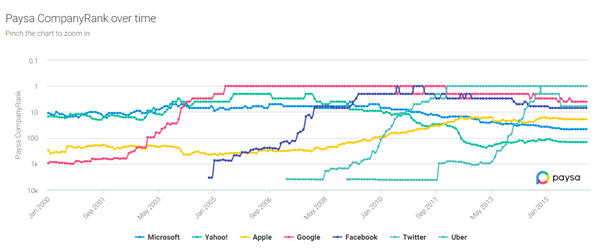
Source: Paysa Company Rank | Paysa.
Some other colours seem to duplicate so you will have to work out which is which by when they exploded in hiring top talent.

Why so little creative destruction in jet packs?
20 Apr 2016 Leave a comment
in economics, entrepreneurship Tags: creative destruction
Creative destruction in speed of first billion YouTube views
17 Apr 2016 Leave a comment
in economics of media and culture Tags: creative destruction, social media, YouTube

Picking winners and @stevenljoyce’s repayable grants to 11 more tech start-ups @JordNZ
13 Apr 2016 Leave a comment
in applied price theory, entrepreneurship, industrial organisation, politics - New Zealand, Public Choice, rentseeking, survivor principle Tags: corporate welfare, creative destruction, entrepreneurial alertness, Hollywood economics, industry policy, picking losers, picking winners
 Minister for Science and Innovation Steven Joyce picked a few more winners today. Eleven more start-up technology companies are to be funded $450,000 each in repayable loans to commercialise their technology. The loans are from Callaghan Innovation’s incubator network.
To cut a long diatribe short, I find these sums of money rather piddling. I have encountered this corporate welfare program before at a presentation.
My reaction then as is now: by handing out such small grants, some will succeed, some will fail. Importantly, there will never be one big disaster to bring the whole show down. There is political safety in diversification.

This is not the case with, for example, film subsidies. If Sir Peter Jackson and others finally produce a box office bomb, it will be all too glaring that the taxpayers backed a Hollywood loser with hundreds of millions of dollars. $500 million in subsidies in the case of Avatar.

By peppering small sums of money across the economy, there is no similar risk from this repayable grant scheme for the commercialisation of products.

Creative destruction of camera sales is not yet complete
13 Apr 2016 Leave a comment
in economic history, economics of media and culture, financial economics, industrial organisation, survivor principle Tags: camera phones, cameras, cell phones, creative destruction, mobile phones

Source: A Few Thoughts About the Camera Market via Paul Kirby

 Utopia, you are standing in it!
Recent Comments