Trends in DNA Sequencing Costs

via DNA Sequencing Costs.

Many more birds to be incinerated as solar energy becomes cost competitive; climate alarmists face mass layoffs

Netzparität

Unsubsidized rooftop solar electricity costs anywhere between $0.13 and $0.23/kWh today, well below retail price of electricity in many markets globally.

The economics of solar have improved significantly due to the reduction in solar panel costs, financing costs and balance of system costs. We expect solar system costs to decrease 5-15% annually over the next 3+ years which could result in grid parity within ~50% of the target markets.

If global electricity prices were to increase at 3% per year and cost reduction occurred at 5-15% CAGR, solar would achieve grid parity in an additional ~30% of target markets globally. We believe the cumulative incremental total available market for solar is currently around ~140GW/year and could potentially increase to ~260GW/year over the next 5 years as solar achieves grid parity in more markets globally and electric capacity needs increase…

solar system costs have declined at ~15% CAGR over the past 8 years and we expect 40% cost reduction over the next 4-5 years as a solar module costs continue to decline, panel efficiencies gradually improve, balance of system costs decline due to scale and competition, global financing costs decline due to development of new business models and customer acquisition costs decline as a result of increasing customer awareness and more seamless technology adoption enabled by storage solutions…

oil represents only about 5% of global electricity production and in some of the important solar markets such as US, China, oil based electricity generation is less than 5% of the total. Moreover, the cost of oil based electricity generation even at $50 oil prices is the 7-9c/kWh range and as shown in the note, the marginal cost is higher than solar in many regions worldwide. Bottom line is that oil prices do not have a material impact on solar demand.

About the only losers from this creative destruction in energy production, aside from the tens of thousands of public officials, academics and NGO employees who jobs and research grants depend up climate alarmism, are the birds that happen to fly past these solar power stations and are incinerated.

via Deutsche Bank’s 2015 solar outlook: accelerating investment and cost competitiveness – Deutsche Bank Responsibility and Deutsche Bank report: Solar grid parity in a low oil price era – Deutsche Bank Responsibility.

Is poverty in America not having a cell phone, or not having a smart phone?

Current cell owner demographicsSmartphone owner demographics

via Mobile Technology Fact Sheet | Pew Research Center’s Internet & American Life Project.

Chiselling on the Closer Economic Relations agreement between New Zealand and Australia

Back in the day, New Zealand television programming was sold cheaply into the Australian market. Many cultural and other products are exported into foreign markets and sold for whatever they can get above the price of shipping or digital transmission. What else explains all that rubbish on cable TV?

Under the Closer Economic Relations agreement that creates a single market between Australia and New Zealand, New Zealand made television programming content must be treated the same way as Australian content so it was included in their 50% local content rules for commercial television back from whenever I remember this story from. There was a Federal Court of Australia case that ruled that New Zealand television programming was Australian content programming for the purposes of the relevant media regulations because of Closer Economic Relations.

From the late 1990s, with revival of the New Zealand film and television industry, New Zealand content was starting to flood the Australian market, especially in the off-season in the summer when stations were looking for cheap content to fill a low ratings period.

Naturally, this Kiwi invasion did not please the rent seeking Australian television programme production industry and many a mendicant actor, writer and producer

Where there is a will, where there is a way: minimum quality standards are introduced into the Australian content rules defined by price – a price that happen to be above what the television stations used to pay for New Zealand made programming.

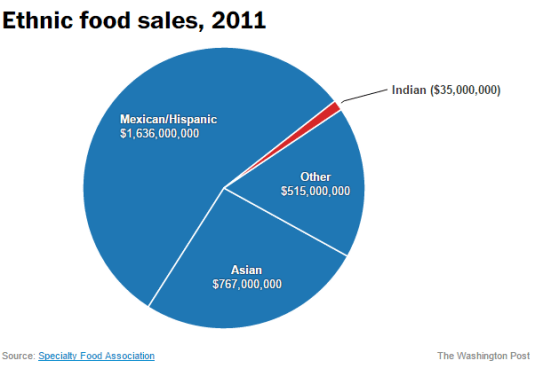
Why delicious Indian food is surprisingly unpopular in the U.S.

No need to rage against the gaucheness of Americans who, in fact, have embraced many foods:

The cuisine is among the most labor intensive in the world. And yet Americans are unwilling to pay beyond a certain, and decidedly low, price point.

Via Why delicious Indian food is surprisingly unpopular in the U.S. – The Washington Post.

Creative destruction and what remains of the legacy mass media

HT: zerohedge.com

Bryan Caplan on the economics of Star Trek replicators (that is, artificial intelligence)

replicator

Bryan Caplan wrote a blog a few years ago, explaining the labour economics of artificial intelligence, using an exam question he poses to his graduate students:

Suppose artificial intelligence researchers produce and patent a perfect substitute for human labour at zero MC.

Use general equilibrium theory to predict the overall economic effects on human welfare before AND after the Artificial Intelligence software patent expires.

He then gave the answer about a week later:

While the patent lasts, the patent-holder will produce a monopoly quantity of AIs. As a result, the effective labour supply increases, and wages for human beings fall – but not to 0 because the patent-holder keeps P>MC.

The overall effect on human welfare, however, is still positive! Since the AIs produce more stuff, and only humans get to consume, GDP per human goes up. How is this possible if wages fall?

Simple: Earnings for NON-labour assets (land, capital, patents, etc.) must go up. Humans who only own labour are worse off, but anyone who owns a home, stocks, etc. experiences offsetting gains.

When the patent expires, this effect becomes even more extreme. With 0 fixed costs, wages fall to MC=0, but total output – and GDP per human – skyrockets.

Human owners of land, capital, and other non-labour assets capture 100% of all output. Humans who only have labour to sell, however, will starve without charity or tax-funded redistribution.

His logic is quite good. Caplan drew attention in the responses to his blog of Capt J Parker and Alex Godofsky in the comments section of his blog.

James T. Kirk clear

My comments at the time were as follows:

  • An artificially intelligent  robot that was a perfect substitute for human labour sounds like the replicators on star trek?
  • Who operates the machines? who tells them what to do? what not to do?
  • After the patent expired, would anyone care if the poor stole/copied the AI machines and made them for for themselves. who cares if a free good is stolen?
  • Is it a crime to steal a replicator on star trek?

Digital ad revenue by company

HT: Time Inc. Has a Big Problem—So Does Digital Journalism – The Atlantic.

This is what is killing the legacy media

HT: Time Inc. Has a Big Problem—So Does Digital Journalism – The Atlantic.

Creative destruction in the smartphone market

Image

Zero hours contracts prevalence, the class struggle and the gales of creative destruction

number of zero hours contracts in UK

Source: Use of zero hours contracts rises to record levels | City A.M.

The number of workers on zero hours contracts has certainly exploded in the UK, going from about 100,000 to 700,000 in about five years. The UK data also suggests that most of these contracts will be in the accommodation and food services sector.

workers on zero hour contracts in UK by sector

Source: Use of zero hours contracts rises to record levels | City A.M.

Zero hours contracts is creative destruction at work in the labour market, sweeping away obsolete working time arrangements, mostly in the retail services sector.

Innovation is the market introduction of a technical or organisational novelty, not just its invention.  - Joseph Schumpeter

Zero hours contracts is creative destruction at work in the labour market, sweeping away obsolete working arrangements mostly in the retail services sector.

New Zealand data is hard to come by on zero hours contracts. Data on working hours arrangements is in the Survey of Working Life which is conducted every couple of years. This survey doesn’t give any data directly on the prevalence of zero hours contracts, but it does tell you how many people are temporary employees and among these, who is a casual and seasonal employee and whether they have regular hours.

image

Source: Survey of Working Life  December  Quarter 2012, Statistics New Zealand.

The first thing can be said about the prevalence of zero hours contracts in New Zealand is two years ago the number of workers both male and female who were casual, fixed term and temp agency workers was relatively small. Less than one in 20 male workers was a casual worker; 3% of male workers was on a fixed term or temp agency worker. For women, 6% were casual workers and 4.9% were either fixed term or temp agency workers.

image

Source: Survey of Working Life  December  Quarter 2012, Statistics New Zealand.

Temporary employment is most common In the agriculture, forestry and fishery sectors, which is no surprise because of the prevalence seasonal workers in that sector.The retail trade accommodation and food sectors is not the next cab off the rank for temporary employment. Temporary employment is rather common in the education and professional science sectors.

image

Source: Survey of Working Life  December  Quarter 2012, Statistics New Zealand.

In the retail trade commendation and food services worker, 90% of all employees are still permanent. There are about 32,000 workers in the retail trade, accommodation and food services sectors.

image

Source: Survey of Working Life  December  Quarter 2012, Statistics New Zealand.

Among all casual employees across all sectors, 50% work standard hours and about 10% have no usual working time. That is, out of the 92,000 casual employees in New Zealand, about 9000 of them have no usual working times, which is the equivalent of a zero hours contract. No data was published by Statistics New Zealand on fixed term and temp  agency workers because the sample sizes were too small so the data was suppressed confidentiality reasons.

image

Source: Survey of Working Life  December  Quarter 2012, Statistics New Zealand.

For casual, fixed term and temp agency employees, it is commonplace for them to change their hours from week to week to suit the needs of their employees. The equivalent of zero hours contracts Is commonplace among employees who do not have permanent employment status. It goes with the territory. Those who want fixed hours seek permanent employment.

For zero hours employment to become common, this form of contract in over working time arrangements will have to be come more common among permanent employees. If that is so, such a trend will make the notion of a permanent employee somewhat vague considering these employees, although permanent, are not guaranteed regular hours.

image

Source: Survey of Working Life  December  Quarter 2012, Statistics New Zealand.

They are a happy lot are temporary employees. Pretty much enjoy their jobs as much as permanent employees do when it comes to their job and, by implication, that perennial left-wing bugbear, the inherent inequality of bargaining power between  the bosses and the workers and the violence inherent in the capitalist system. All is not well for the class war.

image

Source: Survey of Working Life  December  Quarter 2012, Statistics New Zealand.

What is worse for the future of the class struggle is that these temporary employees are rather happy lot when it comes to work life balance. Just as happy as permanent employees. Indeed, temporary or permanent employment status has no effect on job satisfaction and work life balance.

image

Source: Survey of Working Life  December  Quarter 2012, Statistics New Zealand.

Rise up ye workers, rise up for you have nothing to lose but your zero hours contracts may have to be put on hold as the next battle cry of the class war in New Zealand. Indeed, a lot of consciousness-raising will be in store for our friends on the Left because the working class seem a rather happy lot in their jobs, slightly less grumpy than the middle class, and almost as happy as the ruling class.

capitalism rocks

Kicking in the rotted door of capitalism to bring on the permanent revolution has never been easy. Zero hours contracts just does not seem to be the new straw that will break the capitalists’ back any time soon. Workers seem to be rather happy with them or their equivalent that has been around for a long time in the labour market.

Critics overplay their hand if they suggest that somehow workers a very much disadvantaged and employers are holding all the cards. Job turnover and recruitment problems are a serious cost to a business. Workers will not sign contracts, such as zero hours contracts or casual work contracts if they are not to their advantage.

The meaning of capitalism

Image

13 terrible predictions about new technologies

13. Terrible technological predictions


HT: fromquarkstoquasars.com

NYT in 1985 on why laptops doomed to be a niche market

Image

The first “ultra portable” computer, 1975

https://twitter.com/oldpicsarchive/status/565976158026874880

Image

Previous Older Entries Next Newer Entries

Fardels Bear

A History of the Alt-Right

Vincent Geloso

Econ Prof at George Mason University, Economic Historian, Québécois

Bassett, Brash & Hide

Celebrating humanity's flourishing through the spread of capitalism and the rule of law

Truth on the Market

Scholarly commentary on law, economics, and more

The Undercover Historian

Beatrice Cherrier's blog

Matua Kahurangi

Celebrating humanity's flourishing through the spread of capitalism and the rule of law

Temple of Sociology

Celebrating humanity's flourishing through the spread of capitalism and the rule of law

Velvet Glove, Iron Fist

Celebrating humanity's flourishing through the spread of capitalism and the rule of law

Why Evolution Is True

Why Evolution is True is a blog written by Jerry Coyne, centered on evolution and biology but also dealing with diverse topics like politics, culture, and cats.

Down to Earth Kiwi

Celebrating humanity's flourishing through the spread of capitalism and the rule of law

NoTricksZone

Celebrating humanity's flourishing through the spread of capitalism and the rule of law

Homepaddock

A rural perspective with a blue tint by Ele Ludemann

Kiwiblog

DPF's Kiwiblog - Fomenting Happy Mischief since 2003

The Dangerous Economist

Celebrating humanity's flourishing through the spread of capitalism and the rule of law

Watts Up With That?

The world's most viewed site on global warming and climate change

The Logical Place

Tim Harding's writings on rationality, informal logic and skepticism

Doc's Books

A window into Doc Freiberger's library

The Risk-Monger

Let's examine hard decisions!

Uneasy Money

Commentary on monetary policy in the spirit of R. G. Hawtrey

Barrie Saunders

Thoughts on public policy and the media

Liberty Scott

Celebrating humanity's flourishing through the spread of capitalism and the rule of law

Point of Order

Politics and the economy

James Bowden's Blog

A blog (primarily) on Canadian and Commonwealth political history and institutions

Science Matters

Reading between the lines, and underneath the hype.

Peter Winsley

Economics, and such stuff as dreams are made on

A Venerable Puzzle

"The British constitution has always been puzzling, and always will be." --Queen Elizabeth II

The Antiplanner

Celebrating humanity's flourishing through the spread of capitalism and the rule of law

Bet On It

Celebrating humanity's flourishing through the spread of capitalism and the rule of law

History of Sorts

WORLD WAR II, MUSIC, HISTORY, HOLOCAUST

Roger Pielke Jr.

Undisciplined scholar, recovering academic

Offsetting Behaviour

Celebrating humanity's flourishing through the spread of capitalism and the rule of law

JONATHAN TURLEY

Res ipsa loquitur - The thing itself speaks

Conversable Economist

In Hume’s spirit, I will attempt to serve as an ambassador from my world of economics, and help in “finding topics of conversation fit for the entertainment of rational creatures.”

The Victorian Commons

Researching the House of Commons, 1832-1868

The History of Parliament

Articles and research from the History of Parliament Trust

Books & Boots

Reflections on books and art

Legal History Miscellany

Posts on the History of Law, Crime, and Justice

Sex, Drugs and Economics

Celebrating humanity's flourishing through the spread of capitalism and the rule of law

European Royal History

Exploring the Monarchs of Europe

Tallbloke's Talkshop

Cutting edge science you can dice with

Marginal REVOLUTION

Small Steps Toward A Much Better World

NOT A LOT OF PEOPLE KNOW THAT

“We do not believe any group of men adequate enough or wise enough to operate without scrutiny or without criticism. We know that the only way to avoid error is to detect it, that the only way to detect it is to be free to inquire. We know that in secrecy error undetected will flourish and subvert”. - J Robert Oppenheimer.

STOP THESE THINGS

The truth about the great wind power fraud - we're not here to debate the wind industry, we're here to destroy it.

Lindsay Mitchell

Celebrating humanity's flourishing through the spread of capitalism and the rule of law

Alt-M

Celebrating humanity's flourishing through the spread of capitalism and the rule of law

croaking cassandra

Economics, public policy, monetary policy, financial regulation, with a New Zealand perspective