Nice WSJ graph of the remarkable decline in crime in NYC since 2002. on.wsj.com/19XvVY5 http://t.co/iLDNufelVB—
Miles Kimball (@mileskimball) December 31, 2013
Crime in the Big Apple
14 Aug 2015 Leave a comment
in economic history, economics of crime, law and economics, politics - USA Tags: crime and punishment, criminal deterrence, law and order, New York City
@radleybalko @thecounted 156 killed by police 1 July-11 August. How did they die?
13 Aug 2015 2 Comments
in economics of crime, law and economics, politics - USA Tags: common law, crime and punishment, criminal deterrence, law enforcement, police

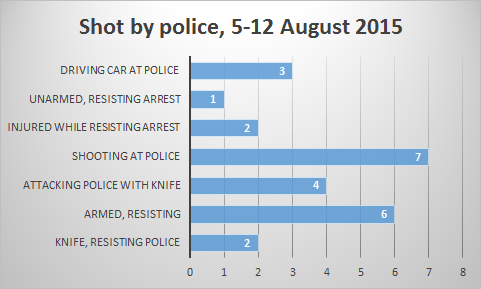
@radleybalko @thecounted 25 killed by police 5-12 August. How did they die? @PoliticalLine
12 Aug 2015 Leave a comment
in economics of crime, law and economics, politics - USA Tags: common law, crime and punishment, criminal deterrence, law enforcement, police
Crimes by age and offence category
27 Jul 2015 Leave a comment
in economics of crime, human capital, labour economics, labour supply, law and economics, occupational choice, politics - USA Tags: crime and punishment, criminal deterrence
Entrepreneurial alertness in filming police brutality
25 Jul 2015 1 Comment
in economics of crime, entrepreneurship, law and economics, managerial economics, market efficiency, organisational economics, personnel economics Tags: crime and punishment, criminal deterrence, entrepreneurial alertness, law enforcement, police, police brutality
Cumulative probability of a parent in prison by the age of 14
24 Jul 2015 Leave a comment
in economics of crime, law and economics, politics - USA Tags: crime and punishment, criminal deterrence, incarceration rates, single parents
What are some economic & social costs of crime & incarceration in the U.S? See 10 facts: bit.ly/1xvWAo2 http://t.co/6YNKYi6f43—
The Hamilton Project (@hamiltonproj) April 13, 2015
America’s Peculiar Bail System
20 Jul 2015 Leave a comment
in economics of crime, law and economics Tags: bail, crime and punishment, criminal deterrence
America's Peculiar Bail System: priceonomics.com/americas-pecul… http://t.co/QxN4do58Uy—
Priceonomics (@priceonomics) May 26, 2015
Personal cameras as evidence that criminal deterrence works and works well
16 Jul 2015 1 Comment
in economics of crime, law and economics, managerial economics, organisational economics, personnel economics, politics - New Zealand, politics - USA Tags: body cameras, crime and punishment, criminal deterrence, police, prisons
Hutt City Council parking wardens are the latest in a long line of frontline staff to wear lapel cameras to deter assaults and verbal abuse. These lapel cameras are another illustration about how criminals and miscreants respond to incentives and are deterred by a greater prospect of being caught, convicted and punished. In the case of lapel cameras, there is a greater prospect of been identified and recorded for later proceedings.

The introduction of personal cameras in New Zealand prisons in high risk areas lead to a large reduction in the number of incidents of violence and abuse towards prison staff. Chief custodial officer Neil Beales said:
The use of on body cameras has led to a 15 to 20 per cent reduction in disruptive incidents (which can range from very minor to more serious) in units where cameras were used, compared with units where they were not used.
Even hardened prison inmates respond to incentives and a greater prospect of being caught and punished.

The introduction of personal cameras is not a priority for the New Zealand police. Mention was made of a six year long budget freeze as one of the reasons.
The first randomized controlled trial of police body cameras in the USA showed that cameras sharply reduce the use of force by police and the number of citizen complaints.

In Seattle, where a dozen officers started wearing body cameras in a pilot program in December, the police department has set up its own YouTube channel, broadcasting a stream of blurred images to protect privacy.
The conservative case against capital punishment – George Will
15 Jun 2015 Leave a comment
in economics of bureaucracy, economics of crime, law and economics, politics - USA, Public Choice Tags: capital punishment, crime and punishment, criminal deterrence, The fatal conceit, The pretence to knowledge, unintended consequences
Prison incarceration rates by race and education
12 Jun 2015 1 Comment
in discrimination, economics of crime, economics of education, human capital, labour economics, labour supply, law and economics, occupational choice, politics - USA Tags: compensating differentials, crime and punishment, criminal deterrence, law and order, racial discrimination, racism
Male African American high school dropouts facing a nearly 70% cumulative risk of imprisonment by their early 30s. However, the increase in incarceration rates among high school graduates appeared to be much the same for both blacks and whites.
This hints that racism is not as good explanatory of high rates of African-American male incarceration. Police do not know whether the people they arrest have high school diplomas or not but most of the people they arrest are high school dropouts. This suggests that the opportunity cost and rewards of crime over lawful occupational pursuits is a driver of the supply of crime.
There was only 1 crime for which sentences went up a lot in the USA
12 Jun 2015 Leave a comment
in economics of crime, law and economics, politics - USA Tags: crime and punishment, criminal deterrence
Striking that there was only 1 crime for which sentences went up a lot: Murder. A bad thing? vox.com/2015/5/7/85653… http://t.co/yTOXPJFT3O—
Kay Hymowitz (@KayHymowitz) May 07, 2015
1/3rd of mass shootings ended when members of the public subdued or shot the perpetrator
28 May 2015 Leave a comment
in economic history, economics of regulation Tags: crime and punishment, criminal deterrence, gun control


Recent Comments