
Friends Don’t Let Friends Become Chinese Billionaires
12 Aug 2019 Leave a comment
in development economics, economics of crime, growth miracles, health economics, labour economics, law and economics, occupational choice Tags: China, crony capitalism
The Economist Crony Capitalism Index
08 Jul 2016 Leave a comment
in applied price theory, applied welfare economics, comparative institutional analysis, constitutional political economy, development economics, economics of bureaucracy, entrepreneurship, financial economics, growth disasters, growth miracles, industrial organisation, politics - USA, Public Choice, rentseeking, survivor principle Tags: crony capitalism, superstar wages, superstars, top 1%

…
#FeeltheBern? There’s a Cure.
09 Jun 2016 Leave a comment
in applied price theory, applied welfare economics, comparative institutional analysis, economic history, economics of education, economics of regulation, health economics, income redistribution, industrial organisation, international economics, politics - USA, Public Choice, public economics, rentseeking Tags: 2016 presidential election, antimarket bias, crony capitalism, living wage, pessimism bias, top 1%
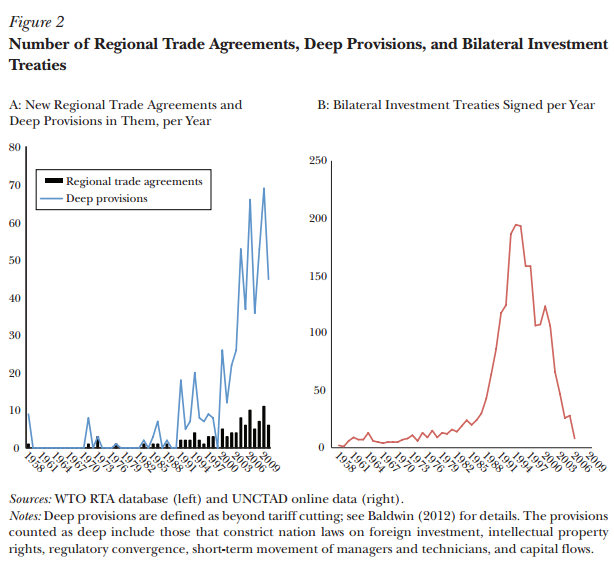
The explosion of lead in the saddlebags of trade agreements @KennedyGraham @DavidShearerMP #TPPANoWay
16 Mar 2016 Leave a comment
in economics of bureaucracy, international economic law, international economics, law and economics, politics - New Zealand, property rights, Public Choice, rentseeking Tags: crony capitalism, customs unions, free trade agreements, international investment law, investor state dispute settlement, preferential trading agreements
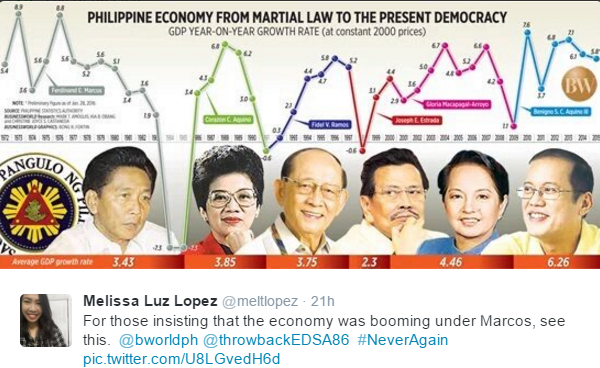
Donald Trump explained
27 Jun 2015 Leave a comment
in international economic law, international economics, politics - USA, Public Choice, rentseeking Tags: 2016 presidential election, antiforeign bias, antimarket bias, crony capitalism, Donald Trump, expressive voting, left-wing populists, populists, right-wing populists

How to build a business?
09 May 2015 Leave a comment
in applied price theory, applied welfare economics, economic history, entrepreneurship, Public Choice, rentseeking Tags: corporate capitalism, crony capitalism, entrepreneurial alertness, rent seeking

Crony capitalism flashback – who voted against the TARP in 2008?
20 Jun 2014 Leave a comment
in financial economics, global financial crisis (GFC), great recession, macroeconomics, rentseeking Tags: crony capitalism, TARP
The US House of Representatives initially voted down the TARP in a grand coalition of right-wing republicans and left-wing democrats, voting 205–228. The right-wing republicans opposed the bailout because capitalism is a profit AND loss system. Democrats voted 140–95 in favour of the Bill while Republicans voted 133–65 against it.
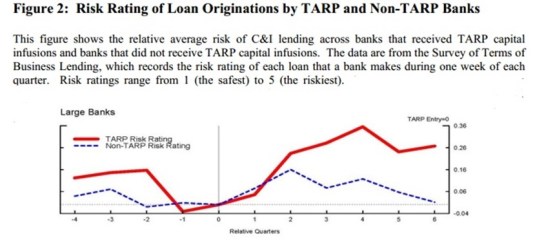
The chart above shows that the degree of risk in commercial loans made by TARP recipients appears to have increased. This is no surprise. In the 1960s, Sam Peltzman published a paper in in the 1960s showing that when deposit insurance was introduced in the USA in the 1930s, the banks halve their capital ratios. They did not need to have as much capital as before to back their lending. The chart below shows that the TARP really didn’t do much for economic policy uncertainty.

In an open letter sent to Congress, over 100 university economists described three fatal pitfalls in the TARP:
1) Its fairness. The plan is a subsidy to investors at taxpayers’ expense. Investors who took risks to earn profits must also bear the losses. The government can ensure a well-functioning financial industry without bailing out particular investors and institutions whose choices proved unwise.
2) Its ambiguity. Neither the mission of the new agency nor its oversight is clear. If taxpayers are to buy illiquid and opaque assets from troubled sellers, the terms, timing and methods of such purchases must be crystal clear ahead of time and carefully monitored afterwards.
3) Its long-term effects. If the plan is enacted, its effects will be with us for a generation. For all their recent troubles, America’s dynamic and innovative private capital markets have brought the nation unparalleled prosperity. Fundamentally weakening those markets in order to calm short-run disruptions is will short-sighted.
A recent IMF study of 42 systemic banking crises showed that in 32 cases, there was government financial intervention.
Of these 32 cases where the government recapitalised the banking system, only seven included a programme of purchase of bad assets/loans (like the one proposed by the US Treasury). These countries were Mexico, Japan, Bolivia, Czech Republic, Jamaica, Malaysia, and Paraguay.
The Government purchase of bad assets was the exception rather than the rule in banking crises and rightly so. The TARP mostly benefited bank shareholders. A case of privatising the gains and socialising the losses from banking was passed on the votes of Congressional Democrats.
Gary Becker on crony capitalism in Latin America
13 May 2014 Leave a comment
in development economics, Gary Becker, politics, Public Choice Tags: crony capitalism, Latin America
One legitimate reason for the opposition to capitalism in Latin America is that it frequently has been "crony capitalism" as opposed to the competitive capitalism that produces desirable social outcomes.
Crony capitalism is a system where companies with close connections to the government gain economic power not by competing better, but by using the government to get favoured and protected positions.
These favours include monopolies over telecommunications, exclusive licenses to import different goods, and other sizeable economic advantages. Some cronyism is found in all countries, but Mexico and other Latin countries have often taken the influence of political connections to extremes.
…The excesses of cronyism have provided ammunition to parties of the left that are openly hostile to capitalism and neo-liberal policies. Yet when these parties come to power they usually do not reduce the importance of political influence but shift power to groups that support them.
…Leftist ideologies take advantage of the discontent this causes among intellectuals and the poor, and promise a redistribution of assets and better education opportunities for the poor.
Promises of redistribution have figured prominently in the speeches of Chavez, Lula, Morales, Peronists in Argentina, and Andres Manuel Lopez Obrador, former mayor of Mexico City and a leading candidate to be Mexico’s next president.
When it is discovered that left wing governments usually do not end up helping the poor very much, they tend to be voted out of office.
… The overall trend during the past several decades in practically all countries of this region has been toward more open economies with greater competition within industries, with much more reliance on private enterprise, and with a reduced role for government mandates, government-run enterprises, and cronyism.
Since these policies have provided greater benefits to all classes than the socialist policies of a Fidel Castro or a Hugo Chavez, the vast majority of people that live under such leaders will be, or in Cuba have been, disappointed by the unfulfilled promises. They are likely to come back to parties that support more market policies as long as free elections are preserved.
Gary Becker 2006

 Utopia, you are standing in it!

Recent Comments