The US-Mexican Border
22 Dec 2015 Leave a comment
in development economics, politics - USA Tags: economics of borders, Mexico
The most confusing international borders
09 Nov 2015 Leave a comment
in international economic law, International law Tags: economics of borders, maps
Most of Canada lives near the border
15 Oct 2015 Leave a comment
in population economics Tags: Canada, economics of borders, NAFTA
Half of Canada lives south of the red line, or 45.7 degrees north.
(via bit.ly/1MRF9cG) http://t.co/QTzV5cquj1—
Max Roser (@MaxCRoser) September 27, 2015
The territorial evolution of #Germany from 1867
21 Sep 2015 Leave a comment
in economic history, war and peace Tags: economics of borders, Germany, World War I, World War II
An opportunity lost – to expel #WesternAustralia from the rest of Australia and seal the border
11 Sep 2015 Leave a comment
in comparative institutional analysis, constitutional political economy, economic history, politics - USA, Public Choice, rentseeking Tags: Australia, economics of borders, economics of succession, Scotland, self-determination, succession movements, Western Australia
Western Australian secessionists, in common with Scottish nationalists, really do like to dictate the terms of their succession which always includes an open border and a generous financial settlement regarding division of federal government debts.
How arrogant. Why should parting be sweet? If you do not want us, why should we want you. If you want to find your own destiny, you can find it good and hard.

Hog heaven! More on exclaves, enclaves and unclaimed territories
19 Aug 2015 Leave a comment
in International law Tags: economics of borders, maps
The Most Complex International Borders in the World
18 Aug 2015 Leave a comment
in International law Tags: economics of borders, maps
Canada & The United States: Bizarre Borders
16 Aug 2015 Leave a comment
in International law, law and economics Tags: borders, economics of borders, maps
% of unemployment lasting longer than 12 months in Scandinavia since 1976
16 Aug 2015 Leave a comment
in applied welfare economics, business cycles, constitutional political economy, economic history, job search and matching, labour economics, labour supply, macroeconomics, Public Choice, unemployment Tags: borders, deployment subsidies, economics of borders, equilibrium unemployment rate, Finland, labour market programs, long-term unemployment, maps, natural unemployment rate, Norway, Scandinavia, search and matching, Sweden, unemployment durations
As I recall, most unemployed have been unemployed longer than 12 months in Sweden have to go on a labour market program. When they returned to unemployment after the program, the clock starts again. They are deemed to be freshly unemployed rather than adding to the previous spell with an interlude on a make work program. This makes Swedish long-term unemployment data rather unintelligible.
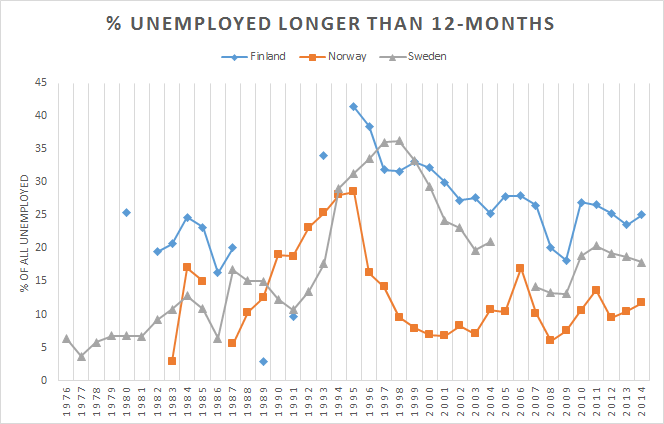
Source: OECD StatExtract.
Finland was recovering from its worst depression since the 1930s and the early 1990s when its data on long-term unemployment started to be continuous. This makes Finnish unemployment data rather difficult to interpret. Norway’s data for the long-term unemployed goes up and down a bit too much to be trustworthy without a background policy narrative.
I’m in hog heaven! Found a blog devoted to anomalies on maps!!
02 Aug 2015 Leave a comment
in economic history, economics of bureaucracy, Public Choice Tags: Bangladesh, economics of borders, enclaves, exclaves, geography, India, maps


via Say goodbye to the weirdest border dispute in the world – The Washington Post.


via An Apology of Enclaves – The New York Times.
The great new blog is http://bigthink.com/articles?blog=strange-maps
 Utopia, you are standing in it!
Recent Comments