Do British general election results have a big impact on the stockmarket? Yes, sometimes econ.st/1PUBhEh http://t.co/Ye7ede34HA—
The Economist (@ECONdailycharts) May 19, 2015
The share market speaks on recent British elections
12 Jul 2015 Leave a comment
in financial economics Tags: British politics, efficient markets hypothesis, event studies
Entrepreneurial alertness in index-linked passive investing front-running
11 Jul 2015 Leave a comment
in entrepreneurship, financial economics Tags: active investing, arbitrage, efficient markets hypothesis, entrepreneurial alertness, passive investing, Speculation
There's an easy way to game the stock market, and it's getting easier by the day bloom.bg/1NNmHPs http://t.co/GFtBhKH2fo—
Bloomberg Business (@business) July 08, 2015
The traders are simply buying stocks before they’re added to the indexes that, by definition, index funds must track.
As the popularity of index investing soars to new heights, the emergence of index front-running is raising fundamental questions about so-called passive investment strategies, as well as how indexes are compiled and the role the funds themselves play in elevating costs.
By one estimate, it gouges owners of funds tracking the Standard & Poor’s 500 Index to the tune of $4.3 billion a year, a sum that can double or even triple the cost of such investments…
Take American Airlines Group Inc., which joined the S&P 500 after markets closed on March 20. Because the addition of the carrier was announced four days earlier, nimble traders had plenty of time to get in front of the less fleet-footed. American jumped 11 percent over the span.
The cost was ultimately borne by index funds, which sparked an $8 billion buying frenzy in the two minutes right before the close — an amount equal to more than two weeks of the stock’s typical volume…
Paul Samuelson on the acceptance of the efficient markets hypothesis by Wall Street
04 Jul 2015 Leave a comment

Should the New Zealand superannuation fund try to beat the market?
09 Jun 2015 Leave a comment
in entrepreneurship, financial economics, politics - New Zealand Tags: active investing, ageing society, demographic crisis, efficient markets hypothesis, entrepreneurial alertness, New Zealand superannuation fund, old age pensions, passive investing, retirement savings
Most mutual funds still can't beat their benchmark read.bi/1GkTig1 http://t.co/r7ezoDGJbV—
BI Chart of the Day (@chartoftheday) June 03, 2015
The essence of macroeconomic forecasting by consultants
24 May 2015 Leave a comment
in applied price theory, business cycles, econometerics, economic growth, economic history, economics of media and culture, macroeconomics Tags: consultants, efficient markets hypothesis, forecasting errors
Greg Mankiw: Why I invest in index funds
09 May 2015 Leave a comment
in applied price theory, economic history, entrepreneurship, financial economics Tags: active investing, efficient markets hypothesis, entrepreneurial alertness, Greg Mankiw, passive investing
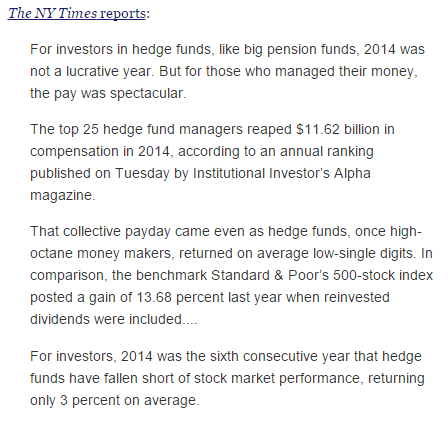
The share market rose 2 points today because of…
23 Apr 2015 Leave a comment
in economics of information, entrepreneurship, financial economics Tags: active investing, efficient markets hypothesis, entrepreneurial alertness, passive investing
Why is US farmland such a good investment?
19 Apr 2015 Leave a comment
in entrepreneurship, financial economics Tags: agricultural economics, efficient markets hypothesis, entrepreneurial alertness, risk and reward
Why US farmland values keep going up read.bi/19MJ89C http://t.co/zDdo82TwaM—
BI Markets (@themoneygame) March 24, 2015
Do vice funds out-perform the share market?
13 Apr 2015 Leave a comment
in entrepreneurship, financial economics, market efficiency, TV shows Tags: active investing, efficient markets hypothesis, entrepreneurial alertness, ethical investing, passive investing, Sopranos, vice funds

The Vice Fund has outperformed the S&P 500 since 2004. They invest in sinful stocks as its managers describe it:
Designed with the goal of delivering better risk-adjusted returns than the S&P 500 Index. It invests primarily in stocks in the tobacco, alcohol, gaming and defence industries. Vice Funds believe these industries tend to thrive regardless of the economy as a whole.
The Vice Fund was founded in 2002 to specialise in socially irresponsible stocks such as gambling, alcohol , tobacco and defence contracting. The Vice Fund is not recession proof, but did do better in the 2009 market crash.
The Vice fund also has high management fees of 2%. Americans can buy Vanguard’s or Fidelity’s index funds and pay only 0.1% in expenses. The Vice Fund may have buckled under the heat because it has rebranded:
The Vice Fund is now called the Barrier Fund. The investment strategy and the portfolio manager have not changed… The Barrier Fund invests in companies, both domestic and foreign, within industries that have significant barriers to entry.
All is not lost, the Ave Maria Catholic Values Fund beat the market almost as handily as Vice.

To confuse further, the Catholic Values Fund revealed that it shared investments in defence contractors with the Vice Fund. The Vice Fund invested in staid Berkshire Hathaway and Microsoft.
HT: Investing in Vice.
Twitter had a better start on the share market than Facebook
05 Apr 2015 Leave a comment
in economics of media and culture, entrepreneurship, financial economics, industrial organisation, survivor principle Tags: efficient markets hypothesis, Facebook, Twitter
Is stock picking better than monkeys throwing darts at a dart board?
25 Mar 2015 Leave a comment
in financial economics Tags: active investing, efficient markets hypothesis, passive investing
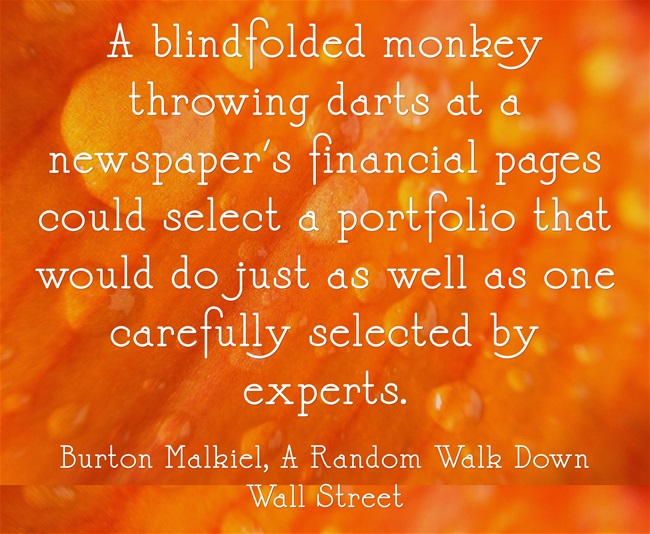

HT:
Active managers have been on the defensive of late.
22 Mar 2015 Leave a comment
in financial economics Tags: active investing, efficient markets hypothesis, index linked investing, passive investing
In 2014, just 21 percent of the funds that pick U.S. stocks beat their benchmarks, according to Morningstar. Investors have noticed and voted with their feet, swapping their actively managed funds for low-cost index and exchange-traded funds…
Some $13.1 trillion was invested in U.S. mutual funds at the end of 2014. Of the $8.3 trillion in stock funds, 38 percent was passively managed. Yet that’s double the percentage at the end of 2004.
via Fund Manager Ab Nicholas Has Been Beating S&P 500 for 40 Years – Bloomberg Business.
Do Paul Samuelson’s criticisms of behavioural economics make him a double secret Austrian economist?
13 Mar 2015 Leave a comment
in applied price theory, Austrian economics, behavioural economics, comparative institutional analysis, entrepreneurship, industrial organisation, survivor principle Tags: efficient markets hypothesis, entrepreneurial alertness, Paul Samuelson
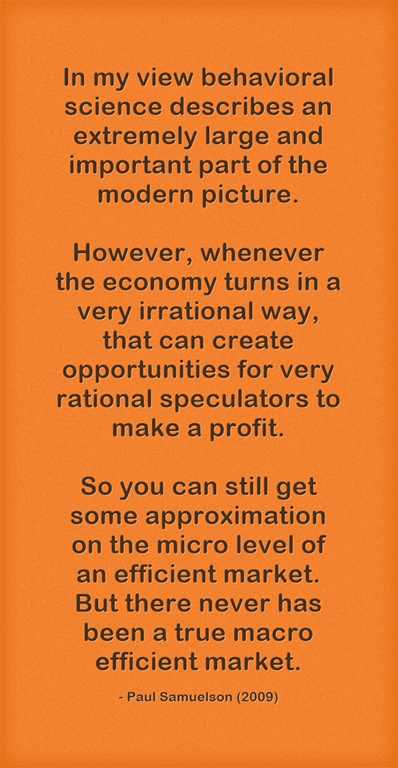
via Samuelson vs. Friedman, David Henderson | EconLog | Library of Economics and Liberty and An Interview With Paul Samuelson, Part One — The Atlantic.


Recent Comments