
Rugby sponsors draw the line in odd places
01 Jul 2019 Leave a comment
in economics of crime, economics of religion, labour economics, law and economics, politics - Australia, sports economics Tags: employment law
Tullock Lecture: Richard Epstein – regulating wages and hours in the age of Uber
03 Feb 2019 Leave a comment
in applied price theory, economics of regulation, labour economics, law and economics, minimum wage, Richard Epstein, unions Tags: employment law, union power
Tullock Lecture: Richard Epstein
20 Dec 2018 Leave a comment
in applied price theory, applied welfare economics, Austrian economics, economics of regulation, industrial organisation, labour economics, labour supply, law and economics, occupational choice, occupational regulation, politics - USA, poverty and inequality, property rights, Public Choice, rentseeking, Richard Epstein, survivor principle Tags: employment law, employment regulation, Uber
Steven Pinker Defends James Damore Against Dishonest Slanderer
23 Oct 2018 1 Comment
in discrimination, economics of education, gender, human capital, industrial organisation, labour economics, law and economics, occupational choice, politics - USA, survivor principle Tags: employment law, gender wage gap
Why We Should Repeal The Fair Work Act
19 Apr 2018 Leave a comment
in applied price theory, economics of regulation, labour economics, labour supply, politics - Australia, unemployment Tags: employment law, employment protection regulation
Was @MBIEgovtnz misreported on the effects of job protection laws and unions? @EricCrampton
07 Feb 2018 1 Comment
in applied price theory, job search and matching, labour economics, unemployment, unions Tags: employment law, employment protection laws
News reports have it that the regulatory impact statement on the new employment law amendments by the new government says that:
The bill aims to strengthen collective bargaining through a range of measures, including guaranteed rest and meal breaks, reasonable union access to a workplace, and bringing back the 30-day rule where a new worker has to be given the same conditions as a collective agreement.
MBIE officials found that the cost of the proposals would mainly fall on employers, including from higher wages and compliance costs, and from a potential fall in productivity.
The MBIE papers identified the following risks associated with the bill:
• reduced employment due to changed incentives on employers to hire new workers • an increase in industrial action and protracted bargaining due to the need to conclude agreements and include pay rates in collective agreements
• an increase in partial strikes by removing an employer’s ability to deduct pay for partial striking
• lower productivity due to less flexibility (mainly from the need for guaranteed meal breaks)
These predictions must be a misreporting of an earlier draft by a junior analyst, perhaps they were not a recruit with a background in economics. The predictions of the effects of employment protection laws and union bargaining seem to be wrong for the former and seriously out of date for the latter.
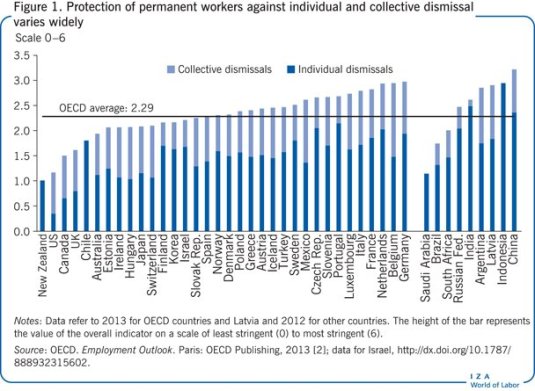
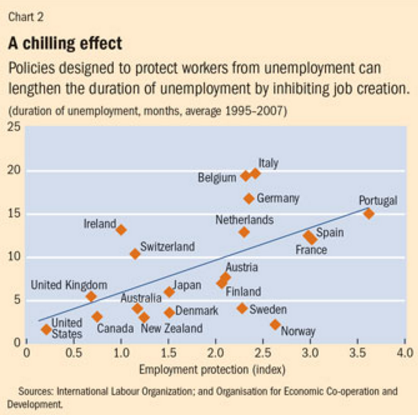
Let us begin with what are the standard predictions of the effect of employment protection laws. They lower wages and have an ambiguous effect on employment because there is both less hiring and less firing. The only unambiguous effect is on the duration of unemployment because fewer vacancies are posted but once you get a job, you keep it for longer.
To give a summary of the literature that appears to be unknown to the junior analyst writing this early draft, graduate textbooks in labour economics show that a wide range of studies have found that:
1. Employment law protections make it more costly to both hire and fire workers.
2. The rigour of employment law has no great effect on the rate of unemployment. That being the case, stronger employment laws do not affect unemployment by much.
3. What is clear is that is more rigourous employment law protections increase the duration of unemployment spells. With fewer people hired, it takes longer to find a new job.
4. Stronger employment law protections also reduce the number of young people and older workers who hold a job. They are outside looking in on a privileged subsection of insiders in the workforce who have stable, long-term jobs and who change jobs infrequently.
The impact of the introduction of trial periods on employment will be ambiguous because the lack of a trial period can be undone by wage bargaining.
- If you have to hire a worker with full legal protections against dismissal, you pay them less because the employer is taking on more of the risk if the job match goes wrong. If they work out, you promote them and pay them more.
- If you hire a worker on a trial period, they may seek a higher wage to compensate for taking on more of the risks if the job match goes wrong and there is no requirement to work it out rather than just sack them.
The twist in the tail is whether there is a binding minimum wage. If there is a binding minimum wage, either the legal minimum or in a collective bargaining agreement, the employer cannot reduce the wage offer to offset the hiring risk so fewer are hired. The introduction of trial periods will affect both wages and employment and employment more in industries that has low pay or often pay the minimum wage.
Trial periods are common in OECD countries. There is plenty of evidence that increased job security leads to less employee effort and more absenteeism. Some examples are:
-
Sick leave spiking straight after probation periods ended;
-
Teacher absenteeism increasing after getting tenure after 5-years; and
-
Academic productivity declining after winning tenure.
Jacob (2013) found that the ability to dismiss teachers on probation – those with less than five years’ experience – reduced teacher absences by 10% and reduced frequent absences by 25%.
Studies also show that where workers are recruited on a trial, employers have to pay higher wages. For example, teachers that are employed with less job security, or with longer trial periods are paid more than teachers that quickly secure tenure.
If employers take on more of the risk of a job match going wrong, they will pay recruits less. They can have a promotion round 6 or 12 months where pay is topped up if there is a good match. If minimum wage laws prevent starting salaries going low enough, there will be fewer job vacancies. But higher up the wage scales, the main effect of employment protection laws is to lower wages because the employer expects a wage discount to compensate for taking on more risk of an unsuccessful job match.
Consider, as an example, if there is a requirement to pay redundancy pay. Employers can easily undo this legal requirement by reducing wages. Another similarity is where employers pay completion bonuses on an offshore posting. They back-load compensation to make up for uncertainties about the willingness of the worker to last the posting. Because wages are lower for the duration of the posting, employees expect a big bonus. Also, there is self-selection, recruits are more likely to be those intending to stay for the whole posting. Both the employer and the employee split the greatest surplus from higher quality and longer lasting job matches arising from offering a completion bonus.
The analysis by the Ministry of the potential effects of unions is out of date. There are now doubts as to whether there is any union wage premium at all. The union wage premium is certainly withering away.
John DiNardo and David Lee compared business establishments from 1984 to 1999 where US unions barely won the union certification election (e. g., by one vote) with workplaces where the unions barely lost. If 50% plus 1 workers vote in favour of the union proposing to organise them, management has to bargain for a collective agreement in good faith with the certified union, if the union loses, management can ignore that union.
Most winning union certification elections resulted in the signing of a collective agreement not long after. Unions who barely win have as good a chance of securing a collective agreement as those unions that win these elections by wide margins.
Importantly, few firms subsequently bargained with a union that just lost the certification election. Employers can choose to recognise a union. Because the vote is so close, a particular workplace becoming unionised was close to a random event.
This closeness of the union certification election may disentangle unionisation from just being coincident with well-paid workplaces, more skilled workers and well-paid industries. Unions could be organising at highly profitable firms that are more likely to grow and pay higher wages independent of any collective bargaining. The unions are possibly claiming credit for wage rises that would have happened anyway.
DiNardo and Lee found only small impacts of unionisation on all outcomes they examined:
-
The estimated changes for wages of unionisation are close to zero.
-
Impacts on survival rates of the unionised business and their profitability were equally tiny.
This evidence of DiNardo and Lee suggests that in recent decades in the USA, requiring an employer to bargain with a certified union has had little impact because unions have been unsuccessful in winning significant wage gains after unionisation. These findings by DiNardo and Lee suggests that there may not be a union wage premium at all since the early 1980s, at least in the USA.
In another paper DiNardo found a substantial union wage premium before the Second World War by studying the share price effects of unionisation. One of the differences back them that there was far more violence associated with strikes.
We find that strikes had large negative effects on industry stock valuation. In addition, longer strikes, violent strikes, strikes won by the union, strikes leading to union recognition, industry-wide strikes, and strikes that led to wage increases affected industry stock prices more negatively than strikes with other characteristics.
New Zealand and U.S. unions are similar in that both are on their own in bargaining with employers for a wage rise. Options for outside arbitration do not exist in New Zealand; there are some forms of compulsory arbitration in the USA. These US result sends a message to New Zealand that unions are a bit of a relic in terms of wage bargaining. MBIE seems to have missed that literature?
In summary, job protection laws reduce wages. For the low paid, they may also reduce employment rates if minimum wage rates are binding. Unions are a dinosaur that do not matter much anymore.
The first @PaulKrugman explains European labour market regulation
02 Jan 2017 Leave a comment
in applied price theory, income redistribution, labour economics, labour supply, law and economics, minimum wage, Public Choice, rentseeking Tags: employment law, labour market regulation, minimum wage laws, rent control, social insurance, unemployment insurance
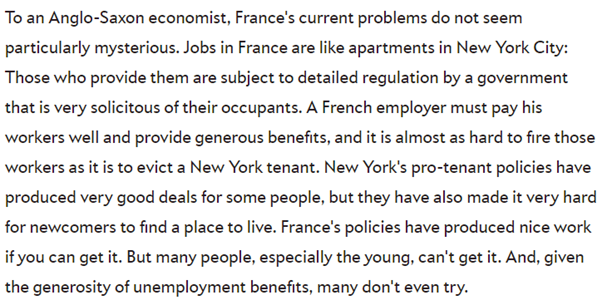
Source: Unmitigated Gauls (1998).
Does @nztreasury @moturesearch understand its own 90-day trials research?
17 Jun 2016 Leave a comment
in applied price theory, econometerics, economics of regulation, labour economics, minimum wage, politics - New Zealand Tags: employment law, employment protection law, employment regulation, offsetting behaviour, probationary periods, trial periods
https://twitter.com/moturesearch/status/743595301345333248
Media reporting and Motu’s own tweet on its research contradict its own conclusions about what it found about the introduction of 90-day trial periods for new jobs in New Zealand.
https://twitter.com/moturesearch/status/743563189451841537
Motu’s executive summary is both as bold as the Motu tweet and directly contradicts it
We find no evidence that the ability to use trial periods significantly increases firms’ overall hiring; we estimate the policy effect to be a statistically and economically insignificant 0.8 percent increase in hiring on average across all industries.
However, within the construction and wholesale trade industries, which report high use of trial periods, we estimate a weakly significant 10.3 percent increase in hiring as a result of the policy.
No evidence means no evidence. Not no evidence but we did find some evidence in two large industries – evidence of a 10.3% increase in hiring. That is a large effect.
Both economic and statistical significance matter. Not only is the effect of 90-day trial periods in the construction and wholesale trades other than zero, 10% is large – a hiring boom. No evidence of any effects on employment of 90 day trial periods means no evidence.
Neither Treasury nor Motu understand their own research and the evidence of large effects in two industries. Can you conclude you have no evidence when you have some evidence, which they did in construction and wholesale trades? There is evidence, there is not no evidence.
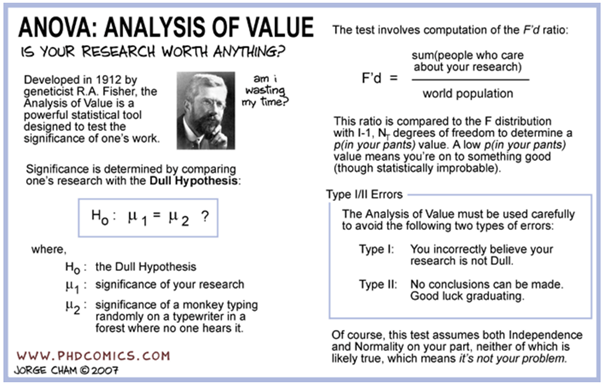
The paper was weak in hypothesis development and in its literature review. It was not clear whether the paper was testing the political hypothesis or the economic hypotheses. Neither were well explained or situated within modern labour economics or labour macroeconomics. If a political hypothesis does not stand up as a question of applied price theory, you cannot test it.
The Motu paper does not remind that graduate textbooks in labour economics show that a wide range of studies have found the predicted negative effects of employment law protections on employment and wages and on investment and the establishment and growth of businesses:
1. Employment law protections make it more costly to both hire and fire workers.
2. The rigour of employment law has no great effect on the rate of unemployment. That being the case, stronger employment laws do not affect unemployment by much.
3. What is very clear is that is more rigourous employment law protections increase the duration of unemployment spells. With fewer people being hired, it takes longer to find a new job.
4. Stronger employment law protections also reduce the number of young people and older workers working age who hold a job.
5. The people who suffer the most from strong employment laws are young people, women and older adults. They are outside looking in on a privileged subsection of insiders in the workforce who have stable, long-term jobs and who change jobs infrequently.
Trial periods are common in OECD countries. There is plenty of evidence that increased job security leads to less employee effort and more absenteeism. Some examples are:
- Sick leave spiking straight after probation periods ended;
- Teacher absenteeism increasing after getting tenure after 5-years; and
- Academic productivity declining after winning tenure.
Jacob (2013) found that the ability to dismiss teachers on probation – those with less than five years’ experience – reduced teacher absences by 10% and reduced frequent absences by 25%.
Studies also show that where workers are recruited on a trial, employers have to pay higher wages. For example, teachers that are employed with less job security, or with longer trial periods are paid more than teachers that quickly secure tenure.
Workers who start on a trial tend to be more productive and quit less often. The reason is that there was a better job match. Workers do not apply for jobs to which they think they will be less suited. By applying for jobs that the worker thinks they will be a better fit, everyone gains in terms of wages, job security and productivity. For more information see
- Pierre Cahuc and André Zylberberg, The Natural Survival of Work, MIT Press, 2009;
- Tito Boeri and Jan van Ours, The Economics of Imperfect Labor Markets, MIT Press, 2nd edition (2013);
- Dale T. Mortensen, “Markets with Search Friction and the DMP Model”, American Economic Review 101, no. 4 (June 2011): 1073-91;
- Christopher Pissarides. “Equilibrium in the Labor Market with Search Frictions”, American Economic Review 101 (June 2011) 1092-1105;
- Christopher Pissarides, “Employment Protection”, Labour Economics 8 (2001) 131-159.
- Eric Brunner and Jennifer Imazeki, “Probation Length and Teachers Salaries: Does Waiting Payoff?” Industrial and Labor Relations Review 64, no. 1 (October 2010): 164-179.
- Andrea Ichino and Regina T. Riphahn, “The Effect of Employment Protection on Worker Effort – A Comparison of Absenteeism During and After Probation”, Journal of the European Economic Association 3 no. 1 (March 2005), 120-143;
- Christian Pfeifer “Work Effort During and After Employment Probation: Evidence from German Personnel Data”, Journal of Economics and Statistics (February 2010); and
- Olsson, Martin “Employment protection and sickness absence”, Labour Economics 16 (April 2009): 208-214.
In the labour market, screening and signalling take the form of probationary periods, promotion ladders, promotion tournaments, incentive pay and the back loading of pay in the form of pension vesting and other prizes and bonds for good performance over a long period.
There is good reasons to have strong priors about how employment regulation will work. Employment law protects a limited segment of the workforce against the risk of losing their job. These are those who have a job and in particular those that have a steady job, a long-term job.
The impact of the introduction of trial periods on employment will be ambiguous because the lack of a trial period can be undone by wage bargaining.
- If you have to hire a worker with full legal protections against dismissal, you pay them less because the employer is taking on more of the risk if the job match goes wrong. If they work out, you promote them and pay them more.
- If you hire a worker on a trial period, they may seek a higher wage to compensate for taking on more of the risks if the job match goes wrong and there is no requirement to work it out rather than just sack them.
The twist in the tail is whether there is a binding minimum wage. If there is a binding minimum wage, either the legal minimum or in a collective bargaining agreement, the employer cannot reduce the wage offer to offset the hiring risk so fewer are hired.
The introduction of trial periods will affect both wages and employment and employment more in industries that are low pay or often pay the minimum wage. Motu found large effects on hiring in two industries that used trial periods frequently. That vindicates the supporters of the law.
Motu said that 36% of employers have used trial periods at least once. The average is 36% of employers have used them with up to 50% using them in construction and wholesale trade. That the practice survives in competition for recruits suggested that it has some efficiency value.
The large size of the employment effect in construction and wholesale trades is indeed a little bit surprising. Given that a well-grounded in economic theory hypothesis about the effect of trial period is ambiguous in regard to what will happen to wages and unemployment, a large employment effect is a surprise. If Motu had spent more time explaining employment protection laws and what hypotheses they imply, that surprise would have come to light sooner.
Motu’s research for the remaining New Zealand industries was a bit of an outlier. It should have spent more time explaining how to manage that anomalous status in light of the strong priors impartial spectators are entitled to have on the economics of employment protection laws.
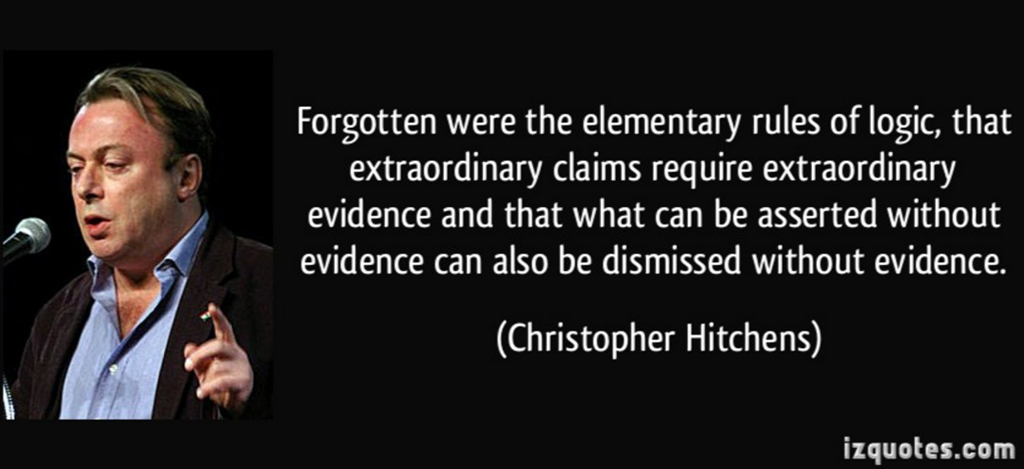
A conflicting study about the effects of any regulation should be no surprise. If there are not conflicting empirical studies, the academics are not working hard enough to win tenure and promotion. Extraordinary claims nonetheless require extraordinary evidence.
Does labor market regulation really protect the interests of workers?
29 Apr 2016 Leave a comment
in economics of media and culture, economics of regulation, industrial organisation, labour economics, occupational regulation Tags: employment law, employment protection laws, employment regulation
McDonald’s Workers Just Lovin’ Their #ZeroHoursContracts @suemoroney @IainLG @FairnessNZ
19 Apr 2016 Leave a comment
in labour economics, labour supply, managerial economics, market efficiency, organisational economics, personnel economics, politics - New Zealand Tags: British economy, British politics, employment law, employment regulation, fixed costs of working, part-time work, The fatal conceit, The pretense to knowledge, zero hours contracts
Revealed preference rules. Not only do about half of unemployed turned down offers of zero hour contract jobs, those that switch from a zero hours contract to minimum hours are not much different from the number of people in these type of jobs who would be quitting to another job anyway.

Source: McDonald’s Workers Are Just Lovin’ Their Zero Hours Contracts – Forbes and McDonald’s offer staff the chance to get off zero-hours contracts | UK news | The Guardian.
The 1st @PaulKrugman on @GrantRobertson1’s #futureofwork?
21 Mar 2016 Leave a comment
in economics of regulation, labour economics, minimum wage, politics - USA, poverty and inequality, unemployment Tags: employment law, employment protection laws, France, labour market regulation, New Zealand Labour Party, rent control, social insurance, The fatal conceit, unintended consequences
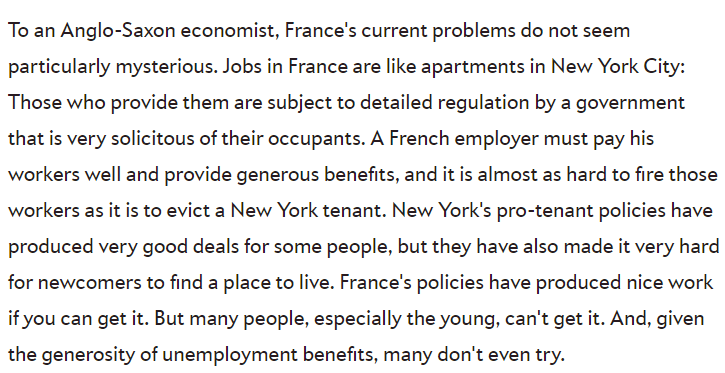
Source: Paul Krugman (1997) Unmitigated Gauls.
Mandatory layoff notice by length of job tenure in the G7, Australia, New Zealand, Ireland, Scandinavia, Greece and Spain
12 Feb 2016 Leave a comment
in labour economics, law and economics, property rights, unemployment Tags: employment law, employment protection laws, employment regulation, mandatory notice, severance pay
Mandatory notice periods for layoffs put the very survival of troubled the business at risk. By having to give long periods of notice, a firm experiencing a downturn is less able to adjust quickly and more likely simply to go out of business because it cannot meet its larger payroll.
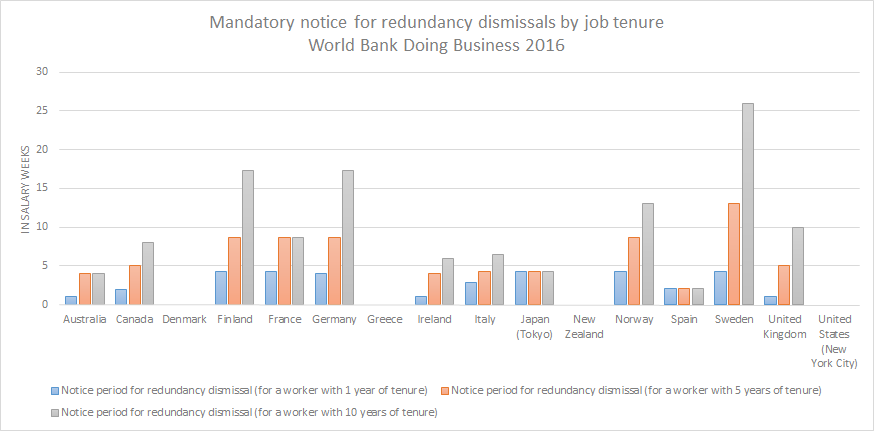
Source: Labor Market Regulation – Doing Business – World Bank Group.
Mandatory severance pay by length of job tenure in the G7, Australia, New Zealand, Ireland, Scandinavia, Greece and Spain
11 Feb 2016 Leave a comment
in human capital, job search and matching, labour economics, labour supply, law and economics, managerial economics, organisational economics, personnel economics, property rights, unemployment Tags: employment law, employment protection laws, employment regulation, firm-specific human capital, job search, labour market regulation, severance pay
There are a wide differences across the OECD in mandatory severance pay in the event of a layoff.
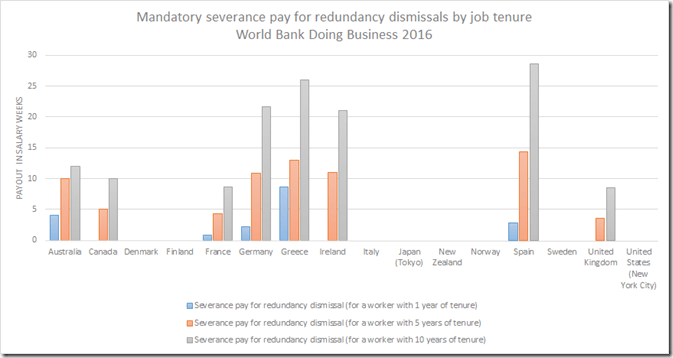
Source: Labor Market Regulation – Doing Business – World Bank Group.
Severance pay makes it more expensive to fire and therefore more expensive to hire. This means fewer job vacancies will be created but they will last longer.
The presence of mandatory severance pay could increase or reduce the unemployment rate but unemployment durations will increase because it takes longer to find a suitable job match among the fewer available vacancies.
Mandating severance pay does not make the job match inherently more profitable. It just redistributes some of the surplus from the job match to the end when it is terminated.
Employers and jobseekers may agree to severance pay where investments in firm specific and job specific human capital for the job is profitable.
Severance pay in these circumstances gives the employer and more reasons to invest in specific human capital. The promise to pay severance pay will make the employer hesitate to lay them off. The employer will instead retain them over a slack period or redeploy them within the company rather than pay them out. This pre-commitment encourages investment in firm specific and job specific human capital by both sides more secure, which makes the job match more profitable overall for both sides.
Of course, if it was possible to negotiate completely around severance pay mandated by law, there would be no effects on hiring, firing and unemployment durations. All it would mean is take-home pay would be less but in the event of a layoff, these employees would get that this wage reduction back as a lump sum.
#TPPANoWay sovereignty objections apply equally to @ILO conventions
04 Feb 2016 Leave a comment
in constitutional political economy, economics of regulation, international economic law, international economics, International law, labour economics, law and economics, politics - New Zealand, unions Tags: employment law, employment protection, employment regulation, ILO, labour market regulation, social clauses, TPPA
New Zealand has signed and ratified dozens of International Labour Organisation Conventions dating back to 1921. They all fetter the sovereignty of New Zealand. As a member of the ILO, New Zealand is required to report on its application of ILO Conventions.
That limitation on the sovereignty of New Zealand is no more and no less than in an international trade agreement. New Zealand can renounce an international trade agreement and has renounced nine International Labour Organisation conventions.
Jane Kelsey makes the following points about the legal implications of the Trans-Pacific Partnership agreement:
The 30 chapter Trans-Pacific Partnership Agreement (TPPA) constrains domestic law and policy at central government level, and in places by local government and SOEs, in diverse areas beyond traditional aspects of international trade.
…The TPP provides cumulative opportunities for foreign states and corporations to influence domestic decisions which may be burdensome and intrusive.
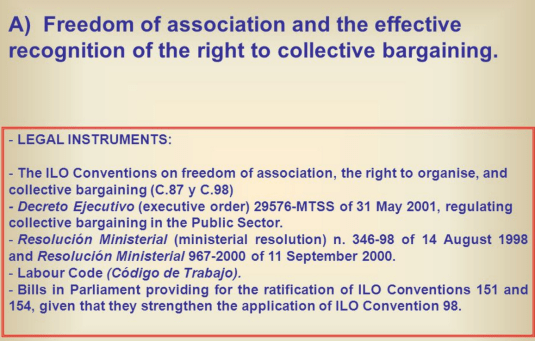
The exact same objections apply to the ILO conventions. The union movement does not hesitate to argue that the democratic process in New Zealand should be overridden because the proposal at hand purportedly conflicts with an ILO convention.
For example, when the government was choosing to deregulate collective bargaining, the sovereignty of Parliament was questioned because of an ILO convention. Helen Kelly, CTU President said:
in Parliament on 4 June, the Minister was asked if he agreed with advice from officials that the ability for employers to opt out of multi-employer bargaining may breach our obligations under ILO Convention 98 on the right to organise and collective bargaining.
…There is no point attending such an important UN ILO conference at the time your Government is being advised it is breaching its undertakings to that very organisation…
The CTU President also referred to the regulatory impact statement prepared for that collective bargaining legislation:
The paper also points out that these changes open NZ up to international examination by the International Labour Organisation (ILO) for non-compliance with Convention 98 – on the Right to Organise and Collectively Bargain, which New Zealand has signed up to.
Helen Kelly says “at least four of the proposals are deemed to be inconsistent with our international obligations, and two of them are classified as uncertain. Why the Government wants law changes that damage our international obligations is unclear.”
Council of Trade Unions submissions to minimum wage reviews have at least a dozen references to ILO conventions and the requirement to honour their provisions.
Posner and Goldsmith rightly argue that international law is a product of states pursuing their interests on the international stage. It does not induce states to comply contrary to their interests. The possibilities for what it can achieve are limited.
Government sign-up to various international agreements depending on their political priorities. You cannot complain that governments that you did not vote do what government you voted for also did, which was sign up to international agreements that suited their political agendas. The solution is to work harder to win the next general election.
As for opposing trade agreements on sovereignty grounds, it is rank hypocrisy for the union movement to do so given the number of times it cites international labour agreements when it suits them and seeks their inclusion in trade agreements to raise labour costs in developing countries.
 Utopia, you are standing in it!
Recent Comments