How many of the richest Americans inherited their fortune? Find out. buff.ly/1DNM3g2 http://t.co/QlarE5yAdT—
HumanProgress.org (@humanprogress) August 14, 2015
More on the rise and the rise of the working super rich
15 Aug 2015 Leave a comment
in applied price theory, applied welfare economics, economic history, entrepreneurship, industrial organisation, survivor principle Tags: antimarket bias, entrepreneurial alertness, superstar wages, superstars, top 0.1%, top 1%, top wage earners
Creative destruction in car manufacturing
14 Aug 2015 Leave a comment
in development economics, economic history, entrepreneurship, growth miracles, industrial organisation, international economics, survivor principle Tags: automotive industry, car industry, comparative advantage, creative destruction, entrepreneurial alertness, manufacturing industry, market selection, The meaning of competition
Changing shares of car production since 1950
(source bit.ly/1hn1l0Y) http://t.co/VPhianlBBX—
Max Roser (@MaxCRoser) August 07, 2015
The unicorns of the US tech sector share market
13 Aug 2015 Leave a comment
in entrepreneurship, industrial organisation, survivor principle Tags: competition as a discovery procedure, efficient markets hypothesis, entrepreneurial alertness, market selection, technology diffusion, Uber
There are 74 "unicorns” in US tech sector, valued at $273 billion. Will they become extinct? econ.st/1ISYkvd http://t.co/ATyuzMsZwA—
The Economist (@EconBizFin) August 11, 2015
Cost control at Google in two charts
12 Aug 2015 Leave a comment
in economics of media and culture, entrepreneurship, industrial organisation, survivor principle Tags: competition as a discovery procedure, creative destruction, economics of advertising, entrepreneurial alertness, Google, innovation, legacy media, market selection, The meaning of competition
Google's core business explained in two charts buff.ly/1UBysMC http://t.co/V6uRrPVKMk—
Business Insider (@businessinsider) August 12, 2015
How @equitablegrowth showed inequality helps growth when arguing inequality harms growth
10 Aug 2015 1 Comment
in applied price theory, applied welfare economics, comparative institutional analysis, currency unions, economic growth, economic history, economics of regulation, entrepreneurship, Euro crisis, fiscal policy, global financial crisis (GFC), income redistribution, labour economics, labour supply, macroeconomics, Marxist economics, poverty and inequality, Public Choice, public economics, rentseeking Tags: British disease, entrepreneurial alertness, Eurosclerosis, France, German unification, Germany, growth of government, sick man of Europe, social insurance, Sweden, taxation and entrepreneurship, taxation and investment, taxation and labour supply, welfare state
The Washington Centre for Equitable Growth recently tweeted that inequality harms growth in the USA as compared to Sweden, France, Germany and the UK. It was relying on some dodgy OECD research.
.@OECD sees continued rise in growth-harming inequality, reports @PaulHannon29 on.wsj.com/1EZpq1S http://t.co/xt4heZysXT—
Equitable Growth (@equitablegrowth) May 21, 2015
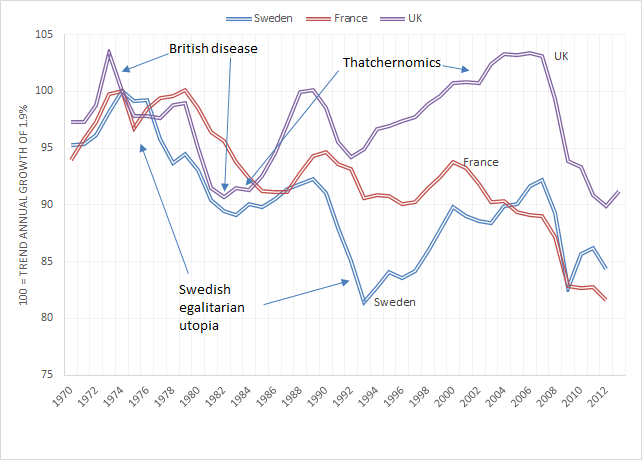
The Washington Centre for Equitable Growth did not check their inequality ratios they tweeted against trends in economic growth and economic policy since 1970, which I have reproduced in figure 1. Germany is not included in figure 1 because German data on growth is thrown askew by German unification.
Figure 1: Real GDP per British, French and Swede aged 15-64, 2014 US$ (converted to 2014 price level with updated 2011 PPPs), 1.9 per cent detrended, 1970-2013
Source: Computed from OECD Stat Extract and The Conference Board. 2015. The Conference Board Total Economy Database™, May 2015, http://www.conference-board.org/data/economydatabase/
Figure 1 shows that France has been in a long-term decline since the late 1970s despite the blessings of a more equal society than the USA as championed by the Washington Centre for Equitable Growth. In figure 1, a flat line is growth in real GDP per working age person, PPP, at the same rate as the USA for the 20th century, which was 1.9% per year. A falling line in figure 1 indicates growth of less than 1.9% while a rising line indicates growth in real GDP per working age person, PPP, in excess of 1.9%. In figure 1, France hardly ever grew at the trend rate of growth for the USA of 1.9% per year and was frequently well below that rate.

Sweden tells a slightly different story in figure 1 because of regime change in the early 1990s when Sweden adopted more liberal economic policies where taxes and government spending were reduced:
The rapid growth of the state in the late 1960s and 1970s led to a large decline in Sweden’s relative economic performance. In 1975, Sweden was the 4th richest industrialised country in terms of GDP per head. By 1993, it had fallen to 14th.
@alexvoronov använda smygfinansiering av Generell Välfärd är alltid av ondo. @NimaSanandaji: bit.ly/1Nar2eV http://t.co/wD0YEgncIE—
Old Whig (@aClassicLiberal) August 05, 2015
That regime change reversed a long economic decline since 1970 under the egalitarian policies of the Swedish Social Democratic Party. Under the Swedish Social Democratic Party, Sweden was almost always growing at less than the trend rate of growth of the USA, which was 1.9%. That position reversed only when there was a turn away from big government and high taxes.

Figure 1 tells a similar story for the British economy: a long economic decline in the 1970s when Britain was the sick man of Europe. Under Thatchernomics, Europe had a long economic boom for 20 years or more – see figure 1.
In the 1970s, under the high taxes of the Heath, Callaghan and Wilson administrations, as figure 1 shows, Britain was the sick man of Europe. With the election of the Thatcher Government, Britain soon grew at better than the US trend growth rate for nearly 20 years through few exceptions.
Graph of the Day: The UK has among the lowest total tax rates on businesses in the G7 http://t.co/l6mMhN9yLD—
CPS Think Tank (@CPSThinkTank) August 04, 2015
The taxes paid by the rich, middle-class and the poorer in the USA
09 Aug 2015 Leave a comment
in politics - USA, public economics Tags: creative destruction, entrepreneurial alertness, envy, taxation and entrepreneurship, taxation and investment, taxation and the labour supply, top 1%
Average Income Before & After Federal Taxes from "An Illustrated Guide to Income" bit.ly/1j9ymXF #inequality http://t.co/eabwDATSlU—
Catherine Mulbrandon (@VisualEcon) April 28, 2014
The Great Enrichment by household type in the 20th century
09 Aug 2015 2 Comments
in applied welfare economics, economic history Tags: creative destruction, entrepreneurial alertness, living standards, The Great Enrichment
https://twitter.com/VisualEcon/status/501347052878823425/photo/1
Share of Income Before & After Federal Taxes "An Illustrated Guide to Income" bit.ly/1tfXrse #inequality http://t.co/DnkSWZ6Yov—
Catherine Mulbrandon (@VisualEcon) April 24, 2014
Adam Smith on entrepreneurial alertness
08 Aug 2015 Leave a comment
in Adam Smith, applied price theory, comparative institutional analysis, economic history, economics of regulation, entrepreneurship, industrial organisation Tags: creative destruction, entrepreneurial alertness, offsetting behaviour, The meaning of competition
What watch a movie 2-D when you can watch it in 3-D?
08 Aug 2015 Leave a comment
in economics of media and culture, industrial organisation, survivor principle Tags: 10-90 lag, consumer sovereignty, creative destruction, entrepreneurial alertness, Hollywood economics, technology diffusion
We were watching some movie trailers last week-end. One of the 3-D movies also mentioned that it was available in 2-D.

I am surprised that there is still a market for movies in 2-D when people have the option for a tiny sum of money to watch it in 3-D. Of course, this market survives therefore it must be efficient and somebody must like watching 2-D movies over the 3-D movie option.

Is also the case that there is considerable difference in the quality of 3-D movies. There must be trade secrets. For example, Peter Jackson’s films in 3-D are excellent. Some 3-D movies sometimes look like they are in 2-D all to frequently. I saw one trailer for a 3-D movie that looked like it was just 2-D with beer goggles on.

The discovery process in student athlete wages
04 Aug 2015 Leave a comment
in economics of education, entrepreneurship, human capital, labour economics, labour supply, sports economics Tags: entrepreneurial alertness, on-the-job training, superstar wages, superstars


FiveThirtyEightSports has a great piece about how much college quarterbacks are really worth in terms of market value. I’m neutral-but-leaning-against on the issue of paying college athletes, but the piece begins with University of Iowa Athletic Director Gary Barta giving a very bad reason to oppose it: it’s too complicated to figure out how much they should be paid. He’s right given how he’s conceiving the issue, he’s just not conceiving the issue in the right way.
Wages are not determined by a person or group of people independently evaluating what a job is “really” worth. That’s what markets do, i.e. that’s what innumerable decisions over time by innumerable anonymous consumers operating within the price system do. The failure to understand how the price system works in allocating resources by preferences is not unique to Barta. Very few people understand it, and lamentably even people who do understand it often…
View original post 619 more words
The tax rates of the top 1%
04 Aug 2015 Leave a comment
in applied welfare economics, entrepreneurship, fisheries economics, income redistribution, politics - USA, rentseeking Tags: entrepreneurial alertness, envy, taxation and entrepreneurship, taxation and investment, taxation and the labour supply, top 1%
Historical Tax Rates of Top 0.01% (15,000 returns reporting more than $8 million in 2010) visualizingeconomics.com/blog/2013/8/14… http://t.co/XygW0t0npu—
Catherine Mulbrandon (@VisualEcon) August 15, 2013
An elephant surfing?
03 Aug 2015 Leave a comment
in economics of media and culture Tags: entrepreneurial alertness
Deirdre McCloskey’s speech on ‘Bourgeois Dignity’
03 Aug 2015 Leave a comment
in applied price theory, applied welfare economics, comparative institutional analysis, constitutional political economy, economic history, entrepreneurship, industrial organisation, law and economics, property rights, survivor principle Tags: Deirdre McCloskey, entrepreneurial alertness, industrial revolution, The Great Enrichment, The Great Fact
 Utopia, you are standing in it!
Recent Comments