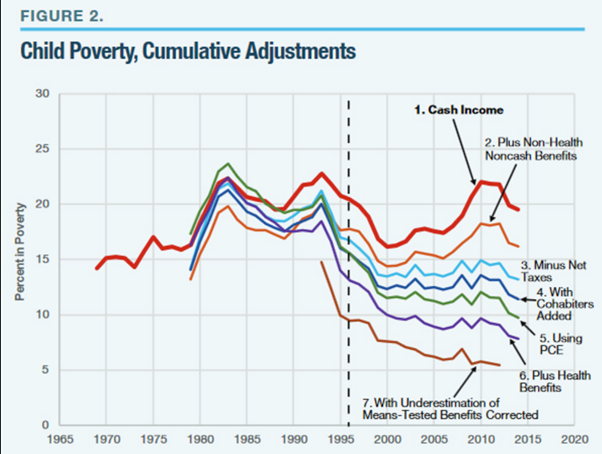
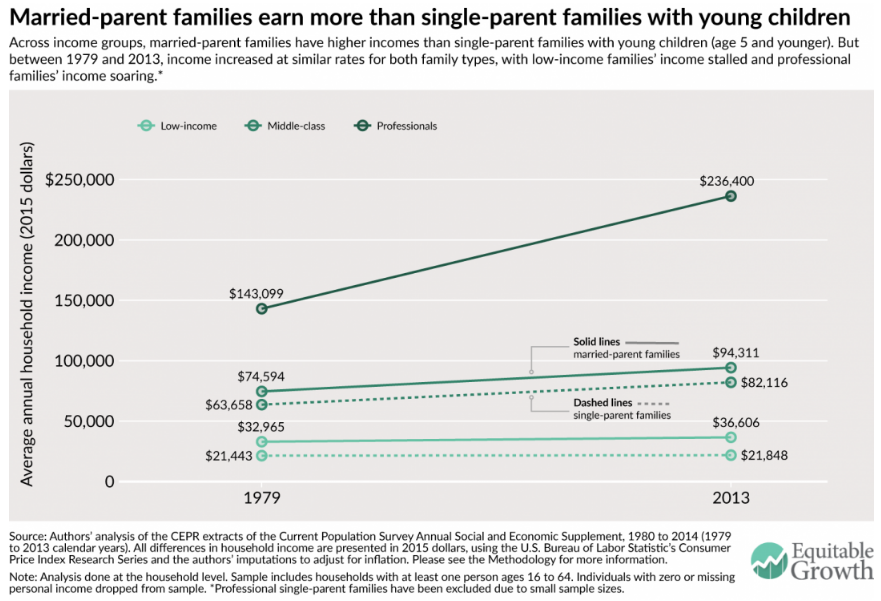
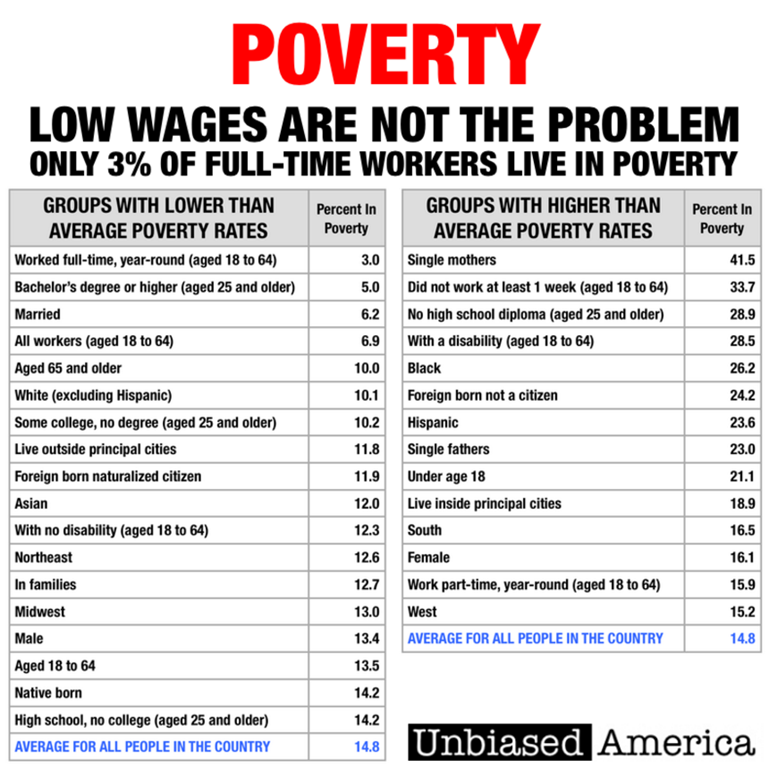
Source: Poverty Has Declined a Lot Over the Past 30 Years | Mother Jones from Poverty After Welfare Reform | Manhattan Institute.
Celebrating humanity's flourishing through the spread of capitalism and the rule of law
27 Aug 2016 Leave a comment
in economic history, labour economics, labour supply, politics - USA, poverty and inequality, welfare reform Tags: 1996 US welfare reforms, child poverty, family poverty, single parents, social insurance, welfare state
Source: Poverty Has Declined a Lot Over the Past 30 Years | Mother Jones from Poverty After Welfare Reform | Manhattan Institute.
25 Aug 2016 Leave a comment
in applied welfare economics, labour economics, politics - New Zealand, poverty and inequality Tags: child poverty, family poverty, homelessness, social housing, social insurance, welfare state
There is a difference between not having a roof over your head and being in emergency or temporary accommodation. It disrespects those who lack a roof over their head tonight to equate their grave misfortune with those fortunate enough to already be in emergency accommodation. Once they are in emergency accommodation, that shows that the system is working. Finding them somewhere to stay pending finding something more permanent.
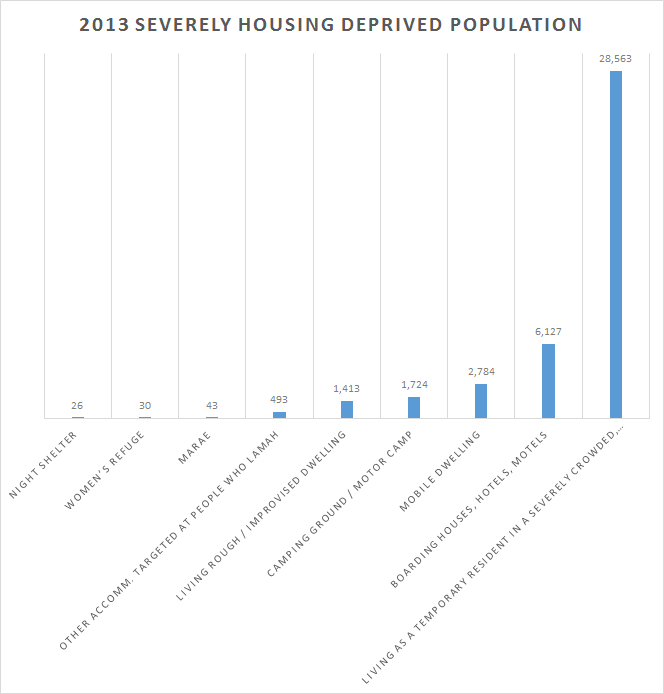
Source: 24 August 2016, Most homeless people working or studying, News, University of Otago, New Zealand, table 4.
https://twitter.com/childpovertynz/status/768631393459040256
https://twitter.com/PhilTwyford/status/768672477807456256
.
16 Aug 2016 Leave a comment
in applied welfare economics, labour economics, labour supply, politics - New Zealand, poverty and inequality, urban economics, welfare reform Tags: child poverty, family poverty, housing affordability, RMA
Today in the Guardian writing on trends in family poverty New Zealand, Eleanor Roy said that
The fact that twice as many children now live below the poverty line than did in 1984 has become New Zealand’s most shameful statistic.
Roy goes back to the 1980s as her base because child poverty has not gone up or down by that much since that sharp rise in the late 1980s.
Child poverty among single-parent households has doubled since 1990 and tripled since 1988. Poverty in families with two parents present is not much higher now than it was in 1988.

Source: Bryan Perry, Household Incomes in New Zealand: trends in indicators of inequality and hardship 1982 to 2014 – Ministry of Social Development, Wellington (August 2015), Table H.4.
Child poverty rates among single-parent families that live with other adults is one-quarter that of single-parent families who live alone. The reasons behind that should be explored more by those concerned with child poverty.

Source: Bryan Perry, Household Incomes in New Zealand: trends in indicators of inequality and hardship 1982 to 2013 – Ministry of Social Development, Wellington (2014), Tables F.6 and F.7.
The evidence is overwhelming that the main driver of the increases in the child poverty since the 1980s is rising housing costs.
In the longer run, after housing costs child poverty rates in 2013 were close to double what they were in the late 1980s mainly because housing costs in 2013 were much higher relative to income than they were in the late 1980s.
– Bryan Perry, 2014 Household Incomes Report – Key Findings. Ministry of Social Development (July 2014).
Any policy to reduce child poverty must increase the supply of houses by reducing regulatory restrictions on the supply of land.
Rather than blame the callousness of government in accepting higher rates of child poverty, Roy should blame its inability to take on the restrictions on land supply in the Resource Management Act that drive up housing costs for the poor. Increased child poverty in New Zealand is a by-product of housing unaffordability.
04 Aug 2016 Leave a comment
in economic history, labour economics, politics - USA, poverty and inequality Tags: child poverty, family poverty, technology diffusion, The Great Enrichment

The present rate of technology adoption is nearly a vertical line —@blackrock https://t.co/3oS3YAI4ld—
Vala Afshar (@ValaAfshar) January 22, 2016
06 Jul 2016 Leave a comment
in economics of love and marriage, labour economics, labour supply, poverty and inequality, welfare reform Tags: child poverty, family poverty, single mothers, single parents
Looks like the greed of the top 1% was targeted exclusively as single parents since the 1980s. Child poverty in two-parent families has not risen much at all. These households often have jobs and will presumably be under the jackboot of neoliberalism stripping away their bargaining power through the decimation of unions and the introduction of the Employment Contracts Act. Despite these horrors, family poverty did not increase much if there are two parents in the house.
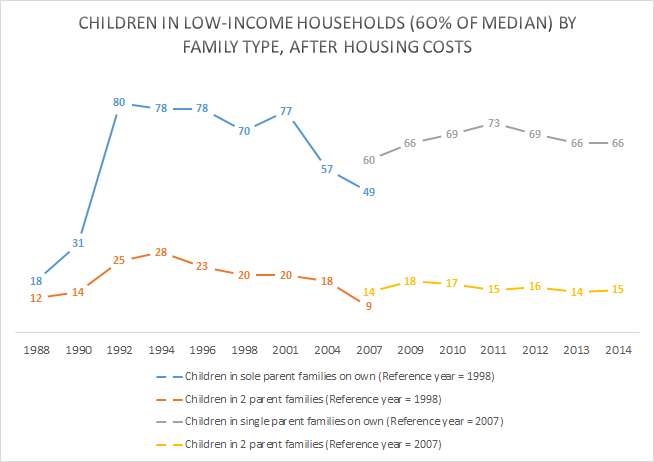
Source: Bryan Perry, Household Incomes in New Zealand: trends in indicators of inequality and hardship 1982 to 2014 – Ministry of Social Development, Wellington (August 2015), Table H.4.
Bryan Caplan argues that there is an undeserving poor if they fail to follow the following reasonable steps to avoid poverty and hardship:
10 Jun 2016 Leave a comment
in labour economics, labour supply, minimum wage, politics - New Zealand, poverty and inequality, public economics Tags: child poverty, family poverty, female labour force participation, living wage, New Zealand Labour Party, single mothers, single parents, social insurance
The Left thinks the solution to poverty is giving the poor more money because poverty is caused by the poor not having enough money.
Labour MP Jacinda Ardern introduced the exception in an op-ed in the Sunday Star Times. People are poor because they do not have enough money unless that is because of a lack of money because you are not married or not living with the father of the child.
Ardern was raging against a report by Lindsey Mitchell arguing that a major driver of child poverty is the breakdown of the family and the rise of single parent households. Ardern said that
I’ve spent the better part of six years reading and researching the issue of child poverty, and what we need to do to resolve this complex problem in New Zealand.
And yet here it was, the silver bullet we have all been looking for. Marriage. Getting hitched. Tying the knot. It turns out that we didn’t need an Expert Advisory Group on child poverty, or any OECD analysis for that matter – apparently all we really need is a pastor and a party
Ardern preferred to attribute the increase in child poverty to welfare benefit cuts in the early 1990s.
There is an exception within this exception for the living wage as Ardern says
But the other factors Family First was so quick to dismiss – low wages and staggering housing costs – mean we have 305,000 children in poverty. And this is the stuff that needs to change. It’s time we faced reality.
A living wage increase can solved family poverty. Actually getting a job and earning a wage does not reduce poverty among single-parent households but living wage increases do for families.

Source: Jacinda Ardern: Govt must improve the lot of our children – National – NZ Herald News.
You cannot have it both ways. That low wages cause family poverty but no wages does not.
The best solution to child poverty is to move their parents into a job. Simon Chapple is quite clear in his book last year with Jonathan Boston that.
Sustained full-time employment of sole parents and the fulltime and part-time employment of two parents, even at low wages, are sufficient to pull the majority of children above most poverty lines, given the various existing tax credits and family supports.
26 May 2016 Leave a comment
in economic history, labour economics, poverty and inequality Tags: child poverty, family poverty, regional economic development
.
23 May 2016 Leave a comment
in applied welfare economics, comparative institutional analysis, economic history, economics of regulation, income redistribution, industrial organisation, politics - New Zealand, poverty and inequality, Public Choice, rentseeking Tags: child poverty, conspiracy theories, expressive voting, family poverty, Leftover Left, living standards, neoliberalism, Old Left, pessimism bias, rational irrationality, reactionary left, top 1%
New work by Chris Ball and John Creedy shows substantial *declines* in NZ inequality.
initiativeblog.com/2015/06/24/ine… http://t.co/f94fw4Bhae—
Eric Crampton (@EricCrampton) June 24, 2015
You really are still fighting the 1990 New Zealand general election if Max Rashbrooke makes more sense than you on the good old days before the virus of neoliberalism beset New Zealand from 1984 onwards.
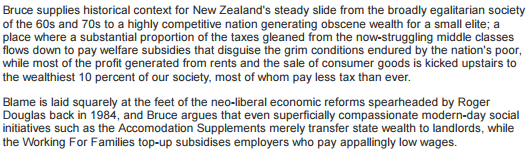
Source: Mind the Gap: Why most of us are poor | Stuff.co.nz.
Bryan Bruce in the caption looks upon the New Zealand of the 1960s and 70s as “broadly egalitarian”. Even Max Rashbrooke had to admit that was not so if you were Maori or female.
The present rate of technology adoption is nearly a vertical line —@blackrock https://t.co/3oS3YAI4ld—
Vala Afshar (@ValaAfshar) January 22, 2016
Maybe 65% of the population of those good old days before the virus of neoliberalism. were missing out on that broadly egalitarian society championed by Bryan Bruce.
As is typical for the embittered left, the reactionary left, gender analysis and the sociology of race is not for their memories of their good old days. New Zealand has the smallest gender wage gap of any of the industrialised countries.
The 20 years of wage stagnation that proceeded the passage of the Employment Contracts Act and the wages boom also goes down the reactionary left memory hole.
That wage stagnation in New Zealand in the 1970s and early 80s coincided with a decline in the incomes of the top 10%. When their income share started growing again, so did the wages of everybody after 20 years of stagnation. The top 10% in New Zealand managed to restore their income share of the early 1970s and indeed the 1960s. That it is hardly the rich getting richer.
28 Apr 2016 Leave a comment

Celebrating humanity's flourishing through the spread of capitalism and the rule of law
Celebrating humanity's flourishing through the spread of capitalism and the rule of law
Celebrating humanity's flourishing through the spread of capitalism and the rule of law
Celebrating humanity's flourishing through the spread of capitalism and the rule of law
Celebrating humanity's flourishing through the spread of capitalism and the rule of law
Celebrating humanity's flourishing through the spread of capitalism and the rule of law
Celebrating humanity's flourishing through the spread of capitalism and the rule of law
A History of the Alt-Right
Econ Prof at George Mason University, Economic Historian, Québécois
Celebrating humanity's flourishing through the spread of capitalism and the rule of law
Scholarly commentary on law, economics, and more
Beatrice Cherrier's blog
Celebrating humanity's flourishing through the spread of capitalism and the rule of law
Celebrating humanity's flourishing through the spread of capitalism and the rule of law
Celebrating humanity's flourishing through the spread of capitalism and the rule of law
Why Evolution is True is a blog written by Jerry Coyne, centered on evolution and biology but also dealing with diverse topics like politics, culture, and cats.
Celebrating humanity's flourishing through the spread of capitalism and the rule of law
A rural perspective with a blue tint by Ele Ludemann
DPF's Kiwiblog - Fomenting Happy Mischief since 2003
Celebrating humanity's flourishing through the spread of capitalism and the rule of law
The world's most viewed site on global warming and climate change
Tim Harding's writings on rationality, informal logic and skepticism
A window into Doc Freiberger's library
Let's examine hard decisions!
Commentary on monetary policy in the spirit of R. G. Hawtrey
Thoughts on public policy and the media
Celebrating humanity's flourishing through the spread of capitalism and the rule of law
Politics and the economy
A blog (primarily) on Canadian and Commonwealth political history and institutions
Reading between the lines, and underneath the hype.
Economics, and such stuff as dreams are made on
"The British constitution has always been puzzling, and always will be." --Queen Elizabeth II
Celebrating humanity's flourishing through the spread of capitalism and the rule of law
Celebrating humanity's flourishing through the spread of capitalism and the rule of law
WORLD WAR II, MUSIC, HISTORY, HOLOCAUST
Undisciplined scholar, recovering academic
Celebrating humanity's flourishing through the spread of capitalism and the rule of law
Res ipsa loquitur - The thing itself speaks
In Hume’s spirit, I will attempt to serve as an ambassador from my world of economics, and help in “finding topics of conversation fit for the entertainment of rational creatures.”
Researching the House of Commons, 1832-1868
Articles and research from the History of Parliament Trust
Reflections on books and art
Posts on the History of Law, Crime, and Justice
Celebrating humanity's flourishing through the spread of capitalism and the rule of law
Exploring the Monarchs of Europe
Cutting edge science you can dice with




Recent Comments