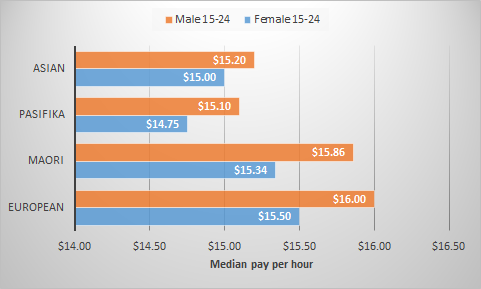
via New Zealand Income Survey 2014 via Human Rights Commission: Tracking Equality at Work
Celebrating humanity's flourishing through the spread of capitalism and the rule of law
29 Jul 2015 Leave a comment
in discrimination, gender, human capital, labour economics, labour supply, occupational choice, politics - New Zealand Tags: employer discrimination, ethnic wage gap, gender wage gap, racial discrimination, racial wage gap
via New Zealand Income Survey 2014 via Human Rights Commission: Tracking Equality at Work
28 Jul 2015 Leave a comment
in discrimination, economics of education, gender, human capital, labour economics, labour supply, occupational choice, politics - New Zealand Tags: gender wage gap
Figure 1: unadjusted median pay per hour by gender and age group, New Zealand, 2014

Source: New Zealand Income Survey 2014 via Human Rights Commission: Tracking Equality at Work.
28 Jul 2015 Leave a comment
in discrimination, economics of education, gender, human capital, labour economics, occupational choice Tags: College premium, education premium, gender wage gap
Men's and Women's Earnings by Education (Ph'Ds are the most equal) bit.ly/153m9jZ http://t.co/IPfT15Qwiz—
Catherine Mulbrandon (@VisualEcon) September 03, 2013
16 Jul 2015 Leave a comment
in discrimination, gender, human capital, labour economics, labour supply, occupational choice Tags: asymmetric marriage premium, economics of families, gender wage gap, motherhood penalty
#Women's earnings drop 20% after 1st child & gap remains the same even 20 years later @LSEEcon bit.ly/1M60KfJ http://t.co/UpoqLkhbl2—
STICERD (@STICERD_LSE) July 15, 2015
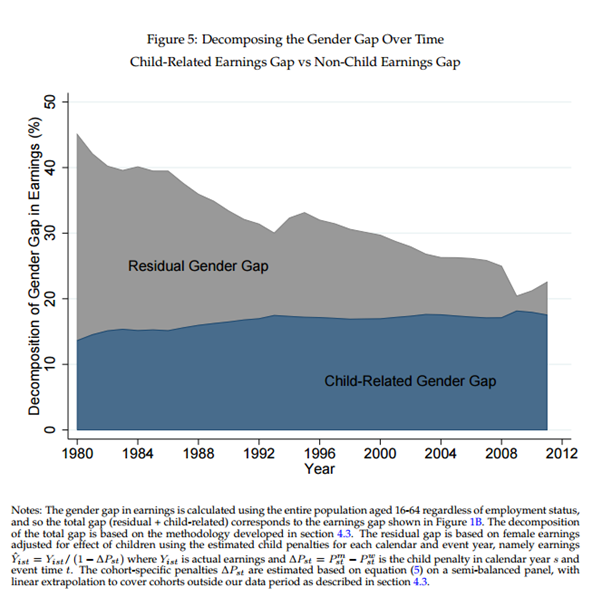
Source: Parenthood and the Gender Gap: Evidence from Denmark by Henrik Jacobsen Kleven, Camille Landais and Jakob Egholt Søgaard, University of Copenhagen January 2015 at http://eml.berkeley.edu/~webfac/auerbach/Landais2015.pdf
13 Jul 2015 Leave a comment
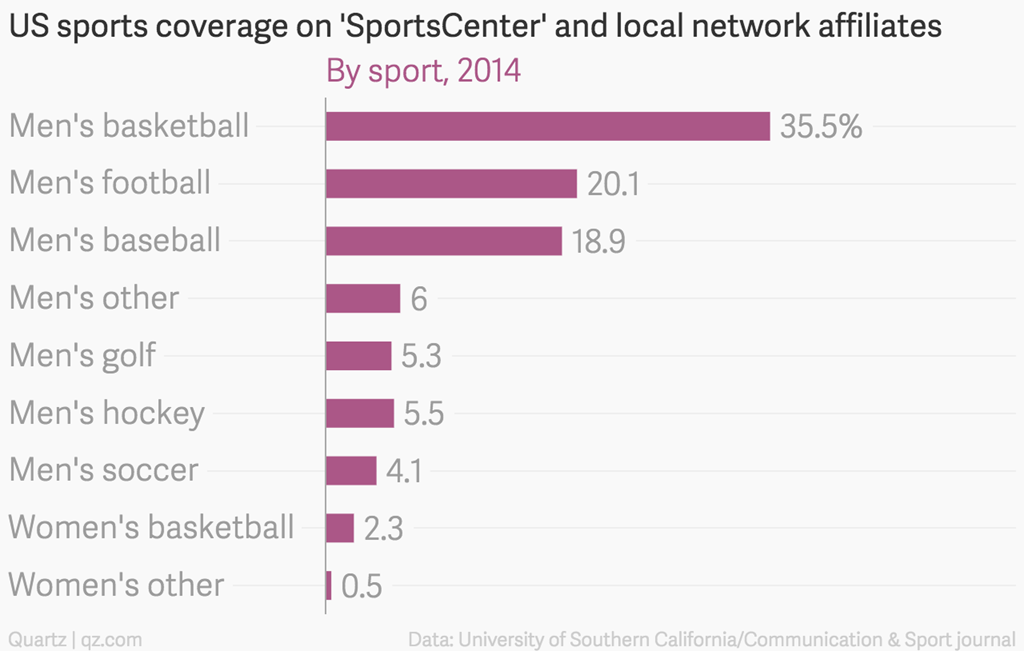
in applied price theory, discrimination, economics of media and culture, entrepreneurship, gender, industrial organisation, labour economics, occupational choice, sports economics, survivor principle Tags: gender wage gap, media bias, sex discrimination, superstar wages, superstars
12 Jul 2015 Leave a comment
in discrimination, economics of love and marriage, gender, labour economics, labour supply, law and economics, occupational choice, politics - USA, poverty and inequality Tags: asymmetric marriage premium, British economy, Canada, gender wage gap, marriage and divorce, motherhood penalty
Figure 1: Female/male earnings ratio by partner status and motherhood, 2004 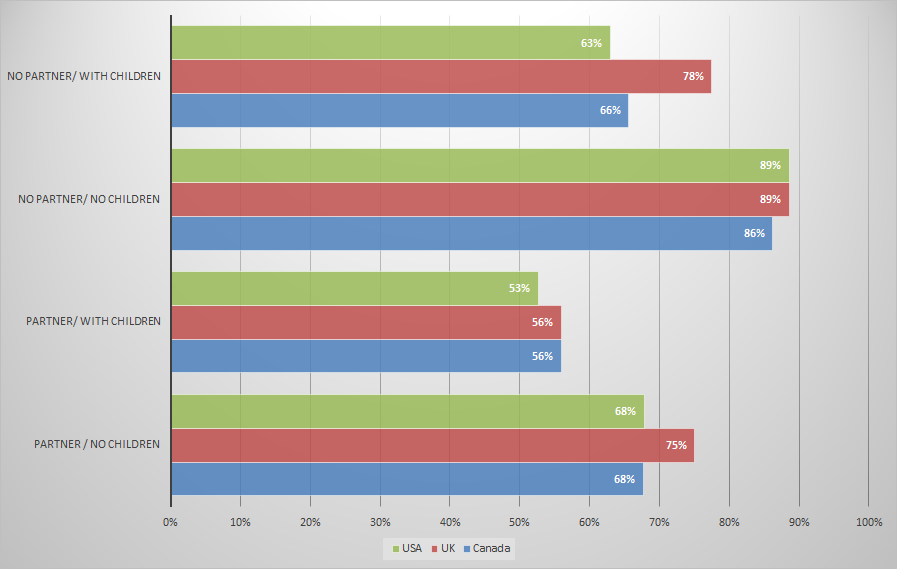 Source: LIS Cross-National Data Center in Luxembourg – Wave VI; individuals with positive earnings only. .
07 Jul 2015 Leave a comment
U.S. wage growth doesn't look as weak when you account for benefit costs covered by employers on.wsj.com/1JJ2EmV http://t.co/s0tJutTjBy—
Nick Timiraos (@NickTimiraos) July 06, 2015
04 Jul 2015 Leave a comment
in discrimination, economic history, gender, labour economics, politics - Australia, politics - New Zealand, politics - USA Tags: Australia, British economy, gender wage gap
Figure 1: Gender wage gap (unadjusted % difference between median wages of male and female full-time employees)
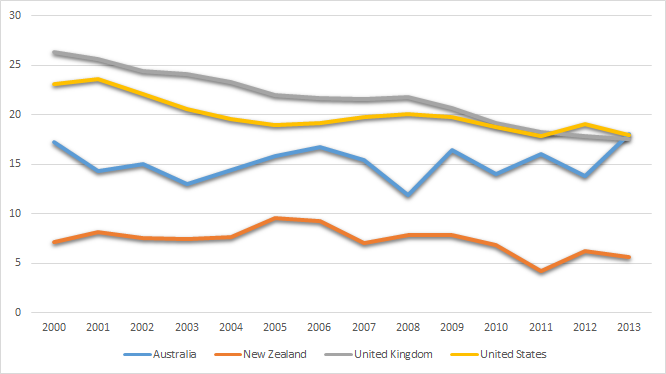
Source: OECD StatExtract.
30 Jun 2015 Leave a comment
in gender, health and safety, labour economics, labour supply, occupational choice Tags: College premium, compensating differentials, gender wage gap, graduate premium, reversing gender wage
30 Jun 2015 Leave a comment
in discrimination, economics of education, gender, human capital, labour economics, occupational choice Tags: economics of personality traits, gender wage gap, reversing gender gap
Figure 1: Percentage of tertiary degrees awarded in humanities and arts qualifications by gender, 2012
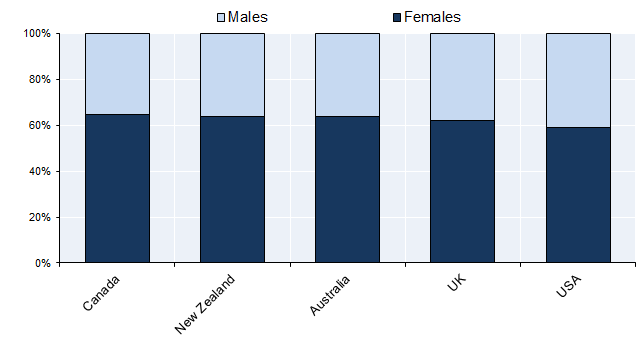
Source: OECD Education Database.
Figure 2: percentage of tertiary degrees awarded in computing qualifications by gender, 2012
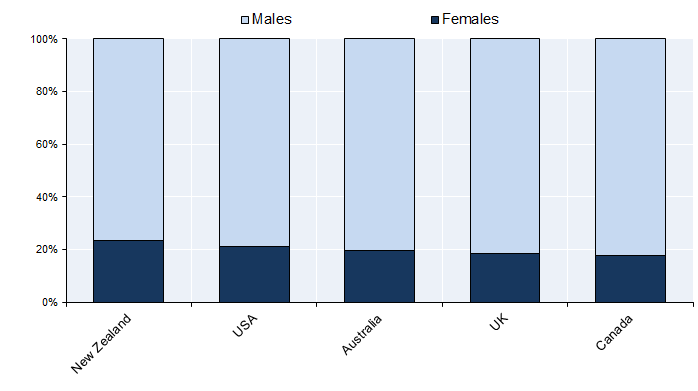
Source: OECD Education Database.
Figure 3: Percentage of tertiary degrees awarded in engineering, manufacturing and construction qualifications by gender, 2012
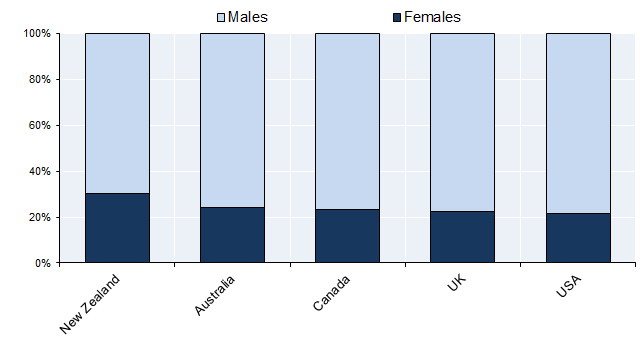
Source: OECD Education Database.
14 Jun 2015 Leave a comment
in discrimination, economics of education, gender, human capital, labour economics, labour supply, occupational choice, politics - Australia, politics - New Zealand, politics - USA Tags: Australia, British economy, Canada, College premium, education premium, gender wage gap, Ireland
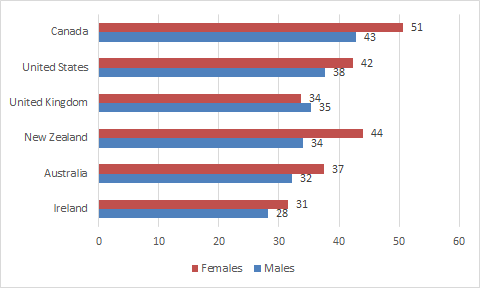
Figure 1: % population who have attained at least tertiary education, age 25 – 34 by gender (2012)
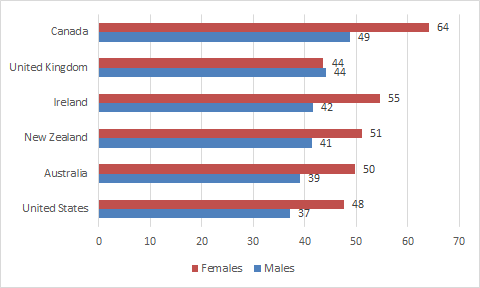
Source: OECD family database.
Figure 2 shows that the stark reversing of the gender gap in educational attainment shown in figure 1 was somewhat more recent in the US, UK and to a lesser extent in Ireland and Australia. In the UK and USA, educational attainment by gender was pretty equal for the earlier generation of graduates as compared to today’s 25 to 34-year-olds. The reversing of the gender gap in educational attainment dates back several decades in Canada and New Zealand.
Figure 2: % population who have attained at least tertiary education, age 45 – 54 by gender (2012)
Source: OECD family database.
13 Jun 2015 Leave a comment
in discrimination, gender, human capital, labour economics, labour supply, occupational choice, politics - Australia, politics - New Zealand, politics - USA, poverty and inequality Tags: asymmetric marriage premium, Australia, British economy, Canada, gender wage gap, Ireland, labour demographics, maternal labour supply
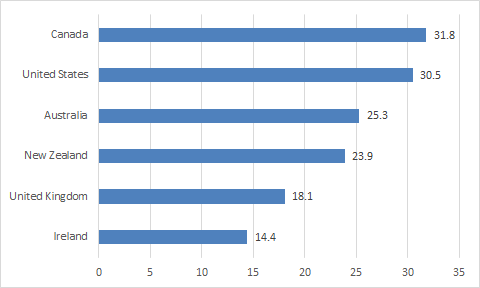
In another blow for the inherent inequality of bargaining power between workers and employers, and for the patriarchy, the wage gap is larger for tertiary educated female full-time workers aged 35-44 than it is for female full-time workers who just finished high school.
Figure 1: gender wage gap for mean full-time, full-year earnings for tertiary educated workers aged 35 – 44, 2012
Source: OECD family database.
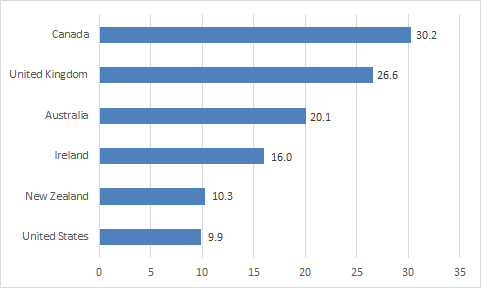
To add insult to injury, the gender wage gap further tertiary educated female workers is quite large in the USA but quite small for high school graduates.
Figure 2: gender wage gap for mean full-time, full-year earnings for below upper secondary educated workers aged 35 – 44, 2012
Source: OECD family database.
Canada seems to be a bit of a patriarchal hellhole while New Zealand does pretty well in gender wage gaps.
The gender gap in figure 1 and in figure 2 are unadjusted and calculated as the difference between mean average annual full-time, full-year earnings of men and of women as a percentage of men’s earnings.
12 Jun 2015 Leave a comment
in discrimination, gender, human capital, labour economics, labour supply, occupational choice, politics - Australia, politics - New Zealand, politics - USA Tags: Australia, British economy, Canada, gender wage gap, Ireland
If there is an inherent inequality of bargaining power between workers and employers, as we are so frequently lectured by those in the self appointed know, why is the gender wage gap so small at the bottom of the earnings distribution?
Figure 1: % Gender gap in full-time earnings at the bottom decile of earnings distribution, 2012

Source: OECD family database
Figure 2: % Gender gap in full-time earnings at the median decile of earnings distribution, 2012

Source: OECD family database
Figure 3: % Gender gap in full-time earnings at the top decile of earnings distribution, 2012

Source: OECD family database
The gender gaps are unadjusted, and are calculated as the difference between the earnings of men and women for their respective earnings percentile.
11 Jun 2015 Leave a comment
in discrimination, gender, human capital, labour economics, labour supply, occupational choice, politics - Australia, politics - New Zealand, politics - USA Tags: Australia, British economy, Canada, gender wage gap, Ireland
Figure 1: % gender gap in median earnings of full-time employees, 2012

Source: OECD family database
11 Jun 2015 Leave a comment
in discrimination, economics of education, gender, human capital, labour economics, labour supply, occupational choice, poverty and inequality Tags: gender wage gap, lost boys, reversing gender gap
Gender gap in bachelor's is 6 percentage points. Men now where women were a decade ago.
nces.ed.gov/programs/diges… http://t.co/u9rAsIcfY0—
S Dynarski (@dynarski) June 01, 2015
Celebrating humanity's flourishing through the spread of capitalism and the rule of law
Celebrating humanity's flourishing through the spread of capitalism and the rule of law
Celebrating humanity's flourishing through the spread of capitalism and the rule of law
Celebrating humanity's flourishing through the spread of capitalism and the rule of law
Celebrating humanity's flourishing through the spread of capitalism and the rule of law
Celebrating humanity's flourishing through the spread of capitalism and the rule of law
Celebrating humanity's flourishing through the spread of capitalism and the rule of law
A History of the Alt-Right
Econ Prof at George Mason University, Economic Historian, Québécois
Celebrating humanity's flourishing through the spread of capitalism and the rule of law
Scholarly commentary on law, economics, and more
Beatrice Cherrier's blog
Celebrating humanity's flourishing through the spread of capitalism and the rule of law
Celebrating humanity's flourishing through the spread of capitalism and the rule of law
Celebrating humanity's flourishing through the spread of capitalism and the rule of law
Why Evolution is True is a blog written by Jerry Coyne, centered on evolution and biology but also dealing with diverse topics like politics, culture, and cats.
Celebrating humanity's flourishing through the spread of capitalism and the rule of law
A rural perspective with a blue tint by Ele Ludemann
DPF's Kiwiblog - Fomenting Happy Mischief since 2003
Celebrating humanity's flourishing through the spread of capitalism and the rule of law
The world's most viewed site on global warming and climate change
Tim Harding's writings on rationality, informal logic and skepticism
A window into Doc Freiberger's library
Let's examine hard decisions!
Commentary on monetary policy in the spirit of R. G. Hawtrey
Thoughts on public policy and the media
Celebrating humanity's flourishing through the spread of capitalism and the rule of law
Politics and the economy
A blog (primarily) on Canadian and Commonwealth political history and institutions
Reading between the lines, and underneath the hype.
Economics, and such stuff as dreams are made on
"The British constitution has always been puzzling, and always will be." --Queen Elizabeth II
Celebrating humanity's flourishing through the spread of capitalism and the rule of law
Celebrating humanity's flourishing through the spread of capitalism and the rule of law
WORLD WAR II, MUSIC, HISTORY, HOLOCAUST
Undisciplined scholar, recovering academic
Celebrating humanity's flourishing through the spread of capitalism and the rule of law
Res ipsa loquitur - The thing itself speaks
In Hume’s spirit, I will attempt to serve as an ambassador from my world of economics, and help in “finding topics of conversation fit for the entertainment of rational creatures.”
Researching the House of Commons, 1832-1868
Articles and research from the History of Parliament Trust
Reflections on books and art
Posts on the History of Law, Crime, and Justice
Celebrating humanity's flourishing through the spread of capitalism and the rule of law
Exploring the Monarchs of Europe
Cutting edge science you can dice with



Recent Comments