
#GMO free but a late model car at speed pollutes less than their well-kept clunker at idle
10 Jun 2018 Leave a comment
in politics - New Zealand, transport economics, urban economics Tags: air pollution, Anti-Science left, green hypocrisy
New Zealand’s 16 flightless birds should count themselves lucky
13 May 2016 Leave a comment
in energy economics, environmental economics Tags: endangered specie, expressive voting, green hypocrisy, killer green technologies, Left-wing hypocrisy, rational irrationality, wind power
@GarethMP is least jet-setting of the @NZGreens
28 Apr 2016 Leave a comment
in politics - New Zealand Tags: green hypocrisy, Left-wing hypocrisy, New Zealand Greens, Parliamentary travel
Green MPs once again spent more than most MPs on air travel – oh, the carbon footprint! They spent considerably more on average than the Labour Party which has MPs all over the country including constituency MPs. There are no green constituency MPs. Gareth Hughes was the only Green MP to spend less than the Parliamentary all parties mean or median travel expenses for the last quarter. Indeed, he was the only Green MP to spend less than the Labour Party average spending for the last quarter on travel! Of the
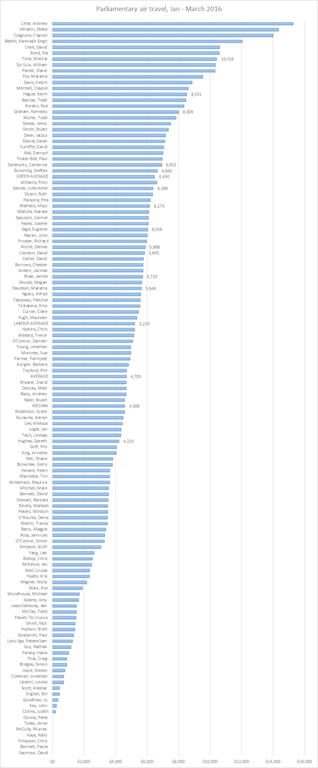
Source: New Zealand Parliament – Members’ Expense Disclosure from 1 January to 31 March 2016.
The irony of environmental protests
24 Oct 2015 Leave a comment
in environmental economics, environmentalism Tags: activists, do gooders, green hypocrisy, Left-wing hypocrisy
Who profits from #climatechange alarmism #COP21 and #roadtoparis
23 Aug 2015 Leave a comment
in applied price theory, environmental economics, environmentalism, global warming, labour economics, occupational choice, personnel economics, Public Choice, rentseeking Tags: bribery and corruption, conjecture and refutation, consultants, green hypocrisy, green rent seeking, Left-wing hypocrisy, public intellectuals
https://twitter.com/RogerAPielkeSr/status/627888796562927616/photo/1
A schematic of climate system from nap.edu/openbook.php?r… Changes are much more than changes in CO2 concentrations http://t.co/g8gs44UnN8—
Roger A. Pielke Sr (@RogerAPielkeSr) August 05, 2015
Turbine country versus fracking country
31 Jul 2015 Leave a comment
in energy economics, environmental economics, law and economics, property rights Tags: Big Wind, cracking, green hypocrisy, visual pollution, wind power
The time when the mass kidnappings of principled anti-war activists started has been uncovered
16 Jul 2015 Leave a comment
in politics - USA, Public Choice Tags: activists, anti-war movement, expressive voting, green hypocrisy, Left-wing hypocrisy, Leftover Left, mass kidnappings, peace movement


via What’s Wrong With the U.S. Peace Movement, Bryan Caplan | EconLog | Library of Economics and Liberty.
@oxfamnz @GreenpeaceNZ Further evidence of mass kidnappings of principled environmentalists – indoor pollution version
14 Jul 2015 1 Comment
in development economics, energy economics, environmentalism, growth disasters, growth miracles, health economics, Public Choice, rentseeking Tags: air pollution, climate alarmists, expressive voting, global warming, green hypocrisy, indoor pollution, Kuznets curve, rational irrationality, The Great Escape
The deadliest environmental problem today is indoor air pollution — killing 4 million a year. vox.com/2014/9/15/6150… http://t.co/xtwLRfkVF2—
Vox Maps (@VoxMaps) June 11, 2015
The killer air pollution that the Greens never mention
12 May 2015 Leave a comment
4.3 million die every year. Indoor air pollution is the least reported problem of the world. bit.ly/1BfMiZg http://t.co/CDhafWSbj8—
Max Roser (@MaxCRoser) May 07, 2015
Hypocritical Greens betray NZ sovereignty to US court decision but oppose investor state dispute settlement on sovereignty grounds
10 May 2015 Leave a comment
in defence economics, economics of crime, international economic law, international economics, International law, law and economics, politics - New Zealand, politics - USA Tags: foreign policy, free trade agreements, green hypocrisy, green party, investor state disputes settlement, national security, preferential trading agreements, war against terror
The Greens are happy to betray New Zealand’s sovereignty to a US court where New Zealand’s side of the story was not heard, New Zealand was not a litigant, New Zealand was not named in the proceedings and New Zealand had not agreed to waive its sovereign immunity under US law.
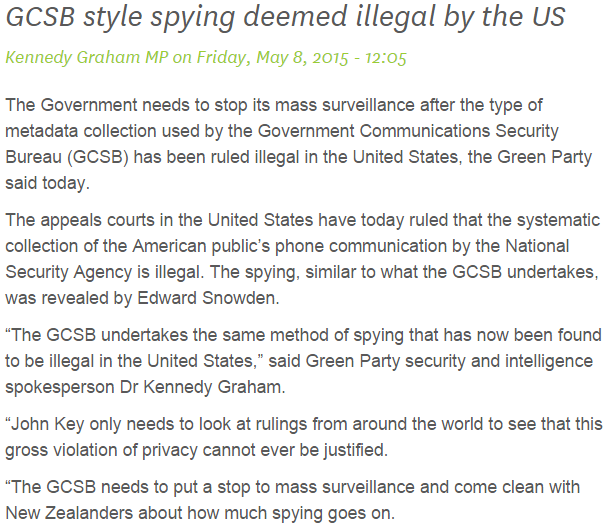
The Greens on the other hand are hysterical about the prospect of New Zealand voluntarily submitting to investor state disputes settlement through an international treaty. International treaties normally are about trading in sovereignty: you give up some form of sovereignty return for something you value more.
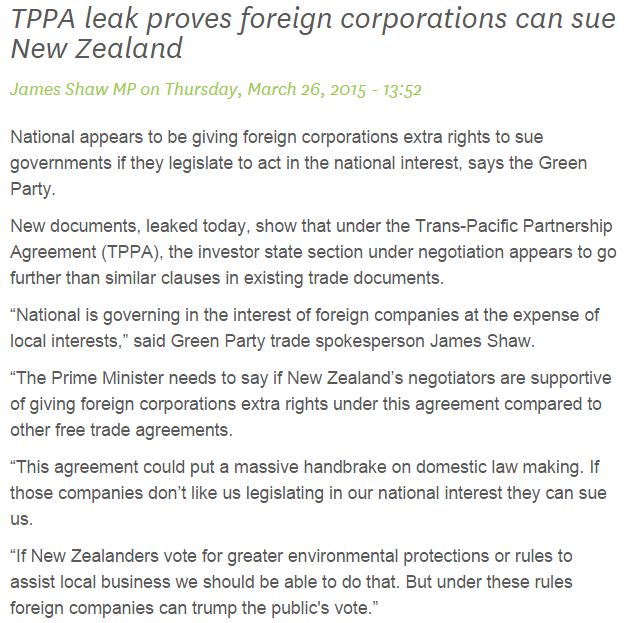
It is thoroughly hypocritical of the Greens to argue the New Zealand should bow down to a foreign court when that court rules in a way that it favours its ideological agenda but refuse to support the principle of international arbitration in circumstances where that may advance New Zealand’s national interests.
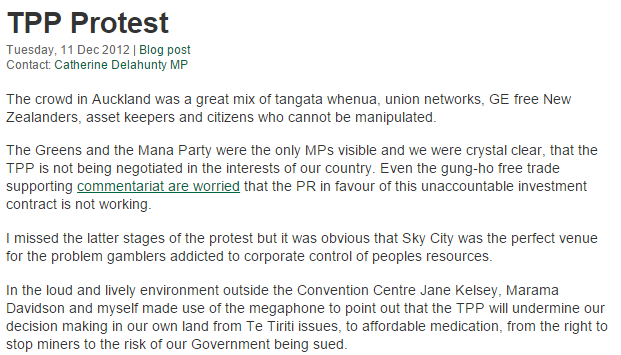
At a minimum, New Zealand itself chose to give up its sovereignty if it agrees to investor state dispute settlement in a trade agreement. The decision was not imposed by a foreign court where it was not heard nor was a party.


Of particular concern to the Greens is international arbitration could "trump the public’s vote vote". New Zealand has repeatedly elected parties that support the alliance with America, and support a robust security and intelligence policy, including electronic surveillance as part of the war on terror.
The last week of the 2014 general election campaign was dominated by the Government Security Communications Bureau and its cooperation with the National Security Agency and the extent to which New Zealand security services engaged in electronic surveillance in New Zealand and abroad.
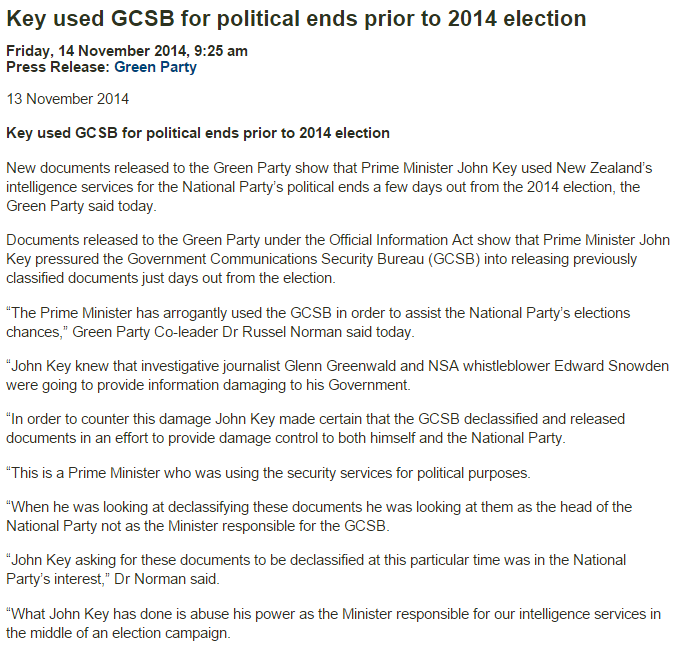
The Greens want to subvert that democratic decision that has been repeated over many New Zealand elections about national security and foreign relations to defer to an American court when New Zealand didn’t even appear as a party.

The US Court of appeal was deciding an issue of statutory interpretation of the Patriot Act. There was no constitutional issues at hand.
The Patriot Act expires in a month unless it is extended. Congress has ample opportunity to amend the renewed law to overturn the appeal court’s decision for the future operation of its security and intelligence laws.
The Greens want a Court of Appeal interpretation of the American Patriot Act to extend to New Zealand without a vote of the New Zealand people or the parliament having any say on whether to give up New Zealand’s sovereignty or waive sovereign immunity in American courts.
.
More evidence of mass kidnapping of environmental activists
08 Apr 2015 Leave a comment
in environmental economics, environmentalism, international economic law, international economics, International law, law and economics, politics - Australia, politics - New Zealand, politics - USA Tags: green hypocrisy, ozone layer
/cdn0.vox-cdn.com/uploads/chorus_asset/file/3577778/ozone_composite.0.png)
Why aren’t they in the streets celebrating the recovery of the ozone layer, pursuant to an international treaty negotiated by the Reagan administration that banned CFCs as soon as they were not required any longer in developed countries:
International efforts to control the gases, particularly among developed countries, began to occur in the mid-1980s as new information appeared that strengthened the link between CFCs and the deterioration of stratospheric ozone. This increased the expected benefits of international action.
At the same time, domestic political opposition began to diminish when Du Pont announced they would no longer make CFCs. A reason for Du Pont’s attitude change was that European firms had increased their share of the CFC market, and in response Du Pont had developed CFC substitutes.
Accordingly, since international controls on CFCs provided them a competitive advantage, Du Pont announced that they would no longer make CFCs and the company lobbied the U.S. Congress for international regulation.
Under the 1987 Montreal Protocol, world leaders agreed to phase out CFCs, and eventually the hole in the ozone layer stopped expanding. In 2014, a UN assessment found that the ozone layer is just now starting to heal — and should be back to its 1980 levels by 2050 or so.
Wind power is bad for the environment
07 Apr 2015 Leave a comment
in environmental economics, global warming Tags: climate alarmism, endangered species, green hypocrisy, killer green technologies
The mass kidnappings of environmental activists has extended to Europe
06 Apr 2015 Leave a comment
in environmental economics, environmentalism Tags: activists, capitalism and freedom, do gooders, green hypocrisy
Europe is getting greener.
Here is the comparison between today and 1900. http://t.co/GFMXD6Bd6c—
Max Roser (@MaxCRoser) March 15, 2015
There is no other explanation for why they are not dancing in the streets to celebrate the greening of Europe under capitalism and freedom.
How Costa Rica went 75 days without using fossil fuels for electricity
26 Mar 2015 Leave a comment
in energy economics, environmental economics, global warming Tags: green hypocrisy, hydroelectricity, renewable energy, renewable resources
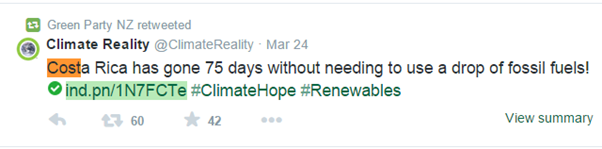
The New Zealand Greens happily retweeted that Costa Rica had not used a drop of fossil fuels for 75 days.

My first experiences with the environmental movement was through their opposition to the building of dams in south-west Tasmania. Maybe they have rehabilitated dams as a permissible energy source?
/cdn0.vox-cdn.com/uploads/chorus_asset/file/3539398/Costa_Rica_electricity.0.png)
via How Costa Rica went 75 days without using fossil fuels for electricity – Vox.
It’s the Trend, Stupid
25 Mar 2015 1 Comment
in econometerics, environmental economics Tags: climate alarmism, conjecture and refutation, double standards, green hypocrisy
If I had a dollar for every time a climate alarmist talked about how hot this summer was or how strong that cyclone was is evidence of global warming, I’d be a rich man.
They can’t then go around saying a sample size of 17 years is too short to assess trends will show evidence of global warming when they routinely use a sample of one for their own global warming alarmism.
Naturally, such is the high stakes of the never admit you’re wrong, never concede anything public political discourse of these days, if a fellow traveller oversteps the mark, you gain nothing from calling him out as someone who overstepped the mark.
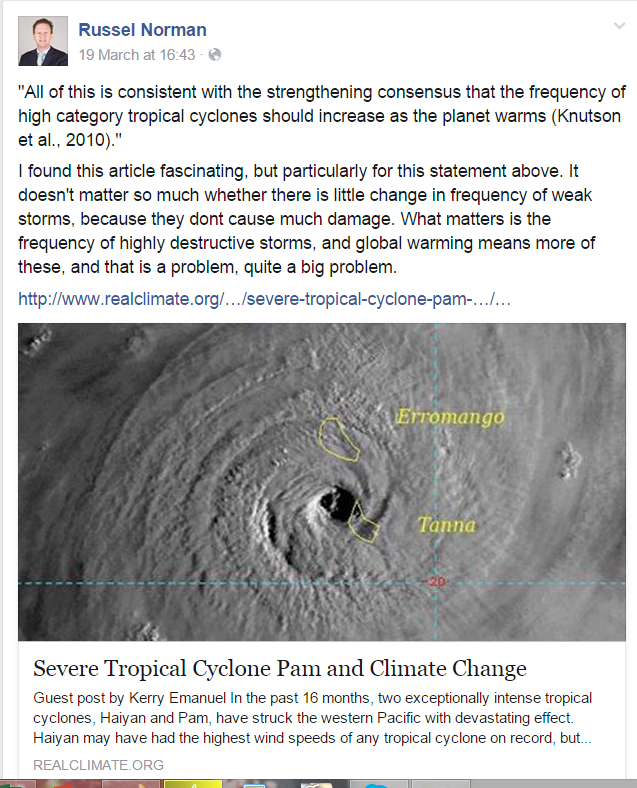

Both NASA and NOAA report 2014 as the hottest year on record. Despite the new #1, neither the news itself nor the response to it has surprised me.
View original post 632 more words
 Utopia, you are standing in it!
Recent Comments