Which U.S. cities are seeing rents eat more and more of your paycheck on.wsj.com/1VMhGft http://t.co/I5cwc7VmfZ—
Nick Timiraos (@NickTimiraos) July 29, 2015
Housing affordability in the USA in recent decades
30 Oct 2015 Leave a comment
in politics - USA, urban economics Tags: housing affordability, land prices, land supply, NIMBYs, zoning
German, French and Italian real housing prices since 1975
19 Oct 2015 Leave a comment
in applied price theory, applied welfare economics, economic history, economics of regulation, rentseeking, urban economics Tags: France, Germany, housing affordability, housing prices, Italy, land supply, land use planning, zoning
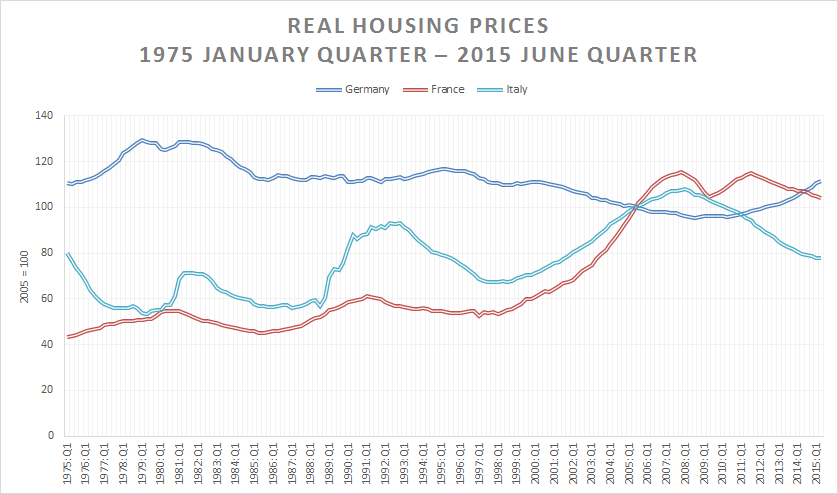
Source and notes: International House Price Database – Dallas Fed June 2015; nominal housing prices for each country is deflated by the personal consumption deflator for that country.
@AndrewLittleMP @jamespeshaw @BillEnglishMP Real housing prices New Zealand, Australia & USA: 1975 January quarter – 2015 June quarter
17 Oct 2015 Leave a comment
in economic history, economics of regulation, politics - Australia, politics - New Zealand, politics - USA, rentseeking, urban economics Tags: green rentseeking, housing affordability, land supply, New Zealand Greens, New Zealand Labour Party, RMA
mg src=”https://utopiayouarestandinginit.com/wp-content/uploads/2015/10/101715_0817_andrewlittl1.png” alt=”” />
Source and notes: International House Price Database – Dallas Fed June 2015; nominal housing prices for each country is deflated by the personal consumption deflator for that country.
New Zealand housing prices were pretty stable until the passage of the Resource Management Act in 1993. After that, prices took off New Zealand and didn’t slow that much for the recession subsequent to the Global Financial Crisis.
American prices just had a bubble because of loose monetary policy by the Fed and loose lending criteria by banks at the behest of regulators. Real housing prices in the USA started to rise again last year after a dramatic fall.
Australian prices were rising steadily until about 2000 but then took off with a strong economy and the usual restrictions on land supply by local governments at the behest of the existing homeowners.
Increase in the Cost of Housing in the US 1901-2002
12 Oct 2015 Leave a comment
in economic history, politics - USA, urban economics Tags: housing affordability, housing prices, land prices, land supply, land use planning, zoning
Increase in the Cost of Housing in the US 1901-2002 bit.ly/195NbKb http://t.co/kt7pmOFPVi—
Catherine Mulbrandon (@VisualEcon) August 25, 2014
Will Auckland become like San Francisco?
10 Oct 2015 1 Comment
in economic history, economics of regulation, environmental economics, politics - New Zealand, politics - USA, urban economics Tags: Auckland, housing affordability, land supply, land use planning, RMA, San Francisco, zoning
https://twitter.com/JoshZumbrun/status/652517712070082561/photo/1
"Your neighborhood could be next." San Francisco-wide mailer in support of Prop I, the Mission housing moratorium. http://t.co/PtN38JTaUM—
Jed Kolko (@JedKolko) October 10, 2015
@sival84 @MarketUrbanism @SFyimby More for thought: Permits vs prices for top ten tech hubs trulia.com/blog/trends/pr… http://t.co/yRvjVWDova—
Ralph B. McLaughlin (@housingnomix) October 01, 2015
NZ Home ownership, 1916–2013
21 Sep 2015 Leave a comment
in economic history, politics - New Zealand, urban economics Tags: homeownership, housing affordability

Generation Rent comes to Scandinavia in lockstep – real housing prices in #Finland, #Sweden & #Norway since 1975
17 Sep 2015 Leave a comment
in economic history, urban economics Tags: Finland, Generation Rent, housing affordability, housing prices, land supply, land use planning, NIMBYs, Norway, Sweden, zoning
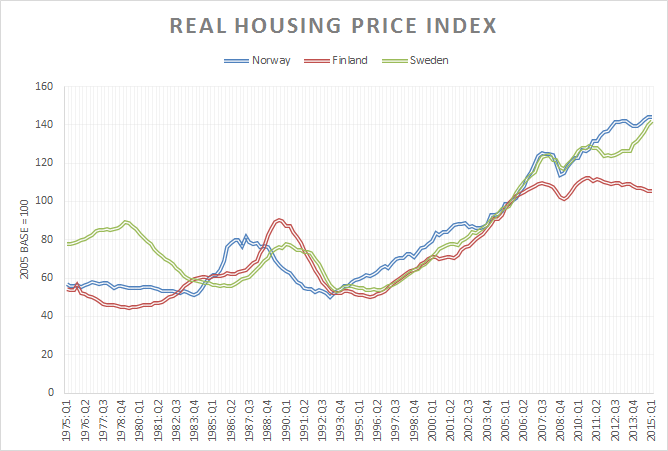
Source: International House Price Database – Dallas Fed
Note: The house price index series is an index constructed with nominal house price data. The real house price index is an index calculated by deflating the nominal house price series with a country’s personal consumption expenditure deflator.
No Generation Rent in #Nihon – real housing prices in #Japan and #SouthKorea since 1975
16 Sep 2015 Leave a comment
in development economics, economic history, growth miracles, urban economics Tags: Generation Rent, housing affordability, housing prices, Japan, land supply, land use planning, NIMBYs, South Korea, zoning
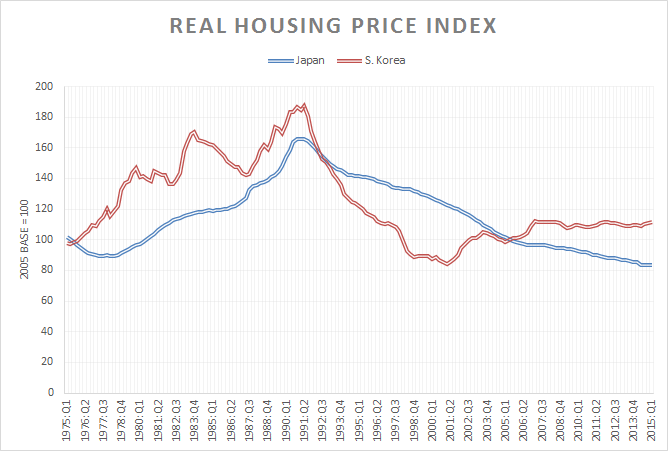
Source: International House Price Database – Dallas Fed
Note: The house price index series is an index constructed with nominal house price data. The real house price index is an index calculated by deflating the nominal house price series with a country’s personal consumption expenditure deflator.
Real housing prices in Australia and New Zealand since 1975
15 Sep 2015 Leave a comment
in politics - Australia, politics - New Zealand, urban economics Tags: Australia, housing affordability, housing prices, land supply, land use planning, NIMBYs, zoning
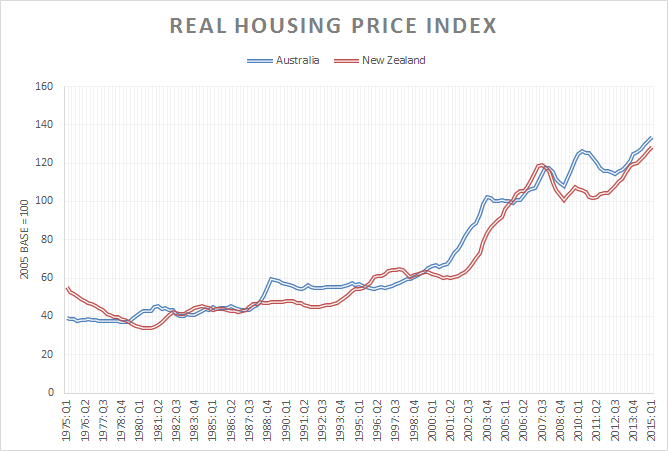
Source: International House Price Database – Dallas Fed
Note: The house price index series is an index constructed with nominal house price data. The real house price index is an index calculated by deflating the nominal house price series with a country’s personal consumption expenditure deflator
No Generation Rent in #Deutschland! Real housing prices in #Germany, #France & #Italy since 1975
14 Sep 2015 Leave a comment
in economic history, urban economics Tags: France, Generation Rent, Germany, housing affordability, housing prices, Italy, land supply, land use planning, NIMBYs, zoning
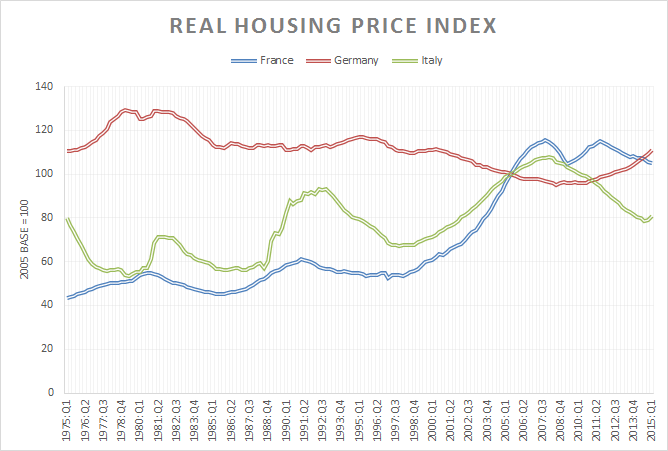
Source: International House Price Database – Dallas Fed
Note: The house price index series is an index constructed with nominal house price data. The real house price index is an index calculated by deflating the nominal house price series with a country’s personal consumption expenditure deflator.
US and UK Real Housing Price Index, 1975 – 2015
13 Sep 2015 Leave a comment
in economic history, economics of regulation, politics - USA, urban economics Tags: British economy, British politics, housing affordability, housing prices, land supply, land use planning, NIMBYs, zoning

Source: International House Price Database – Dallas Fed
Note: The house price index series is an index constructed with nominal house price data. The real house price index is an index calculated by deflating the nominal house price series with a country’s personal consumption expenditure deflator.
Much higher house prices and the political sustainability of a return of inflation
13 Sep 2015 1 Comment
in business cycles, economic history, global financial crisis (GFC), inflation targeting, macroeconomics, monetary economics, politics - New Zealand, urban economics Tags: expressive voting, housing affordability, inflation rates, median voter theorem, mortgage belt, mortgage rates, rational ignorance, rational rationality
Mortgage interest rates were last in the double digits in the late 1980s and early 1990s. Since then, housing prices have exploded in New Zealand and barely paused for the recession in the wake of the Global Financial Crisis.
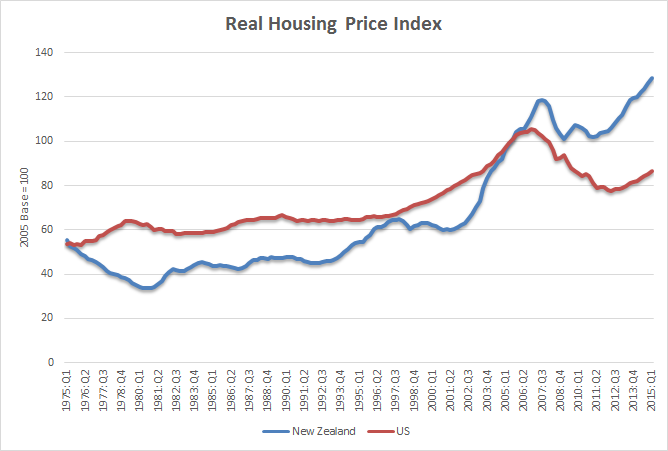
Source: International House Price Database – Dallas Fed; Housing prices deflated by personal consumption expenditure deflator.
With house prices and mortgages several times what they used to be, the ability for any household income to absorb the sudden return of high mortgage interest rates because of a return of even moderate CPI inflation and double-digit mortgage rates is well-nigh impossible, politically.
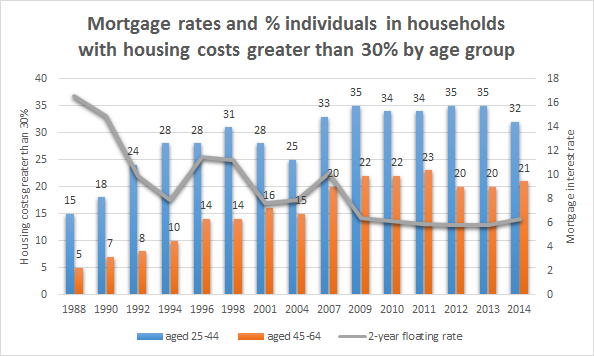
Source: Reserve Bank of New Zealand Mortgage rates and Bryan Perry, Household Incomes in New Zealand: trends in indicators of inequality and hardship 1982 to 2014 – Ministry of Social Development, Wellington (August 2015) Table C.5.
The chart above shows that the number of 25 to 44-year-olds in New Zealand who have more than 30% of their income going to housing expenses has doubled since 1988 to nearly a third of all households. The number of 45 to 64-year-olds who pay more than 30% of their income in housing expenses has quadrupled to 20%. That is a lot of voters who would be offended by mismanagement of monetary policy.
None of these households would have much left over to absorb an increasing mortgage interest rates. That is very different political arithmetic too the last time both mortgage rates and CPI inflation were in double digits, which was more than 20 years ago. Not many New Zealanders under the age of 40 or 45 have an adult memory of high inflation and high mortgage rates.
@metiria @NZGreens child poverty is driven by housing unaffordability – by Green opposition to RMA reform
13 Aug 2015 1 Comment
in applied welfare economics, economic history, economics of regulation, labour economics, politics - New Zealand, poverty and inequality, urban economics Tags: antimarket bias, child poverty, expressive voting, family poverty, green rent seeking, housing affordability, land use planning, Leftover Left, New Zealand Greens, NIMBYs, rational ignorance, rational irrationality, RMA, zoning
#moreinclusivenz @povertymonitor Killer graphs & #infographics by NZ Children's Commissioner. Shameful content, NZ http://t.co/mG987C5kh0—
Isabella Cawthorn (@fixiebelle) July 26, 2015
Nothing much has happening to child poverty before housing costs in New Zealand since the early 1980s. It is after housing costs poverty that is crucifying the children in New Zealand.
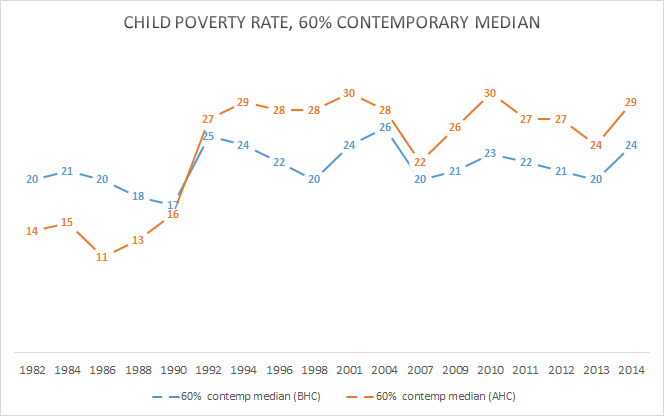
Source: Bryan Perry, Household Incomes in New Zealand: trends in indicators of inequality and hardship 1982 to 2014 – Ministry of Social Development, Wellington (August 2015), Table F6 and table F7.
An economy that is not working for all of us, is simply not working. http://t.co/zZu0LOy7ED—
Green Party NZ (@NZGreens) August 13, 2015
From HES 2013 to HES 2014 median household income rose 5% in real terms (5% above the CPI inflation rate)…
On the AHC moving line measures, child poverty rates in HES 2014 are around the same as their peak after the GFC. A good amount of the rise from HES 2013 to HES 2014 is due to the large rise in the BHC median, as noted above, rather than a change in the numbers in low income per se.
The parties that oppose measures to increase the supply of land and reduce the cost of housing through reform of the Resource Management Act and its many restraints on the supply of land are the New Zealand Labour Party and New Zealand Greens.
Children's views on poverty #childpovertynz occ.org.nz/assets/Uploads… http://t.co/wZHJ19QcpN—
Child Poverty NZ (@povertymonitor) September 08, 2015
Liberal voting cities markets have higher income inequality and worse affordability
12 Aug 2015 Leave a comment
in politics - New Zealand, politics - USA, Public Choice, rentseeking, urban economics Tags: Director's Law, expressive boating, green rent seeking, housing affordability, land supply, land use planning, Left-wing hypocrisy, NIMBYs, rational ignorance, rational irrationality, zoning
All homeowners have an incentive to stop new housing because if developers build too many homes, prices fall, and housing is many families’ main asset. But in cities with many Democrats and Green Party members, environmental concerns might also be a factor. The movement might be too eager to preserve the past.

via Why Middle-Class Americans Can’t Afford to Live in Liberal Cities – The Atlantic.
The decline of home ownership in the USA
16 Jun 2015 1 Comment
in economics of regulation, politics - USA, urban economics Tags: home ownership, housing affordability, lamb supply, land use planning, zoning
Home ownership rate, down to level of 20 yrs-ago, is headed even lower, says @NickTimiraos on.wsj.com/1IvwgDA http://t.co/2GeP3VIZzE—
Greg Ip (@greg_ip) June 08, 2015
 Utopia, you are standing in it!

Recent Comments