
Source: Investigation: People shot and killed by police this year – Washington Post.
Celebrating humanity's flourishing through the spread of capitalism and the rule of law
07 Mar 2016 Leave a comment
in economics of crime, politics - USA Tags: crime and punishment, criminal deterrence, law and order, police killings
23 Feb 2016 Leave a comment
in economics of crime, law and economics, politics - New Zealand Tags: criminal deterrence, law and order, police chases, police killings, road safety

Source: Rodney Hide, “Pursuit culture skews police priorities”, National Business Review, 19 February 2016, p.28.
22 Feb 2016 Leave a comment
in economics of crime, law and economics, politics - New Zealand Tags: criminal deterrence, law and order, police chases, police killings
Rodney Hide found that one in four New Zealand police chases ends in a crash. Of the 137 police pursuits that ended in death or serious injury between 2003 and 2008 there are 9 violence charges. Six were for manslaughter – all caused by crashes that ended the chase. There was also one charge of murder relating to the crash at the end of the chase. No violence charges arose from information known at the time of the start of the police chase. There was ambiguous information about a charge of kidnapping after a police chase. I could not determine if this kidnapping was known at the time the police chase started and therefore was its motive.

Source: Rodney Hide, “Pursuit culture skews police priorities”, National Business Review, 19 February 2016, p.28.
In all, 13 of the 137 police chases were motivated by the fleeing driver having committed a crime. The most serious of these was burglary. Rodney Hide also found that between 2005 and 2008 there are an average of 182 police chases a month.
I am all for police chasing kidnappers and armed criminals brandishing their weapons. As for the rest, they are not serious offenders. Chasing them puts the public at risk. Most of the fleeing drivers and their passengers are enthusiastic applicants for the Darwin awards.
01 Feb 2016 Leave a comment
in economics of crime, law and economics, politics - USA Tags: law and order, police shootings
12 Jan 2016 Leave a comment
in economics of crime, law and economics Tags: crime and punishment, law and order
12 Jan 2016 Leave a comment
in economics of crime, law and economics Tags: crime and punishment, law and order
Why are assault rates so low in the USA that they are next to Japan?
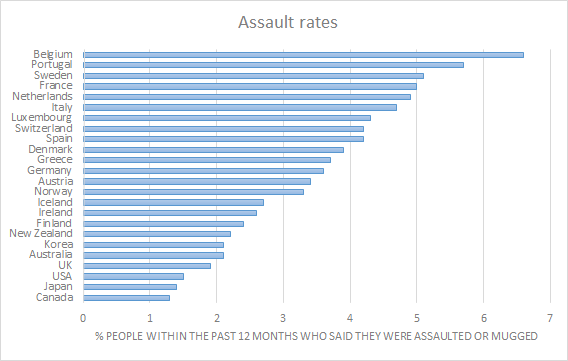
Data extracted on 08 Jan 2016 21:44 UTC (GMT) from OECD.Stat
08 Jan 2016 Leave a comment
in economics of crime, law and economics, politics - USA Tags: crime and punishment, law and order, tasers
06 Jan 2016 Leave a comment
in economics of crime, law and economics, politics - USA Tags: crime and punishment, law and order, police shootings
Despite what you see on TV, surprisingly few unarmed people are shot because they are reaching for a weapon. Most unarmed suspects shot by police last year were resisting arrest. A few were killed in crossfire or by mistake. The chart below does not include unarmed Blacks who were attacking police when they were shot and killed according to Washington Post database.

06 Jan 2016 Leave a comment
in economics of crime, law and economics, politics - USA Tags: crime and punishment, law and order, police shootings
05 Jan 2016 1 Comment
in economics of crime, politics - USA Tags: law and order, police shootings
28 Dec 2015 Leave a comment
in economics of crime, law and economics Tags: law and order
28 Dec 2015 Leave a comment
in economics of crime, law and economics, occupational choice Tags: law and order, New York City
09 Dec 2015 Leave a comment
in economic history, economics of crime, law and economics, politics - New Zealand Tags: crime and punishment, law and order
20 Nov 2015 Leave a comment
in economics of crime, law and economics, politics - New Zealand, politics - USA Tags: battered woman's defence, crime and punishment, criminal deterrence, criminal procedure, Justice Michael Kirby, law and order
Celebrating humanity's flourishing through the spread of capitalism and the rule of law
Celebrating humanity's flourishing through the spread of capitalism and the rule of law
Celebrating humanity's flourishing through the spread of capitalism and the rule of law
Celebrating humanity's flourishing through the spread of capitalism and the rule of law
Celebrating humanity's flourishing through the spread of capitalism and the rule of law
Celebrating humanity's flourishing through the spread of capitalism and the rule of law
Celebrating humanity's flourishing through the spread of capitalism and the rule of law
Celebrating humanity's flourishing through the spread of capitalism and the rule of law
Celebrating humanity's flourishing through the spread of capitalism and the rule of law
A History of the Alt-Right
Econ Prof at George Mason University, Economic Historian, Québécois
Celebrating humanity's flourishing through the spread of capitalism and the rule of law
Scholarly commentary on law, economics, and more
Beatrice Cherrier's blog
Celebrating humanity's flourishing through the spread of capitalism and the rule of law
Celebrating humanity's flourishing through the spread of capitalism and the rule of law
Celebrating humanity's flourishing through the spread of capitalism and the rule of law
Why Evolution is True is a blog written by Jerry Coyne, centered on evolution and biology but also dealing with diverse topics like politics, culture, and cats.
Celebrating humanity's flourishing through the spread of capitalism and the rule of law
A rural perspective with a blue tint by Ele Ludemann
DPF's Kiwiblog - Fomenting Happy Mischief since 2003
Celebrating humanity's flourishing through the spread of capitalism and the rule of law
The world's most viewed site on global warming and climate change
Tim Harding's writings on rationality, informal logic and skepticism
A window into Doc Freiberger's library
Let's examine hard decisions!
Commentary on monetary policy in the spirit of R. G. Hawtrey
Thoughts on public policy and the media
Celebrating humanity's flourishing through the spread of capitalism and the rule of law
Politics and the economy
A blog (primarily) on Canadian and Commonwealth political history and institutions
Reading between the lines, and underneath the hype.
Economics, and such stuff as dreams are made on
"The British constitution has always been puzzling, and always will be." --Queen Elizabeth II
Celebrating humanity's flourishing through the spread of capitalism and the rule of law
Celebrating humanity's flourishing through the spread of capitalism and the rule of law
WORLD WAR II, MUSIC, HISTORY, HOLOCAUST
Undisciplined scholar, recovering academic
Celebrating humanity's flourishing through the spread of capitalism and the rule of law
Res ipsa loquitur - The thing itself speaks
In Hume’s spirit, I will attempt to serve as an ambassador from my world of economics, and help in “finding topics of conversation fit for the entertainment of rational creatures.”
Researching the House of Commons, 1832-1868
Reflections on books and art
Posts on the History of Law, Crime, and Justice
Celebrating humanity's flourishing through the spread of capitalism and the rule of law
Exploring the Monarchs of Europe




Recent Comments