Crime way down in NYC
28 Dec 2015 Leave a comment
in economics of crime, law and economics, occupational choice Tags: law and order, New York City
Crime has been trending downwards for 20 years in New Zealand
09 Dec 2015 Leave a comment
in economic history, economics of crime, law and economics, politics - New Zealand Tags: crime and punishment, law and order
@amyadamsMP Justice Michael Kirby on the battered woman’s defence
20 Nov 2015 Leave a comment
in economics of crime, law and economics, politics - New Zealand, politics - USA Tags: battered woman's defence, crime and punishment, criminal deterrence, criminal procedure, Justice Michael Kirby, law and order

@amyadamsMP Bias in the battered women’s syndrome as a defence for murder
18 Nov 2015 Leave a comment
in economics of crime, law and economics, politics - Australia, politics - New Zealand Tags: battered woman's defence, crime and punishment, criminal deterrence, criminal procedure, Justice Michael Kirby, law and order

Psychopaths versus sociopaths: what is the difference? by Xanthe Mallett
05 Nov 2015 Leave a comment
in applied price theory, economics of crime, law and economics Tags: crime and punishment, criminal deterrence, criminal psychiatry, economics of personality traits, law and order, psychopaths, sociopaths
Psychopath and sociopath are popular psychology terms to describe violent monsters born of our worst nightmares. Think Hannibal Lecter in Silence of the Lambs (1991), Norman Bates in Psycho (1960) and Annie Wilkes in Misery (1990). In making these characters famous, popular culture has also burned the words used to describe them into our collective consciousness.
Most of us, fortunately, will never meet a Hannibal Lecter, but psychopaths and sociopaths certainly do exist. And they hide among us. Sometimes as the most successful people in society because they’re often ruthless, callous and superficially charming, while having little or no regard for the feelings or needs of others.
These are known as “successful” psychopaths, as they have a tendency to perform premeditated crimes with calculated risk. Or they may manipulate someone else into breaking the law, while keeping themselves safely at a distance. They’re master manipulators of other peoples’ feelings, but are unable to experience emotions themselves.
Sound like someone you know? Well, heads up. You do know one; at least one. Prevalence rates come in somewhere between 0.2% and 3.3% of the population.
If you’re worried about yourself, you can take a quiz to find out, but before you click on that link let me save you some time: you’re not a psychopath or sociopath. If you were, you probably wouldn’t be interested in taking that personality test.
You just wouldn’t be that self-aware or concerned about your character flaws. That’s why both psychopathy and sociopathy are known as anti-social personality disorders, which are long-term mental health conditions.

Although most of us will never meet someone like Hannibal Lecter from Silence of the Lambs, we all know at least one sociopath. from shutterstock.com
What’s the difference?
Psychopaths and sociopaths share a number of characteristics, including a lack of remorse or empathy for others, a lack of guilt or ability to take responsibility for their actions, a disregard for laws or social conventions, and an inclination to violence. A core feature of both is a deceitful and manipulative nature. But how can we tell them apart?
Sociopaths are normally less emotionally stable and highly impulsive – their behaviour tends to be more erratic than psychopaths. When committing crimes – either violent or non-violent – sociopaths will act more on compulsion. And they will lack patience, giving in much more easily to impulsiveness and lacking detailed planning.
Psychopaths, on the other hand, will plan their crimes down to the smallest detail, taking calculated risks to avoid detection. The smart ones will leave few clues that may lead to being caught. Psychopaths don’t get carried away in the moment and make fewer mistakes as a result.
Both act on a continuum of behaviours, and many psychologists still debate whether the two should be differentiated at all. But for those who do differentiate between the two, one thing is largely agreed upon: psychiatrists use the term psychopathy to illustrate that the cause of the anti-social personality disorder is hereditary. Sociopathy describes behaviours that are the result of a brain injury, or abuse and/or neglect in childhood.
Psychopaths are born and sociopaths are made. In essence, their difference reflects the nature versus nurture debate.
There’s a particularly interesting link between serial killers and psychopaths or sociopaths – although, of course, not all psychopaths and sociopaths become serial killers. And not all serial killers are psychopaths or sociopaths.

Thomas Hemming murdered two people in 2014 just to know what it felt like to kill. Tracey Nearmy/AAP Image
But America’s Federal Bureau of Investigation (FBI) has noted certain traits shared between known serial killers and these anti-social personality disorders. These include predatory behaviour (for instance, Ivan Milat, who hunted and murdered his seven victims); sensation-seeking (think hedonistic killers who murder for excitement or arousal, such as 21-year-old Thomas Hemming who, in 2014, murdered two people just to know what it felt like to kill); lack of remorse; impulsivity; and the need for control or power over others (such as Dennis Rader, an American serial killer who murdered ten people between 1974 and 1991, and became known as the “BTK (bind, torture, kill) killer”).
A case study
The Sydney murder of Morgan Huxley by 22-year-old Jack Kelsall, who arguably shows all the hallmarks of a psychopath, highlights the differences between psychopaths and sociopaths.
In 2013, Kelsall followed Huxley home where he indecently assaulted the 31-year-old before stabbing him 28 times. Kelsall showed no remorse for his crime, which was extremely violent and pre-meditated.
There’s no doubt in my mind he’s psychopathic rather than sociopathic because although the murder was frenzied, Kelsall showed patience and planning. He had followed potential victims before and had shared fantasies he had about murdering a stranger with a knife with his psychiatrist a year before he killed Huxley, allegedly for “the thrill of it”.
Whatever Kelsall’s motive, regardless of whether his dysfunction was born or made, the case stands as an example of the worst possible outcome of an anti-social personality disorder: senseless violence perpetrated against a random victim for self-gratification. Throughout his trial and sentencing, Kelsall showed no sign of remorse, no guilt, and gave no apology.
A textbook psychopath, he would, I believe, have gone on to kill again. In my opinion – and that of the police who arrested him – Kelsall was a serial killer in the making.
In the end, does the distinction between a psychopath and sociopath matter? They can both be dangerous and even deadly, the worst wreaking havoc with people’s lives. Or they can spend their life among people who are none the wiser for it.
This article was originally published on The Conversation in July 2015. Read the original article. Republished under the a Creative Commons Attribution No Derivatives licence.
Why 788 people were shot dead by police so far this year
20 Oct 2015 Leave a comment
in economics of crime, politics - USA Tags: crime and punishment, law and order, police, police shootings
The Washington Post also compiles a list of Americans shot dead by their police. The police hate speech host site, The Countered at The Guardian has some competition.
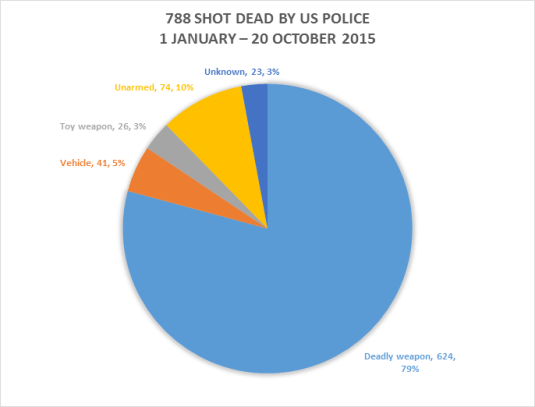
Source: Investigation: Police shootings – Washington Post.
The Washington Post counts 788 police shot dead by police. The Counted counts 922 because it includes deaths in custody, Taser deaths and people collapsing after a struggle. The Countered even included one poor sod who was lost at night-time and accidentally run over by the police cruiser searching for him. He wasn’t on the run. He was just run over at night.

Source: Investigation: Police shootings – Washington Post.
In common with The Counted, the Washington Post does not present the data on police shootings in the simple pie chart graphics to get a handle on how many times police shot armed criminals. That is why I am posting this pie chart today presenting this most basic information necessary for a balanced view.
The continued decline of violent crime in America
13 Oct 2015 Leave a comment
in economic history, economics of crime, law and economics, occupational choice, politics - USA Tags: crime and punishment, crime statistics, criminal deterrence, law and order
Violent crime fell again in 2014. So much for the "Ferguson effect."
washingtonpost.com/news/wonkblog/… http://t.co/h2a6b746qS—
Christopher Ingraham (@_cingraham) September 29, 2015
The causes of the 1466 US police officer deaths, 2005 – 2014
27 Sep 2015 Leave a comment
in economic history, economics of crime, health and safety, occupational choice Tags: law and order, police, road safety
A surprisingly large number of police officers die in car crashes or struck by vehicles.

Source: National Law Enforcement Officers Memorial Fund: Causes of Law Enforcement Deaths.

Source: National Law Enforcement Officers Memorial Fund: Causes of Law Enforcement Deaths.
High-speed police chases kill 330 people per year, one-third of whom are innocent bystanders: priceonomics.com/the-case-for-b… http://t.co/uFmzxgcplk—
Zachary Crockett (@zzcrockett) July 22, 2015
Another reason not to have a car alarm
26 Sep 2015 Leave a comment
in economics of crime, law and economics Tags: car alarms, crime and punishment, criminal deterrence, law and order
Car Alarms are completely f*cking useless.
priceonomics.com/are-car-alarms… http://t.co/tmJDHeIiGp—
Zachary Crockett (@zzcrockett) July 28, 2015
Deaths in police car chases
22 Sep 2015 Leave a comment
in economics of crime, law and economics, politics - USA Tags: crime and punishment, law and order, police, police car chases

728 shot by police by race, 2015 @thecounted @radleybalko @Mark_J_Perry
21 Sep 2015 1 Comment
in economics of crime, law and economics, politics - USA Tags: crime and punishment, law and order, police, police shootings
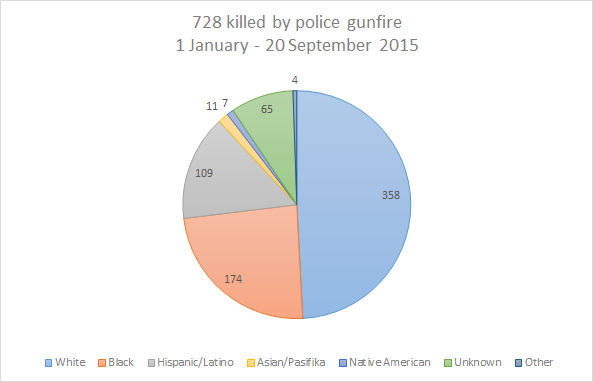
Source: The Counted: people killed by police in the United States in 2015 – interactive | US news | The Guardian accessed 20 September 2015 New Zealand standard time.
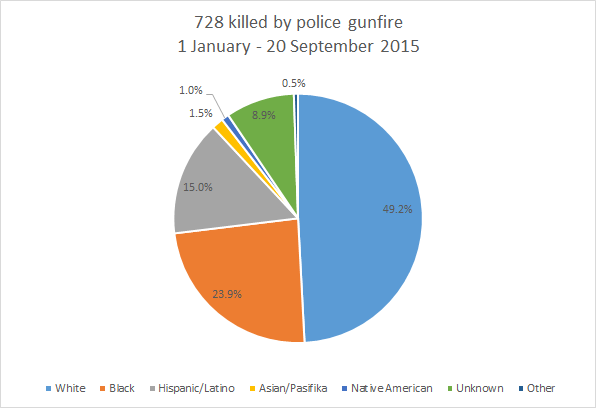
Source: The Counted: people killed by police in the United States in 2015 – interactive | US news | The Guardian accessed 20 September 2015 New Zealand standard time.
@ChristchurchCC Deputy Mayor is clueless about the criminal justice system
21 Sep 2015 Leave a comment
in economics of crime, law and economics, politics - New Zealand, television, transport economics, urban economics Tags: crime and punishment, evidence-based policy, law and order, local government, rational ignorance, rational rationality, road safety, Yes Minister
 In responding to demands for police to crack down on windscreen washers, some of whom intimidate motorists to pay, the deputy mayor of Christchurch showed a cultured ignorance of youth courts. She has never read newspaper reports that show that youth court defendants are never named and their convictions are not held against them as adults. Furthermore, she is unaware of the spent convictions law in New Zealand that expunges most convictions after seven years, especially petty convictions.
The 43 Taser deaths by race in 2015 @thecounted @radleybalko @Mark_J_Perry
21 Sep 2015 Leave a comment
in economics of crime, law and economics, politics - USA Tags: crime and punishment, law and order, police, tasers

Source: The Counted: people killed by police in the United States in 2015 – interactive | US news | The Guardian accessed 1:30 p.m. 20 September 2015 New Zealand standard Time.

Source: The Counted: people killed by police in the United States in 2015 – interactive | US news | The Guardian accessed 1:30 p.m. 20 September 2015 New Zealand standard Time.
@thecounted How did the 24 unarmed Hispanics/Latinos killed by police in 2015 die @radleybalko @Mark_J_Perry
20 Sep 2015 Leave a comment
in economics of crime, law and economics, politics - USA Tags: crime and punishment, criminal deterrence, law and order, police, police shootings
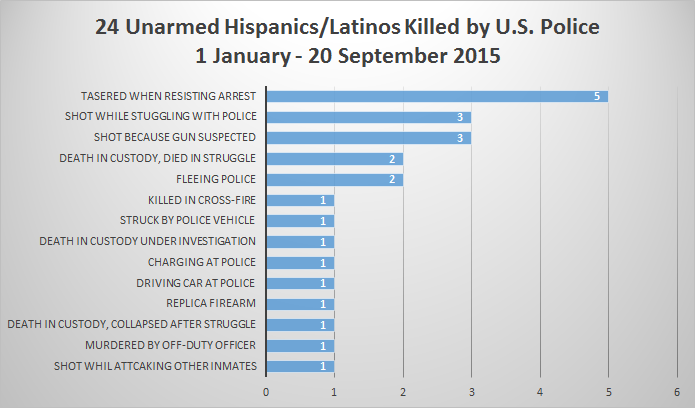
Source: The Counted: people killed by police in the United States in 2015 – interactive | US news | The Guardian accessed 1 p.m. 20 September 2015 New Zealand standard Time.
.
RT @jeremycorbyn tried to fund IRA bomber’s flight
19 Sep 2015 Leave a comment
in economics of crime, law and economics, Marxist economics, Public Choice Tags: British Labour Party, British politics, crime and punishment, IRA, law and order, Northern Ireland, war on terror
https://twitter.com/walterolson/status/645089447197962240
Here is the Commons motion slamming Corbyn as a threat when the IRA bomber row broke in 1987: sunnation.co.uk/jeremy-corbyn-… http://t.co/KiOEUkqi9a—
Harry Cole (@MrHarryCole) September 19, 2015
Does Jeremy Corbyn have a hope in hell of winning a general election? i100.io/Acc95PD http://t.co/gMpddm3VtV—
i100 (@thei100) September 19, 2015


Recent Comments