22 Sep 2016
by Jim Rose
in constitutional political economy, politics - Australia, Public Choice
Tags: 2016 Australian federal election, antiforeign bias, antimarket bias, expressive voting, free trade, globalisation, left-wing popularism, makework bias, rational irrationality, right-wing popularism
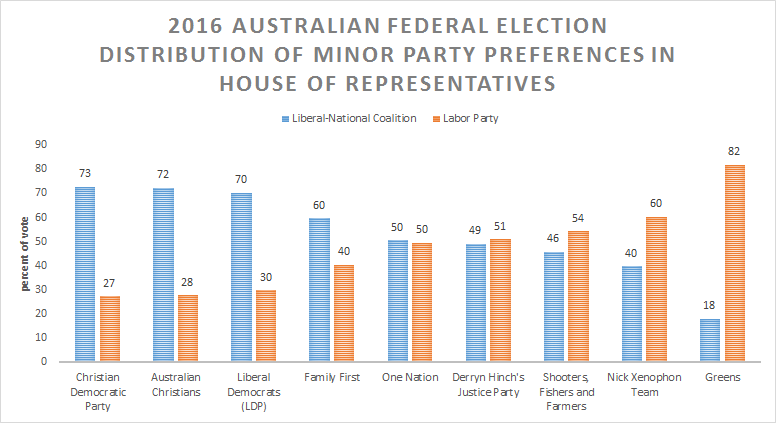
How can Pauline Hanson be an extreme right-winger if half of her votes come from people who 2nd preference the Australian Labour Party? This strong support for her populism has been well-known since she won the safest Labour Party seed in Queensland in the 1996 Australian Federal Election but is hardly ever mentioned by the media or her critics.

Source: Antony Green’s Election Blog: Preference Flows at the 2016 Federal Election.
It should be therefore no surprise that a lot of her views have popular support because she has support across the political spectrum. Not knowing that will means you will be not very good at combating her views which you simply do not understand where they come from.
Few of her supporters see themselves as extremists and will be insulted when you suggest they are. Listen here dummy is no way to win back votes of people who just voted for you recently.
Hanson’s support among Labour voters is increasing. Only 42% of her voters gave their 2nd preference to Labour in previous federal elections for the House of Representatives.
27 Apr 2016
by Jim Rose
in applied price theory, business cycles, economics of bureaucracy, economics of regulation, fiscal policy, macroeconomics, monetary economics
Tags: anti-market bias, antiforeign bias, expressive voting, lags on monetary policy, makework bias, rational rationality, tax incidence, The fatal conceit, The pretense to knowledge
I used to argue that the quality of public policy making would double if public policy analysts remembered the first 6 weeks of microeconomics 101 but on reflection more than that is required.
I picked up my initial insight out when working as a graduate economist in the Australian Department of Finance. That was a few years ago.
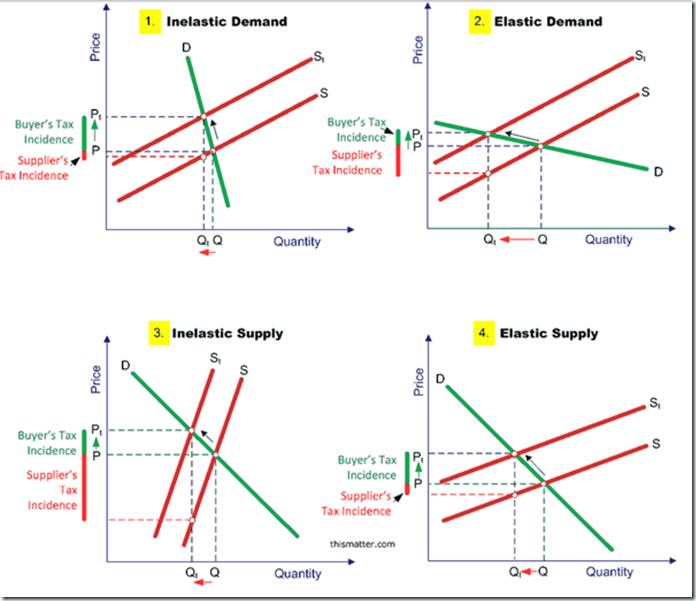
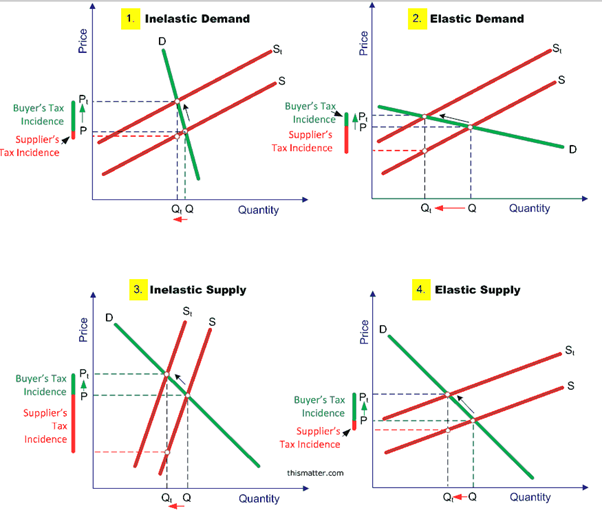
I am now concluded that policy analysts also need to know the basics of the economics of tax incidence. Who pays the tax depends on the elasticities of supply and demand rather than who writes the check to the taxman.
The number of times that I have read media and public policy analysis saying who pays the tax is the writer of the cheque to the taxman is beyond counting.
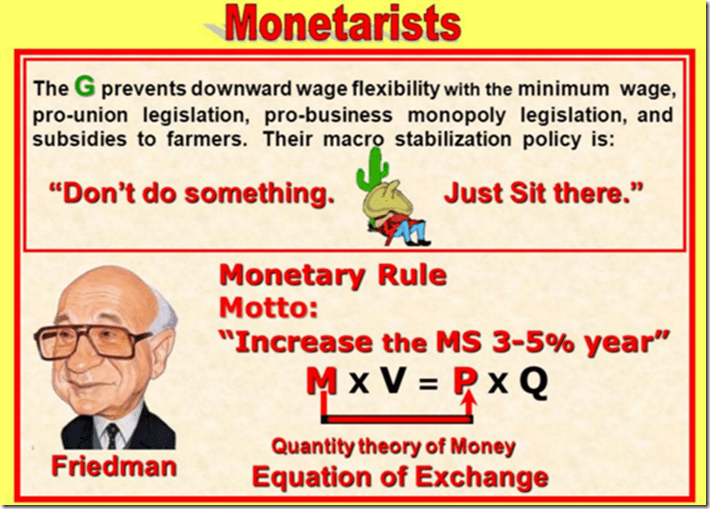
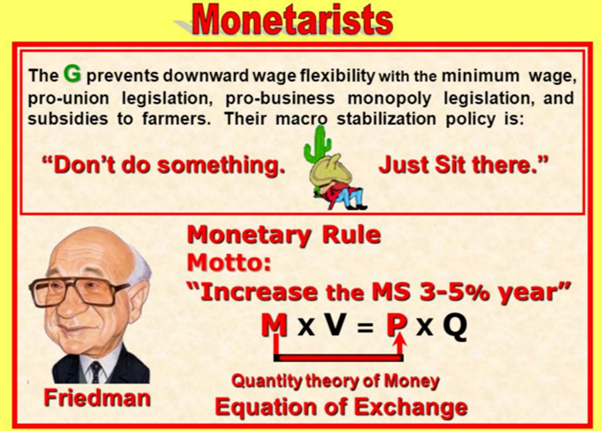
There is also what to do about unemployment and inflation. Do not just do something, sit there might be good advice on most occasions. As Tim Kehoe and Gonzalo Fernandez de Cordoba explain in the context of first do no harm:
Looking at the historical evidence, Kehoe and Prescott conclude that bad government policies are responsible for causing great depressions.
In particular, they hypothesize that, while different sorts of shocks can lead to ordinary business cycle downturns, overreaction by the government can prolong and deepen the downturn, turning it into a depression.
13 Apr 2016
by Jim Rose
in international economics, labour economics, minimum wage, politics - New Zealand, politics - USA
Tags: antiforeign bias, antimarket bias, expressive voting, Leftover Left, living wage, makework bias, rational irrationality
12 Apr 2016
by Jim Rose
in applied price theory, applied welfare economics, development economics, international economics, job search and matching, labour economics, labour supply, macroeconomics, politics - New Zealand
Tags: antiforeign bias, free trade, makework bias, Paul Krugman, protectionism, tariffs, trade policy
Minister for everything Stephen Joyce wrote some nonsense in the paper today about how trade agreements and more exports will mean more jobs:
I would like to make the point that trade access is hugely important for a small country like New Zealand.
Without fair and equal trade access we can’t sell as much of our goods and we get less for them. And that means fewer jobs.
This make-work bias is as bad as those who oppose trade agreements on the grounds of an anti-foreign bias. Trade affects the composition of employment, not the number of jobs. Paul Krugman spent a good part of the 1990s trying to explain that to the general public and public intellectuals.
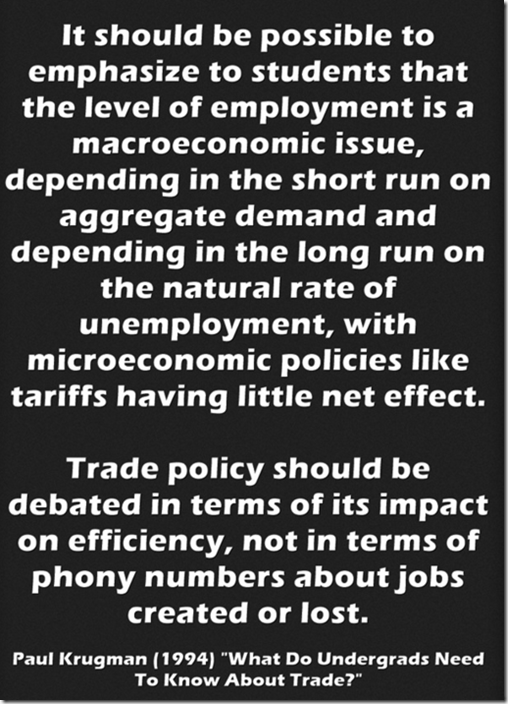
Source: What Do Undergrads Need To Know About Trade?.
31 Mar 2016
by Jim Rose
in applied price theory, applied welfare economics, economics of media and culture, industrial organisation, international economics, politics - USA, Public Choice, public economics, rentseeking
Tags: 2016 presidential election, antiforeign bias, antimarket bias, makework bias, pessimism bias, rational irrationality
22 Mar 2016
by Jim Rose
in development economics, economic history, growth disasters, growth miracles, international economics
Tags: anti-market bias, antiforeign bias, GATT, gender analysis, gender wage gap, makework bias, NAFTA, pessimism bias, preferential trading agreements, rational irrationality, TPPA, WTO
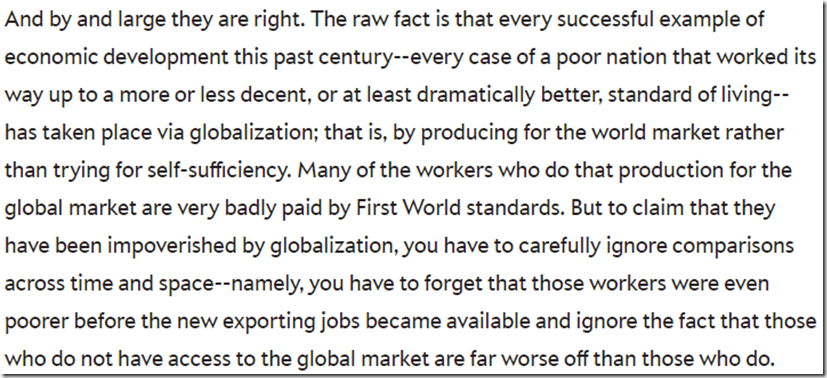
Source: Paul Krugman (1997) Enemies of the WTO.
This visiting American education professor who specialises in globalisation, claimed in the linked radio interview that real wages had fallen in the USA and Mexico. Even for the bottom 20% of the USA, their after-tax household incomes increased by 40% since 1979, with most of that after the signing of NAFTA.
Everything that is bad in crony capitalist Mexico is the fault of NAFTA if our visiting academic is to be believed despite trade tripling and investment increasing 600% because of NAFTA.
Women’s earnings growth has been perfectly fine over the last 40 years despite the horrors of NAFTA and the attack on unions and workers rights by a top 1% emboldened by NAFTA and globalisation, if our visiting academic is to be believed.
Gender analysis, gender analysis, where is his gender analysis of NAFTA? Few labour market statistics make sense without being broken down by sex because of the immense economic progress of women in the last 50 years. Can NAFTA claim credit for that?
21 Aug 2015
by Jim Rose
in applied price theory, applied welfare economics, development economics, economic history, economics of information, economics of media and culture, growth miracles, liberalism, Public Choice
Tags: Bryan Caplan, capitalism and freedom, makework bias, The Great Enrichment, The Great Escape, The Great Fact
20 Aug 2015
by Jim Rose
in applied price theory, applied welfare economics, comparative institutional analysis, constitutional political economy, economics of bureaucracy, income redistribution, Public Choice, rentseeking
Tags: antiforeign bias, antimarket bias, bootleggers and baptists, green rent seeking, Henry Hazlett, makework bias, methodology of economics, philosophy of economics
06 Aug 2015
by Jim Rose
in liberalism, Marxist economics, politics - Australia, politics - New Zealand, politics - USA, Public Choice
Tags: antiforeign bias, antimarket bias, expressive voting, Left-wing hypocrisy, Leftover Left, makework bias, meddlesome preferences, nanny state, political correctness, rational irrationality, Twitter left
25 Jul 2015
by Jim Rose
in applied price theory, applied welfare economics, comparative institutional analysis, constitutional political economy, economic history, economics of bureaucracy, economics of education, economics of regulation, economics of religion, energy economics, environmental economics, income redistribution, industrial organisation, international economics, Murray Rothbard, politics - Australia, politics - New Zealand, politics - USA, Public Choice, rentseeking, survivor principle
Tags: antiforeign bias, antimarket bias, Catholic social thought, climate alarmism, expressive voting, global warming, makework bias, Pope Francis, rational ignorance, rational irrationality, voter demographics
24 Jul 2015
by Jim Rose
in business cycles, econometerics, economic growth, economic history, job search and matching, labour economics, labour supply, macroeconomics, politics - New Zealand, Public Choice, unemployment, unions, welfare reform
Tags: antimarket bias, Don Brash, economic reform, expressive voting, Homer Simpson, Leftover Left, lost decades, makework bias, neoliberalism, rational ignorance, rational irrationality, Sir Roger Douglas, Twitter left
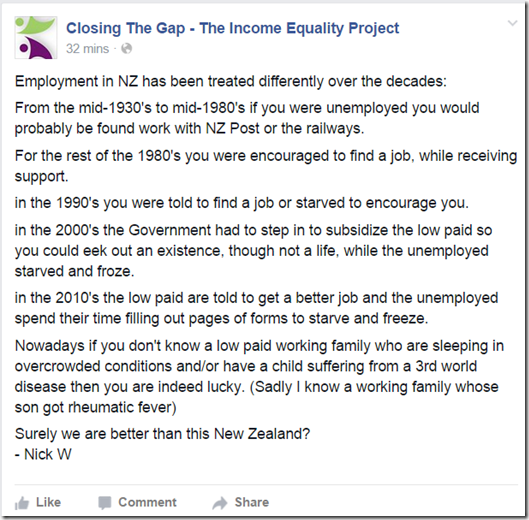
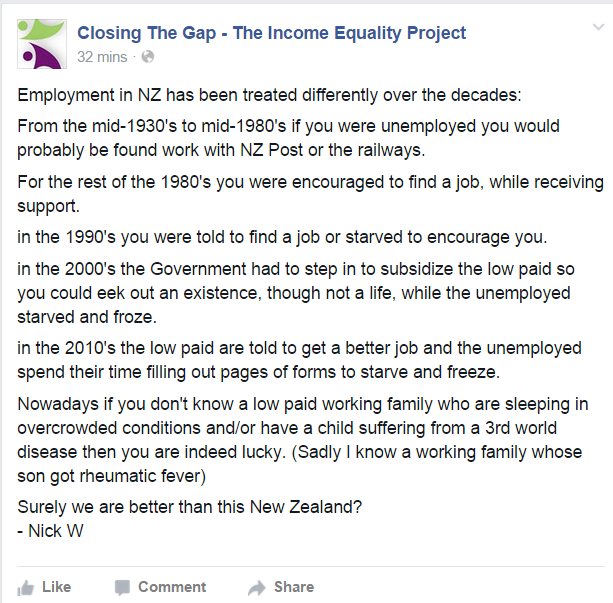
Today, Closing The Gap – The Income Inequality Project boldly claimed today that there was next to no unemployment in New Zealand prior to the onset of the curse of neoliberalism.
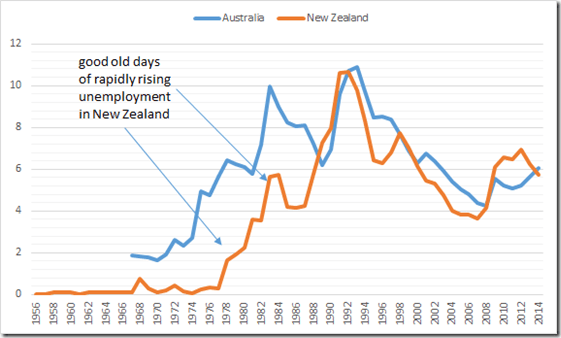
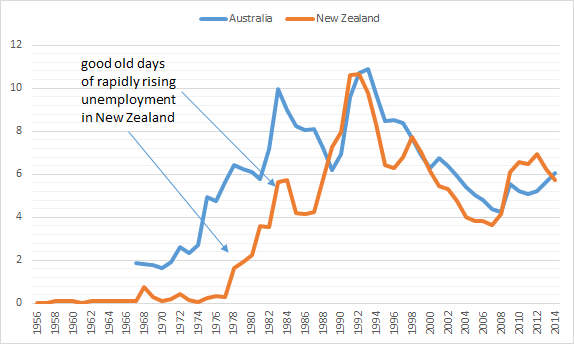
There is an Internet on computers now where it is easy to find data showing that the unemployment rate was rising rapidly in New Zealand in the 1970s and in double digits by the end of the 1980s – see figure 1.
Figure 1: harmonised unemployment rates, Australia and New Zealand, 1956-2014
Source: OECD StatExtract.
Figure 1 shows unemployment was rising rapidly in the 1970s and wasn’t much different by the end of the 1970s to the unemployment rates recorded after about 2000 in New Zealand.

One of the reasons that Sir Roger Douglas wrote There’s Got To Be A Better Way was the rapidly rising unemployment in New Zealand and the stagnant economic growth in the late 1970s and early 1980s.

New Zealand was one of the most regulated economies, so much so that Prime Minister David Lange said:
We ended up being run very similarly to a Polish shipyard.
As for those jobs on the railways, the then Reserve Bank Governor Don Brash said in 1996:
Railways cut its freight rates by 50 percent in real terms between 1983 and 1990, reduced its staff by 60 percent, and made an operating profit in 1989/90, the first for six years.
Previous Older Entries




 Utopia, you are standing in it!
Recent Comments