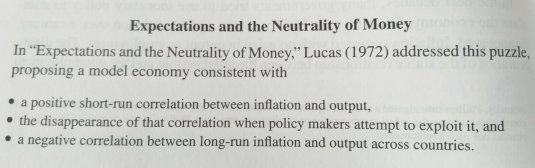
Scott Freeman summarizes Lucas
16 Nov 2018 Leave a comment
in business cycles, economic growth, macroeconomics, monetary economics, Robert E. Lucas Tags: monetary policy
Scott Freeman on monetary policy as a stabilizing tool
15 Nov 2018 Leave a comment
in business cycles, economic growth, macroeconomics, monetary economics Tags: monetary policy

Central banks can’t raise interest rates so what chance of bankers’ cartel fixing interest rates
15 Nov 2018 Leave a comment
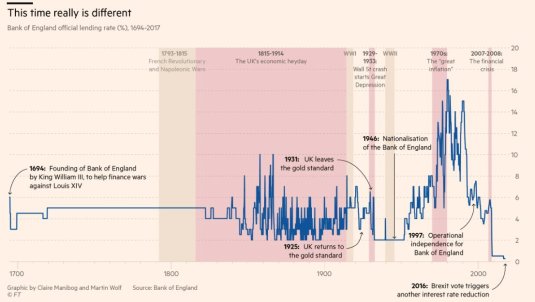
Scott Freeman on monetary policy neutrality
07 Nov 2018 Leave a comment
in applied price theory, business cycles, economic growth, macroeconomics, monetary economics Tags: monetary neutrality, monetary policy

Scott Freeman explains monetary neutrality
05 Nov 2018 Leave a comment
in applied price theory, business cycles, economic growth, macroeconomics, monetary economics Tags: monetary policy

Stephen Williamson Monetary Policy Normalization: Origins of The Bank of England
23 May 2018 Leave a comment
in economic history, financial economics, macroeconomics, monetary economics Tags: monetary policy
Monetary Policy: The Best Case Scenario
11 Aug 2017 Leave a comment
in business cycles, economics, inflation targeting, macroeconomics, monetarism, monetary economics Tags: monetary policy
7. The New Deal and the Post War International Monetary System – Murray N Rothbard
16 Jul 2017 Leave a comment
in economic history, international economics, macroeconomics, monetary economics Tags: Austrian business cycle theory, monetary policy, regulatory capture
5 . The Inflationary Boom of the 1920s – Murray N Rothbard
15 Jul 2017 Leave a comment
in Austrian economics, business cycles, economic history, macroeconomics, monetary economics Tags: Austrian business cycle theory, monetary policy
Ed Prescott makes an excellent point in his last paragraph
16 May 2017 Leave a comment
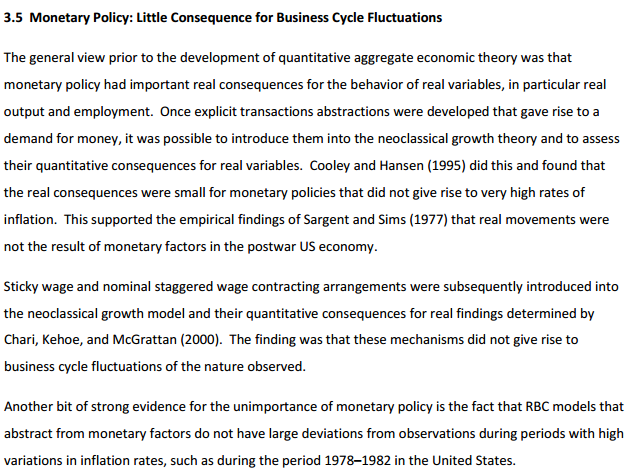
Source: RBC Methodology and the Development of Aggregate Economic Theory Edward C. Prescott, Federal Reserve Bank of Minneapolis Staff Report 527 February 2016.
Milton Friedman is said to have mesmerised several countries with a flying visit!?
30 Sep 2016 Leave a comment
in business cycles, economic growth, macroeconomics, Milton Friedman, monetarism, monetary economics, politics - Australia Tags: central banks, conspiracy theories, lags on monetary policy, monetary policy, rules versus discretion, The fatal conceit, The pretense to knowledge
Milton Friedman visited Australia in 1975. He spoke with government officials and appeared on the TV show Monday Conference. Apparently, that was enough for him to take over Australian monetary policy setting for the foreseeable future.
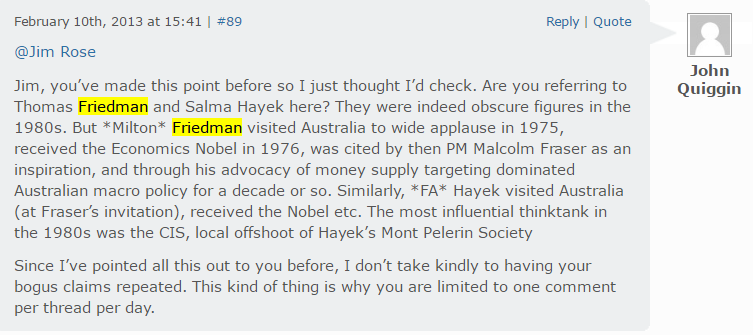
When working at the next desk to the monetary policy section in the late 1980s, I heard not a word of Friedman’s Svengali influence:
- The market determined interest rates, not the reserve bank was the mantra for several years. Joan Robinson would be proud that her 1975 visit was still holding the reins.
- Monetary policy was targeting the current account. Read Edwards’ bio of Keating and his extracts from very Keynesian treasury briefings to Keating signed by David Morgan that reminded me of macro101.
See Ed Nelson’s (2005) Monetary Policy Neglect and the Great Inflation in Canada, Australia, and New Zealand who used contemporary news reports from 1970 to the early 1990s to uncover what was and was not ruling monetary policy. For example:
“As late as 1990, the governor of the Reserve Bank rejected central-bank inflation targeting as infeasible in Australia, and cited the need for other tools such as wages policy (AFR, October 18, 1990).”
Bernie Fraser was still sufficiently deprogrammed in 1993 to say that “…I am rather wary of inflation targets.” Easy to then announce one in the same speech when inflation was already 2-3%.
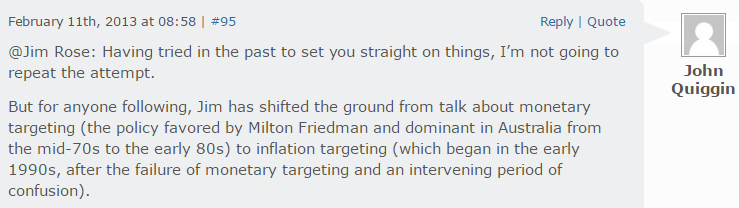
When as a commentator on a Treasury seminar paper in 1986, Peter Boxhall – fresh from the US and 1970s Chicago educated – suggested using monetary policy to reduce the inflation rate quickly to zero, David Morgan and Chris Higgins almost fell off their chairs. They had never heard of such radical ideas.
In their breathless protestations, neither were sufficiently in-tune with their Keynesian educations to remember the role of sticky wages or even the need for the monetary growth reductions to be gradual and, more importantly, credible as per Milton Freidman and as per Tom Sargent’s End of 4 big and two moderate inflations papers.
I was far too junior to point to this gap in their analytical memories about the role of sticky wages, and I was having far too much fun watching the intellectual cream of the Treasury senior management in full flight. At a much later meeting, another high flying deputy secretary was mystified as to why 18% mortgage rates were not reining in the current account in 1989.
Friedman’s Svengali influence did not extend to brainwashing in the monetarist creed that the lags on monetary policy were long and variable. The 1988 or 1989 budget papers put the lag on monetary policy at 1 year, which is short and rapier, if you ask me.
When did Canberra policy makers accept that inflation was a monetary phenomenon?
27 Sep 2016 3 Comments
in business cycles, economic history, macroeconomics, monetarism, monetary economics, politics - Australia Tags: central banks, monetary policy, The Great Inflation
Australian policymakers from at least 1971 viewed inflation as not a consequence of their monetary policy decisions. There were repeated references by them to wage-price spirals and both unsuccessful (1977) and successful attempts (1981) at wage freezes.
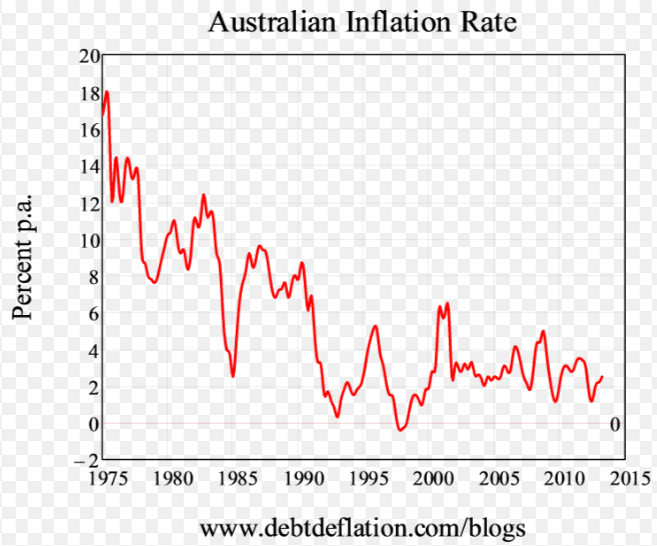
The prices and incomes accord from 1983 onwards was just another 1970s wage tax trade-off. An Incomes policy attributes inflation to non-monetary factors, as did Fraser and Lynch regularly.
• It was not until 1980 that the Fraser government’s monetary policy became genuinely anti-inflationary. With a lag, these changes halved inflation to the mid-single digits by 1983. The implementation lag on the 1975 Monday conference programme must have been long and variable and lasted for a three year window!? Three years out of 20 is hardly a monetarist hegemony!
• Australia had lower CPI inflation in the 1980s than the 1970s, but this was marred by rebounds in 1985–86 and 1988–90 to near 9%.
The monetary policy regime change in the late 1980s was triggered by factors besides rising inflation: a demonic view of currant account.
After several years of high interest rates, the budget papers forecasted a moderate slowing:
• The budget GDP forecast for 1990-91 was 2% with an actual of minus 0.4%; for inflation the actual and forecast were 5.3% versus 6.5%; 1989-90 inflation rate was 8% with GDP growth of 3.3%.
• In 1991-92, the budget GDP forecast was 1.5% with an actual of 2.1%; for inflation the actual and forecast were 1.9% versus 3.8%.
• In 1992-93, the budget papers forecast for inflation 3% for an actual of 1%.
• In 1993-94, the budget forecast for inflation 3.5% for an actual of 1.8%.
The monetarists in the Treasury, entranced as they were by Friedman’s 1975 visit, still had not clicked to the link between a tight monetary policy and low inflation as late as 1993. Australia pursued a stop-go monetary policy from 1971 to the early 1990s.
I worked in the next desk to the monetary policy section in the Prime Minister’s Department in the 1980s. They were determined that market set interest rates, not monetary policy.
I suggest you read the biography of keating by john edwards(?) – his economic advisor in the late 1980s.
Edwards quotes from numerous Treasury briefings to Keating. the Treasury remembered their Keynesian educations well, as did those at DPMC. the prices and incomes accord was very Keynesian: inflation as a non-monetary phenomenon
Mentioning Friedman’s name in the 1980s at job interviews would have been extremely career limiting. Not much better in the early 1990s. Back in the late 1980s, Friedman was graduating from ‘a wild man in the wings’ to just a suspicious character in policy circles.
If you name dropped Hayek in the 1980s and 1990s, any sign of name recognition would have indicated that you were been interviewed by people who were very widely read.
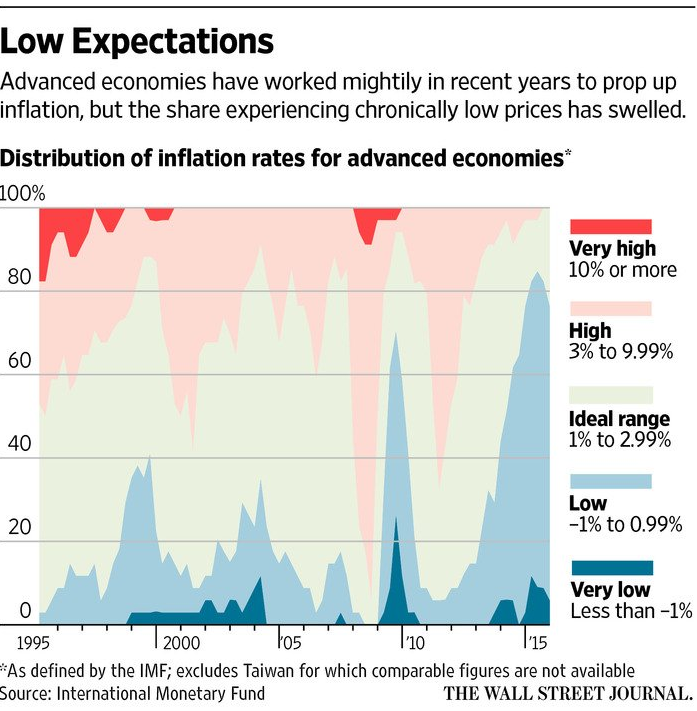
There is not a lot of inflation out there
17 Mar 2016 Leave a comment
in macroeconomics, monetary economics Tags: deflation, inflation rate, liquidity trap, monetary policy
.
% of New Zealand mortgages that were fixed and floating since 2004
16 Mar 2016 Leave a comment
in economic history, economics of information, economics of regulation, monetary economics, politics - USA Tags: antimarket bias, libertarian paternalism, monetary policy, mortgage interest rates, New Zealand Labour Party, Other people are stupid fallacy, rational irrationality, The fatal conceit, The pretence to knowledge
Despite the best efforts of the libertarian paternalists to sell the other people are stupid fallacy, ordinary New Zealanders are quite nimble at moving between fixed and floating rates depending upon their forecasts of the future of interest rates. Price controls on floating rate mortgages, as suggested by the New Zealand Labour Party, would make this more difficult, not easier.
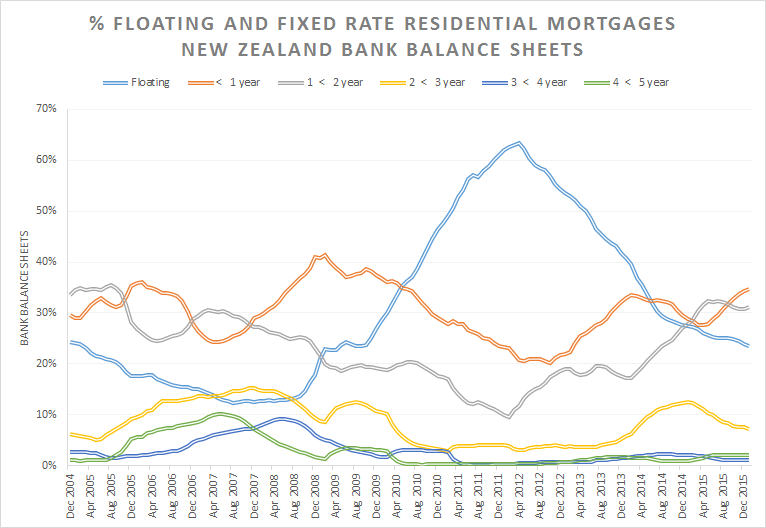
Source: S8 Banks: Mortgage lending ($m) – Reserve Bank of New Zealand.
% industrialised countries at zero or near zero central bank interest rates
04 Feb 2016 Leave a comment
in business cycles, currency unions, Euro crisis, global financial crisis (GFC), great recession, inflation targeting, macroeconomics, monetarism, monetary economics Tags: central banks, liquidity trap, monetary policy


Recent Comments