15% and more. The long-term view on U.S. Nominal Interest Rates
(from 1.usa.gov/1V2PhP1) http://t.co/52o992NFhJ—
Max Roser (@MaxCRoser) September 20, 2015
US interest rates since 1871
09 Oct 2015 Leave a comment
in business cycles, economic history, macroeconomics, monetary economics Tags: interest rates, monetary policy
Compliance by the Fed with the Taylor rule
03 Oct 2015 Leave a comment
in business cycles, macroeconomics, monetarism, monetary economics, politics - USA Tags: central banks, economics of central banking, monetary policy, rules and discretion, Taylor rule, The Fed
Yellen vs. Congress: The Fed's independence is under attack despite economic rebound bloom.bg/1HM9c0A http://t.co/NQ6548yGJK—
Bloomberg VisualData (@BBGVisualData) August 10, 2015

The Fed Rate since 1955
18 Sep 2015 Leave a comment
in business cycles, economic history, macroeconomics, monetary economics Tags: monetary policy, The Fed

Greg Mankiw on the zero influence of modern macroeconomics on monetary policy making
17 Sep 2015 1 Comment
in business cycles, history of economic thought, inflation targeting, macroeconomics, managerial economics, monetarism, monetary economics, organisational economics Tags: Alan Blinder, Alan Greenspan, credible commitments, Greg Mankiw, modern macroeconomics, monetary policy, neo-Keynesian macroeconomics, new classical macroeconomics, The Fed, timing inconsistency
Two of my brothers studied economics in the early 1970s and then went on to different paths in law and computing respectively. If Greg Mankiw is right, my two older brothers could happily conduct a conversation with a modern central banker. Their 1970s macroeconomics, albeit batting for memory, would be enough for them to hold their own.
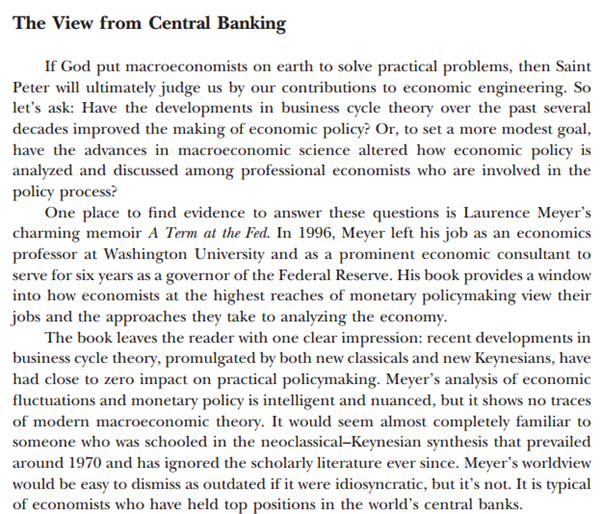
Source: AEAweb: JEP (20,4) p. 29 – The Macroeconomist as Scientist and Engineer – Greg Mankiw (2006).
I would spend my time arguing with a central banker that Milton Friedman may be right and central banks should be replaced with a computer. The success of inflation targeting is forcing me to think more deeply about that position. In particular the rise of pension fund socialism means that most voters are very adverse to inflation because of their retirement savings and that is before you consider housing costs are much largest proportions of household budgets these days.
Forecasting is not getting any easier
28 Aug 2015 Leave a comment
in business cycles, financial economics, macroeconomics, monetary economics Tags: forecasting errors, monetary policy, The fatal conceit, The pretence to knowledge
Economists: They refuse to accept low interest rates! http://t.co/WyTlm6L1KS—
Tim Fernholz (@TimFernholz) August 18, 2015
ABCT insights are predominantly a theory of unsustainable credit-induced booms
09 Aug 2015 Leave a comment
in Austrian economics, business cycles, global financial crisis (GFC), great depression, great recession, macroeconomics, monetarism, monetary economics Tags: Austrian business cycle theory, Austrian macroeconomics, booms and busts, central banking, monetary policy, Roger Garrison

via What Austrian business cycle theory does and does not claim as true | Institute of Economic Affairs
A severe commentary
29 Jul 2015 Leave a comment
in macroeconomics, politics - New Zealand Tags: central banks, forecasting errors, monetary policy, The pretence to knowledge
I don’t place much weight on criticisms of forecasting errors. If someone is any good at forecasting the economy, they would be fabulously rich through trading on their own account rather than working in a central bank.
The fact that Reserve Banks can’t forecast with any greater accuracy than anybody else is a bit of an indictment considering they have inside knowledge of the future course of monetary policy.
By the way, I wrote my masters sub thesis on official forecasting errors.

Plenty of commentaries have remarked on the very low inflation numbers out this morning.
None (that I have seen) has highlighted what a severe commentary these numbers are on the Reserve Bank’s conduct of monetary policy over the last few years.
Reciting the history in numbers gets a little repetitive, but:
• December 2009 was the last time the sectoral factor model measure of core inflation was at or above the target midpoint (2 per cent)
• Annual non-tradables inflation has been lower than at present only briefly, in 2001, when the inflation target itself was 0.5 percentage points lower than it is now.
• Non-tradables inflation is only as high as it is because of the large contribution being made by tobacco tax increases (which aren’t “inflation” in any meaningful sense).
• Even with the rebound in petrol prices, CPI inflation ex tobacco was -0.1 over the last year…
View original post 1,600 more words
What Will Happen to a Generation of Wall Street Traders Who Have Never Seen a Rate Hike?
03 Jun 2015 Leave a comment
in business cycles, economic history, macroeconomics, monetary economics Tags: monetary policy, The Fed

Has New Zealand been in deflation since 2012?
21 Apr 2015 Leave a comment
in global financial crisis (GFC), great depression, inflation targeting, macroeconomics, monetary economics Tags: CPI bias, deflation, inflation, monetary policy
All agree that the consumer price index (CPI) is biased and overstates inflation. In 1996, economists hired by the Senate Finance Committee estimated that the U.S. CPI overstates annual inflation by 1.1% (Boskin et al. 1996). That estimated CPI bias has not gotten smaller with time. It is now up to 1.5%, even 2%.
One of the rationales for the inflation target of the Reserve Bank of New Zealand of 0-2% was the 2% was to account for the consumer price index was biased upwards. Targeting 0% would lead to mild deflation when inflation was properly measured.
The main biases in the consumer price index everywhere come from how to handle changes in the quality of goods and services and how to deal with completely new goods and services.
I thought I might see what happened if I took this one and a half percentage point annual bias in the CPI estimated for the USA and adjusted the New Zealand CPI inflation rates available at the Reserve Bank of New Zealand’s website over the last 20 years or so with this number.

If these consumer price index bias adjustments are correct, and they are roughly correct, inflation came to a dead stop in New Zealand after the global financial crisis in 2008, spiked again, and then moved into deflation in 2012. If anything, there’s been a mixture of price stability and the deflation since 2012.
People get quite hot and bothered with deflation. The New Zealand economy has been in a deflationary phase since the beginning of 2012 but it is recently grown so quickly that it is referred to in the media as the rock-star economy.
Breathless journalism aside , fears of inflation are just a legacy of the great depression in the 1930s. The only depression where deflation was accompanied by mass unemployment was the Great Depression. Mild deflation with good growth is a common phenomena as Atkinson and Kehoe found:
Are deflation and depression empirically linked? No, concludes a broad historical study of inflation and real output growth rates.
Deflation and depression do seem to have been linked during the 1930s. But in the rest of the data for 17 countries and more than 100 years, there is virtually no evidence of such a link.
The three lags on monetary policy
31 Mar 2015 1 Comment
in business cycles, economics of information, inflation targeting, macroeconomics, Milton Friedman, monetarism, monetary economics Tags: lags on monetary policy, monetary policy
There are large uncertainties about the size and timing of responses to changes in monetary policy. There is a close and regular relationship between the quantity of money and nominal income and prices over the years. However, the same relation is much looser from month to month, quarter to quarter and even year to year. Monetary changes take time to affect the economy and this time delay is itself highly variable. The lags on monetary policy are three in all:
- The lag between the need for action and the recognition of this need (the recognition lag)
-
The lag between recognition and the taking of action (the legislation lag)
-
the lag between action and its effects (the implementation lag)
These delays mean that is it difficult to ascertain whether the effects of monetary policy changes in the recent past have finished taking effect.

Secondly, it is difficult to ascertain when proposed changes in monetary policy will take effect. Thirdly, feedbacks must be assessed. The magnitude of the monetary adjustment necessary to deal with the problem at hand is never obvious.
It is common for a central bank to act incrementally. The central bank makes small adjustments to monetary conditions over time as more information is available on the state of the economy and forecasts are updated.
Most discussions on monetary policy focus on the implementation lag. This lag depends on the fundamental characteristics of the economy.
A long and variable implementation lag means that it is difficult for central banks to ascertain what is happening now or forecast what will happen. Central banks may stimulate the economy after it is well on the way to recovery and tighten monetary policy when the economy is already going into a recession.
In his classic A Program for Monetary Stability, published in 1959, Milton Friedman summarised his empirical findings on length and variability of the lags on monetary policy:
on the average of 18 cycles, peaks in the rate of change in the stock of money tend to preceded peaks in general business by about 16 months and troughs in the rate of change in the stock of money to precede troughs in general business by about 12 months. For individual cycles, the recorded lead has varied between 6 and 29 months at peaks and between 4 and 22 months at troughs.
With lags as variable as those estimated by Friedman, it is difficult to see how any policy maker could know which direction to adjust his policy, much less the precise magnitude needed. Long lags greatly complicate good forecasting. A forecaster cannot know what the state of the economy will be when his policy takes effect.
Many Keynesians, Friedman notes, advocate “leaning against the wind.” By this they mean, in some sense, that the monetary (and fiscal) authorities should try to balance out the private sector’s excesses rather than passively hope that it adjusts on its own.
Friedman tested the Fed’s success at leaning “against the wind” by checking whether the rate of money growth has truly been lower during expansions and higher during contractions. He admits that this method of grading he Fed’s performance is open to criticism, but decides to go ahead and see what turns up. He finds that Fed has – for the periods surveyed – been unsuccessful.
By this criterion, for eight peacetime reference cycles from March 1919 to April 1958. Actual policy was in the ‘right’ direction in 155 months, in the ‘wrong’ direction in 226 months; so actual policy was ‘better’ than the [constant 4% rate of money growth] rule in 41% of the months.
Nor is the objection that the inter-war period biased his study is good since Friedman found that:
For the period after World War II alone, the results were only slightly more favourable to actual policy according to this criterion: policy was in the ‘right’ direction in 71 months, in the ‘wrong’ direct in 79 months, so actual policy was better than the rule in 47% of the months. [2]
One of the best ways to parry a metaphor is with another metaphor. Keynesians have a host of metaphors in their rhetorical arsenal; one frequently voiced is that a wise government should “lean against the wind” when choosing policy. Friedman counters:
We seldom know which way the economic wind is blowing until several months after the event, yet to be effective, we need to know which way the wind is going to be blowing when the measures we take now will be effective, itself a variable date that may be a half year or a year or two from now. Leaning today against next year’s wind is hardly an easy task in the present state of meteorology.
By scrutinising the practice of monetary policy over the decades, Friedman manages to produce objections that both Keynesians and non-Keynesians must take seriously. A key part of any response to Friedman rests on the ability of forecasters to do their jobs with tolerable accuracy.
The most important aspect of monetary strategy is timing
28 Mar 2015 Leave a comment
in business cycles, economic growth, economics of information, macroeconomics, Milton Friedman, monetarism, monetary economics, Robert E. Lucas Tags: Keynesian macroeconomics, lags on monetary policy, monetary policy
The simplest statement to make about the lags in monetary policy is they are long and variable. This simple statement is also the key insight to understanding the actual implementation of monetary policy. Hence, how many months or years in advance must a central bank forecast to achieve its monetary goals? In 1994, the Economist said:
But [central banks] cannot afford to wait until inflation is actually rising before they act. Monetary policy does not change the speed of the economy instantly: it can take 18 months or more for a rise in interest rates to have its full impact on inflation. The target of policy ought therefore to be future not current inflation, in order to prevent a surge in 1996. The earlier interest rates are raised, the better the chances of engineering a smooth slowdown to a sustainable rate of growth before slack in the economy is exhausted.
Economists differ about the length of those lags. Uncertainty about the average length of those lags and the variability of those lags makes discretion most difficult. Activist policy can improve welfare only if the information about economic structure and economists’ ability to forecast is sufficiently accurate.

Friedman is the most famous and persuasive critic of Keynesianism on the grounds of lags. He has two main arguments: first, that there are “long and variable lags” between the identification of a problem and the effects of the designed remedy; second, that activist policy often itself becomes a source of instability since policy itself becomes a variable that the market must guess.
Friedman’s critique does not depend on the quantity theory of money. Keynesian policies do not necessarily follow even if the Keynesian theory of the business cycle were conclusively proved.
It must also be demonstrated that the government has the ability and willingness of the government to act as the theory prescribes. We are therefore further assuming that central banks have the incentive to stabilise the economy. If the government lacks the information required to stabilise the economy, issues of public choice incentives become fully redundant. Incentives to pursue an objective do not matter if the objective itself is unattainable.
Competing visions of central banking
25 Mar 2015 1 Comment
in business cycles, economic growth, inflation targeting, macroeconomics, Milton Friedman, monetarism, monetary economics, Robert E. Lucas Tags: Keynesian macroeconomics, monetary policy

The competing visions of central banks over monetary policy have been defined by Franco Modiglani and Milton Friedman respectively. Modiglani considers the Keynesian vision of macroeconomic policy to be:
a market economy is subject to fluctuations which need to be corrected, can be corrected, and therefore should be corrected.
The Keynesian claim implies that central banks have sufficient knowledge of the structure of the economy to be able to choose the policy mix appropriate to a given set of circumstances. It is possible to target unemployment, interest rates and inflation in such a way that they can be maintained (and hence made predictable) by constant adjustment of policy instruments to new shocks.
The Keynesian approach assumes that the economy can slip into recessions for all sorts of reasons (Barro 1989). Business fluctuations result from shocks to aggregate demand. The principal source of these shocks are expectations induced shifts in investment demand. The role of the central bank is to make prompt, frequent policy responses to counteract this instability.
The task of government is to discover the particular monetary and fiscal polices which can eliminate shocks emanating from the private sector. A key finding of recent macroeconomic research is that anticipated monetary policy has very different effects to unanticipated monetary policy.
The Keynesian vision thus presuppose that government can foresee shocks which are invisible to the private sector but at the same time it is unable to reveal this advance information in a credible way and hence defusing the shock because it is no longer unanticipated. In addition, the counter cyclical monetary policies of governments must themselves be unforeseeable by private agents, but at the same time systematically related to the state of the economy (Lucas and Sargent 1979)
Of course, the Keynesian view of central banking is also premised on a goodwill theory of government. Governments pursue policies that are in the public interest. That is a public interest that is well-defined and is free of conflicts over income distribution, electoral success and power the could lead policy-makers to pursue goals other than full employment, stable prices and efficiency. Thus, if the latest forecast is a recession, additional stimulus is the usual prescription. However, since most Keynesian economists accept the permanent income and natural rate hypotheses, more stimulus implies less later at some unknown time.
Friedman’s vision of central banking is far more circumspect:
The central problem is not designing a highly sensitive [monetary] instrument that offsets instability introduced by other factors[in the economy], but preventing monetary arrangements becoming a primary source of instability (Milton Friedman 1959).
Friedman considers that a key element in the case for policy discretion is whether the sufficient information is available that can be used to reduce variability and assist the economy’s adjustment the unforeseen. A well intentioned policy-maker will destabilise if he is mislead by incomplete or incorrect information.

From the monetarist standpoint, price stability can be approximately attained under a well chosen and predictable monetary policy rule. Under this view, the unemployment and interest rates are unpredictable and can manipulated only at a prohibitive cost. The Keynesian and monetarist views are mutually incompatible and lead to very different policy recommendations (Lucas 1981).
Paul Samuelson on where he disagreed with Milton Friedman on macroeconomic policy
19 Mar 2015 Leave a comment
in budget deficits, business cycles, economic growth, fiscal policy, inflation targeting, macroeconomics, Milton Friedman, monetarism, monetary economics Tags: fiscal policy, monetary policy, Paul Samuelson, rules versus discretion, stabilisation policy
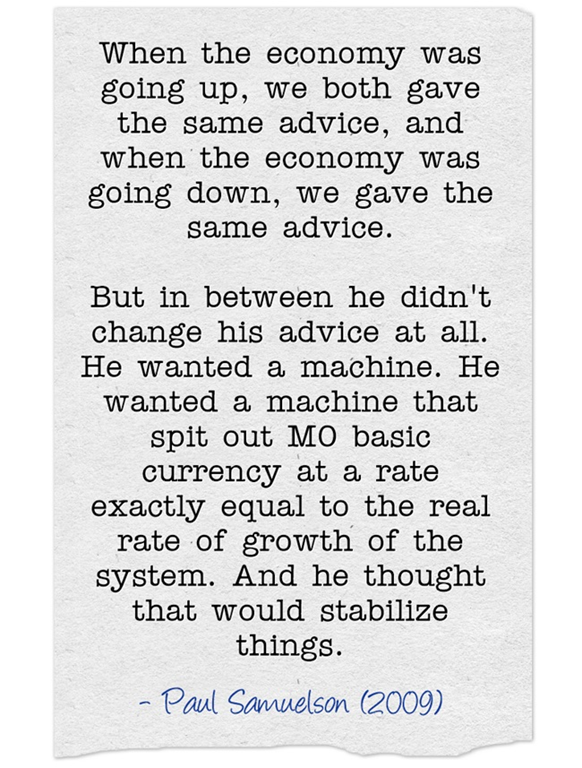
via Samuelson vs. Friedman, David Henderson | EconLog | Library of Economics and Liberty and An Interview With Paul Samuelson, Part One — The Atlantic.


Recent Comments