What Percentage of Your Country Smokes Marijuana?
priceonomics.com/what-percentag… http://t.co/t5ybdqNv4X—
Priceonomics (@priceonomics) April 21, 2015
What Percentage of Your Country Smokes Marijuana?
25 Jun 2015 Leave a comment
in economics of crime, law and economics, liberalism, politics - Australia, politics - New Zealand, politics - USA Tags: marijuana decriminalisation, meddlesome preferences, nanny state
How fainting couch feminism threatens freedom
24 Jun 2015 Leave a comment
in liberalism, politics - Australia, politics - New Zealand, politics - USA Tags: feminism, free speech, meddlesome preferences, nanny state, political correctness
More and more countries still think smokers don’t know the risks of cancer sticks
02 Jun 2015 Leave a comment
in economics of information, economics of media and culture, economics of regulation, health economics Tags: economics of smoking, nanny state, Other people are stupid fallacy, paternalism, risk trade-offs
The war on smoking, in one chart i100.io/6f3d2uj http://t.co/mlajmx68yq—
i100 (@thei100) November 26, 2014
Banned In San Francisco
25 May 2015 Leave a comment
in economics of regulation, politics - USA Tags: meddlesome preferences, nanny state, safety Nazis, San Francisco


Is David Hockney the grumpiest man in Britain?
12 May 2015 Leave a comment
in economic history, economics of regulation, economics of religion, environmental economics, global warming, liberalism Tags: climate alarmism, David Hockney old man, do gooders, economics of smoking, global warming, meddlesome preferences, nanny state


The crusade to ban e-cigarette had the predictable effect among teens
12 May 2015 Leave a comment
in environmental economics, health economics Tags: do gooders, economics of smoking, meddlesome preferences, nanny state, offsetting behaviour, The fatal conceit, The pretence to knowledge, unintended consequences
Teen e-cigarette consumption has surpassed conventional smoking in 2014 #vaping via @CDCgov
statista.com/chart/3417/eci… http://t.co/RnZz1nbj5X—
Statista (@StatistaCharts) April 22, 2015
Coming to a nanny state near you
10 May 2015 Leave a comment
in economics of regulation, health economics Tags: compassion Fascists, food police, health warnings, meddlesome preferences, nanny state, safety Nazis
The left has become it once mocked. They are all school marms now. http://t.co/2AgTfZ2ZuQ—
The Left, Exposed (@leftexposed) February 11, 2015
Labour Party betrays working class again: nanny state obligations to enrol to vote
09 May 2015 Leave a comment
in politics - New Zealand, politics - USA, Richard Posner, Public Choice, constitutional political economy Tags: expressive voting, Richard Posner, Joseph Schumpeter, voter demographics, nanny state, Robert Tollison, rational irrationality, rational ignorance, Internet, Labour Party, non-voting, compulsory voting, William F. Shughart, Robert McCormick

Extraordinary. Political junkies don’t realise that there are people out there that have better things to do with their lives than take an interest in politics.

It’s a free society. They are free not to listen, not engage and not vote for anyone. Free speech includes a right not to speak and not to participate. If you disappointed with that political apathy, put forward a party platform that excites them enough to vote. Get out the vote by being worth voting for.
What is more extraordinary is a party that claims to speak for the working class first opposed obligations on welfare benefit receipt regarding looking more intensively for work and paying court fines and so forth, but it is happy to use the same provisions for their own political advantage because they are on the ropes. The New Zealand Labour Party’s party vote at the last election was at record low levels. It is still at the same level in the opinion polls.
As for voter registration drives in working-class electorates, the New Zealand Labour Party has no large donors apart from unions. The reason for this is as their former president, Mike Williams says " if you don’t ask, you don’t get ".
Voter registration is voluntary in the USA and for all its flaws, and I think there are far fewer than people say, Richard Posner could still give an excellent defence of political participation in the USA:
American democracy enables the adult population, at very little cost in time, money or distraction from private pursuits commercial or otherwise, to punish at least the flagrant mistakes and misfeasances of officialdom, to assure an orderly succession of at least minimally competent officials, to generate feedback to the officials concerning the consequences of their policies, to prevent officials from (or punish them for) entirely ignoring the interests of the governed, and to prevent serious misalignments between government action and public opinion.
Too many as Richard Posner has argued well in his writing want to remake democracy with the faculty workshop as their model. Such deliberation has demanding requirements for popular participation in the democratic process, including a high level of knowledge and analytical sophistication and an absence, or at least severe curtailment, of self-interested motives.
Much empirical research demonstrates that citizens have astonishingly low levels of political knowledge. Most lack very basic knowledge of political parties, candidates and issues, much less the sophisticated knowledge necessary to meet the demands of a deliberative democracy.
One reason for these low levels of political knowledge is a large number of people are simply not interested in politics even if they have the time to take an interest.
Because of this political ignorance and apathy, Posner championed Schumpeter’s view of democracy. Schumpeter disputed the widely held view that democracy was a process by which the electorate identified the common good, and that politicians carried this out:
- The people’s ignorance and superficiality meant that they were manipulated by politicians who set the agenda.
- Although periodic votes legitimise governments and keep them accountable, their policy programmes are very much seen as their own and not that of the people, and the participatory role for individuals is limited.
Schumpeter’s theory of democratic participation is that voters have the ability to replace political leaders through periodic elections. Citizens do have sufficient knowledge and sophistication to vote out leaders who are performing poorly or contrary to their wishes.
The power of the electorate to turn elected officials out of office at the next election gives elected officials an incentive to adopt policies that do not outrage public opinion and administer the policies with some minimum honesty and competence.
The outcome of Schumpeterian democracy in the 20th century, where governments are voted out rather than voted in, is that most of modern public spending is income transfers that grew to the levels they are because of support from the average voter.
Political parties on the Left and Right that delivered efficient increments and stream-linings in the size and shape of government were elected, and then thrown out from time to time, in turn, because they became tired and flabby or just plain out of touch.
I wouldn’t revel too much on the higher voter turnout as as yet another saviour on the horizon to bring the Left over Left back from the political wilderness. The most votes ever won by a political party in the UK was 14 million by John Major’s Tory party in 1992 when the shy Tories came out in force to re-elected the incumbent government much the surprise of the opinion polls.
Higher voter turnout is not necessarily always a good thing in terms of good governance. William Shughart found that voter participation increases in gubernatorial elections in the USA when evidence of corruption mounts. Candidates, political parties, and interest groups have incentives to invest in mobilising support on Election Day.
Those who stand to gain from being office through their corruption invest considerable resources in mobilising voter turnout that is in their favour. Corruption increase the value of winning public office and strengthens the demand-side efforts to build winning coalitions.
In a prophetic article at the dawn of the Internet, Robert Tollison, William F. Shughart II, and Robert McCormick wrote in 1999 about how voting is not the only way in which people express their political preferences effectively.
Observers of American democracy complain that voter turnout and voter registration are low and had been low from 50 years. Tollison, Shughart, and McCormick reminded these critics that:
Voters now have more political information available to them than ever before, and they are no longer confined to expressing their political preferences at the polls once every two or four years.
Newly available technologies have lowered voters’ costs of becoming informed about political issues and of communicating with their political representatives.
Voter registration and voter turnout is lowest among young people who also happen to be the most Internet savvy. This is not surprising considered the prophetic observation of Tollison, Shughart, and McCormick in 1999 that:
What is more important, the opinions voters form on the basis of the information available to them can be communicated to policy makers rapidly and effectively.
E-mails, faxes, and phone calls are substitutes for ballots. By the time an election rolls around, politicians and policy makers already know what the voters think and, hence, their wishes have already been incorporated into laws and policies.
Tollison, Shughart, and McCormick asked why vote when you have already influenced political outcomes through alternative means between elections such as social media:
Having affected policy outcomes, voters are naturally less interested in voting on candidates. Low turnout rates on election day may paradoxically be evidence of greater voter participation in the political process.
In fact, we are fast approaching a return to the town meeting, where individuals register their preferences on specific policy proposals and politicians can assess the intensities of those preferences by reading their e-mail. Indeed, voters can vote as much and as often as they want in the information age.
It is not surprising therefore in this prophetic article that Tollison, Shughart, and McCormick predicted that politicians would pay close regard to social media, and if they did, democracy works:
As long as politicians are good agents who read their faxes and e-mails correctly, voters will correspondingly have less need to go to the polls.
Voters will vote only when their representatives ignore their electronic opinions. Indeed, that is the implicit threat.
And because voters don’t have to go to the barricades to voice those opinions, political discourse should become more civil and political protests less frequent and disruptive.
HT: Nick Kearney
Why wasn’t this study about health and the vegetarian lifestyle reported?
13 Apr 2015 Leave a comment
in environmental economics, health economics Tags: antiscience left, meddlesome preferences, nanny state, vegans, vegetarians
As one of a great many who enjoy eating tasty animals, I’m surprised this story about how the vegetarian lifestyle is less healthy wasn’t widely reported:
According to the study, those who abstain from meat are “less healthy (in terms of cancer, allergies, and mental health disorders), have a lower quality of life, and also require more medical treatment.”
Vegetarians were twice as likely to have atopy (allergies), a 50 percent increase in cancer and a 50 percent increase in heart attacks. They also drank less alcohol.
This is not the first time counter-intuitive research has shown the negative effects of consuming a meat-free diet.
In 2010 the WHO published a study where 30,604 people were followed for an average of 8.7 years on their fruit and vegetable consumption. Those who consumed the recommended 5 pieces of fruit and vegetables a day did not have less cancer nor enjoyed better health. They were even forced to conclude the opposite.
“A very small inverse association between intake of total fruits and vegetables and cancer risk was observed in this study.”
This study even concluded that a “..growing body of epidemiological, clinical and experimental evidence suggesting that regular cheese intake may reduce the risk of cardiovascular outcomes.”
Is this sign for real?
09 Mar 2015 Leave a comment
in economics of information Tags: nanny state, warning signs
Singapore Campaigns of the 70s/80s
17 Jan 2015 Leave a comment
in applied welfare economics, economic history, economics of regulation Tags: meddlesome preferences, nanny state, Singapore


 With intensive usage of media, campaigns are launched to achieve certain particular goals, usually in a political, social or commercial sense. Sometimes, a campaign represents an era, and some of its posters go on to become iconic representations that are even remembered after decades. One of the examples is the United States’ “I Want You For U.S. Army” poster in 1917.
 Campaigns are meant to have a long term impact. However, human errors, wrong judgement or a lack of foresight during the introduction of campaigns can sometimes lead to failures or even disasters to the country. In 1958, the new China launched the Four Pests Campaign in a bid to eliminate rats, flies, mosquitoes and sparrows. The sparrows were targeted because they ate the farmers’ grain seeds. In a short time, millions of Chinese were mobilised for the campaign. Sparrows, as well as other birds, were shot, with their nests…
View original post 3,146 more words
Housing habitability laws
25 Nov 2014 1 Comment
in economics of regulation, urban economics Tags: consumer products standards, do gooders, economics of regulation, nanny state, offsetting behaviour, rent control, The fatal conceit, The pretence to knowledge, urban economics

Minimum standards for rental housing is back in the news in New Zealand. After some deaths in some rather nasty fires in rental houses without fire alarms, there are demands that landlords must put fire alarms in place and maintain those fire alarms. About a dozen people or so die in fires in New Zealand every year.
The fact that in the proposed regulation, landlords are also required to maintain those fire alarms – ensure they have batteries in them – is a microcosm of the economics of rental housing habitability laws.
Even when landlords put in fire alarms, low income tenants prefer to spend their money on something other than replacement batteries for those alarms. These tenants are presumed to be competent to vote and drive cars, but not manage the risk of fires in the houses in which they live.
Maybe the reason for the lack of interest of low income tenants in putting batteries and fire alarms is domestic household fires are relatively rare these days. Fire is buried in the green area of the diagram below and is similar to drowning and falls.
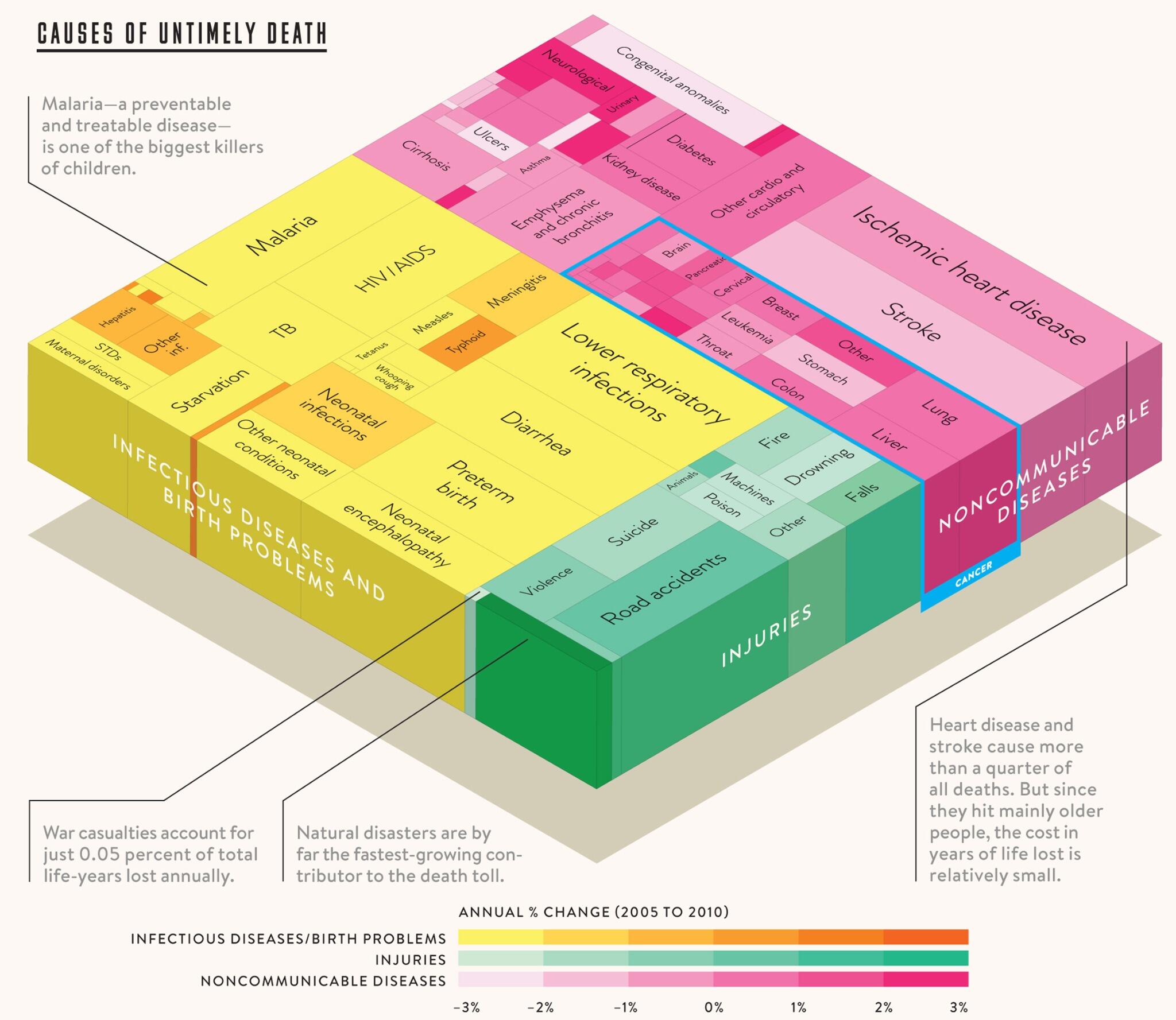
The American data below suggests that your chances of dying by fire are about the same as dying from choking and a little worse from dying from post surgery complications.

Rather than in need of nudging, your average low income tenants seems to have it pretty right regarding the risks of dying in a fire.
When I went looking for some economics of housing habitability laws, Google was a bit of a disappointment. There are some empirical work done in the 1970s and early 1980s and then it fell away.
My suspicion is there is not so much empirical work on the economics of housing habitability laws because proving the obvious is not a good investment in Ph.D. topics or tenure track economic research.

Walter Block wrote an excellent defence of slumlords in his 1971 book Defending the Undefendable:
The owner of ghetto housing differs little from any other purveyor of low-cost merchandise. In fact, he is no different from any purveyor of any kind of merchandise. They all charge as much as they can.
First consider the purveyors of cheap, inferior, and second-hand merchandise as a class. One thing above all else stands out about merchandise they buy and sell: it is cheaply built, inferior in quality, or second-hand.
A rational person would not expect high quality, exquisite workmanship, or superior new merchandise at bargain rate prices; he would not feel outraged and cheated if bargain rate merchandise proved to have only bargain rate qualities.
Our expectations from margarine are not those of butter. We are satisfied with lesser qualities from a used car than from a new car. However, when it comes to housing, especially in the urban setting, people expect, even insist upon, quality housing at bargain prices.
Richard Posner discussed housing habitability laws in his Economic Analysis of the Law. The subsection was titled wealth distribution through liability rules. Posner concluded that habitability laws will lead to abandonment of rental property by landlords and increased rents for poor tenants.

What do-gooder would want to know that a warranty of habitability for rental housing will lead to scarcer, more expensive housing for the poor! Surprisingly few interventions in the housing market work to the advantage of the poor.
Certainly, there will be less rental housing of a habitability standard below that demanded by do-gooders. In the Encyclopaedia of Law and Economics entry on renting, Werner Hirsch said:
It would be a mistake, however, to look upon a decline in substandard rental housing as an unmitigated gain. In fact, in the absence of substandard housing, options for indigent tenants are reduced. Some tenants are likely to end up in over-crowded standard units, or even homeless.
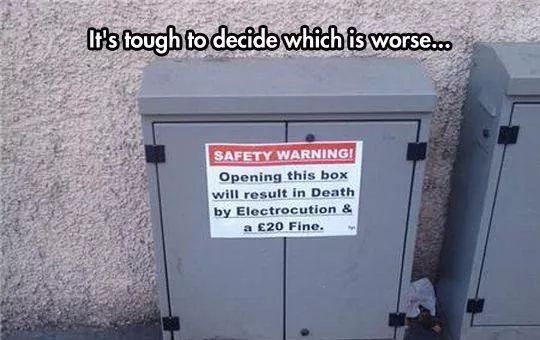
Safety warning gone mad
10 Sep 2014 Leave a comment
in health and safety Tags: nanny state
HT: Tortylicious via Cato Institute
Who Is More Irrational – Consumers or Regulators?
08 Sep 2014 Leave a comment
in economics of regulation, energy economics, entrepreneurship, environmental economics, environmentalism, global warming Tags: Bjørn Lomborg, expressive voting, futile gestures, global warming, Kip Viscusi, nanny state, regulatory failure, The fatal conceit, The pretence to knowledge

A study by Ted Gayer and W. Kip Viscusi looked into this implied irrationality of consumers. They have found no empirical evidence to support the view that if consumers are so irrational that government agencies must prohibit certain energy consuming products for us to make the right choices:
Rather than accept the implications that consumers and firms are acting so starkly against their economic interest, a more plausible explanation is that there is something incorrect in the assumptions being made in the regulatory impact analyses.
Indeed, upon closer inspection it is apparent that there is no empirical evidence provided for the types of consumer failures alleged.
Even the EPA acknowledged this logical gap in its economic analysis of energy efficiency regulations:
it is a conundrum from an economic perspective that these large fuel savings have not been provided by automakers and purchased by consumers
Not surprisingly Kip Viscusi observed that
The regulatory impact analyses examined in this study contain virtually no empirical evidence to support the irrationality proposition.
• This proposition ignores the fact that consumers and firms purchase products based on a number of factors—only one of which is energy efficiency.
• Government agencies exhibit a parochial bias by ignoring all product attributes other than energy efficiency.

 Utopia, you are standing in it!
Recent Comments