
Thirteen years' ago yesterday: but who will stop the cell phone king? pic.twitter.com/eNbtwJchji
— Ryan Bourne (@MrRBourne) November 13, 2020
Celebrating humanity's flourishing through the spread of capitalism and the rule of law
12 Nov 2021 Leave a comment
in economic history, industrial organisation, survivor principle Tags: creative destruction, natural monopoly, network economics
30 Aug 2021 Leave a comment
in applied price theory, applied welfare economics, Austrian economics, comparative institutional analysis, economic history, economics of regulation, law and economics Tags: competition law, network economics
09 May 2020 1 Comment
in economics of education, economics of media and culture Tags: economics of languages, network economics
09 Mar 2020 Leave a comment
in economics of bureaucracy, economics of regulation, energy economics, entrepreneurship, environmental economics, financial economics, income redistribution, industrial organisation, law and economics, property rights, Public Choice, rentseeking, Richard Epstein, survivor principle Tags: competition law, network economics, price controls
11 Apr 2017 Leave a comment
in energy economics Tags: network economics, power prices, solar energy
02 Jun 2016 Leave a comment
in politics - New Zealand, transport economics Tags: celebrity technologies, expressive voting, KiwiRail, network economics, picking losers, picking winners, rational irrationality, urban transport
$5.2 billion in rail spending since the 2003 budget! This $5.2 billion does not include any spending on urban rail, commuter train networks or their electrification. The $5.2 billion since the 2003 budget is for the passenger and freight network, not the urban metro contracts

Source: New Zealand Budget Papers, various years.
Desperately waiting for that dividend the taxpayers lose if any of these assets are privatised. The spending listed below in the two charts includes loans, capital injections and the purchase of the track and of the train operator itself. The latter was purchased for $690 million which was soon written down to zero.
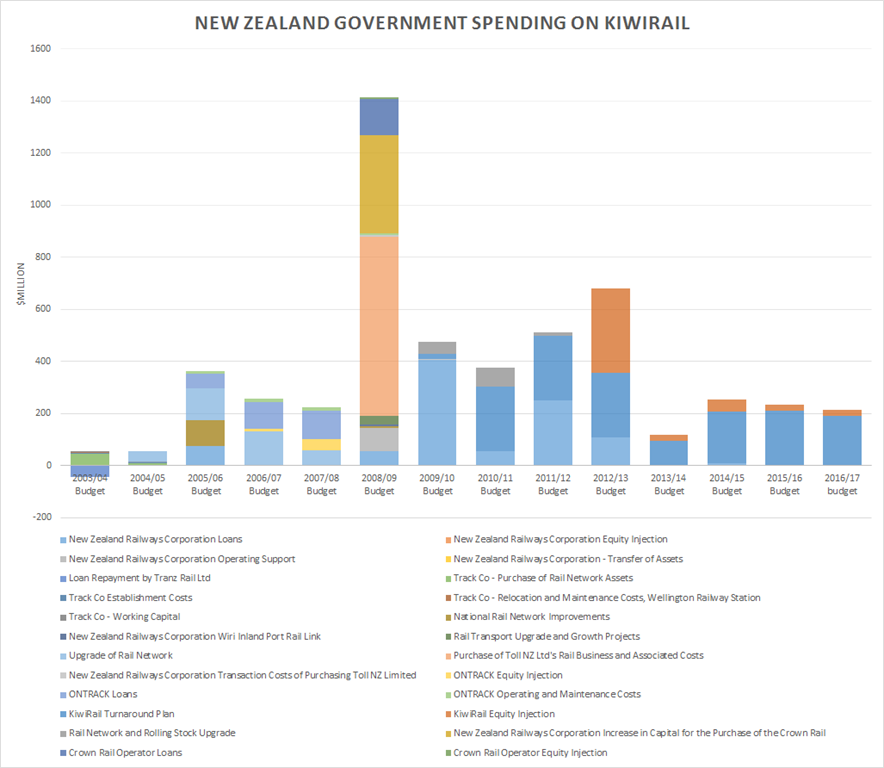
Source: New Zealand Budget Papers, various years.
There is no table because the table format breaks down when blogged.
At various times, OnTrack and KiwiRail was subsidiaries of the New Zealand Railways Corporation, which was the holding company. Now OnTrack is a division of KiwiRail.
10 Oct 2015 Leave a comment
in economic history, industrial organisation Tags: maps, network economics
The Internet underwater.
Map of cables laid internationally.(by The Guardian) http://t.co/FrBpHsTs7t—
Max Roser (@MaxCRoser) September 19, 2015
06 Oct 2015 Leave a comment
in economics of media and culture Tags: brand names, economics of languages, economics of names, network economics
The median Emily is just 17 years old. The median Dorothy is 74. 53eig.ht/1HAbW2j http://t.co/b4oUzm4pfy—
(@FiveThirtyEight) September 24, 2015
13 Aug 2015 Leave a comment
in economics of media and culture Tags: economics of languages, network economics, network goods
Each language's equivalent of "it's all Greek to me".
(Source: bit.ly/1KM8dML ) http://t.co/WmLBWkIqzZ—
Max Roser (@MaxCRoser) June 11, 2015
07 Jul 2015 Leave a comment
in population economics Tags: economics of languages, network economics, network goods
Gorgeous representation of the world's languages.
scmp.com/infographics/a… http://t.co/HytMI4nXzQ—
Zach Noble (@thezachnoble) May 30, 2015
02 May 2015 Leave a comment
in health economics Tags: anti-vaccination movement, measles, network economics, vaccines
A Measles patient infects 12-18 other people.
An Ebola patient infects 1-2.5 other people. http://t.co/iQS0c6vxYz—
Amitabh Chandra (@amitabhchandra2) April 24, 2015
23 Apr 2015 1 Comment
in discrimination, economics of education, human capital, labour economics, politics - USA, poverty and inequality Tags: do gooders, economics of languages, Maori economic development, network economics, Te reo Māori
The Race Relations Commissioner Dame Susan Davoy has called for Te Reo Māori to be compulsory in New Zealand schools. She said being bilingual would be “a real added advantage” to young Kiwis and more people knowing Te reo Māori would help race relations.
Learning another language is not a priority for the Pākehā children or Māori mokupuna when you consider the poor literacy rates among Māori, Pasifika and Pākehā. The priority for children in an English speaking country is to master English. Too many children leave school with inadequate reading and writing skills.
Figure 1: Prose literacy by ethnicity, 2011
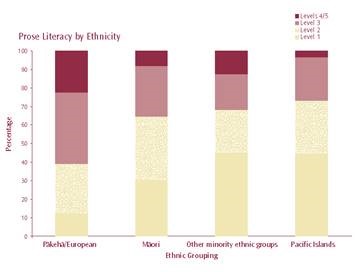
Source: Literacy skills of young adult New Zealanders | Education Counts.
Lower levels of literacy and numerously are much higher among Māori and Pasifika children. Pākehā consistently having a larger proportion in the higher levels of prose literacy.
Figure 2: Prose literacy rates by ethnicity, 1996 and 2006
Source: Indicator 9: Literacy rates — Office of the Auditor-General New Zealand.
60%of Pākehā are above the minimum level of competence to meet the prose literacy requirements of a knowledge society. This contrasts with the majority of Māori and Pasifika who are below the minimum level of competence.
Furthermore, requiring children who do not have an aptitude for language or school in general to learn a language will reinforce in those who are not doing well that they are not very smart. This will give them more reasons to hate school and leave as soon as possible and never go back.
The key to helping children who do not have an aptitude to succeed greatly at school is to find the subjects where they do do well so they can get a good start to life. If students are not good at academic subjects, requiring them to do more academic studies such as study language is fool-hardy.
Taking resources, and more importantly, students learning time away from basic literacy skills will do little for a Māori economic development and race relations. This is because this taking resources and student learning time away from literacy and basic education will slow the closing of income gaps between Māori and others.
Language is a network good. It pays to join the largest network so you can communicate and do business with more people. The wage premium for immigrants learning English in English-speaking’s countries is about 15%.

Learning Te reo Māori will not help children in their other subjects. The psychology of the transfer of learning was founded 100 years ago to explore the hypothesis that learning Latin gave the student muscle to learn other subjects, both other languages and generally learn faster.
Educational psychologists found that Latin does not help much in studying other languages and other subjects. No significant differences were found in deductive and inductive reasoning or text comprehension among students with 4 years of Latin, 2 years of Latin or no Latin at all.
Celebrating humanity's flourishing through the spread of capitalism and the rule of law
Scholarly commentary on law, economics, and more
Beatrice Cherrier's blog
Celebrating humanity's flourishing through the spread of capitalism and the rule of law
Celebrating humanity's flourishing through the spread of capitalism and the rule of law
Celebrating humanity's flourishing through the spread of capitalism and the rule of law
Why Evolution is True is a blog written by Jerry Coyne, centered on evolution and biology but also dealing with diverse topics like politics, culture, and cats.
Celebrating humanity's flourishing through the spread of capitalism and the rule of law
Celebrating humanity's flourishing through the spread of capitalism and the rule of law
A rural perspective with a blue tint by Ele Ludemann
DPF's Kiwiblog - Fomenting Happy Mischief since 2003
Celebrating humanity's flourishing through the spread of capitalism and the rule of law
The world's most viewed site on global warming and climate change
Tim Harding's writings on rationality, informal logic and skepticism
A window into Doc Freiberger's library
Let's examine hard decisions!
Commentary on monetary policy in the spirit of R. G. Hawtrey
Thoughts on public policy and the media
Celebrating humanity's flourishing through the spread of capitalism and the rule of law
Politics and the economy
A blog (primarily) on Canadian and Commonwealth political history and institutions
Reading between the lines, and underneath the hype.
Economics, and such stuff as dreams are made on
"The British constitution has always been puzzling, and always will be." --Queen Elizabeth II
Celebrating humanity's flourishing through the spread of capitalism and the rule of law
Celebrating humanity's flourishing through the spread of capitalism and the rule of law
WORLD WAR II, MUSIC, HISTORY, HOLOCAUST
Undisciplined scholar, recovering academic
Celebrating humanity's flourishing through the spread of capitalism and the rule of law
Res ipsa loquitur - The thing itself speaks
Celebrating humanity's flourishing through the spread of capitalism and the rule of law
Researching the House of Commons, 1832-1868
Articles and research from the History of Parliament Trust
Reflections on books and art
Posts on the History of Law, Crime, and Justice
Celebrating humanity's flourishing through the spread of capitalism and the rule of law
Exploring the Monarchs of Europe
Cutting edge science you can dice with
Small Steps Toward A Much Better World
“We do not believe any group of men adequate enough or wise enough to operate without scrutiny or without criticism. We know that the only way to avoid error is to detect it, that the only way to detect it is to be free to inquire. We know that in secrecy error undetected will flourish and subvert”. - J Robert Oppenheimer.
The truth about the great wind power fraud - we're not here to debate the wind industry, we're here to destroy it.
Celebrating humanity's flourishing through the spread of capitalism and the rule of law
Celebrating humanity's flourishing through the spread of capitalism and the rule of law
Economics, public policy, monetary policy, financial regulation, with a New Zealand perspective
Celebrating humanity's flourishing through the spread of capitalism and the rule of law
Restraining Government in America and Around the World
 Utopia, you are standing in it!
Recent Comments