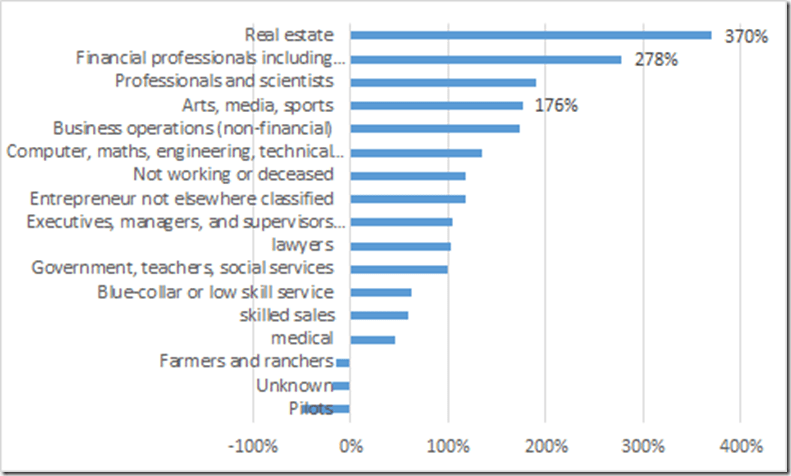
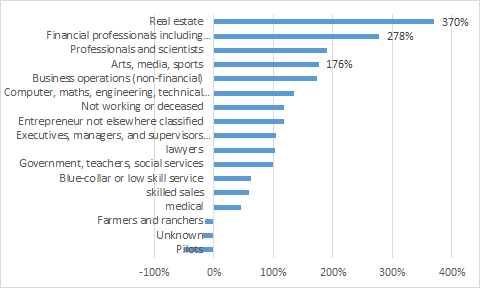
The members of the top 1% whose income increased the most between 1979 and 2005 were real estate professionals followed by financial professionals – see figure 1.
Figure 1: increase in share of national income (including capital gains) received by top 1% for each primary taxpayer occupation in top 1% between 1979 and 2005
Source: Jon Bakija, Adam Cole and Bradley T. Heim “Jobs and Income Growth of Top Earners and the Causes of Changing Income Inequality: Evidence from U.S. Tax Return Data”.
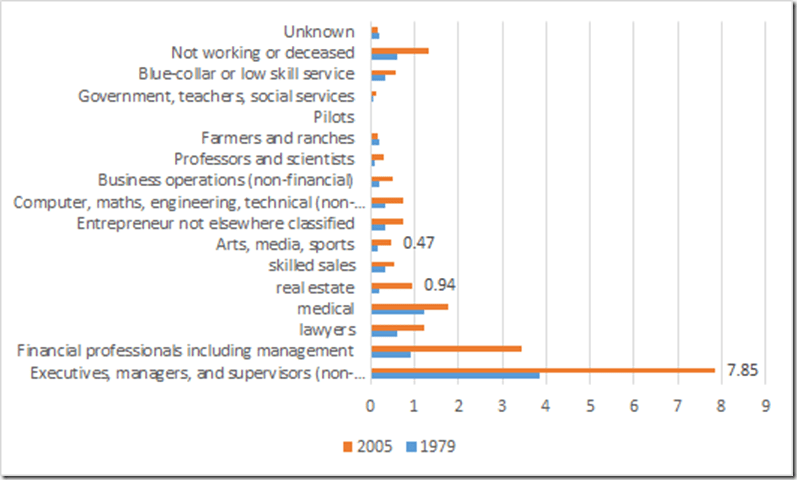
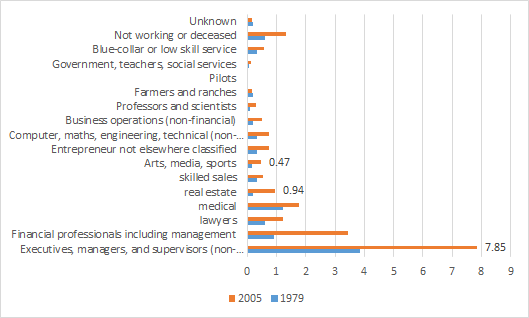
Figure 2 shows that the fastest-growing shares among the top 1% as in figure 1 are not necessarily the largest occupational group are those income earners. Moreover, their fortunes seem largely unrelated to each other.
Figure 2: Percentage of national income (including capital gains) received by top 1%, and each primary taxpayer occupation in top 1%
Source: Jon Bakija, Adam Cole and Bradley T. Heim “Jobs and Income Growth of Top Earners and the Causes of Changing Income Inequality: Evidence from U.S. Tax Return Data”.
The next members of the top 1% in terms of income growth were rather respectable group:professionals and scientists and arts, media and sports. The latter,arts, media and sports get a complete pass on their membership of the top 1% despite their great success in increasing their incomes since 1979 at the expense apparently on the bottom 99% if the Twitter Left is to be believed.
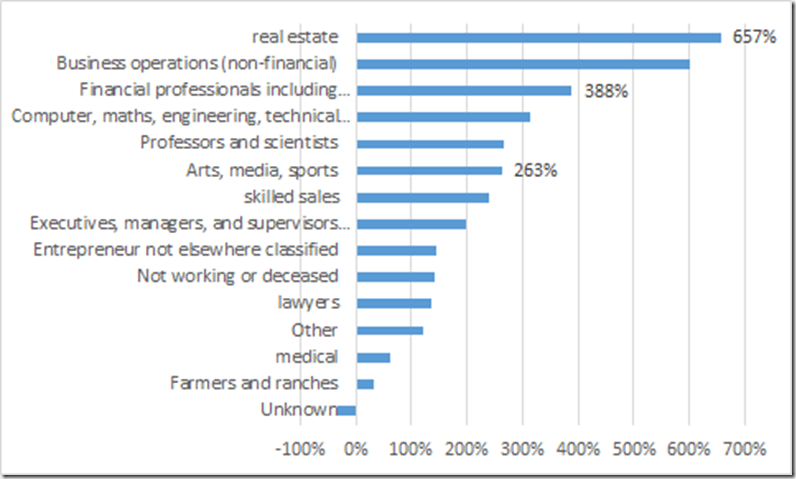
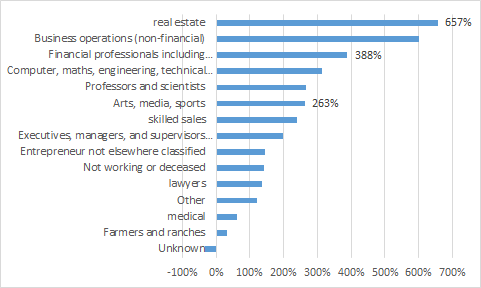
Figure 3: increase in share of national income (including capital gains) received by top 0.1% for each primary taxpayer occupation in top 0.1%between 1979 and 2005
Source: Jon Bakija, Adam Cole and Bradley T. Heim “Jobs and Income Growth of Top Earners and the Causes of Changing Income Inequality: Evidence from U.S. Tax Return Data”.
Arts, media and sports superstars are one of the fastest-growing members of the top 0.1% – see figure 3. Again, the arts, media and sports superstars get a complete pass on their membership of the top 0.1% from the Twitter Left. Most of the other occupations in the top 0.1% don’t strike me as anything other than working rich – see figure 3 and figure 4.
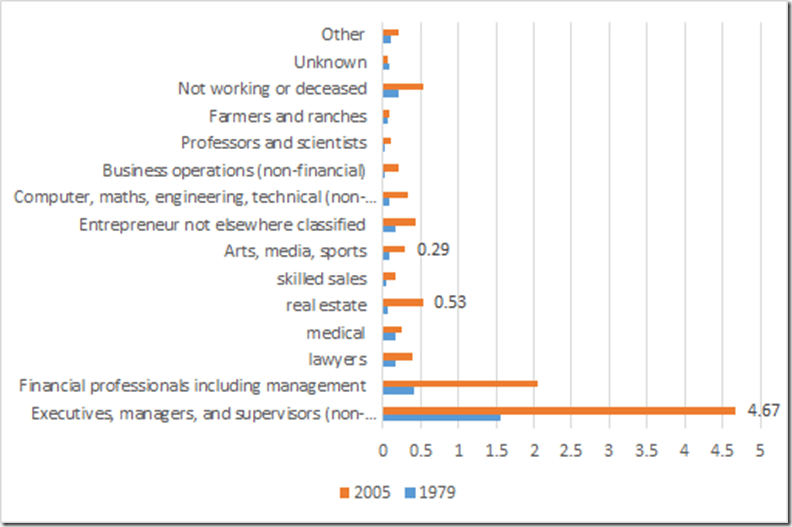
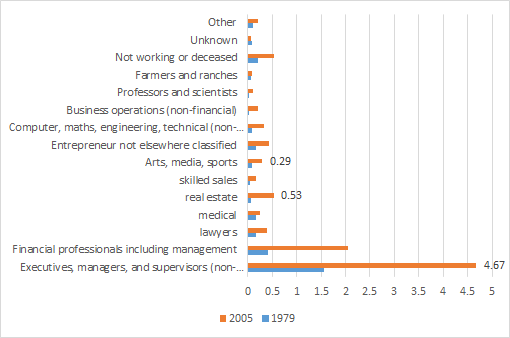
As with the top 1%, the top 0.1% of income earners are a mixed bag of occupations – see figure 4. Their fortunes are unrelated to each other terms of the forces driving there are increased incomes.
Figure 4: Percentage of national income (including capital gains) received by top 0.1%, and each primary taxpayer occupation in top 0.1%
Source: Jon Bakija, Adam Cole and Bradley T. Heim “Jobs and Income Growth of Top Earners and the Causes of Changing Income Inequality: Evidence from U.S. Tax Return Data”.





 Utopia, you are standing in it!
Recent Comments