Have @NZGreens accidentally published a chart showing substantial and pretty continuous real wages growth in recent decades?
12 Nov 2014 Leave a comment
in labour economics, politics - New Zealand, poverty and inequality, welfare reform Tags: poverty and inequality, The Great Enrichment
How Not to Be Poor | NCPA
12 Nov 2014 Leave a comment
in applied welfare economics, economics of education, labour economics Tags: poverty and inequality, welfare reform


James Tobin on limiting the domain of inequality
08 Nov 2014 Leave a comment
in applied welfare economics, income redistribution, Public Choice, welfare reform Tags: James Tobin, negative income tax, poverty and inequality, welfare reform

The slums of Jebson Pl – down and out in New Zealand includes Sky TV
08 Nov 2014 Leave a comment
in poverty and inequality, welfare reform Tags: poverty and inequality, The Great Erichment, welfare reform

via Whale Oil Beef Hooked and waikato-times
Occupy Wall Street protesters didn’t like what they found when they actually met the bottom 1%
06 Nov 2014 Leave a comment
in labour economics, poverty and inequality, welfare reform Tags: bottom 1%, economics of personality traits, Occupy Wall Street, poverty and inequality, top 1%

The Occupy Wall Street protesters had free food provided by kitchens staffed by volunteers.

These self appointed representatives of the bottom 99% didn’t appreciate brushing shoulders with the bottom 1 percent of the social stratum:
The Occupy Wall Street volunteer kitchen staff launched a “counter” revolution yesterday — because they’re angry about working 18-hour days to provide food for “professional homeless” people and ex-cons masquerading as protesters.
For three days beginning tomorrow, the cooks will serve only brown rice and other spartan grub instead of the usual menu of organic chicken and vegetables, spaghetti bolognese, and roasted beet and sheep’s-milk-cheese salad.
They will also provide directions to local soup kitchens for the vagrants, criminals and other freeloaders who have been descending on Zuccotti Park in increasing numbers every day.
To show they mean business, the kitchen staff refused to serve any food for two hours yesterday in order to meet with organizers to air their grievances, sources said…
Overall security at the park had deteriorated to the point where many frightened female protesters had abandoned the increasingly out-of-control occupation, security- team members said.

Bryan Caplan on the pathologies of poverty
05 Nov 2014 Leave a comment
in labour economics, poverty and inequality, welfare reform Tags: Bryan Caplan, do gooders, Occupy Wall Street, poverty and inequality, top 1%

Bryan Caplan drew up a nice list of factors that contribute to poverty
- alcoholism: Alcohol costs money, interferes with your ability to work, and leads to expensive reckless behaviour.
- drug addiction: Like alcohol, but more expensive, and likely to eventually lead to legal troubles you’re too poor to buy your way out of.
- single parenthood: Raising a child takes a lot of effort and a lot of money. One poor person rarely has enough resources to comfortably provide this combination of effort and money.
- unprotected sex: Unprotected sex quickly leads to single parenthood. See above.
- dropping out of high school: High school drop-outs earn much lower wages than graduates. Kids from rich families may be able to afford this sacrifice, but kids from poor families can’t.
- being single: Getting married lets couples avoid a lot of wasteful duplication of household expenses. These savings may not mean much to the rich, but they make a huge difference for the poor.
- non-remunerative crime: Drunk driving and bar fights don’t pay. In fact, they have high expected medical and legal expenses. The rich might be able to afford these costs. The poor can’t.
Caplan argues that there is an undeserving poor if they fail to follow the following reasonable steps to avoid poverty and hardship:
- Work full-time, even if the best job you can get isn’t fun.
- Spend your money on food and shelter before getting cigarettes and cable t.v.
- Use contraception if you can’t afford a child
The fire of truth: the relationship between inequality and economic prosperity in New Zealand since the 1970s
29 Oct 2014 Leave a comment
in economic growth, economics of regulation, income redistribution, politics - New Zealand, rentseeking Tags: Auckland urban limit, economic growth, Gini coefficient, green rent seeking, poverty and inequality, Resource Management Act
Figure 1: Before Housing Costs Gini coefficient, New Zealand, 1982 – 2013

closertogether.org.nz/nzs-income-inequality-problem claims that NZ income inequality increased very rapidly in the late 1980s and 1990s — faster than in any other wealthy country.
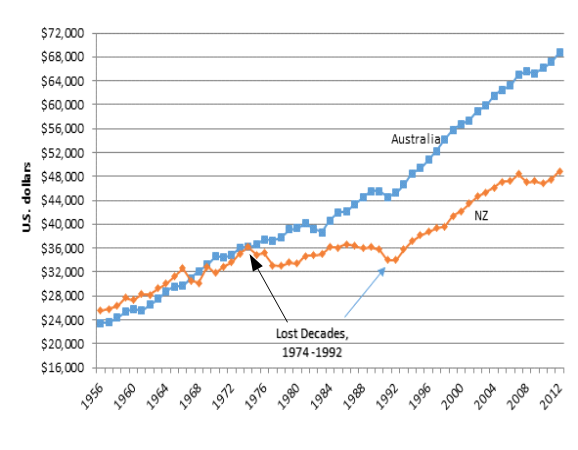
Figure 2 shows that this rapid rise in inequality coincided with the resumption of economic growth after two lost decades: next to no increase in real GDP per working age New Zealander from 1974 to 1992.
Figure 2: Real GDP per New Zealander and Australian aged 15-64, converted to 2013 price level with updated 2005 EKS purchasing power parities, 1956-2012
Source: Source: Computed from OECD Stat Extract and The Conference Board, Total Database, January 2014, http://www.conference-board.org/economics
Perry (2014) found that:
- Income inequality in New Zealand is at a similar level to Australia, Canada, Italy and Japan (Ginis of 32-33) and a little lower than the UK (34). Countries such as Denmark, Norway, Finland and Belgium have lower than average inequality (Ginis of 25-26). The US and Israel have higher scores of 39.
- The top 1% in New Zealand received around 8% of all taxable income in 2010 and 2011 (before tax), similar to Norway, Finland and Australia, lower than Ireland and Switzerland (11%) and much lower than the UK and Canada (13%) and the US (18%).
- The trend for the New Zealand share has been steady at around 8-9% since the mid 1990s, with perhaps a slight fall in the last few years. Many OECD countries saw small rises in the period, and in the USA the top 1% share continued to rise strongly, from 13% to 19%.
Perry (2014) concluded that:
Overall, there is no evidence of any sustained rise or fall in inequality in the last two decades. The level of household disposable income inequality in New Zealand is a little above the OECD median. The share of total income received by the top 1% of individuals is at the low end of the OECD rankings.
This remark by Parry that there is no evidence of any sustained rise or fall in inequality in New Zealand in the last 20 years is very much at odds with the claim of Closer Together New Zealand that income inequality inequality increased rapidly in the late 1980s and 1990s.
The increase in inequality in New Zealand was in the late 1980s and early 1990s. In the early 1990s, a long economic boom started that lasted until the global financial crisis.
Figure 3 : Income Inequality in New Zealand as Assessed by the Gini Coefficient

Source: Perry 2014 derived from Statistics NZ Household Economic Survey (HES) 1982–2012.
Figure 4: Income Inequality in New Zealand as Assessed by the P80/P20 Ratio

Source: Perry 2014 derived from Statistics NZ Household Economic Survey (HES) 1982–2012.
Figures 3 and 4 both show that after housing costs inequality in New Zealand is higher, but has been pretty stable for 20 years as measured by the Gini coefficient and by the P80/P20 ratio. (When individuals are ranked by equivalised household income and then divided into 100 equal groups, each group is called a percentile. If the ranking starts with the lowest income, then the income at the top of the 20th percentile is denoted P20; the income at the top of the 80th percentile is called P80. The ratio of the value at the top of the 80th percentile to the value at the top of the 20th percentile is called the P80/20 ratio and is often used as a measure of income inequality).
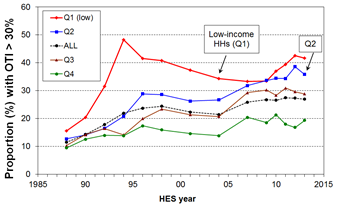
Figure 5: Proportion of HHs with housing cost outgoings to income of greater than 30%, by income quintile
Source: Perry (2014); OTI = outgoings to income
Figure 5 shows that
- for the bottom quintile (Q1), the proportion with high outgoings to income (OTI) steadily reduced from 48% in 1994 to 34% in 2004, as unemployment fell, employment and income rose, and income-related rental policies were introduced in 2000 for those in HNZC houses. From HES 2009 to HES 2013 the proportion rose strongly from 33% to 42%, the highest it has been in the last 25 years except for the peak of 48% in 1994.
- For households with incomes in the second quintile (Q2) there was a strong rise from the 1980s through to the mid 1990s, followed by a relatively flat trend to 2004. Since 2004, the proportion with high OTIs has risen strongly from 27% to 36%.
- For the third quintile (Q3) the proportion with high OTIs settled at around 30% for 2007 to 2013, up from 21% in 2004 and 10% in 1988.
Rising housing costs in New Zealand have one explanation, which is restrictions on the supply of land under the Resource Management Act.
HT: nzchildren.co.nz/income_inequality for figures 3 and 4.
The Top 1% of income earners in NZ are lazy – the Occupy Movement have nothing to protest about – updated
25 Oct 2014 Leave a comment
in applied welfare economics, income redistribution, Marxist economics, politics - New Zealand, rentseeking Tags: lost decades, occupy movement, poverty and inequality, prosperity and depression, top 1%
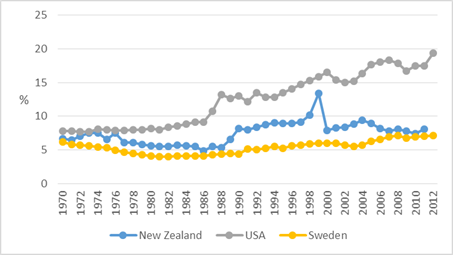
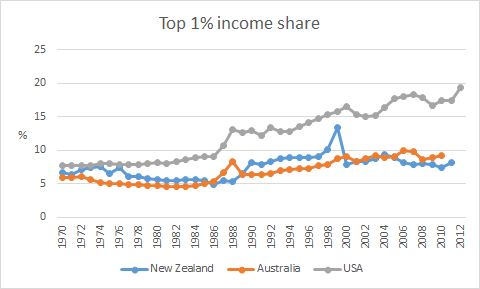
The NZ top 1% share has been steady at 8-9% since the mid-1990s. The top 1%’s share rose strongly in the USA in recent decades, from 13% in the mid-1980s to 19% in 2012.
Figure 1: Top 1% income shares, USA, New Zealand and Sweden, 1970-2012
Source: The World Top Income Database at http://topincomes.g-mond.parisschoolofeconomics.eu/#Database
The top 1% in New Zealand is so lazy that Sweden is overtaking it – See figure 1.
The Occupy crowd blame everything from the global financial crisis to a bad environment on growing inequality and the top 1%. Such an argument has no foundation in fact in New Zealand.
Income inequality as measured by the Gini coefficient has not risen much in New Zealand for 20 years – See figure 2. How can the poor be getting getting poorer, ground under by the yoke of capitalism, if the rich are not getting richer. The occupy movement should apply for unemployment benefits and seek career guidance.
Figure 2: Gini coefficient New Zealand 1980-2015
![clip_image002[7]](https://utopiayouarestandinginit.com/wp-content/uploads/2014/10/clip_image00271.png "clip_image002[7]")
Source: Bryan Perry, Household incomes in New Zealand: Trends in indicators of inequality and hardship 1982 to 2013. Ministry of Social Development (July 2014).
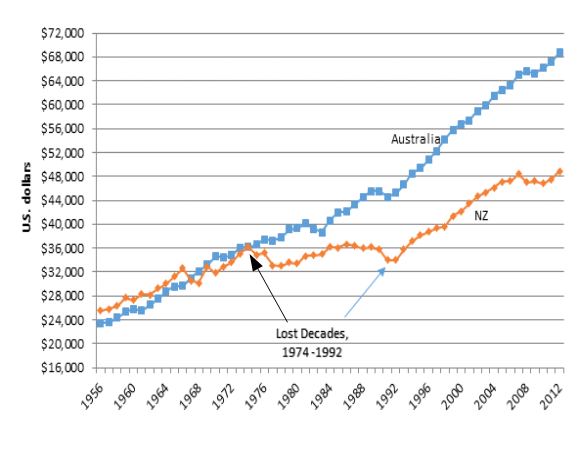
The last major increase in income inequality in New Zealand was in the late 1980s and early 1990s and that was followed by a long economic boom – See figure 3 .
Figure 3: Real GDP per New Zealander and Australian aged 15-64, converted to 2013 price level with updated 2005 EKS purchasing power parities, 1956-2012
Source: Computed from OECD Stat Extract and The Conference Board, Total Database, January 2014, http://www.conference-board.org/economics .
This long boom was after two decades of next to no economic growth in the 1970s and 1980s in New Zealand – see figure 3 . This depression between 1974 and 1992 was New Zealand’s lost decades.
Figure 4 shows that both the lost decades of economic growth in New Zealand and the emergence of the trans-Tasman income gap the seemed to somewhat coincide with the top 1% of earners in Australia increasing their share of income from 6% to 10% of total incomes while the New Zealand top 1% sat on their hands. They are such lazy devils.
Figure 4: Top 1% income shares, USA, New Zealand and Australia, 1970-2012
Source: The World Top Income Database at http://topincomes.g-mond.parisschoolofeconomics.eu/#Database
Deirdre McCloskey on the right way to get angry about poverty and inequality
19 Oct 2014 Leave a comment

Piketty on inequality: views of the IGM economic experts
16 Oct 2014 Leave a comment
in applied price theory, applied welfare economics, comparative institutional analysis, constitutional political economy, discrimination, economic growth, entrepreneurship, gender, human capital, income redistribution, industrial organisation, labour economics, Marxist economics, Rawls and Nozick Tags: Daron Acemoglu, James Robinson, Piketty, poverty and inequality, The Great Enrichment
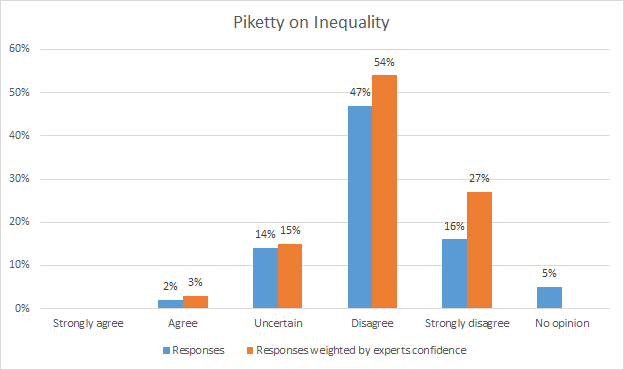
Question: The most powerful force pushing towards greater wealth inequality in the US since the 1970s is the gap between the after-tax return on capital and the economic growth rate?
Daron Acemoglu and James Robinson have a simple explanation for why Piketty is wrong:
But like Marx, Piketty goes wrong for a very simple reason. The quest for general laws of capitalism or any economic system is misguided because it is a-institutional.
It ignores that it is the institutions and the political equilibrium of a society that determine how technology evolves, how markets function, and how the gains from various different economic arrangements are distributed.
Despite his erudition, ambition, and creativity, Marx was ultimately led astray because of his disregard of institutions and politics. The same is true of Piketty.


 Utopia, you are standing in it!
Recent Comments