The truth about the press and power? Readers, not editors, decide elections. @RobertdgSmith specc.ie/1c58mAr http://t.co/Vhit9P9iM7—
Fraser Nelson (@FraserNelson) May 06, 2015
Market segmentation in the London newspaper market
11 Jul 2015 Leave a comment
in constitutional political economy, economic history, economics of media and culture, entrepreneurship, industrial organisation, Public Choice, survivor principle Tags: British elections, British politics, consumer sovereignty, creative destruction, entrepreneurial alertness, expressive voting, London newspapers, market selection, media bias, product differentiation, rational ignorance, rational irrationality, The meaning of competition
Newspaper bias just ain’t what it used to be
10 Jul 2015 Leave a comment
in economic history, economics of media and culture, entrepreneurship, industrial organisation, Public Choice Tags: British elections, creative destruction, expressive voting, London newspapers, media bias, rational ignorance, rational irrationality, red scares
Here's the Daily Mirror's polling day advice from days when it was more fair and balanced (h/t Guido) http://t.co/GJ5CNGMoRj—
Fraser Nelson (@FraserNelson) May 07, 2015
A living wage helps well-off households more!
10 Jul 2015 Leave a comment
in applied price theory, applied welfare economics, econometerics, income redistribution, politics - Australia, politics - New Zealand, politics - USA, Public Choice, rentseeking Tags: activists, British economy, British politics, do gooders, expressive voting, living wage, rational ignorance, rational irrationality, The fatal conceit, The pretence to knowledge, unintended consequences
Do Living Wage advocates realise it helps richer households more than poorer ones? My take: telegraph.co.uk/finance/budget… … http://t.co/YPTB6v7tSB—
Fraser Nelson (@FraserNelson) July 10, 2015
The left-wing solution to Greek bankruptcy
10 Jul 2015 Leave a comment
in applied price theory, applied welfare economics, comparative institutional analysis, constitutional political economy, currency unions, fiscal policy, global financial crisis (GFC), income redistribution, liberalism, macroeconomics, Marxist economics, Public Choice, public economics, rentseeking Tags: Eurosclerosis, expressive voting, Greece, rational ignorance, rational irrationality, sovereign default
Has NZ child poverty doubled as @MaxRashbrooke said?
09 Jul 2015 1 Comment
in applied welfare economics, economic history, economics of regulation, labour economics, law and economics, politics - New Zealand, poverty and inequality, property rights Tags: Auckland urban limit, child poverty, Director's Law, expressive voting, family poverty, family tax credits, in-work tax credits, land use planning, median voter theorm, rational ignorance, rational irrationality, RMA, top 1%, working for families
Lindsay Mitchell put me onto a quote by veteran grumbler Max Rashbrooke that the child poverty rate doubled in New Zealand:
In a system where income goes disproportionately to the already well-off, ordinary workers are missing out on the rewards of their efforts, to the tune of billions of dollars a year. Welfare benefits, cut by a quarter in 1991 and increased just 8 per cent in the last budget, are far too low to meet people’s basic needs.
The result is a doubling of child poverty and the return of childhood diseases unknown in most developed countries – a national embarrassment, as one researcher described it.
Poverty, income and inequality data is collected in loving detail by Brian Perry every year for the Ministry of Social Development.
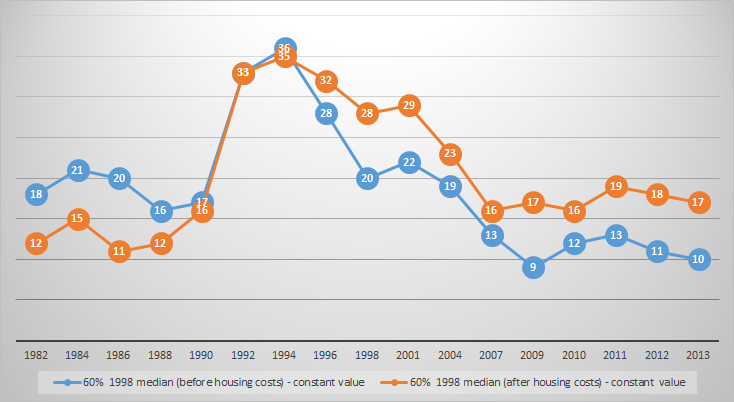
Figure 1: % child poverty in New Zealand (before and after housing costs), 60% 1998 median constant value, 1982 – 2013
Source: Bryan Perry, Household incomes in New Zealand: Trends in indicators of inequality and hardship 1982 to 2013. Ministry of Social Development (July 2014), Tables F.6 and F.7.
The only thing noticeable in the downward trend in child poverty in New Zealand since its doubling with the sharp recession in 1990 with double-digit unemployment rates is child poverty stop falling shortly after in-work family tax credits were introduced in the form of Working for Families in 2005.
New QV figures show Auckland house prices are up a massive 16.1% on last year, now estimated to reach $1m by Aug '16. http://t.co/DwAU79ozCy—
New Zealand Labour (@nzlabour) June 09, 2015
There was a break in trend in the long decline in child poverty as soon as in-work family tax credits were introduced in New Zealand. I’m sure this is a coincidence because, as Brian Perry said when discussing the introduction of Working for Families in 2005:
The 2004 to 2007 period was the only one in the 25 years to 2007 in which the incomes of low- to middle-income households grew more quickly than those of households above the median.
The real killer in New Zealand in terms of poverty and inequality are housing costs. Housing costs are wholly under the control of government through its control of the supply of land, which is restricted at the behest of the parties of the left.
Figure 2: real equivalised household incomes (before and after housing costs): changes at the top of lowest income decile, New Zealand, 1982 to 2013

Source: Bryan Perry, Household incomes in New Zealand: Trends in indicators of inequality and hardship 1982 to 2013. Ministry of Social Development (July 2014), tables D.2 and D.4.
Figure 2 shows that real equivalised household income after housing costs has not grown and in fact has fallen for the bottom 10% of the income distribution in New Zealand.

It is the left-wing parties who oppose measures to reduce housing costs and and increase the supply of land through reforms to the Resource Management Act and the relaxation of the Auckland metropolitan urban limit.

Labour and the Greens are in effect keeping the poor poor to win middle-class votes.
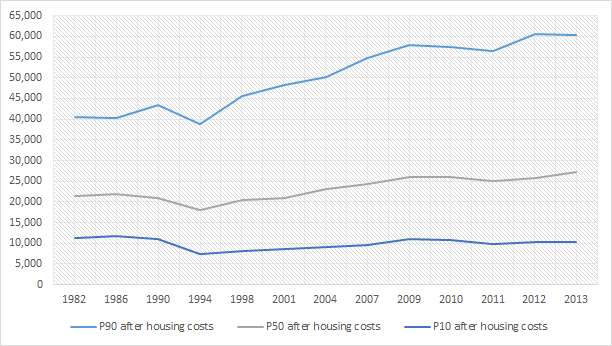
Figure 3: real equivalised household incomes (before and after housing costs): changes at the top of the top, middle and lowest lowest income deciles, New Zealand, 1982 to 2013
Source: Bryan Perry, Household incomes in New Zealand: Trends in indicators of inequality and hardship 1982 to 2013. Ministry of Social Development (July 2014), tables D.2 in D.4.
Figure 3 shows that those in the middle and higher deciles, a political territory rich in swinging voters, are still doing well after housing costs. The parties of the left are collaborating with a middle-class home owning voter while betraying the working class and its aspirations from home ownership and quite simply affordable housing costs when they rent.
The increases for all groups may be understated by the inability of living standards measures to adequately account for new goods, product upgrades and rising life expectancies.
President Donald Trump? Just Say No
09 Jul 2015 Leave a comment
in politics - USA, Public Choice, rentseeking Tags: 2016 presidential election, antiforeign bias, antimarket bias, Donald Trump, expressive voting, rational ignorance, rational irrationality
A lot of voters want to protect themselves from the scourge of lower prices
09 Jul 2015 Leave a comment
in industrial organisation, international economics, politics - Australia, politics - New Zealand, politics - USA Tags: antiforeign bias, antimarket bias, expressive voting, free trade, rational ignorance, rational irrationality, voter demographics
Who favors free trade?
(The affluent.)
nytimes.com/2015/05/28/ups… @BrendanNyhan http://t.co/kojmUWUtH0—
Justin Wolfers (@JustinWolfers) May 27, 2015
The political bias of psychologists
05 Jul 2015 Leave a comment
in economics of bureaucracy, economics of education, economics of media and culture, politics - Australia, politics - New Zealand, politics - USA, Public Choice, rentseeking Tags: academic bias, bureaucratic bias, expressive voting, Leftover Left, media bias, occupational choice, political bias, rational ignorance, rational irrationality, social psychology, Twitter left
Why is it that the economics profession is the only profession questioned on the grounds of its political diversity?

1) Academic psychology once had considerable political diversity, but has lost nearly all of it in the last 50 years;
2) This lack of political diversity can undermine the validity of social psychological science via mechanisms such as the embedding of liberal values into research questions and methods, steering researchers away from important but politically unpalatable research topics, and producing conclusions that mischaracterize liberals and conservatives alike;
3) Increased political diversity would improve social psychological science by reducing the impact of bias mechanisms such as confirmation bias, and by empowering dissenting minorities to improve the quality of the majority’s thinking; and
4) The underrepresentation of non-liberals in social psychology is most likely due to a combination of self-selection, hostile climate, and discrimination.
via Psychology’s Political Diversity Problem | Psychology Today.
The role of low wages in poverty
04 Jul 2015 Leave a comment
in labour economics, politics - USA, poverty and inequality Tags: expressive politics, Leftover Left, poverty, rational ignorance, rational irrationality
A Schumpeterian explanation of the recent rejection of the centre-left in Europe
02 Jul 2015 Leave a comment
in political change, Public Choice Tags: EU, Euroland, European politics, expressive voting, Joseph Schumpeter, Leftover Left, rational ignorance, rational irrationality
Kiwiblog put me onto the story in the Guardian about how only one third of Europe’s population is governed by the centre-left and the left is lost all but one of the last 13 elections in Europe. The exception was Greece, which they may regret.

Austria, Croatia, the Czech Republic, France, Italy, Malta, Slovakia and Sweden are the only EU members that are on the centre-left. In 2011, only 14.5% of the 28 countries’ total population was led by the centre-left. In 2007, it was nearly 45%.
The reason for the shift to the right can be explained by Joseph Schumpeter’s theory of democracy. Schumpeter disputed the widely held view that democracy was a process by which the electorate identified the common good, and that politicians carried this out:
- The people’s ignorance and superficiality meant that they were manipulated by politicians who set the agenda.
- Although periodic votes legitimise governments and keep them accountable, their policy programmes are very much seen as their own and not that of the people, and the participatory role for individuals is limited.
Schumpeter’s theory of democratic participation is that voters have the ability to replace political leaders through periodic elections.
Citizens do have sufficient knowledge and sophistication to vote out leaders who are performing poorly or contrary to their wishes. The power of the electorate to turn elected officials out of office at the next election gives elected officials an incentive to adopt policies that do not outrage public opinion and administer the policies with some minimum honesty and competence.
Power rotates in the Schumpeterian sense. Governments were voted out when they disappointed voters with the replacement not necessarily having very different policies. Greece is the exception to this.

Public Acceptance Of Evolution In 34 Countries
02 Jul 2015 Leave a comment
in economics of religion Tags: conjecture and refutation, evolution, expressive voting, rational ignorance, rational irrationality
Public Acceptance Of Evolution In 34 Countries
From Science (2006): bit.ly/13teDlY http://t.co/CwWUqkgboY—
Max Roser (@MaxCRoser) June 07, 2015
Anthony Downs on the unsustainability of buses and trains as compared to cars
30 Jun 2015 Leave a comment
in politics - New Zealand, transport economics, urban economics Tags: Anthony Downs, antimarket bias, expressive voting, Leftover Left, makework bias, meddlesome preferences, nanny state, rational ignorance, rational irrationality

 Utopia, you are standing in it!
Recent Comments