The super-rich are super-mobile. So, if a country decides to increase taxes on the super-rich (for example, with a wealth tax), some (but not all) of the super-rich will simply move elsewhere. This should not be a surprise to anyone. And yet, simplistic proposals to tax the super-rich are a favourite policy for some political…
Newsflash! The super-rich are mobile, and higher taxes incentivise them to move away
Newsflash! The super-rich are mobile, and higher taxes incentivise them to move away
25 Sep 2025 1 Comment
in applied price theory, human capital, income redistribution, labour economics, labour supply, occupational choice, Public Choice, public economics Tags: taxation and entrepreneurship, taxation and investment
David Splinter on how much tax billionaires pay
30 Aug 2025 Leave a comment
in applied price theory, econometerics, entrepreneurship, human capital, income redistribution, labour economics, labour supply, politics - USA, poverty and inequality, Public Choice, public economics Tags: taxation and entrepreneurship, taxation and investment
Here is his comment on the paper presented here: Summary: The U.S. tax system is highly progressive. Effective tax rates increase from 2% for the bottom quintile of income to 45% for the top hundredth of one percent. But rates may be lower among those with the highest wealth. This comment starts with the “top 400” […]
David Splinter on how much tax billionaires pay
The Laffer Curve Triumphs Again: Class Warfare in the United Kingdom Backfires
02 Aug 2025 Leave a comment
in applied price theory, fiscal policy, labour economics, macroeconomics, public economics Tags: taxation and investment

The Laffer Curve provides incredibly important insights about tax policy. Most important, it informs us that you don’t measure the revenue impact of tax policy changes merely by looking at what is happening to tax rates. You also have to consider whether changes in tax rates will alter incentives to earn and report income. Or, […]
The Laffer Curve Triumphs Again: Class Warfare in the United Kingdom Backfires
Slowly Strangling the Death Tax
23 Jun 2025 Leave a comment
in applied price theory, Austrian economics, economic growth, macroeconomics, politics - USA, Public Choice, public economics Tags: death taxes, taxation and entrepreneurship, taxation and investment, taxation and savings
Back in 2013, I debated Joe Biden’s top economist on the death tax. Everything I said then (and wrote four years before then) is still true today. In the interview, I mentioned nations that have abolished their death taxes, including Australia. I should have mentioned Sweden as well. As a general rule, I don’t want […]
Slowly Strangling the Death Tax
What happened when Spain brought back the wealth tax?
13 Jun 2025 1 Comment
in applied price theory, Public Choice, public economics Tags: Spain, taxation and entrepreneurship, taxation and investment, taxation and savings
From the Journal of Public Economics Twitter feed: What happened when Spain brought back the Wealth Tax in 2011? Using variation in exposure, this paper finds: – No drop in savings, but drop in taxable wealth—mainly via legal avoidance – Asset shifting caused most revenue loss – Estimated revenue loss was 2.75x initial 2011 rev. […]
What happened when Spain brought back the wealth tax?
One last post on Investment Boost
27 May 2025 Leave a comment
in applied price theory, economic growth, fiscal policy, macroeconomics, politics - New Zealand, public economics Tags: taxation and investment

After the discussion in my post yesterday on the Investment Boost subsidy scheme announced in the Budget I thought a bit more about who was likely to benefit the most from it. The general answer of course is the purchasers of the longest-lived assets. Why? Because if you have an asset which IRD estimates to […]
One last post on Investment Boost
Some more post-Budget thoughts
27 May 2025 Leave a comment
in budget deficits, business cycles, economic growth, fiscal policy, macroeconomics, politics - New Zealand, Public Choice, public economics Tags: taxation and investment

On two separate themes; aggregate fiscal policy, and the Investment Boost initiative. Aggregate fiscal policy Over the weekend for some reason I was prompted to look up the Budget Responsibility Rules that Labour and the Greens committed to in early 2017 (my commentary on them here). At the time, the intention seemed to be to […]
Some more post-Budget thoughts
The Economic Consequences of Ever-Growing Government in Finland
10 May 2025 1 Comment
in applied price theory, economic growth, entrepreneurship, human capital, labour economics, labour supply, macroeconomics, Public Choice Tags: Finland, taxation and entrepreneurship, taxation and investment, taxation and labour supply

I’m currently in Finland for meetings with various people and I learned that the country’s bloated public sector and expensive welfare state are imposing a very heavy cost on the economy. How heavy of a cost? According to IMF data, there’s been no growth in per-capita GDP over the past 18 years. Why is Finland […]
The Economic Consequences of Ever-Growing Government in Finland
Ireland: Good Corporate Tax Policy vs. Bad Government Spending Policy
11 Feb 2025 Leave a comment
in budget deficits, business cycles, economic growth, economic history, Euro crisis, fiscal policy, global financial crisis (GFC), great recession, labour economics, labour supply, law and economics, macroeconomics, monetary economics, public economics Tags: Ireland, taxation and investment
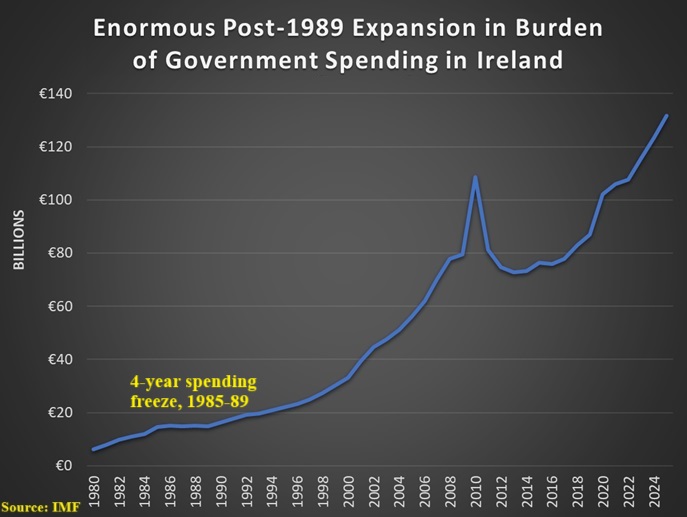
I’m a big fan of Ireland’s low corporate tax rate for three reasons. First, it shows that good tax policy generates positive economic outcomes as per-capita GDP in Ireland has grown by record amounts. Second, it shows that lower tax rates can in some cases lead to more revenue. Sort of a turbo-charged version of […]
Ireland: Good Corporate Tax Policy vs. Bad Government Spending Policy
Goldilocks and the Laffer Curve
09 Feb 2025 Leave a comment
in applied price theory, budget deficits, economic growth, entrepreneurship, fiscal policy, labour economics, labour supply, macroeconomics, politics - USA, public economics Tags: taxation and entrepreneurship, taxation and investment, taxation and labour supply
Other than Art Laffer, I think of myself as the world’s biggest advocate of the Laffer Curve. I’ve literally written hundreds of columns explaining and promoting the concept. My goal is to help people understand that there is not a linear relationship between tax rates and tax revenue. Why is this the case? Because when […]
Goldilocks and the Laffer Curve
Can President Trump break the International Corporate Tax Cartel?
01 Feb 2025 Leave a comment
in entrepreneurship, financial economics, fiscal policy, industrial organisation, International law, macroeconomics, politics - USA, Public Choice, public economics Tags: taxation and entrepreneurship, taxation and investment
From the Economist: The international tax system has long suffered from two related problems: firms go to great lengths to book profits in low-tax jurisdictions, and governments thus have strong incentives to compete with each other in cutting levies so as to attract investment [only a dirigiste would consider this a problem]. Hoping to forestall…
Can President Trump break the International Corporate Tax Cartel?
Scandinavian Governments Are Greedy, not Socialist
27 Dec 2024 Leave a comment
in applied price theory, economic growth, entrepreneurship, fiscal policy, human capital, income redistribution, labour economics, labour supply, liberalism, macroeconomics, Marxist economics, politics - USA, poverty and inequality, Public Choice, public economics Tags: Denmark, Norway, social insurance, Sweden, taxation and entrepreneurship, taxation and investment, taxation and labour supply
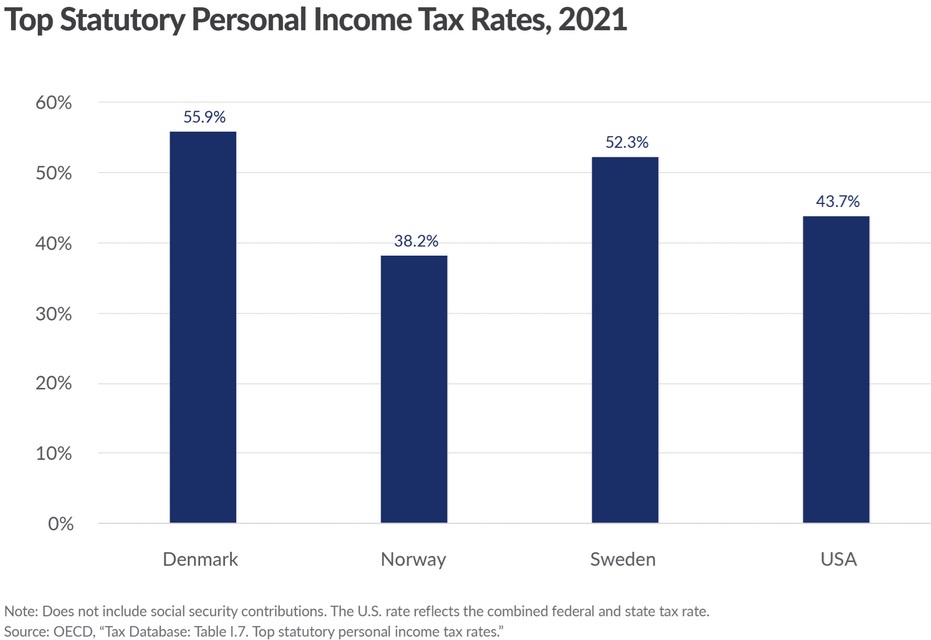
Scandinavian nations are not socialist, at least if we’re using the technical definition (government ownership, central planning, and price controls). But those countries do have big welfare states. And that means stifling tax burdens. And those harsh taxes don’t just apply to rich taxpayers. Lower-income and middle-class people also get pillaged. I’ve already explained that punitive value-added […]
Scandinavian Governments Are Greedy, not Socialist
Bye and Bye: Washington State Moves To Toward a “Wealth Tax” As the Wealthy Move to Leave the State
26 Dec 2024 Leave a comment
in applied price theory, entrepreneurship, financial economics, fiscal policy, income redistribution, macroeconomics, Marxist economics, politics - USA, Public Choice, public economics Tags: regressive left, taxation and entrepreneurship, taxation and investment, taxation and savings, wealth tax

Washington State’s unofficial state motto has long been “Al-ki” which means either “bye and bye” or “by and by” in Chinook. The former meaning now seems official as Gov. Jay Inslee pushed for a “wealth tax.” Wealthy citizens are already saying bye to the state in anticipation of what one Democratic billionaire recently called a […]
Bye and Bye: Washington State Moves To Toward a “Wealth Tax” As the Wealthy Move to Leave the State
The Consequences of Limiting the Tax Deductibility of R&D
03 Dec 2024 Leave a comment
in applied price theory, econometerics, entrepreneurship, fiscal policy, macroeconomics, Public Choice, public economics Tags: taxation and entrepreneurship, taxation and investment
We study the tax payment and innovation consequences of limiting the tax deductibility of research and development (“R&D”) expenditures. Beginning in 2022, U.S. companies are required to capitalize and amortize R&D rather than immediately deduct these expenditures. We utilize variation in U.S. firms’ fiscal year ends to test the effects of the R&D tax change […]
The Consequences of Limiting the Tax Deductibility of R&D
Biden-Harris policies and their consequences were no surprise to those paying attention
30 Oct 2024 Leave a comment
in applied price theory, applied welfare economics, budget deficits, business cycles, econometerics, economic growth, economic history, economics of bureaucracy, economics of regulation, energy economics, entrepreneurship, environmental economics, financial economics, fiscal policy, global warming, health economics, income redistribution, industrial organisation, law and economics, macroeconomics, monetary economics, politics - USA, property rights, Public Choice, public economics, rentseeking Tags: 2024 presidential election, drug lags, taxation and entrepreneurship, taxation and investment
Milton Friedman used to advise researchers to focus on large policy changes rather than attempting to separate a small change’s signal from the noise. In this sense, the “ambitious” policy agenda of the Biden-Harris administration was expected to be a gift to the research community. Accepting this gift, since 2020 I have been making forecasts…
Biden-Harris policies and their consequences were no surprise to those paying attention
 Utopia, you are standing in it!
Recent Comments