I frequently make the point that America’s tax system is more progressive than European tax systems. But not because the United States imposes higher tax rates on upper-income households. Instead, the big difference is that lower-income and middle-class households in the United States face much lower tax burdens than their European counterparts. In those columns, […]
Is it time to pack our belongings and head to Argentina, where Javier Milei is dramatically improving economic policy and cultural attitudes? I’m joking, but also not joking. The reason I’m not joking is that there’s a very depressing scenario for America’s near-term economic outlook. It involves these six potential developments. Thanks in part to […]
One of the key insights of good tax policy is that people respond to incentives. If tax rates are punitive, people will do what they can to protect themselves from predatory government. Especially if they have any ability to control the timing, level, and composition of their income. Star athletes are definitely in this group. They avoid […]
I’m a big fan of tax migration. I cheer when productive people escape high-tax states or high-tax nations. And when the geese with the golden eggs fly away, it thwarts the plans of greedy politicians. The latest example of this is the exodus of billionaires – worried about a wealth tax – from California (the […]
Olivier Blanchard writes: The French are not lazy. They just enjoy leisure more than most (no irony here) And this is perfectly fine: As productivity increases, it is perfectly reasonable to take it partly as more leisure (fewer hours per week, earlier retirement age), and only partly in income. He has follow-up points and clarifications…
Unless you’re a policy wonk, I realize “exciting” may not be the right word to describe new developments in public-finance economics. For nerds, however, three economists at the Joint Committee on Taxation have some important new research on the Laffer Curve. The study, authored by Rachel Moore, Brandon Pecoraro, and David Splinter, concludes that the […]
There can be honest and constructive debates about the size of government, such as when I cross swords with someone on the left who understands Arthur Okun’s efficiency-equity tradeoff. Another legitimate debate is about the impact of tax policy, specifically whether higher or lower tax rates have big effects or small effects. But to have […]
I wrote a column about taxes and growth in 2020. Let’s augment that analysis by digging into some details. I decided to address the issue today after seeing a tweet with this helpful summary of how different taxes cause different levels of economic damage (the Tax Foundation also has a table that ranks different taxes, […]
This policy has been so popular with economists on a bipartisan basis, yet a recent piece in ReStud raises some doubts, as the wage subsidies induce many to drop out of school: As a complement to the federal earned income tax credit (EITC), some states offer their own EITC, typically calculated as a percentage of […]
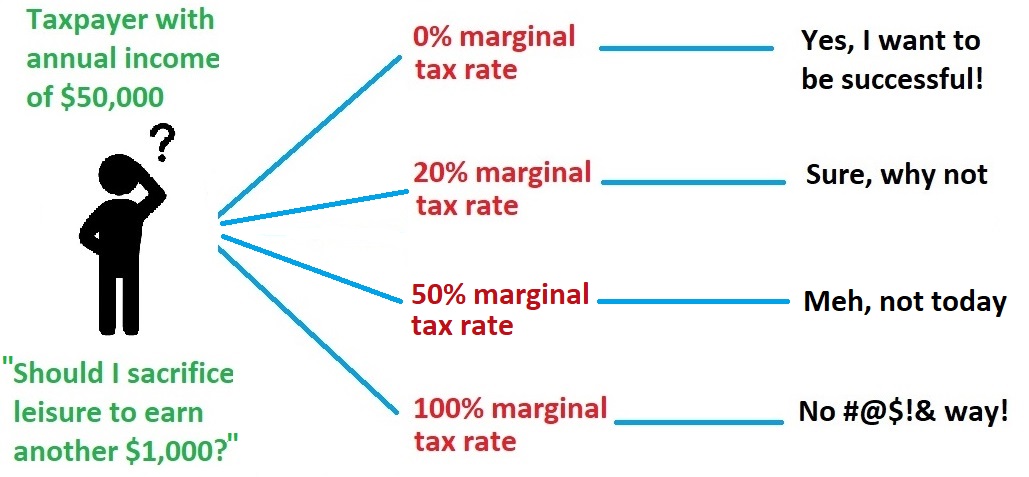
There are several visual ways of helping people understand how fiscal policy (and especially marginal tax rates) can change behavior. The philoso-raptor meme. The questioning worker. Supply-and-demand curves. The Wizard-of-Id parody. To augment these examples, I’ve started a series that is based on real-world examples. Part I of the series highlighted how the capital gains […]
From a big-picture economic perspective, I worry most about the damage of high tax burdens on innovation, entrepreneurship, and investment. Those are things that generate enormous benefits for society, yet also things that are very sensitive to bad tax policy (specifically high marginal tax rates and the tax code’s bias against saving and investment). Sadly, […]
Even in Denmark: We investigate long-run earnings responses to taxes in the presence of dynamic returns to effort. First, we develop a theoretical model of earnings determination with dynamic returns to effort. In this model, earnings responses are delayed and mediated by job switches. Second, using administrative data from Denmark, we verify our model’s predictions […]
I’m currently in Finland for meetings with various people and I learned that the country’s bloated public sector and expensive welfare state are imposing a very heavy cost on the economy. How heavy of a cost? According to IMF data, there’s been no growth in per-capita GDP over the past 18 years. Why is Finland […]
Other than Art Laffer, I think of myself as the world’s biggest advocate of the Laffer Curve. I’ve literally written hundreds of columns explaining and promoting the concept. My goal is to help people understand that there is not a linear relationship between tax rates and tax revenue. Why is this the case? Because when […]
Why Evolution is True is a blog written by Jerry Coyne, centered on evolution and biology but also dealing with diverse topics like politics, culture, and cats.
“We do not believe any group of men adequate enough or wise enough to operate without scrutiny or without criticism. We know that the only way to avoid error is to detect it, that the only way to detect it is to be free to inquire. We know that in secrecy error undetected will flourish and subvert”. - J Robert Oppenheimer.




 Utopia, you are standing in it!
Recent Comments