Being classically liberal
12 Sep 2015 Leave a comment
in constitutional political economy, liberalism, Public Choice Tags: Leftover Left, meddlesome preferences, nanny state, progressive left, The fatal conceit, The pretence to knowledge
Is sociology really irrelevant in policy debates?
03 Sep 2015 Leave a comment
in applied price theory, applied welfare economics, comparative institutional analysis, constitutional political economy, economics of bureaucracy, economics of media and culture, income redistribution, labour economics, occupational choice, Public Choice, rentseeking Tags: compensating differentials, evidence-based policy, media bias, offsetting behaviour, public intellectuals, sociology, The fatal conceit, The pretence to knowledge, unintended consequences
Is sociology really irrelevant in policy debates? @familyunequal does a better job with the #s blog.contexts.org/2015/01/25/soc… http://t.co/c4E25DTCmm—
(@SocImages) February 04, 2015
Forecasting is not getting any easier
28 Aug 2015 Leave a comment
in business cycles, financial economics, macroeconomics, monetary economics Tags: forecasting errors, monetary policy, The fatal conceit, The pretence to knowledge
Economists: They refuse to accept low interest rates! http://t.co/WyTlm6L1KS—
Tim Fernholz (@TimFernholz) August 18, 2015
@NZGreens @TransportBlog cars rule in Auckland! Auckland commuting times by transport mode
21 Aug 2015 1 Comment
in job search and matching, labour economics, occupational choice, politics - New Zealand, transport economics, urban economics Tags: Auckland, bicycles, commuting times, compensating differentials, expressive voting, green rent seeking, Inner-city Left, New Zealand Greens, public transport, rational irrationality, search and matching, The fatal conceit, The pretense to knowledge
I am not surprised only 7% of Auckland’s take public transport to work considering it takes much longer than any other form of commuting.
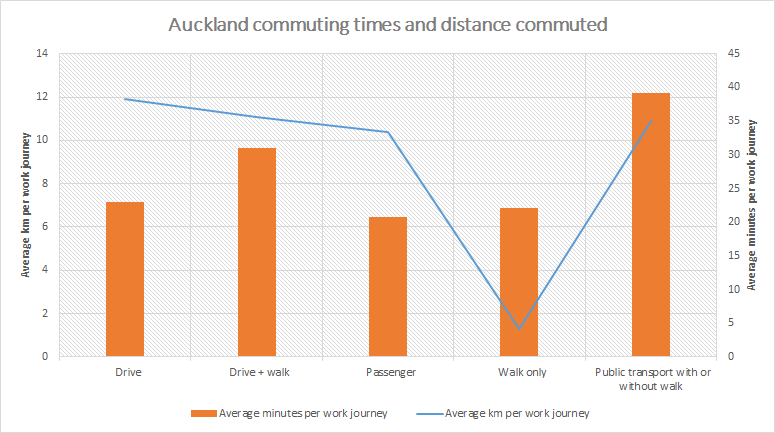
The average commute by public transport is 40 minutes as compared to less than 25 in a car. 74% of Aucklanders drive to work and another 9% are a passenger in a car.
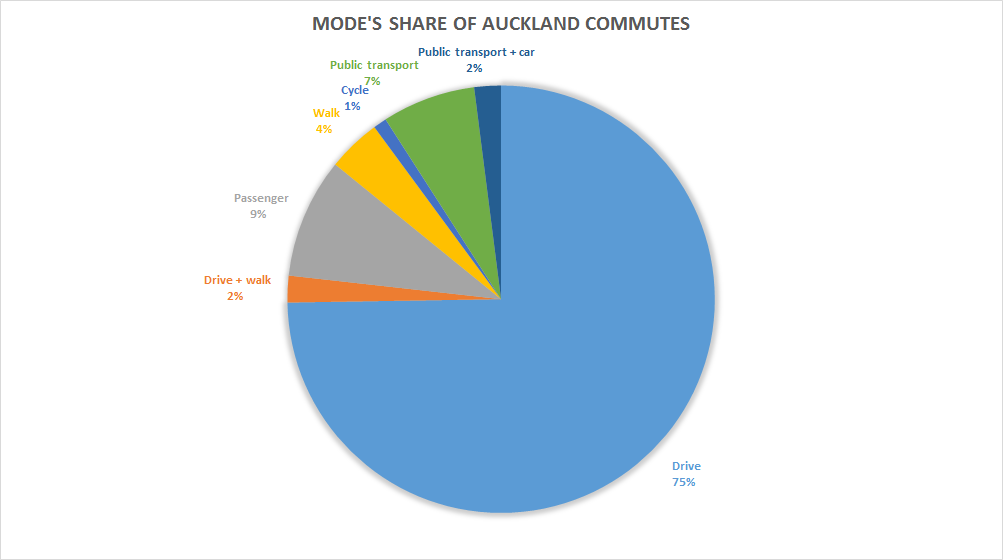
No information was available on those who bike to work because only 1% of Aucklanders bike to work. Only 2% of all New Zealanders take a bike to work. The sample size was therefore too small. Yet another reason to ban bikes at night. Few commute on this mode of transport in Auckland.
The near identical commuting distances irrespective of the mode of transport except walking is further evidence that people are quite discerning in balancing commuting times and job selection as per the theory of compensating differentials. Indeed, average commuting times in Auckland are much the same as the average commuting time in America.

The Auckland transport data showing people commute much the same distance by any mode of transport bar walking also validates Anthony Downs’ theory of triple convergence.

Improving the commuting times in one mode of transport will mean people simply take the mode of peak hour transport that is suddenly become less congested while others who were not going to commute at peak times or start commuting at peak times as Anthony Downs explains:
If that expressway’s capacity were doubled overnight, the next day’s traffic would flow rapidly because the same number of drivers would have twice as much road space.
But soon word would spread that this particular highway was no longer congested. Drivers who had once used that road before and after the peak hour to avoid congestion would shift back into the peak period. Other drivers who had been using alternative routes would shift onto this more convenient expressway. Even some commuters who had been using the subway or trains would start driving on this road during peak periods.
Within a short time, this triple convergence onto the expanded road during peak hours would make the road as congested as it was before its expansion.
Best 2 Minimum Wage Cartoons
21 Aug 2015 Leave a comment
in labour economics, minimum wage, politics - Australia, politics - New Zealand, politics - USA Tags: antimarket bias, expressive voting, Leftover Left, offsetting behaviour, rational ignorance, rational irrationality, The fatal conceit, The pretense to knowledge, unintended consequences
Best 2 Minimum Wage Cartoons Ever, from Henry Payne, Updated for Seattle's $15 "Economic Death Wish" @HenryEPayne http://t.co/vatUzkHMss—
Mark J. Perry (@Mark_J_Perry) August 18, 2015
Does the minimum wage increase unemployment?
20 Aug 2015 Leave a comment
in labour economics, minimum wage, unemployment Tags: College premium, compensating differentials, education premium, evidence-based policy, offsetting behaviour, The fatal conceit, The pretence to knowledge, unintended consequences
https://twitter.com/MiltonFriedmanS/status/630956276554444800/photo/1
#Australia:highest minimum wage in OECD relative to purchasing power. Increases #youthunemployment #auspol #jobsearch http://t.co/HML9l2rD7R—
Bob Day (@senatorbobday) August 11, 2015
Over-qualification rates in jobs in the USA, UK and Canada
19 Aug 2015 2 Comments
in economics of bureaucracy, economics of education, human capital, job search and matching, labour economics, labour supply, occupational choice, politics - USA, Public Choice Tags: British economy, Canada, compensating differentials, job shopping, offsetting behaviour, on-the-job training, search and matching, The fatal conceit, The pretense to knowledge
In the UK, foreign-born are much more likely to be over qualified than native born highly educated not in education with less difference between men and women. More men than women are overqualified for their jobs in the UK. Over qualification is less of a problem in the UK than in the USA and Canada.
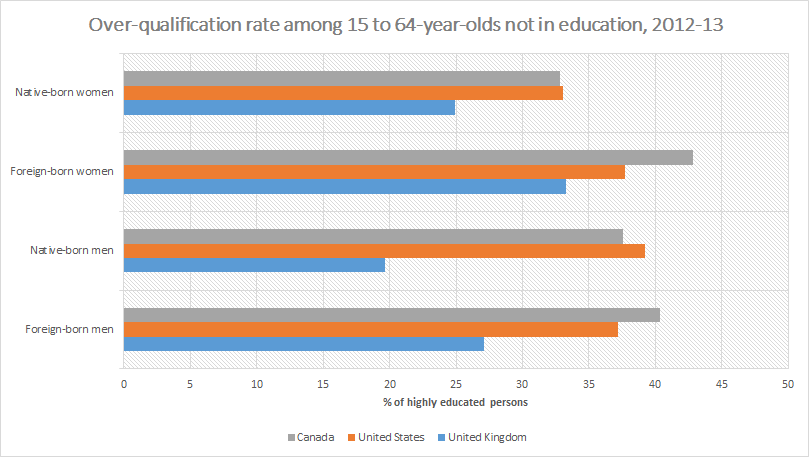
Source: OECD (2015) Indicators of Immigrant Integration 2015: Settling In.
In the USA and Canada, there are few differences between native and foreign born men in over-qualification rates. Foreign-born women tend to be more over-qualified than native born women in the USA and more so in Canada. Many more workers are overqualified for their jobs in the USA and Canada as compared to the UK.
There are large differences in the percentage of people with tertiary degrees and the education premium between these three countries that are outside the scope of this blog post. These trends may explain differences in the degree of educational mismatch.
It goes without saying that the concept of over-qualification and over-education based mismatch in the labour market is ambiguous, if not misleading and a false construct.
To begin with, under human capital theories of labour market and job matching, what appears to be over-schooling substitutes for other components of human capital, such as training, experience and innate ability. Not surprisingly, over-schooling is more prominent among younger workers because they substitute schooling for on-the-job training. A younger worker of greater ability may start in a job below his ability level because he or she expects a higher probability to be promoted because of greater natural abilities. Sicherman and Galor (1990) found that:
overeducated workers are more likely to move to a higher-level occupation than workers with the required level of schooling
Investment in education is a form of signalling. Workers invest so much education that they appear to be overqualified in the eyes of officious bureaucrats. The reason for this apparent overinvestment is signalling superior quality as a candidate. Signalling seems to be an efficient way of sorting and sifting among candidates of different ability. The fact that signalling survives in market competition suggests that alternative measure ways of measuring candidate quality that a more reliable net of costs are yet to be discovered.
A thoroughly disheartening chart if you're a graduate in the UK i100.io/mpDbJAl http://t.co/mv9izA0mbc—
i100 (@thei100) August 20, 2015
Highly educated workers, like any other worker, must search for suitable job matches. Not surprisingly, the first 5 to 10 years in the workforce are spent in half a dozen jobs as people seek out the most suitable match in terms of occupation, industry and employer. Some of these job seekers who are highly educated will take less suitable jobs while they search on-the-job for better matches. Nothing is free or instantly available in life including a good job match.
A more obvious reason for over qualification is some people like attending university and other forms of education for the sheer pleasure of it.
Anyone who encounters the words over-qualified and over-educated should immediately recall concepts such as the pretence to knowledge, the fatal conceit, and bureaucratic busybodies. As Edwin Leuven and Hessel Oosterbeek said recently:
The over-education/mismatch literature has for too long led a separate life of modern labour economics and the economics of education.
We conclude that the conceptional measurement of over-education has not been resolved, omitted variable bias and measurement error are too serious to be ignored, and that substantive economic questions have not been rigorously addressed.
On the inefficiency of fuel efficiency standards
17 Aug 2015 Leave a comment
in applied price theory, applied welfare economics, economics of regulation, energy economics, environmental economics Tags: fuel efficiency standards, offsetting behaviour, The fatal conceit, The pretense to knowledge, unintended consequences
If Someone Replaced Your Car with a Prius, Would You Drive More?
17 Aug 2015 Leave a comment
in applied price theory, energy economics, entrepreneurship, environmental economics, industrial organisation Tags: offsetting behaviour, The fatal conceit, The pretense to knowledge, unintended consequences
Pope Francis Needs a Better Role Model for Economic Policy
15 Aug 2015 Leave a comment
in applied price theory, applied welfare economics, comparative institutional analysis, constitutional political economy, economics of bureaucracy, Public Choice Tags: Catholic Church, The fatal conceit, The pretense to knowledge

What’s the greatest economic tragedy in modern history?
The obvious answer is communism, which produced tens of millions of needless deaths and untold misery for ordinary people.  Just compare living standards in North Korea and South Korea, or Chile and Cuba.
But if there was a second-place prize for the world’s biggest economic failure, Argentina would be a strong contender.
Here’s one fact that tells you everything you need to know. In 1946, when Juan Perón came to power, Argentina was one of the 10-richest nations in the world. Economic policy certainly wasn’t perfect, but government wasn’t overly large are markets generally were allowed to function. Combined with an abundance of natural resources, that enabled considerable prosperity.
But Perón decided to conduct an experiment in statism.
Here’s how Wikipedia describes his economic policy.
Campaigning among workers with promises of land, higher wages, and social security, he won…
View original post 630 more words
Analysing environmental benefits from driving electric vehicles
09 Aug 2015 Leave a comment
in applied welfare economics, energy economics, environmental economics, global warming, politics - USA, Public Choice, rentseeking Tags: coal power, electric cars, green rent seeking, hydroelectric power, nuclear energy, nuclear power, offsetting behaviour, The fatal conceit, The pretense to knowledge, unintended consequences

- The benefit is large and positive in many places in the west because the western electricity grid is relatively clean – primarily a mix of hydro, nuclear, and natural gas.
- The benefit is large and negative in many places in the east because the eastern electricity grid primarily relies more heavily on coal and natural gas.
via Economist’s View.
Minimum wage scenarios across the OECD
04 Aug 2015 Leave a comment
in labour economics, minimum wage, politics - USA, unemployment Tags: aggressive voting, antimarket bias, living wage, offsetting behaviour, rational ignorance, rational irrationality, The fatal conceit, The pretence to knowledge, unintended consequences
Does a higher minimum wage really reduce employment? econ.st/1gp4Jbs http://t.co/WGMZGLKHmI—
The Economist (@EconBizFin) July 30, 2015
The economics of trophy hunting
03 Aug 2015 Leave a comment
in economic history, economics of media and culture, economics of regulation, environmental economics, law and economics, property rights Tags: Africa, antimarket bias, conservation, economics of conservation, endangered species, expressive voting, offsetting behaviour, rational irrationality, The fatal conceit, The pretence to knowledge, uninte
The exchange rate “needs” to come down?
01 Aug 2015 Leave a comment
in inflation targeting, macroeconomics, monetary economics, politics - New Zealand Tags: central banking, forecasting errors, The fatal conceit, The pretence to knowledge
Anyone who had a good idea about what the the New Zealand dollar should be would be trading on their own account. These super-rich would not be wasting their time giving advice to others. Their time would be too handsomely rewarded for such meagre returns as pontificating to others as to what they should do with their portfolios.
https://twitter.com/JimRose69872629/status/626597273007296514
One of my delights as a bureaucrat was at a meeting between the Reserve Bank of New Zealand and the International Monetary Fund some 15 years or so ago
The Fund asked whether Bank whether it thought the exchange rate was too high, and what their exchange-rate modelling say about this?
- The reply of the Deputy Governor of the Reserve Bank of New Zealand was we don’t have exchange rate model because we don’t think there are any good. Gone are those days.
- The International Monetary Fund team was quite flabbergasted by this response.
At one stage the Fund team tried to draw me into the conversation about the level of New Zealand dollar because I was there representing the New Zealand Treasury. I was only attended as an observer, so naturally my response to their questions was to waffle incoherently. I could have been blunter and simply said the Reserve Bank of New Zealand spoke for New Zealand in this matter, but that would have been impolite.

I’ve been continuing to reflect on Graeme Wheeler’s repeated observation that New Zealand’s exchange rate “needs” to come down. I’m still not entirely sure what he means. The exchange rate is an asset price and presumably should reflect all expected future relevant information, not just spot information about current dairy prices. And the market has no particular reason to focus on stabilising the net international investment position at around current levels. Indeed, although it is a convenient reference point, neither does the Reserve Bank.
“Need” or not, I’d have thought it was likely that the exchange rate would fall further.
The ANZ Commodity Price Index, which lags behind (for example) falling GDT and futures dairy prices, has already had one of the larger falls in the history of the series.
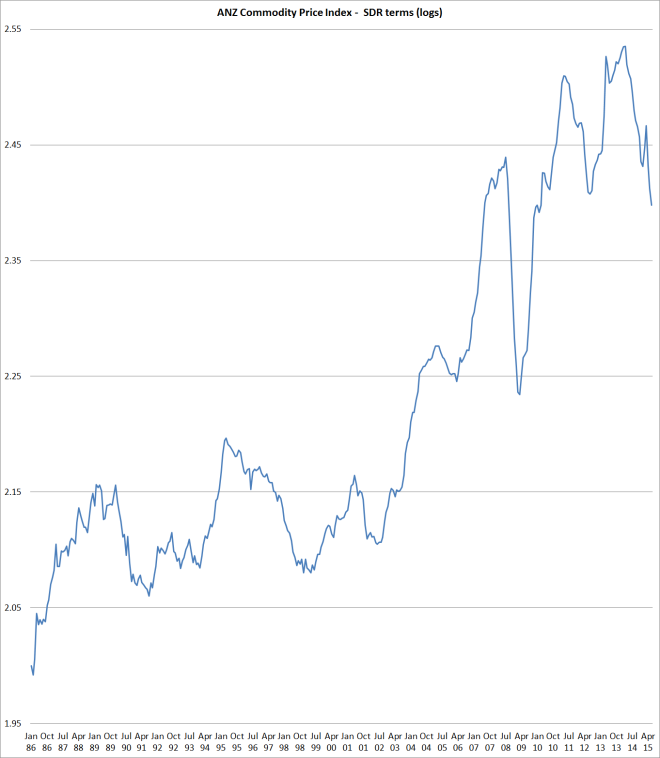
Meanwhile, the fall in the exchange rate, while material, remains pretty small by the standards of past New Zealand adjustments…
View original post 165 more words
 Utopia, you are standing in it!
Recent Comments