The researchers found that the upfront cost of efficiency upgrades of a large randomized controlled trial of 30,000 homes in Michigan came to about $5,000 per house, on average. But their central estimate of the energy savings only amounted to about $2,400 per household, on average, over the lifetime of the upgrades.
After the upgrades, homes used 10 to 20 percent less energy for electricity and heating. But, that was only about 39 percent of the savings that engineering modelers had predicted ahead of time. The program simply wasn’t as effective at saving energy as everyone thought.
The Government admits that its proposed insulation and smoke alarm standards for rental properties could push up rents by more than $3 a week. Under legislation to be introduced in October, social housing would have to be retrofitted with ceiling and underfloor insulation by next July, and all other rental homes by July 2019.
An important driver of lower quality housing in New Zealand is the restrictions on land supply. The costs of those restrictions, land makes up 60% of the cost of new houses rather than 40%. Land prices have doubled and tripled in a number of cities. As the Ministry of Business, Innovation and Employment has said:
The median price of sections has increased from $94,000 in 2003 to over $190,000 today (compared with $NZ 100,000 per section in the US), ranging from Southland ($82,000) to Auckland ($308,000)…
Section costs in Auckland account for around 60% of the cost of a new dwelling, compared with 40% in the rest of New Zealand.
The RMA is the Resource Management Act and was passed just before New Zealand housing prices started to rise rapidly.
Source: Dallas Fed; Housing prices deflated by personal consumption expenditure (PCE) deflator.
Higher land prices for new houses spill into the prices of existing houses, which are now much more expensive than they need to be but for the RMA inspired land supply restrictions in Auckland and elsewhere in New Zealand.
One way in which homeowners and landlords can keep costs down when buying a house either for their own use or as an investment property is not to invest in insulation and smoke alarms. Deposits are less, mortgages are less and rents are less. It all adds up.
#nzqt today. John Key insists tht hungry kids in schools don't exist. Schools, teachers, parents insist tht they do. http://t.co/n1M3hTe5oh— Green Party NZ (@NZGreens) December 03, 2014
Put simply, you cannot argue that a few dollars is a lot of money to people on low incomes but ignore the consequences for their welfare of a $3 per week increase in their rents.
New QV figures show Auckland house prices are up a massive 16.1% on last year, now estimated to reach $1m by Aug '16. http://t.co/DwAU79ozCy— New Zealand Labour (@nzlabour) June 09, 2015
If tenants were willing to pay for insulation, landlords would provide well-insulated rental properties to service that demand. Walter Block wrote an excellent defence of slumlords in his 1971 book Defending the Undefendable:
The owner of ghetto housing differs little from any other purveyor of low-cost merchandise. In fact, he is no different from any purveyor of any kind of merchandise. They all charge as much as they can.
First consider the purveyors of cheap, inferior, and second-hand merchandise as a class. One thing above all else stands out about merchandise they buy and sell: it is cheaply built, inferior in quality, or second-hand.
A rational person would not expect high quality, exquisite workmanship, or superior new merchandise at bargain rate prices; he would not feel outraged and cheated if bargain rate merchandise proved to have only bargain rate qualities.
Our expectations from margarine are not those of butter. We are satisfied with lesser qualities from a used car than from a new car.
However, when it comes to housing, especially in the urban setting, people expect, even insist upon, quality housing at bargain prices.
Richard Posner discussed housing habitability laws in his Economic Analysis of the Law. The subsection was titled wealth distribution through liability rules. Posner concluded that habitability laws will lead to abandonment of rental property by landlords and increased rents for poor tenants.
What do-gooder would want to know that a warranty of habitability for rental housing will lead to scarcer, more expensive housing for the poor! Surprisingly few interventions in the housing market work to the advantage of the poor.
Will the Govt intervene in Auckland's housing crisis? Or will home ownership become a preserve of the wealthy? http://t.co/CK2AnCeuYB— Green Party NZ (@NZGreens) February 05, 2015
Certainly, there will be less rental housing of a habitability standard below that demanded by do-gooders in the new New Zealand legislation. In the Encyclopaedia of Law and Economics entry on renting, Werner Hirsch said:
It would be a mistake, however, to look upon a decline in substandard rental housing as an unmitigated gain.
In fact, in the absence of substandard housing, options for indigent tenants are reduced. Some tenants are likely to end up in over-crowded standard units, or even homeless.
The straightforward way to increase the quality of housing in New Zealand without increasing poverty is to increase the supply of land.
Govt advised even with best financial mgmt, not 1 treat, a family with 2 kids could still be down by $72 each week. http://t.co/VDLmdO8gz9— leah haines (@writeonleah) July 09, 2015
As land prices fall, both homebuyers and tenants will be able to pay for better quality fixtures and fittings because less of their limited income is paying for buying or renting the land.
I didn’t notice any discussion in the Cabinet paper of a government doing this before and whether their investment promotion efforts succeeded or not. This latest policy proposal cannot even count as evidence-based policy dreaming, much less a serious contribution to public policy.
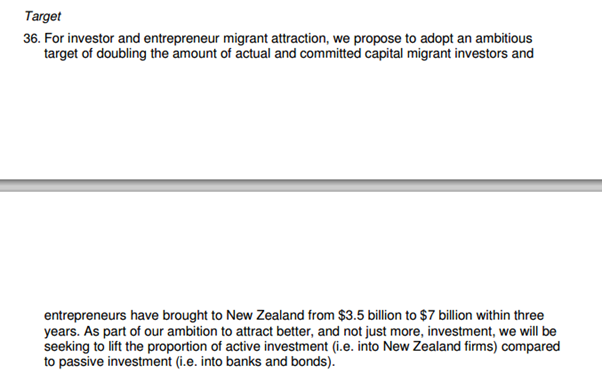
Hoping to double incoming foreign investor and entrepreneur migration from $3.5 billion to $7 billion inside three years without spending any extra public money is breathless public policy making. I am sure lots of governments previously tried to get something for nothing.
It will be helpful if ministers pointed to where overseas governments have been successful in doubling foreign investment by simply reprioritising existing investment promotion efforts.
There are at least 2,500 national, provincial and city investment promotion agencies out. Some of them must have been subject to some sort of evaluation as to their success.
This overseas literature review would be in addition to the recent findings of the Ministry of Economic Development about the poor performance and perhaps futility of the foreign direct investment promotion by New Zealand Trade and Enterprise.
Imagine how much bigger a boost in foreign investor and entrepreneur migration lays before us if actual real new money was put on the table.
Starting in 2012, the University of Vermont began a process of requiring that all campus locations selling beverages provided 30% “healthy” beverages, and then that all locations phases out all sales of bottled water.
There were two hope: 1) reduced use of bottles, when bottled water was no longer available, and 2) that healthier beverages would be consumed.
The orange line that drops to zero shows bottled water being phased out. The rising line at the top shows the rise in sugar-sweetened beverages. The red line in the middle that rises sharply shows the rise in sugar-free beverages.
Why Evolution is True is a blog written by Jerry Coyne, centered on evolution and biology but also dealing with diverse topics like politics, culture, and cats.
“We do not believe any group of men adequate enough or wise enough to operate without scrutiny or without criticism. We know that the only way to avoid error is to detect it, that the only way to detect it is to be free to inquire. We know that in secrecy error undetected will flourish and subvert”. - J Robert Oppenheimer.
/cdn0.vox-cdn.com/uploads/chorus_asset/file/3817414/Screen_Shot_2015-06-23_at_3.40.36_PM.0.png)








 Utopia, you are standing in it!
Recent Comments