Capitalism and peace since 1945
18 Sep 2015 Leave a comment
in war and peace Tags: capitalism and freedom, The Great Enrichment
Since 1975 average UK earnings for full-time employees have more than doubled after accounting for inflation
10 Sep 2015 Leave a comment
in applied welfare economics, economic history, labour economics, labour supply, poverty and inequality Tags: British economy, The Great Enrichment

How is the immiseration of the proletariat going?
24 Aug 2015 Leave a comment
in economic history, Marxist economics Tags: Class war, conjecture and refutation, Karl Marx, The Great Enrichment, The Great Fact, Withering away of the proletariat
@syed17005919 @Noahpinion Look at what happened in a "world where corporations rule:" http://t.co/tAbbJW1Gvd—
David Andolfatto (@dandolfa) June 28, 2015

Could Wealth Redistribution End Global Poverty?
24 Aug 2015 Leave a comment
in development economics, economic growth, economic history, growth disasters, growth miracles, liberalism Tags: capitalism and freedom, extreme poverty, global poverty, The Great Enrichment, The Great Fact
The Great Fact simply stated
23 Aug 2015 Leave a comment
“The only people much better off than $3 [a day]…"—@DeirdreMcClosk. See how far we've come: buff.ly/1Bbh5N6 http://t.co/H1W0VGbI8D—
HumanProgress.org (@humanprogress) June 12, 2015
Make Progress, Not Work! Bryan Caplan’s best single video
21 Aug 2015 Leave a comment
in applied price theory, applied welfare economics, development economics, economic history, economics of information, economics of media and culture, growth miracles, liberalism, Public Choice Tags: Bryan Caplan, capitalism and freedom, makework bias, The Great Enrichment, The Great Escape, The Great Fact
Julian Simon and William Buckley on Cross–Fire
18 Aug 2015 Leave a comment
in applied price theory, applied welfare economics, economic history, energy economics, entrepreneurship, environmental economics, environmentalism, liberalism, resource economics Tags: commodity prices, creative destruction, entrepreneurial alertness, Julian Simon, peak oil, The Great Enrichment, The Great Escape, The Great Fact, William Buckley
Joseph Schumpeter on The Great Enrichment
18 Aug 2015 Leave a comment
in applied welfare economics, economic history, entrepreneurship, liberalism Tags: capitalism and freedom, creative destruction, Joseph Schumpeter, The Great Enrichment, The Great Escape, The Great Fact
Everything’s Amazing and Nobody’s Happy
18 Aug 2015 Leave a comment
in applied welfare economics, development economics, economic history, economics of information, economics of media and culture, growth disasters, growth miracles, liberalism Tags: antimarket bias, Bryan Caplan, capitalism and freedom, life expectancies, living standards, pessimism bias, The Great Enrichment, The Great Escape, The Great Fact
Has the ‘Peak Oil’ drama peaked?
17 Aug 2015 Leave a comment
in economic history, energy economics, entrepreneurship, environmental economics, resource economics Tags: creative destruction, entrepreneurial alertness, peak oil, The Great Enrichment

Remember Peak Oil? Just a few years ago Green Party leaders Jeanette Fitzsimons and Russell Norman routinely issued warnings about ‘the world running out of oil’ and told us that we needed to move freight off roads and on to shipping and rail, and commuters out of cars and on to trains, buses and bicycles.
They weren’t alone of course. An April 2006 article in The Economist reported that:
For years a small group of geologists has been claiming that the world has started to grow short of oil, that alternatives cannot possible replace it and that an imminent peak in production will lead to economic disaster. In recent months this view has gained wider acceptance on Wall Street and in the media. Recent books on oil have bewailed the threat. Every few weeks, its seems, “Out of Gas”, “The Empty Tank” and “The Coming Economic Collapse: How You Can…
View original post 651 more words
Julian Simon on Resources, Growth and Human Progress
17 Aug 2015 Leave a comment
in applied welfare economics, development economics, economic history, energy economics, entrepreneurship, environmentalism, health economics, liberalism, resource economics Tags: capitalism and freedom, commodity prices, creative destruction, entrepreneurial alertness, Julian Simon, life expectancies, peak oil, The Great Enrichment, The Great Escape, The Great Fact
Why we shouldn’t rely too much on GDP and Human development index to tell us how we are doing
15 Aug 2015 Leave a comment
in applied price theory, applied welfare economics, development economics, economic history, economics of media and culture Tags: measurement error, The Great Enrichment, The Great Escape, The Great Fact

Up to now, I personally think we are yet to come up with a more accurate and adequate way of measuring our welfare, our quality or standard of living, that is, how happy we feel in our lives or how enjoyable and satisfying our lives are. If this is what we are measuring GDP (output) is in so many ways an inadequate measure of welfare because it is concentrating on output, it focuses more on commodities therefore GDP does not capture the happiness and joy got from family and social networks. So some economists have tried to come up with new ways to better measure GDP as a measure of our welfare, and they have broken down welfare into three things that they believe constitute welfare. Firstly, welfare has something to do with consumption of goods and services giving us utility, pleasure, or happiness. Secondly, it also has something to…
View original post 722 more words
@WJRosenbergCTU A brief history of rising equality in New Zealand
13 Aug 2015 Leave a comment
in applied price theory, applied welfare economics, economic history, economics of media and culture, income redistribution, labour economics, politics - New Zealand, poverty and inequality, Public Choice Tags: capitalism and freedom, Leftover Left, The Great Enrichment, The Great Fact, top 1%, Twitter left
Bill Rosenberg at the Council of Trade Unions was good enough to tweet a Treasury chart that shows next to no increases in inequality in New Zealand for at least 20 years.
A brief history of inequality-from Treasury paper Fig4. Note Employment Contracts Act,GST,income tax,benefit cuts,WFF http://t.co/y4w3cUsgjD—
Bill Rosenberg (@WJRosenbergCTU) June 27, 2015
Inequality in both market and disposable incomes has been stable for a good 20 years, as the above tweet shows, while inequality in consumption has been falling. To back this interpretation of mine up, coincidentally today Bryan Perry published his annual report on income and inequality under the banner of the Ministry of Social Development.
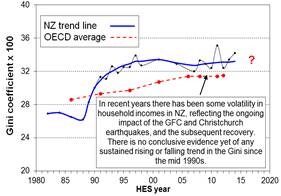
His report showed that there be no significant increase in New Zealand in at least 20 years.
The Great Enrichment by household type in the 20th century
09 Aug 2015 2 Comments
in applied welfare economics, economic history Tags: creative destruction, entrepreneurial alertness, living standards, The Great Enrichment
https://twitter.com/VisualEcon/status/501347052878823425/photo/1
Share of Income Before & After Federal Taxes "An Illustrated Guide to Income" bit.ly/1tfXrse #inequality http://t.co/DnkSWZ6Yov—
Catherine Mulbrandon (@VisualEcon) April 24, 2014


Recent Comments