Deirdre McCloskey's speech @IllinoisPolicy last night on 'Bourgeois Dignity': https://t.co/9rM9s0f6Zu
— DeirdreMcCloskey.org (@PrudentiaMag) August 21, 2014
Deirdre McCloskey’s speech on ‘Bourgeois Dignity’
03 Aug 2015 Leave a comment
in applied price theory, applied welfare economics, comparative institutional analysis, constitutional political economy, economic history, entrepreneurship, industrial organisation, law and economics, property rights, survivor principle Tags: Deirdre McCloskey, entrepreneurial alertness, industrial revolution, The Great Enrichment, The Great Fact
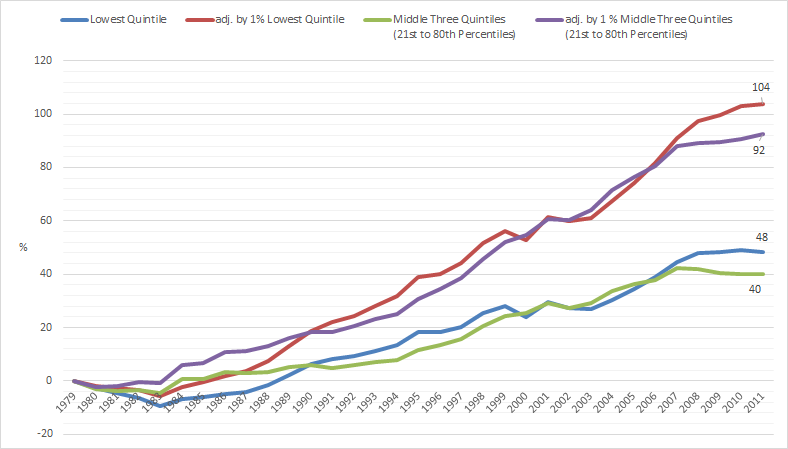
Cumulative Growth in Average Inflation-Adjusted After-Tax Income by Before-Tax Income Group, 1979 to 2011 with 1% annual adjustment for inflation measurement bias
01 Aug 2015 Leave a comment
in applied price theory, applied welfare economics, economic history, politics - USA Tags: CPI bias, living standards, measurement errors, The Great Enrichment
The Congressional Budget Office did its best to adjust after-tax incomes for inflation between 1979 in 2011. In figure 1, I added an extra 1% inflation adjustment in every year from 1979. 1% per annum is a common estimate of the inflation bias introduced by the inability of most measures of inflation to account for new goods and upgrades in the quality of existing goods to name but a few bias is in the measurement of consumer price inflation.
Figure 1: Cumulative Growth in Average Inflation-Adjusted After-Tax Income, by Before-Tax Income Group, USA, 1979 to 2011, 1% upward annual adjustment for inflation bias for new goods and quality upgrades
Source: derived from Congressional Budget Office, The Distribution of Household Income and Federal Taxes, 2011.
As can be seen from figure 1, with a 1% up left for measurement bias, instead of increases of 48% and 40% in the incomes of the lowest quartile in the middle three quartiles respectively, their after-tax, after inflation incomes about doubled since 1979.
"The rich got richer, true. But…" —@DeirdreMcClosk buff.ly/1Imdv4o http://t.co/M3ERx3JTIn—
HumanProgress.org (@humanprogress) June 28, 2015
Well done, capitalism. Everyone was on a working class income in the 1970s is now on a middle-class income. Such are the joys of compounding 1% per year over more than 30 years.
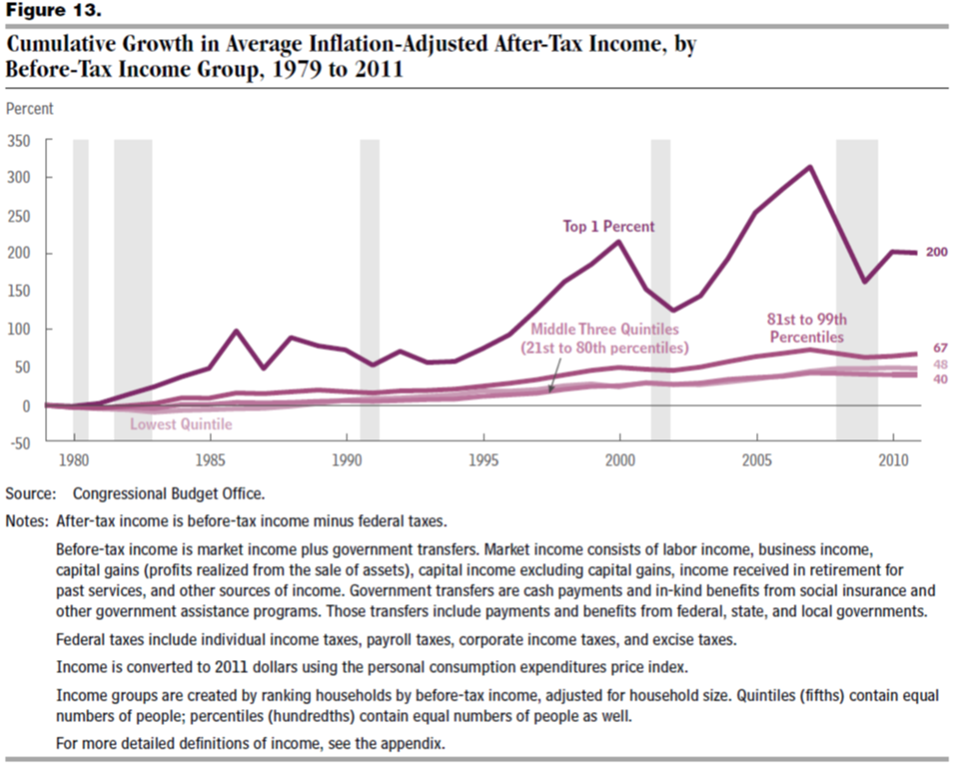
Source: Congressional Budget Office, The Distribution of Household Income and Federal Taxes, 2011.
The original Congressional Budget Office diagram above with the higher income quartiles is presented for comparison. I didn’t present the top quartiles in figure 1 because it made it unreadable because of the dominant influence of the top 1%’s increase in income.
The lesson for the day is small inaccuracies in the measurement of prosperity can over several decades through compounding lead to massive misunderstandings of the increases in prosperity.
Deirdre McCloskey on the Samaritan’s dilemma
30 Jul 2015 Leave a comment
in applied price theory, applied welfare economics, comparative institutional analysis, constitutional political economy, development economics, economic history, economics of regulation, entrepreneurship, growth disasters, growth miracles, history of economic thought, income redistribution, industrial organisation, liberalism, Public Choice, rentseeking, survivor principle Tags: Age of Innovation, bourgeoisie deal, capitalism and freedom, Deirdre McCloskey, The Great Enrichment, The Great Escape, The Great Fact

Digital poverty in America is less than 3% for young adults
29 Jul 2015 Leave a comment
in economic history, economics of media and culture, politics - USA, poverty and inequality Tags: 10-90 lag, Digital poverty, technology diffusion, The Great Enrichment
15% of Americans don’t use the internet. Who are they? pewrsr.ch/1HYkSgM http://t.co/vL6uRuz5iK—
PewResearch FactTank (@FactTank) July 28, 2015
Down and out in America
28 Jul 2015 Leave a comment
in labour economics, politics - USA, poverty and inequality Tags: child poverty, family poverty, living standards, The Great Enrichment
Down and out in America in 2009
28 Jul 2015 Leave a comment
in applied welfare economics, labour economics, politics - USA, population economics, poverty and inequality Tags: living standards, The Great Enrichment

Matt Ridley on How Fossil Fuels are Greening the Planet
26 Jul 2015 Leave a comment
in economic history, energy economics Tags: Fossil Fuels, The Great Enrichment, The Great Escape, The Great Fact
The world poverty rate has been reduced by 80% since 1970
25 Jul 2015 Leave a comment
in development economics, growth disasters, growth miracles Tags: The Great Enrichment, The Great Escape, The Great Fact
@larry_kudlow @LarryKudlowShow @jason_trennert @MarkPMills The world poverty rate has been reduced by 80% since 1970 http://t.co/KfDG4HBi09—
Mark J. Perry (@Mark_J_Perry) May 30, 2015
Creative destruction in family spending in the 20th century
24 Jul 2015 Leave a comment
in applied welfare economics, economic history, politics - USA Tags: creative destruction, living standards, The Great Enrichment
Change in Family spending in the 20th c. bit.ly/195NbKb http://t.co/9wd27BGzpT—
Catherine Mulbrandon (@VisualEcon) September 08, 2014
Gary Becker and Kevin Murphy on inequality and growth in living standards
23 Jul 2015 Leave a comment

More and more people are able to travel by air
20 Jul 2015 Leave a comment
More and more people are able to travel by air. buff.ly/1G4fMMT #progress http://t.co/Dgseo3FCJL—
HumanProgress.org (@humanprogress) June 18, 2015
Equality lacks relevance if the poor are growing richer
17 Jul 2015 Leave a comment
in development economics, economic history, growth disasters, growth miracles, liberalism Tags: capitalism and freedom, Deirdre McCloskey, life expectancies, The Great Enrichment, The Great Escape, The Great Fact, top 1%

And the rich got richer, who cares
16 Jul 2015 Leave a comment
in applied price theory, applied welfare economics, Austrian economics, comparative institutional analysis, constitutional political economy, development economics, economic history, economics of bureaucracy, economics of education, economics of regulation, economics of religion, energy economics, entrepreneurship, environmental economics, financial economics, growth disasters, growth miracles, income redistribution, industrial organisation, international economics, labour economics, labour supply, liberalism, poverty and inequality, Public Choice, rentseeking, survivor principle, transport economics, urban economics Tags: Deirdre McCloskey, entrepreneurial alertness, The Great Enrichment, The Great Escape, The Great Fact, top 1%
"The rich got richer, true. But…" —@DeirdreMcClosk buff.ly/1Imdv4o http://t.co/M3ERx3JTIn—
HumanProgress.org (@humanprogress) June 28, 2015
A stunning aspect of The Great Escape since my parents were born
13 Jul 2015 Leave a comment
in applied welfare economics, development economics, economic history, growth disasters, growth miracles, health economics Tags: Africa, British economy, British history, child mortality, child poverty, infant mortality, life expectancies, The Great Enrichment, The Great Escape, The Great Fact
"Today, children in sub-Saharan Africa are more likely…"—Prof. Angus Deaton, @Princeton
Data: buff.ly/1K2tELk http://t.co/lrTdiLi3F7—
HumanProgress.org (@humanprogress) July 12, 2015


Recent Comments