Moving Brad DeLong’s Time Machine behind John Rawls’ veil of ignorance

Brad DeLong set up a thought experiment to work out if we were better off than in the good old days. He asked how much money would you want to take with you if you had to step into a time machine to go back to some specific point in time and not be worse off for the trip in living standards and life expectancy. He was writing in 1995, talking about going back to 1895.

John Rawls asks a similar question by saying what type of society would you to agree to in a social contract if you’re behind a veil of ignorance. You didn’t know where you were going to be in society behind the veil of ignorance.

All you know you is you will be some random member of that society, at the top, bottom or somewhere in between.

…no one knows his place in society, his class position or social status; nor does he know his fortune in the distribution of natural assets and abilities, his intelligence and strength, and the like.

What social institutions would you agree in that society given you don’t know where you will be in it?

John Rawls also said that the society was fair if you didn’t mind showing up somewhere in it as a random member.

Let’s suppose a thought experiment which combines a time machine with a veil of ignorance:

  • Alien proctologists from outer space take time off from kidnapping rednecks at closing time at pubs to kidnap you instead;
  • After probing your nether regions, but before flying off to light years away where they came from without any further earthly contact they offer you the option of beaming back to where you came from but with a twist in time;
  • You can beam back to be a random member of your current society or a random member of a society in the past of your choice; but
  • Random reassignment to either the present or a past of your choosing are your only options as the alien kidnap victim.

Behind that inter-temporal veil of ignorance, would you choose to be a random member of your own society or prefer to beam back in time to before the ravages of neoliberalism destroyed the good old days?

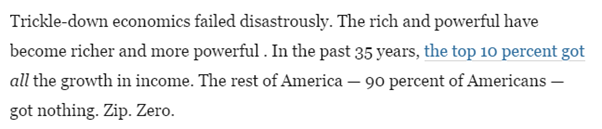
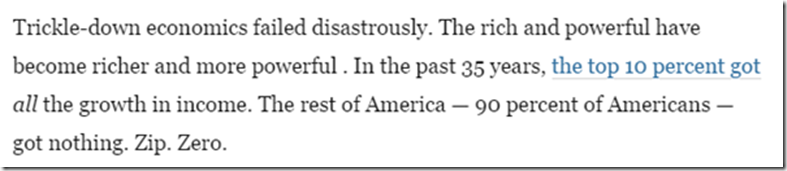
Apparently, we not a cent better off compared to the 70s because all the income gains, every single cent, went into the pockets of the top 10%, if Senator Warren is to be believed in her recent Washington post op-ed:
image

When you line up by Senator Warren to go into the time machine, remember to leave your iPhones and air points at the door.
John Rawls defines a just society

Image

Down and out in Australia as measured by consumer durables affordability

Televisions in the good old days

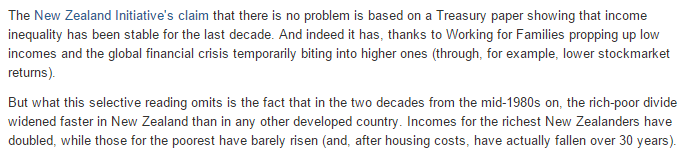
More heat than light in the recent inequality debate

Image

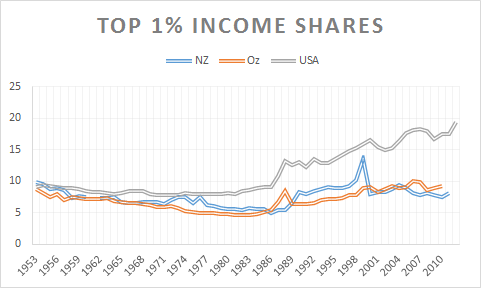
@MaxRashbrooke The top 1% in New Zealand are lazy and incompetent as a ruling class

The top 1% in New Zealand really have been dropping the class war ball for at least a generation.

image

Source: The World Top Incomes Database.

Not only have the New Zealand top 1% been pretty miserable at increasing their share of incomes, hardly any change since 1990 and not much before that, the top 1% allowed inequality in both consumption and disposable income to actually fall since 1990 as shown by Treasury analysis published today.

Joan Robinson was on to this in the 1940s when she said the battle cry of Marxists would have to change from the 1848 version “rise up ye workers, rise up for you have nothing to lose but your chains” to “rise up ye workers, rise up for you have nothing to lose but the prospect of a suburban home and a motorcar”.

Today that battle cry of the Marxist revolution would have to be “rise up ye workers rise up for you have nothing to lose but your iPhone and your air points”. As Joan Robinson observed in the 1940s, that’s not much of a basis for a revolutionary movement.

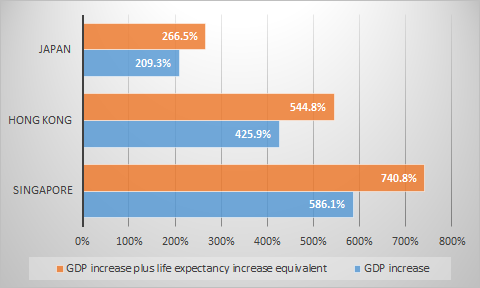
The Quantity and Quality of Japanese, Singaporean and Hong Kong Lives, 1965 to 1995

Figure 1: increase in real GDP and increase in real GDP plus life expectancy GDP increase equivalent, Japan, Singapore and Hong Kong, 1965 to 1995

image

Source: Becker, Gary S., Tomas J. Philipson, and Rodrigo R. Soares. The Quantity and Quality of Life and the Evolution of World Inequality, NBER Working Paper No. 9765 (June 2003).

GDP per capita is usually used to proxy for the quality of life of individuals living in different countries. Becker and his co-authors computed a "full" growth rate that incorporates the gains in health and life expectancy.

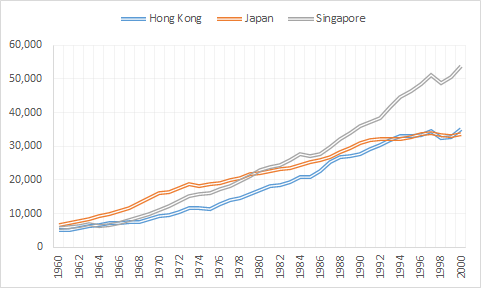
Figure 2 shows that Japan, Hong Kong and Singapore started from similar levels of real GDP per capita PPP in 1960.

Figure 2: GDP per capita in 2014 US$ (converted to 2014 price level with updated 2011 PPPs), Hong Kong, Japan and Singapore, 1960 – 2000

image

Source: The Conference Board. 2015. The Conference Board Total Economy Database™, May 2015, http://www.conference-board.org/data/economydatabase/

What Oxfam doesn’t want you to know: global poverty has been declining faster than at any point in human history

Creative destruction in electronic devices

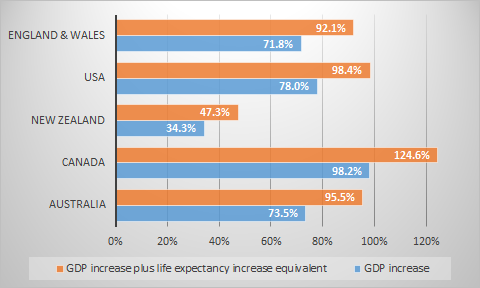
The Quantity and Quality of Australian, New Zealand, Canadian, American and English & Welsh Lives, 1965 to 1995

Figure 1: increase in real GDP and increase in real GDP plus life expectancy GDP increase equivalent, Australia, New Zealand, Canada, USA and England & Wales, 1965 to 1995

image

Source: Becker, Gary S., Tomas J. Philipson, and Rodrigo R. Soares. The Quantity and Quality of Life and the Evolution of World Inequality, NBER Working Paper No. 9765 (June 2003).

GDP per capita is usually used to proxy for the quality of life of individuals living in different countries. Becker and his co-authors computed a "full" growth rate that incorporates the gains in health and life expectancy.

Figure 1 shows that New Zealand was way behind the other countries in improvements in the quantity and quality of life between 1965 and 1995. This brings new meaning to the two decades of lost growth between 1973 and 1995. Canada should refer to 1965 to 1995 as its golden era.

Would you rather make $50,000 in today’s New Zealand or $100,000 in the 1980s before neo-liberalism?

Ezra Klein and Matt O’Brien posed an interesting variation of Brad De Long’s Time Machine question. O’Brien asked:

Try this thought experiment. Adjusted for inflation, would you rather make $50,000 in today’s world or $100,000 in 1980’s? In other words, is an extra $50,000 enough to get you to give up the internet and TV and computer that you have now? The answer isn’t obvious.

And if $100,000 isn’t enough, what would be? $200,000? More? This might be the best way to get a sense of how much better technology has made our lives—not to mention the fact that people are living longer—the past 35 years, but the problem is it’s particular to you and your tastes. It’s not easy to generalize.

This doesn’t mean, though, that the middle class is doing well or even as well as it should be. Just that it’s doing better than the official numbers say it is.

Let them have iPhones is the new let them eat cake.

The same questions are asked in New Zealand in a different way when people go on about how much more unequal New Zealand is compared to the 1980s and how bad things have got because of that rise in inequality.

Would it better to be on the welfare benefit in the 1980s than on a benefit today in a less equal New Zealand than in the 1980s? It is certainly the case that the Gini coefficient is worse than it was in the 1980s – see figure 1.

Figure 1: Gini coefficient New Zealand 1980-2015

gini coefficient 1980-2005

Source: Bryan Perry, Household incomes in New Zealand: Trends in indicators of inequality and hardship 1982 to 2013. Ministry of Social Development (July 2014).

But household incomes on a real basis increased across the border in New Zealand – see figure 2 – including for Maori and Pasifika. As shown in figure 2 below, between 1994 and 2010, real equivalised median New Zealand household income rose by 47%; for Māori, this rise was 68%; for Pasifika, the rise in real equivalised median household income was 77%.

Figure 2: Real equivalised median household income (before housing costs) by ethnicity, 1988 to 2013 ($2013)

image

Source: Bryan Perry, Household incomes in New Zealand: Trends in indicators of inequality and hardship 1982 to 2013. Ministry of Social Development (July 2014).

The biggest worry for anyone longing to be on a welfare benefit or to be otherwise working back in the  good old days in the 1980s on the more equal incomes of back then is instant death.

Stepping into that Time Machine to go back to the more equal, more egalitarian 1980s shaves about five years off your life expectancy, if not more! Death certainly is the great leveller when it comes to Left over Left fantasies about the good old days before the economic reforms of the 1980s. Indeed, the 1980s was a period where life expectancies started to increase again after a hiatus in the 1960s and 1970s.

Time travel back to the good old days in the 1980s before neoliberalism would be particularly grim from Maori because of their much lower life expectancies of Maori back in the 1980s – see figure 3.

Figure 3: Life expectancy at birth, Maori and non-Maori by sex

image

Source: Statistics New Zealand.

The most apt summary of how bad it was in the 1980s compared to today is by veteran left-wing grumbler Max Rashbrooke. To paint pre-1984 New Zealand, pre-neoliberal New Zealand as an egalitarian paradise, he had to ignore the economic progress of two thirds of the population and the inequalities they suffered:

New Zealand up until the 1980s was fairly egalitarian, apart from Maori and women, our increasing income gap started in the late 1980s and early 1990s.

If I could only show one graph on The Great Fact

The impact of religion and science on life expectancy

The Great Fact: Prospects for Ending Extreme Poverty by 2030

Middle class stagnation versus food poverty

Previous Older Entries Next Newer Entries

David Andolfatto

Celebrating humanity's flourishing through the spread of capitalism and the rule of law

Monetary Non-Neutrality

Celebrating humanity's flourishing through the spread of capitalism and the rule of law

Reason Magazine

Celebrating humanity's flourishing through the spread of capitalism and the rule of law

Coyote Blog

Celebrating humanity's flourishing through the spread of capitalism and the rule of law

Thoughts from the North

Celebrating humanity's flourishing through the spread of capitalism and the rule of law

Fardels Bear

A History of the Alt-Right

Vincent Geloso

Econ Prof at George Mason University, Economic Historian, Québécois

Bassett, Brash & Hide

Celebrating humanity's flourishing through the spread of capitalism and the rule of law

Truth on the Market

Scholarly commentary on law, economics, and more

The Undercover Historian

Beatrice Cherrier's blog

Matua Kahurangi

Celebrating humanity's flourishing through the spread of capitalism and the rule of law

Temple of Sociology

Celebrating humanity's flourishing through the spread of capitalism and the rule of law

Velvet Glove, Iron Fist

Celebrating humanity's flourishing through the spread of capitalism and the rule of law

Why Evolution Is True

Why Evolution is True is a blog written by Jerry Coyne, centered on evolution and biology but also dealing with diverse topics like politics, culture, and cats.

NoTricksZone

Celebrating humanity's flourishing through the spread of capitalism and the rule of law

Homepaddock

A rural perspective with a blue tint by Ele Ludemann

Kiwiblog

DPF's Kiwiblog - Fomenting Happy Mischief since 2003

The Dangerous Economist

Celebrating humanity's flourishing through the spread of capitalism and the rule of law

Watts Up With That?

The world's most viewed site on global warming and climate change

The Logical Place

Tim Harding's writings on rationality, informal logic and skepticism

Doc's Books

A window into Doc Freiberger's library

The Risk-Monger

Let's examine hard decisions!

Uneasy Money

Commentary on monetary policy in the spirit of R. G. Hawtrey

Barrie Saunders

Thoughts on public policy and the media

Liberty Scott

Celebrating humanity's flourishing through the spread of capitalism and the rule of law

Point of Order

Politics and the economy

James Bowden's Blog

A blog (primarily) on Canadian and Commonwealth political history and institutions

Science Matters

Reading between the lines, and underneath the hype.

Peter Winsley

Economics, and such stuff as dreams are made on

A Venerable Puzzle

"The British constitution has always been puzzling, and always will be." --Queen Elizabeth II

The Antiplanner

Celebrating humanity's flourishing through the spread of capitalism and the rule of law

Bet On It

Celebrating humanity's flourishing through the spread of capitalism and the rule of law

History of Sorts

WORLD WAR II, MUSIC, HISTORY, HOLOCAUST

Roger Pielke Jr.

Undisciplined scholar, recovering academic

Offsetting Behaviour

Celebrating humanity's flourishing through the spread of capitalism and the rule of law

JONATHAN TURLEY

Res ipsa loquitur - The thing itself speaks

Conversable Economist

In Hume’s spirit, I will attempt to serve as an ambassador from my world of economics, and help in “finding topics of conversation fit for the entertainment of rational creatures.”

The Victorian Commons

Researching the House of Commons, 1832-1868

The History of Parliament

Articles and research from the History of Parliament Trust

Books & Boots

Reflections on books and art

Legal History Miscellany

Posts on the History of Law, Crime, and Justice

Sex, Drugs and Economics

Celebrating humanity's flourishing through the spread of capitalism and the rule of law

European Royal History

Exploring the Monarchs of Europe

Tallbloke's Talkshop

Cutting edge science you can dice with

Marginal REVOLUTION

Small Steps Toward A Much Better World

NOT A LOT OF PEOPLE KNOW THAT

“We do not believe any group of men adequate enough or wise enough to operate without scrutiny or without criticism. We know that the only way to avoid error is to detect it, that the only way to detect it is to be free to inquire. We know that in secrecy error undetected will flourish and subvert”. - J Robert Oppenheimer.