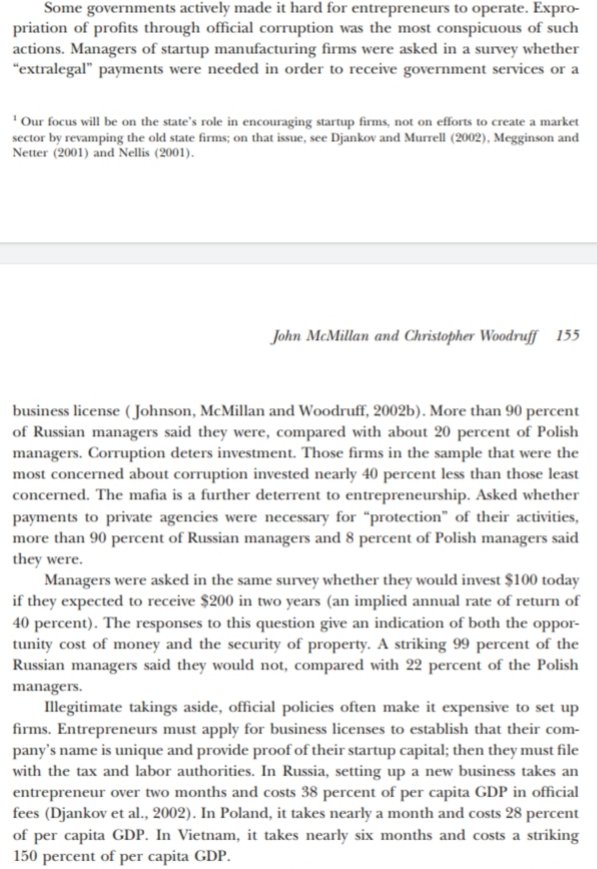
The risks of doing business in 1990s Russia
14 Aug 2019 Leave a comment
in comparative institutional analysis, development economics, economics of bureaucracy, economics of crime, economics of regulation, entrepreneurship, growth disasters, law and economics, property rights, Public Choice Tags: bribery and corruption, fall of communism, transitional economies
Transition in Eastern Europe – Gary Becker and Ronald Coase
06 Aug 2016 Leave a comment
in applied price theory, applied welfare economics, comparative institutional analysis, constitutional political economy, defence economics, economics, Gary Becker, Ronald Coase Tags: transitional economies
The life satisfaction gap between former workers’ paradises and capitalist economies is closing
22 Jan 2016 Leave a comment
in Marxist economics Tags: transitional economies
Capitalism and The Great Fact in China
17 Jul 2015 Leave a comment
in applied price theory, applied welfare economics, comparative institutional analysis, development economics, economic history, economics of education, economics of regulation, entrepreneurship, environmental economics, growth disasters, growth miracles, history of economic thought, industrial organisation, Marxist economics, Public Choice Tags: capitalism and freedom, China, fall of communism, Leftover Left, transitional economies
As China grew freer economically, its poverty rate fell. buff.ly/1KohOxS http://t.co/OpaxOzNdNs—
HumanProgress.org (@humanprogress) June 29, 2015
Doing business in Russia and Italy – World Bank rankings compared
05 Jul 2015 Leave a comment
in applied price theory, applied welfare economics, comparative institutional analysis, economics of regulation, entrepreneurship, industrial organisation, international economics, law and economics, property rights, survivor principle Tags: doing business, Eurosclerosis, Italy, rule of law, Russia, transitional economies
Figure 1: Doing Business rankings, Russia and Italy, 2014
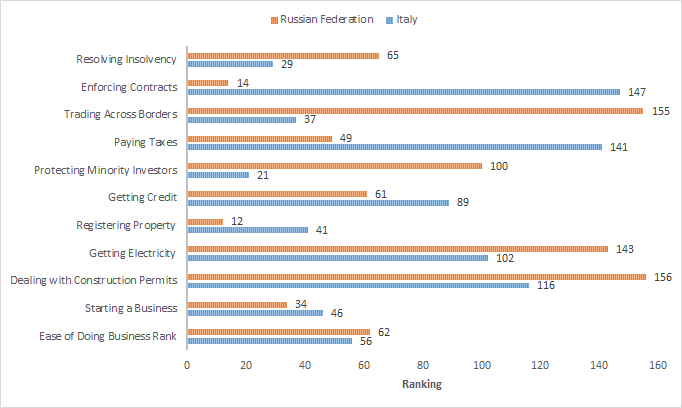
Source: World Bank Doing Business 2015.
It is rather disturbing that it is a lot easier to register property and enforce contracts in Russia than in Italy and far harder to pay your taxes in Italy. Once again, Italy’s saving grace is the ability to trade across borders Because of its membership of the European Union.
Greece (61st) is ranked one above the Russia in the World Bank’s Doing Business Survey 2015
29 Jun 2015 Leave a comment
in economics of bureaucracy, economics of crime, economics of regulation, industrial organisation, labour economics, law and economics, property rights, Public Choice, rentseeking Tags: cost of doing business, Euroland, Greece, Russia, sovereign defaults, transitional economies, World Bank
Figure 1: Greek and Russian Doing Business sub-rankings, 2015
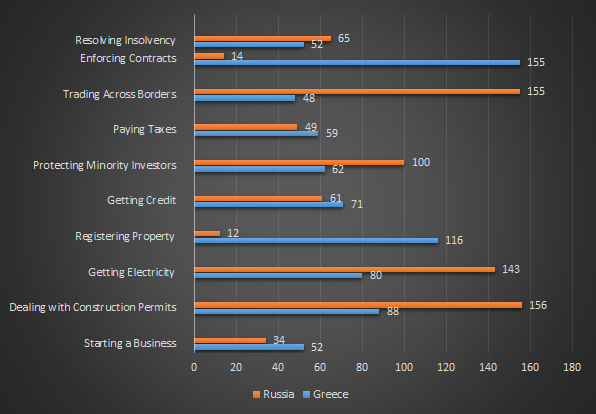
Source: World Bank Doing Business 2015.
As long as you’re not in a construction or export business, and don’t mind waiting for your electricity, it’s better to do business in Russia than in Greece! The main difference between Russia and Greece is its membership of the European Union makes it easy to export?
In Russia, it’s easier to start a business, register property and enforce contracts than it is in Greece!
Maybe joining Euroland isn’t that bad after all
08 May 2015 Leave a comment
in business cycles, currency unions, development economics, Euro crisis, global financial crisis (GFC), growth miracles, international economics, macroeconomics, monetary economics Tags: Eastern Europe, Euroland, European Union, Eurosclerosis, transitional economies
#Dailychart: How "New Europe" has fared on its tenth birthday econ.st/1fwOg33 http://t.co/AvkCqHmzAf—
The Economist (@ECONdailycharts) May 01, 2014
Maybe the European Union membership isn’t that bad after all, especially if you’re a former Eastern Bloc country
24 Apr 2015 Leave a comment
in applied price theory, applied welfare economics, comparative institutional analysis, constitutional political economy, development economics, growth disasters, growth miracles Tags: European Union, transitional economies

Words used in Chinese books illuminate how a nation’s values changed during economic reforms | UCLA
19 Feb 2015 Leave a comment
in Austrian economics, development economics, economic history, economics of media and culture, growth miracles, industrial organisation Tags: China, transitional economies

Use of the word “communal” rose sharply during the Cultural Revolution, especially from 1970 to 1976; it decreased during the 1980s. (China launched economic reforms in 1978, and they continue to this day.)
The word “autonomy” was used just one-third as frequently as “obedience” in 1970. In 2008, the ratio had flipped and “autonomy” appeared three times as much as “obedience.”
The increase in use of words like “choose,” “compete,” “private,” “autonomy” and “innovation” demonstrated a growing prevalence of individualistic values coinciding with sharp rises in urban population, household consumption and education levels.
Words reflecting communal values, such as “help” and “sacrifice,” declined in frequency.
via Words used in Chinese books illuminate how a nation’s values changed during economic reforms | UCLA.
The Putin Effect on transitional economies in the former Soviet union
14 Sep 2014 Leave a comment
in development economics, growth disasters, growth miracles, income redistribution, Marxist economics, Public Choice, rentseeking Tags: development, development miracles, disasters, former Soviet Union, Poland, The Great Enrichment, transitional economies, Ukraine

Poland was in the same position as Ukraine after the collapse of the Soviet empire, but it followed better policy and is now several times richer.

 Utopia, you are standing in it!
Recent Comments