Great chart. Labour not keen on choosing on leaders who can win elections, 1906-2015. Contrast the Tories http://t.co/VBlT7k5ONB—
paulkirby (@paul1kirby) September 12, 2015
@jeremycorbyn @UKLabour has a long history of picking losers as leaders
13 Sep 2015 Leave a comment
in economic history, Public Choice Tags: British Labour Party, British politics, Leftover Left, Twitter left
@NZGreens are so polite on Twitter @MaramaDavidson @RusselNorman @greencatherine
12 Sep 2015 1 Comment
in comparative institutional analysis, constitutional political economy, economics of media and culture, liberalism, managerial economics, organisational economics Tags: Cass Sunstein, Daily Me, information cocoons, infotopia, John Stuart Mill, Karl Popper, New Zealand Greens, Twitter, Twitter left
One of the first things I noticed when feuding on Twitter with Green MPs was how polite they were. Twitter is not normally known for that characteristic and that is before considering the limitations of 144 characters. People who are good friends and work together will go to war over email without any space limitations for the making an email polite and friendly. Imagine how easy it is to misconstrue the meaning and motivations of tweets that can only be 144 characters.

The New Zealand Green MPs in their replies on Twitter make good points and ask penetrating questions that explain their position well and makes you think more deeply about your own. Knowledge grows through critical discussion, not by consensus and agreement.

Cass Sunstein made some astute observations in Republic.com 2.0 about how the blogosphere forms into information cocoons and echo chambers. People can avoid the news and opinions they don’t want to hear.
Sunstein has argued that there are limitless news and information options and, more significantly, there are limitless options for avoiding what you do not want to hear:
- Those in search of affirmation will find it in abundance on the Internet in those newspapers, blogs, podcasts and other media that reinforce their views.
- People can filter out opposing or alternative viewpoints to create a “Daily Me.”
- The sense of personal empowerment that consumers gain from filtering out news to create their Daily Me creates an echo chamber effect and accelerates political polarisation.
A common risk of debate is group polarisation. Members of the deliberating group move toward a more extreme position relative to their initial tendencies! How many blogs are populated by those that denounce those who disagree? This is the role of the mind guard in group-think.
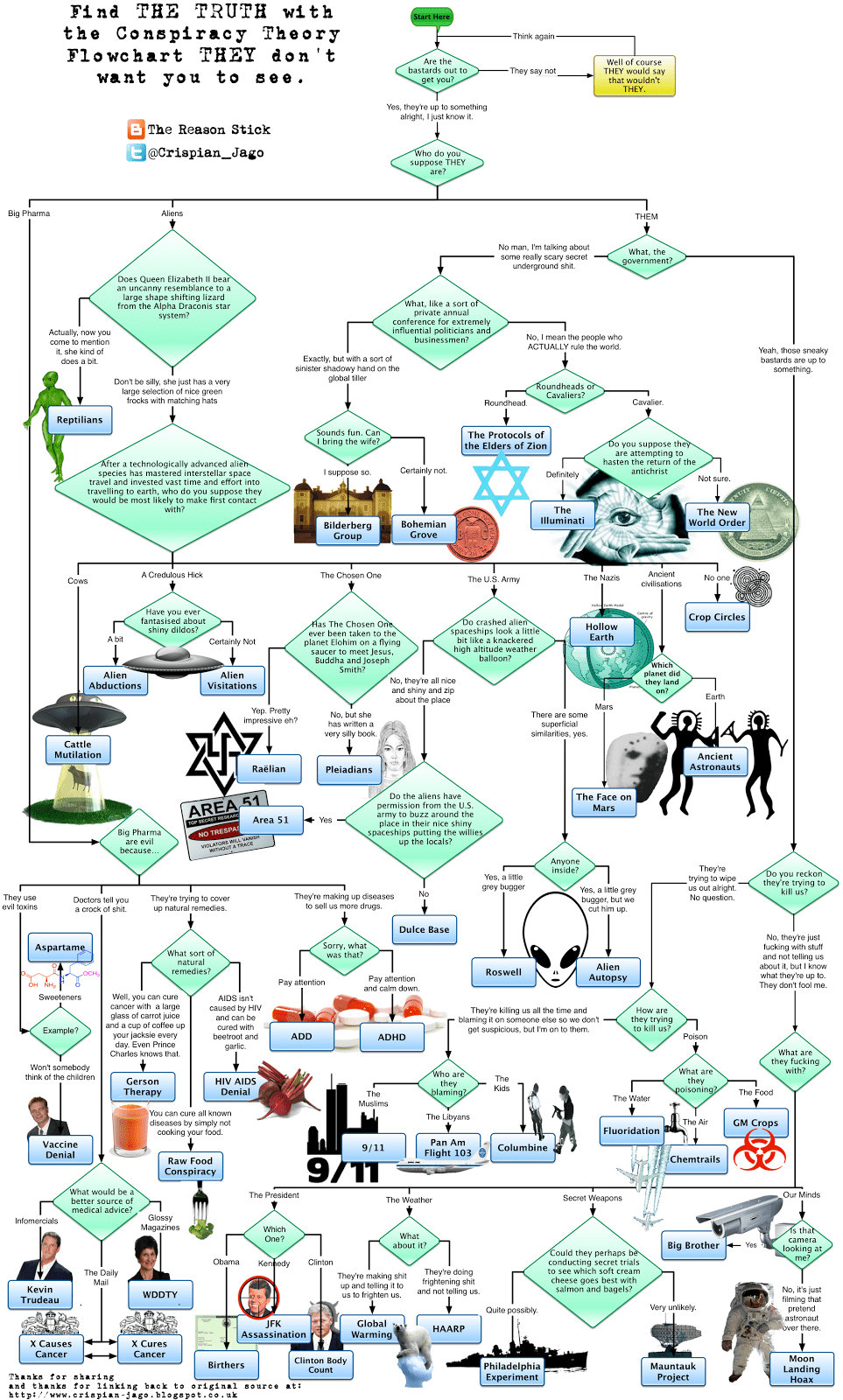
Sunstein in Infotopia wrote about how people use the Internet to spend too much time talking to those that agree with them and not enough time looking to be challenged:
In an age of information overload, it is easy to fall back on our own prejudices and insulate ourselves with comforting opinions that reaffirm our core beliefs. Crowds quickly become mobs.
The justification for the Iraq war, the collapse of Enron, the explosion of the space shuttle Columbia–all of these resulted from decisions made by leaders and groups trapped in “information cocoons,” shielded from information at odds with their preconceptions. How can leaders and ordinary people challenge insular decision making and gain access to the sum of human knowledge?
Conspiracy theories had enough momentum of their own before the information cocoons and echo chambers of the blogosphere gained ground.

J.S. Mill pointed out that critics who are totally wrong still add value because they keep you on your toes and sharpened both your argument and the communication of your message. If the righteous majority silences or ignores its opponents, it will never have to defend its belief and over time will forget the arguments for it.
As well as losing its grasp of the arguments for its belief, J.S. Mill adds that the majority will in due course even lose a sense of the real meaning and substance of its belief. What earlier may have been a vital belief will be reduced in time to a series of phrases retained by rote. The belief will be held as a dead dogma rather than as a living truth.
Beliefs held like this are extremely vulnerable to serious opposition when it is eventually encountered. They are more likely to collapse because their supporters do not know how to defend them or even what they really mean.

J.S. Mill’s scenarios involves both parties of opinion, majority and minority, having a portion of the truth but not the whole of it. He regards this as the most common of the three scenarios, and his argument here is very simple. To enlarge its grasp of the truth, the majority must encourage the minority to express its partially truthful view. Three scenarios – the majority is wrong, partly wrong, or totally right – exhaust for Mill the possible permutations on the distribution of truth, and he holds that in each case the search for truth is best served by allowing free discussion.

Mill thinks history repeatedly demonstrates this process at work and offered Christianity as an illustrative example. By suppressing opposition to it over the centuries Christians ironically weakened rather than strengthened Christian belief. Mill thinks this explains the decline of Christianity in the modern world. They forgot why they were Christians.
What do #McDonalds & @GreenpeaceNZ no longer have in common? @NZGreens @RusselNorman
12 Sep 2015 Leave a comment
in economics of regulation, environmental economics, environmentalism, global warming, health economics, politics - New Zealand Tags: anti-science left eye global warming, climate alarmism, GMOs, Greenpeace, Leftover Left, New Zealand Greens, Russell Norman, The Great Escape, The Great Fact, Twitter left
Like McDonalds, Greenpeace globally is a brand. I read the papers every day in detail but are utterly clueless as to who its leaders are. That is a deliberate branding decision so people cannot conflate the inevitably dodgy and far left backgrounds of its leaders and activist support base with self appointed environmental do-gooders brand.

That is no longer so in New Zealand where a middle-age political junkie retiring as co-leader of the New Zealand Greens will now be their CEO in New Zealand.
.@RusselNorman to lead @GreenpeaceNZ bit.ly/1K08JJj http://t.co/M4QNmeGQjr—
Greenpeace NZ (@GreenpeaceNZ) September 10, 2015
If Russell Norman wants to do his job properly, you should never give an interview, never appear in public.
Incoming @GreenpeaceNZ leader @RusselNorman says Greenpeace critical for humanity's future stuff.co.nz/national/polit… http://t.co/XqpxYjYmf4—
Greenpeace NZ (@GreenpeaceNZ) September 12, 2015
What is worse is the carrying on by the Greens about the retirement of Russell Norman to lead the Greenpeace in New Zealand.
If they wanted to maintain the political effectiveness of Greenpeace, they should have made a short press release congratulating him on his retirement and wishing him well in his new job and saying little more. The Greens should stop carrying on as though you have taken over Greenpeace New Zealand.
I do not wish Greenpeace well with its anti-growth, anti-science, anti-human agenda, so I hope this was a mistake and I hope I am not interrupting them in making that mistake.
@metiria @NZGreens 20,000 drop in children in hardship in 2014
13 Aug 2015 Leave a comment
in applied welfare economics, economic history, income redistribution, labour economics, politics - New Zealand, poverty and inequality, Public Choice, welfare reform Tags: child poverty, family poverty, family tax credits, Leftover Left, New Zealand Greens, Twitter left
The material hardship measure shows a falling child material hardship rate using a threshold equivalent to the ‘standard’ EU level, down from a peak of 21% immediately after the GFC to 14% in 2014.
Using the more severe threshold, there was a slight rise through the GFC to 10% and a small fall to 8%, the level it was at before the GFC.
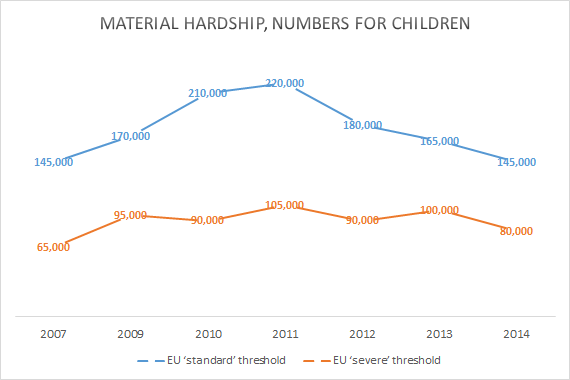
Source: Bryan Perry, Household Incomes in New Zealand: trends in indicators of inequality and hardship 1982 to 2014 – Ministry of Social Development, Wellington (August 2015), p. 133.
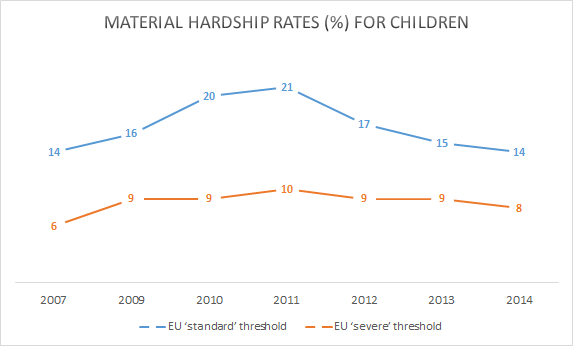
Source: Bryan Perry, Household Incomes in New Zealand: trends in indicators of inequality and hardship 1982 to 2014 – Ministry of Social Development, Wellington (August 2015), p. 133.
@WJRosenbergCTU A brief history of rising equality in New Zealand
13 Aug 2015 Leave a comment
in applied price theory, applied welfare economics, economic history, economics of media and culture, income redistribution, labour economics, politics - New Zealand, poverty and inequality, Public Choice Tags: capitalism and freedom, Leftover Left, The Great Enrichment, The Great Fact, top 1%, Twitter left
Bill Rosenberg at the Council of Trade Unions was good enough to tweet a Treasury chart that shows next to no increases in inequality in New Zealand for at least 20 years.
A brief history of inequality-from Treasury paper Fig4. Note Employment Contracts Act,GST,income tax,benefit cuts,WFF http://t.co/y4w3cUsgjD—
Bill Rosenberg (@WJRosenbergCTU) June 27, 2015
Inequality in both market and disposable incomes has been stable for a good 20 years, as the above tweet shows, while inequality in consumption has been falling. To back this interpretation of mine up, coincidentally today Bryan Perry published his annual report on income and inequality under the banner of the Ministry of Social Development.

His report showed that there be no significant increase in New Zealand in at least 20 years.
The Progressive Mind
06 Aug 2015 Leave a comment
in liberalism, Marxist economics, politics - Australia, politics - New Zealand, politics - USA, Public Choice Tags: antiforeign bias, antimarket bias, expressive voting, Left-wing hypocrisy, Leftover Left, makework bias, meddlesome preferences, nanny state, political correctness, rational irrationality, Twitter left
@DN_Debatt_betyg @LibyAlonso Vem vaktar väktarna? Vem tillser att experter är fria från bias? Vem nudgar, nudgarna? http://t.co/T01Va6UYOV—
Old Whig (@aClassicLiberal) July 26, 2015
Any progress ever on the gender wage gap in France, Germany, Sweden and Norway since 1980?
05 Aug 2015 Leave a comment
in discrimination, economic history, gender, labour economics, law and economics Tags: France, gender wage gap, Germany, Leftover Left, Norway, Sweden, Twitter left
Our friends on the Left go on about how wonderful place Sweden is despite its gender gap being stuck for 35 years. Not much better in Norway and in Germany and France for that matter.
Figure 1: gender wage, % of median male wage, full-time employees, France, Germany, Sweden and Norway, 1980 – 2012

Source: Earnings and wages – Gender wage gap – OECD Data.
The gender wage gap in figure 1 is unadjusted and defined as the difference between median earnings of men and women relative to median earnings of men. Data refer to full-time employees.
Feuding with the Left over Left again @gtiso @helenkellyCTU
03 Aug 2015 Leave a comment
in economic history, politics - New Zealand Tags: antimarket bias, expressive voting, Leftover Left, lost decades, rational ignorance, rational irrationality, Twitter left
The fates of two islands under constant threat from a neighbouring military colossus
01 Aug 2015 Leave a comment
in applied price theory, applied welfare economics, Austrian economics, comparative institutional analysis, constitutional political economy, development economics, economics of media and culture, economics of regulation, growth disasters, growth miracles, income redistribution, industrial organisation, law and economics, liberalism, Marxist economics, property rights, Public Choice, rentseeking, survivor principle Tags: anticapitalist mentality, antimarket bias, capitalism and freedom, China, Cuba, expressive voting, Hong Kong, Leftover Left, public intellectuals, rational ignorance, rational irrationality, Twitter left
Trigger warning for the Twitter Left
31 Jul 2015 Leave a comment
in applied price theory, applied welfare economics, constitutional political economy, income redistribution, politics - Australia, politics - New Zealand, politics - USA, Public Choice, public economics, rentseeking Tags: antimarket bias, endogenous growth theory, expressive voting, laffer curve, Leftover Left, taxation and entrepreneurship, taxation and human capital, taxation and investment, taxation and the labour supply, top 1%, Twitter left
@Income_Equality there’s an Internet you know – was there next to no unemployment prior to the mid-1980s in New Zealand?
24 Jul 2015 Leave a comment
in business cycles, econometerics, economic growth, economic history, job search and matching, labour economics, labour supply, macroeconomics, politics - New Zealand, Public Choice, unemployment, unions, welfare reform Tags: antimarket bias, Don Brash, economic reform, expressive voting, Homer Simpson, Leftover Left, lost decades, makework bias, neoliberalism, rational ignorance, rational irrationality, Sir Roger Douglas, Twitter left
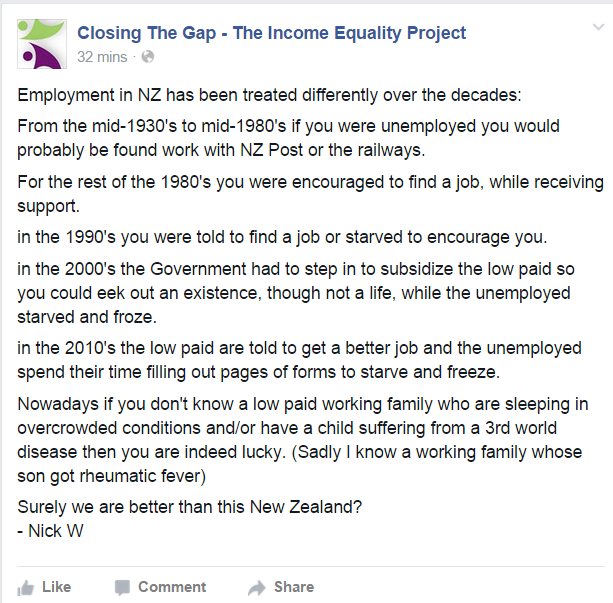
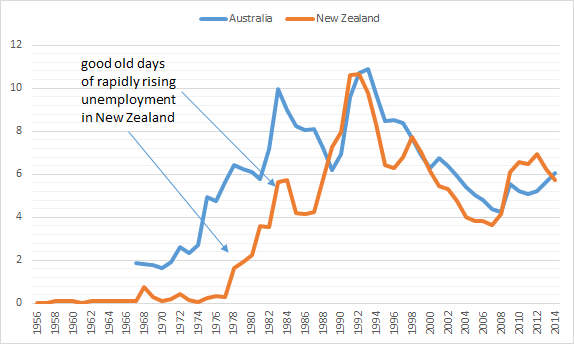
Today, Closing The Gap – The Income Inequality Project boldly claimed today that there was next to no unemployment in New Zealand prior to the onset of the curse of neoliberalism.
There is an Internet on computers now where it is easy to find data showing that the unemployment rate was rising rapidly in New Zealand in the 1970s and in double digits by the end of the 1980s – see figure 1.
Figure 1: harmonised unemployment rates, Australia and New Zealand, 1956-2014
Source: OECD StatExtract.
Figure 1 shows unemployment was rising rapidly in the 1970s and wasn’t much different by the end of the 1970s to the unemployment rates recorded after about 2000 in New Zealand.

One of the reasons that Sir Roger Douglas wrote There’s Got To Be A Better Way was the rapidly rising unemployment in New Zealand and the stagnant economic growth in the late 1970s and early 1980s.

New Zealand was one of the most regulated economies, so much so that Prime Minister David Lange said:
We ended up being run very similarly to a Polish shipyard.
As for those jobs on the railways, the then Reserve Bank Governor Don Brash said in 1996:
Railways cut its freight rates by 50 percent in real terms between 1983 and 1990, reduced its staff by 60 percent, and made an operating profit in 1989/90, the first for six years.
More on unemployment: In 1955 the New Zealand’s prime minister knew all unemployed personally.
– Atkinson’s new book http://t.co/x37Vxya97C—
Max Roser (@MaxCRoser) July 24, 2015
The impact of neoliberalism on labour market freedom in Argentina, Brazil, Chile and Venezuela
22 Jul 2015 Leave a comment
in development economics, economic history, economics of regulation, growth disasters, growth miracles, labour economics, labour supply, minimum wage, unions Tags: Argentina, Brazil, Chile, conspiracy theories, employment law, employment regulation, Index of Economic Freedom, Leftover Left, Mont Pelerin Society, neoliberalism, Twitter left, Venezuela
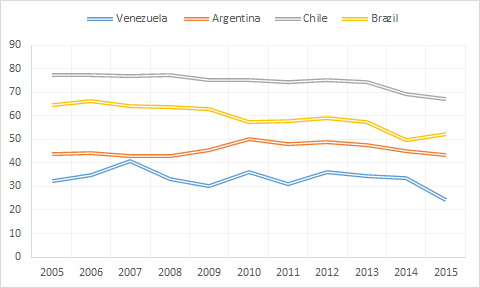
All was quiet on the neoliberalism front in Latin America for the last 20 years. In yet another defeat for the Mont Pelerin Society led transnational conspiracy, labour market freedom has declined in the four countries in figure 1. I’ve always had my doubts about the ability of a transnational conspiracy to be led by a society with such a crappy website.
Figure 1: Index of Economic Freedom, Argentina, Brazil, Chile and Venezuela, 95 – 2015
Source: Index of Economic Freedom 2015.
The impact of neoliberalism on economic freedom in Argentina, Brazil, Chile and Venezuela since 1995
20 Jul 2015 Leave a comment
in applied price theory, applied welfare economics, comparative institutional analysis, development economics, economic history, economics of regulation, growth disasters, growth miracles Tags: Argentina, Brazil, Chile, conspiracy theories, Index of Economic Freedom, Leftover Left, Mont Pelerin Society, neoliberalism, Twitter left, Venezuela
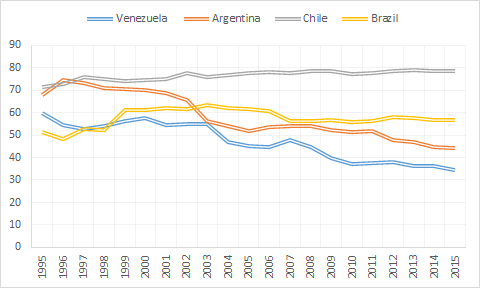
All was quiet on the neoliberalism front in Latin America for the last 20 years. In yet another defeat for the Mont Pelerin Society led transnational conspiracy, economic freedom has been pretty stable in Chile for 20 years and in the serious decline in Venezuela and Argentina – see figure 1. Not much happening in Brazil either on the neoliberalism front – see figure 1. I’ve always had my doubts about the ability of a transnational conspiracy to be led by a society with such a crappy website.
Figure 1: Index of Economic Freedom, Argentina, Brazil, Chile and Venezuela, 95 – 2015
Source: Index of Economic Freedom 2015.

Moving Brad DeLong’s Time Machine behind John Rawls’ veil of ignorance
06 Jul 2015 Leave a comment
in applied welfare economics, constitutional political economy, economic history, Rawls and Nozick Tags: Brad Delong, Elizabeth Warren, good old days, John Rawls, The Great Enrichment, The Great Escape, The Great Fact, time machine, Twitter left
Brad DeLong set up a thought experiment to work out if we were better off than in the good old days. He asked how much money would you want to take with you if you had to step into a time machine to go back to some specific point in time and not be worse off for the trip in living standards and life expectancy. He was writing in 1995, talking about going back to 1895.

John Rawls asks a similar question by saying what type of society would you to agree to in a social contract if you’re behind a veil of ignorance. You didn’t know where you were going to be in society behind the veil of ignorance.

All you know you is you will be some random member of that society, at the top, bottom or somewhere in between.
…no one knows his place in society, his class position or social status; nor does he know his fortune in the distribution of natural assets and abilities, his intelligence and strength, and the like.
What social institutions would you agree in that society given you don’t know where you will be in it?
John Rawls also said that the society was fair if you didn’t mind showing up somewhere in it as a random member.

Let’s suppose a thought experiment which combines a time machine with a veil of ignorance:
- Alien proctologists from outer space take time off from kidnapping rednecks at closing time at pubs to kidnap you instead;
- After probing your nether regions, but before flying off to light years away where they came from without any further earthly contact they offer you the option of beaming back to where you came from but with a twist in time;
- You can beam back to be a random member of your current society or a random member of a society in the past of your choice; but
- Random reassignment to either the present or a past of your choosing are your only options as the alien kidnap victim.
Behind that inter-temporal veil of ignorance, would you choose to be a random member of your own society or prefer to beam back in time to before the ravages of neoliberalism destroyed the good old days?
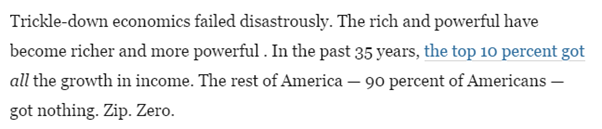
Apparently, we not a cent better off compared to the 70s because all the income gains, every single cent, went into the pockets of the top 10%, if Senator Warren is to be believed in her recent Washington post op-ed:
When you line up by Senator Warren to go into the time machine, remember to leave your iPhones and air points at the door.
Innovation is letting us accomplish more with less. Learn more: buff.ly/1LmtAZD #tech #progress http://t.co/e2kQlGu3NA—
HumanProgress.org (@humanprogress) June 22, 2015
The political bias of psychologists
05 Jul 2015 Leave a comment
in economics of bureaucracy, economics of education, economics of media and culture, politics - Australia, politics - New Zealand, politics - USA, Public Choice, rentseeking Tags: academic bias, bureaucratic bias, expressive voting, Leftover Left, media bias, occupational choice, political bias, rational ignorance, rational irrationality, social psychology, Twitter left
Why is it that the economics profession is the only profession questioned on the grounds of its political diversity?

1) Academic psychology once had considerable political diversity, but has lost nearly all of it in the last 50 years;
2) This lack of political diversity can undermine the validity of social psychological science via mechanisms such as the embedding of liberal values into research questions and methods, steering researchers away from important but politically unpalatable research topics, and producing conclusions that mischaracterize liberals and conservatives alike;
3) Increased political diversity would improve social psychological science by reducing the impact of bias mechanisms such as confirmation bias, and by empowering dissenting minorities to improve the quality of the majority’s thinking; and
4) The underrepresentation of non-liberals in social psychology is most likely due to a combination of self-selection, hostile climate, and discrimination.
via Psychology’s Political Diversity Problem | Psychology Today.
 Utopia, you are standing in it!
Recent Comments