Milton Friedman – The Negative Income Tax
20 Apr 2016 Leave a comment
in economics, Milton Friedman Tags: negative income tax, universal basic income
4 Lessons for Morgan Foundation on How to Sell the #UBI @JordNZ
13 Apr 2016 Leave a comment
in applied welfare economics, labour economics, labour supply, politics - New Zealand, welfare reform Tags: expressive voting, rational irrationality, universal basic income
![clip_image002[4]](https://utopiayouarestandinginit.com/wp-content/uploads/2016/04/clip_image0024.gif "clip_image002[4]")
Source: Morgan Foundation (12 April 2016) Four Lessons for Labour on How to Sell the UBI.
I will contract out to Geoff Simmons of the Morgan Foundation my reply to the claim yesterday by the Morgan Foundation’s Susan Guthrie that there are no negatives from a Universal Basic income. Simmons said:
With an unconditional basic income, most beneficiaries would be no better off than they are now (in fact sole parents would almost certainly receive a lower benefit).
Single parents are $150 a week worse off and retirees are $50 worse off per week if their current income support were replaced by a Universal Basic Income of $11,000 per adult.
Both were entitled to much more under the current welfare benefit system and New Zealand Superannuation respectively. Unemployment, sickness and invalid beneficiaries are about 5% better off under a Universal Basic Income.
Labour’s background paper described a Universal Basic Income of $11,000 as not enough. Guthrie is even franker yesterday about how inadequate a Universal Basic Income is for the poor:
A basic income policy would provide everyone aged 18 and over with an unconditional, tax free survival-level of income each and every year.
I will contract out to Gareth Morgan (2011) why a Universal Basic Income that provides a “survival-level of income” is not good enough:
Rather than decreeing a minimum wage and discovering the consequences for jobs and top-up payments, let’s agree on what is a minimum income every adult should have in order to live a dignified life and then see what flows from that.
We begin by specifying the income level below which we are not prepared to see anyone having to live.
A survival-level of income and a minimum income on which every adult can live a dignified life are not the same thing.
Gareth Morgan’s universal basic income of $11,000 for adults makes most better off except those for whom the modern welfare state was established to protect.
Most of the evidence against the Universal Basic Income comes from examining the numbers put forward by its proponents such as the Morgan Foundation and its excellent online tool. Brian Easton (2015) put it well when he said:
Many advocates put the UMI forward without doing the sums.
Those who do, find that the required tax rates are horrendous or the minimum income is so low that it is not a viable means of eliminating poverty. Among the latter are New Zealanders Douglas, Gareth Morgan and Keith Rankin.
@garethmorgannz’s @grantrobertson1’s #UBI is worse than I thought @JordNZ
03 Apr 2016 Leave a comment
in applied welfare economics, labour economics, labour supply, politics - New Zealand, poverty and inequality, welfare reform Tags: expressive voting, New Zealand Labour Party, rational irrationality, universal basic income
The Universal Basic Income of $11,000 per adult proposed by the Morgan Foundation and floated as a idea to consider by the New Zealand Labour Party leaves the poor way below even that the stingy as the poverty line switch is that 50% relative poverty line. Little wonder that the Labour Party said that increasing the Universal Basic Income to avoid leaving current beneficiaries worth off would lead to a very high tax rate.

Source: A Universal Basic Income may be a good idea – but we will still need social security that works.
@JordNZ best way to talk yourself out of #UBI is listen to advocate list new taxes required
01 Apr 2016 Leave a comment
in economics, income redistribution, labour economics, labour supply, politics - New Zealand, poverty and inequality, Public Choice, public economics, welfare reform Tags: universal basic income
@garethmorgannz the @TaxpayersUnion #UBI report isn’t bonkers @JordNZ
31 Mar 2016 Leave a comment
in labour economics, politics - New Zealand, poverty and inequality, welfare reform Tags: child support, deadbeat dads, do gooders, expressive voting, New Zealand Labour Party, New Zealand superannuation, old-age pension, rational irrationality, single mothers, social insurance, universal basic income, welfare state
A clever man can climb out of the hole a wise man would not have fallen into. In responding to my Taxpayers’ Union paper on a Universal Basic Income, Gareth Morgan just kept digging.

His first response was to say a Universal Basic Income would not be implemented immediately. This avoids retirees taking home $50 per week less than currently under NZ Superannuation.
Gareth Morgan’s solution is to say that only those currently under 50 will have to rely on a Universal Basic Income.
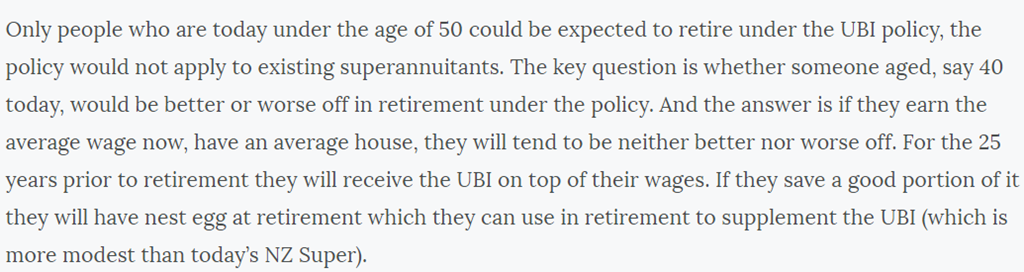
Only people who are today under the age of 50 could be expected to retire under the UBI policy, the policy would not apply to existing superannuitants.
Generation Rent have to pay higher taxes to keep current retirees in the superannuation style they have become accustomed. Those aged over 50 are also grandfathered in to the existing level of income support from New Zealand Superannuation.
Home ownership rates among Millenials are on average 16 percentage points lower than those recorded by Generation X https://t.co/QNcCXvFbif—
ResolutionFoundation (@resfoundation) February 13, 2016
Generation Rent will have to save their Universal Basic Income so they do not live in poverty when they retire in as little as 15 years from the date of introduction. As Gareth Morgan explains when referring to 40-year-olds:
For the 25 years prior to retirement they will receive the UBI on top of their wages. If they save a good portion of it they will have nest egg at retirement which they can use in retirement to supplement the UBI (which is more modest than today’s NZ Super).
At least the Labour Party admitted that a Universal Basic Income of $11,000 per adult was inadequate and will have to be supplemented so that no one is left worse off:
After all, $11,000 is a lower income than what is currently paid out as part of New Zealand Super. If the figure is too low, then the benefits of security and freedom promised by a UBI may not be realised.
On the other hand, if the figure is pushed higher, taxes will have to rise, possibly to an unrealistically high figure. (Morgan’s $11,000 UBI is funded through a flat tax of 30%.) There is, therefore, a real feasibility-sufficiency trade-off.
It may be that a UBI has to be supplemented by other transfers to ensure that the most vulnerable groups have enough income.
As for single parents relying on a welfare benefit, they are $150 a week short under a Universal Basic Income. Where is Sue Bradford when you need her to go on about beneficiary bashing.
Gareth Morgan’s proposed solution to this $150 per week cut in the incomes of the needy is to suggest that the non-custodial parent of the child should give up part or all of their Universal Basic Income to support their child:
Each child has two parents, the UBI is paid to both whether they live together or not.
It is totally feasible that the UBI of both parents could be required to be directed to support the children in the event of separation. In the Kahuna the amount paid per family would be $22,000 after tax – more than is paid to a sole parent family now.
This hard line on child support will make being a non-custodial parent of a child a rather risky venture under a Universal Basic Income. A Universal Basic Income is supposed to make you feel very secure against misfortune as Gareth Morgan explained back in 2011:
…let’s agree on what is a minimum income every adult should have in order to live a dignified life and then see what flows from that. We begin by specifying the income level below which we are not prepared to see anyone having to live.
If you are the non-custodial parent and down on your luck – unemployed, sick or an invalid – you cannot rely on your Universal Basic Income as a backstop because part or all of that is already transferred to support your child.
Paternity suits will take on a new meaning because you can lose your Universal Basic Income. The Universal Basic Income with Gareth Morgan’s ad hoc amendments this week has strings attached on whether you or someone else receives your Universal Basic Income. That make or break decision will be up to the Family Court and the Child Support Agency at IRD.
I am not sure how a Universal Basic Income deals with deadbeat dads at home and living abroad. Central to its funding is abolition of the welfare state bureaucracy to save $2 billion.
Those down on their luck will not have a welfare state bureaucracy to turn to if their child support does not come through or have nothing to live on after their child support is paid.
Now let Gareth Morgan explain why he wanted to get rid of that welfare state bureaucracy and replace it with a Universal Basic Income:
We must finally admit that with all the paternalistic will in the world there is no chance that public servants can adequately identify and monitor eligibility for a needs-based benefit regime.
We should save ourselves the torture of continuously getting it wrong and designing an endless stream of discriminatory “fixes” to cover our mistakes in finding targeted perfection.
The reality is that people’s circumstances are dynamic and that they will change their behaviour to suit the design of the benefit regime making the chicken and egg nature of determining “needs” an exercise in futility.
The important thing is to be fair and to have a consensus on the level of income that we all have an unconditional entitlement to in order to live a dignified life.
Gareth Morgan seems to throw Generation Rent and non-custodial parents under the bus to deliver on his dream. They both have to give up much of their Universal Basic Income either to their children or their KiwiSaver to fill the growing number of gaps in his Big Kahuna. Their unconditional entitlement to be able to live a dignified life through a Universal Basic Income of $11,000 per adult has a lot of strings attached to it and cracks to fall through with no safety net.
Wear a condom, do not divorce and do not be under 50 are the secrets to enjoying a Universal Basic Income. If not, you are on your own. Your Universal Basic income is already spoken for.
Questions for @grantrobertson1 on the #UBI @JordNZ
30 Mar 2016 1 Comment
in labour economics, labour supply, politics - New Zealand, poverty and inequality, welfare reform Tags: flat rate tax, New Zealand Labour Party, top tax rate, universal basic income
Labor Party finance spokesman Grant Robertson yesterday ruled out an income rate tax of 50% to fund a Universal Basic Income. Labour is considering a Universal Basic Income. It released a background paper for that purpose as part of its Future of Work Commission.

Source: Taxpayers’ Union rubbishes Universal Basic Income idea | Stuff.co.nz.
Questions arise as to how the Labour Party will fund its Universal Basic Income after ruling out a tax rate of 50%. As Brain Easton said:
Many advocates put the UMI forward without doing the sums. Those who do find that the required tax rates are horrendous or the minimum income is so low that it is not a viable means of eliminating poverty. Among the latter are New Zealanders Douglas, Gareth Morgan and Keith Rankin.
The Labour Party’s background paper already has said that the Universal Basic Income proposed by the Morgan Foundation is insufficient because many beneficiaries and all retirees will be much worse off. They receive much more in income support under the existing welfare state and they would under a Universal Basic Income of $11,000 per adult as proposed by the Morgan Foundation.
The solution proposed by the Labour Party is a supplemental income transfers to ensure no one is worse under a Universal Basic Income. This will greatly increase the cost of a Universal Basic income in comparison to the Morgan Foundation proposals.
https://twitter.com/grantrobertson1/status/711758860659240960
A series of questions come to mind that the Labour Party and its finance spokesman Grant Robinson must answer if they are to go anywhere with a Universal Basic Income;
- Is not the point of a Universal Basic Income to replace the welfare state, not supplement it?
- How will the Labour Party fund its Universal Basic Income plus the supplemental income transfers without introducing a $8 billion tax on capital income (including the family home) as in the Morgan Foundation’s proposals?
- The Universal Basic Income proposed by the Morgan Foundation requires $13 billion in extra taxes ($8 billion from taxing capital and $5 billion from a 30% flat-rate income tax) so how much more to that will Labour need for a Universal Basic Income plus supplemental income transfers?
- What is the maximum top marginal income tax rate that Labour will consider to fund a Universal Basic Income?
- Will the Labour Party’s Universal Basic Income be funded by a flat rate income tax or a progressive income tax system?

Source: How we pay for a universal basic income – Whiteboard Wednesday.It would have been my first point
@garethmorgannz’s #UBI finishes the job on #GenerationRent @JordNZ
29 Mar 2016 Leave a comment
in fiscal policy, labour economics, labour supply, macroeconomics, politics - New Zealand, population economics, poverty and inequality Tags: Edward Prescott, New Zealand superannuation, old age pensions, social insurance, timing inconsistency, universal basic income, welfare state
Gareth Morgan revealed today a hitherto unnoticed design feature in his Universal Basic Income of $11,000 per annum. It will be phased in over a long time. That will mean that Generation Rent will continue to pay taxes to fund a universal old age pension for their parents and grandparents, but will not be fortunate enough to receive that themselves.
Source: Morgan Foundation (2016) Taxpayers Union Critique of the UBI just bonkers – again
They are not left of their own devices. Generation Rent is expected to save the Universal Basic Income they receive over their working lives to avoid living in poverty in their retirement. Does not strike me as a political winner.
The Morgan Foundation does not understand the implications of time inconsistency for retirement savings policy:
- Which is better? Save for your retirement through the share market or save to own your own home and then present yourself at the local social security office to collect your taxpayer funded old-age pension?
- Under this fine game of bluff, you bleed the taxpayer in your old age and pass on your debt-free home to your children.
This strategy of not saving much for retirement is rational for the less well-paid. The family home is exempt from income and asset testing for social security. If you lose you bet, sell your house and live off the capital. For ordinary workers, this is a good bet. The middle class might prefer to live in a more luxurious retirement.
For ordinary workers, whose wages are not a lot more than their old age pension from the government, a government funded pension is a good political gamble. The old-age pension for a couple in New Zealand is set at no less that 60% of average earnings.
Edward Prescott argues for compulsory retirement savings account albeit with important twists because it is otherwise irrational for many to save for their retirement against the background of a welfare state:
The reason we need to have mandatory retirement accounts is not because people are irrational, but precisely because they are perfectly rational — they know exactly what they are doing.
If, for example, somebody knows that they will be cared for in old age — even if they don’t save a nickel — then what is their incentive to save that nickel? Wouldn’t it be rational to spend that nickel instead?
…Without mandatory savings accounts we will not solve the time-inconsistency problem of people under-saving and becoming a welfare burden on their families and on the taxpayers. That’s exactly where we are now.
Just exactly how big is @grantrobertson1’s great big new tax?
20 Mar 2016 1 Comment
in labour economics, labour supply, politics - USA, poverty and inequality, welfare reform Tags: Director's Law, universal basic income
https://twitter.com/grantrobertson1/status/711303279284629505
Gareth Morgan’s universal basic income, by his own calculations, make well-to-do people better off and the poor and old age pensioners worse off at the cost of $12 billion tax rise. The Labour Party has now adopted this policy as worth considering.

Source: Gareth Morgan Presentation Slide 20 of 27 | Big Kahuna Book.
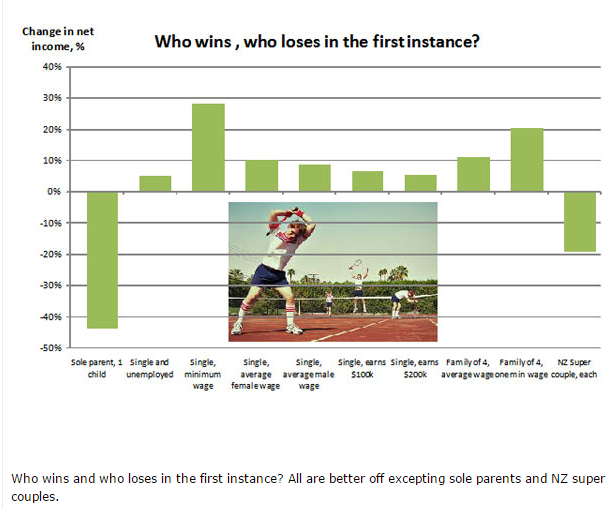
Source: Gareth Morgan Presentation Slide 20 of 27 | Big Kahuna Book.
@garethmorgannz @geoffsimmonz the public choice illogic of the UBI
27 Jan 2016 Leave a comment
in labour economics, labour supply, politics - New Zealand, poverty and inequality, public economics Tags: family tax credit, growth of government, negative income tax, size of government, social insurance, universal basic income, welfare state
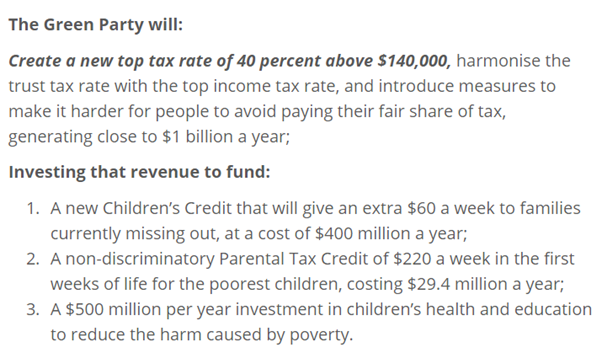
Things are pretty grim when your ideas for fixing child poverty by throwing a lot more money at the problem are easily outclassed by the Greens in terms of economic rationale, fiscal sense and political practicality.
Source: Greens launch billion dollar plan to reduce child poverty | Green Party of Aotearoa New Zealand.
But that is the case for Gareth Morgan’s proposals for a universal basic income for New Zealand. His proposal for a universal basic income funded by comprehensive capital tax make much less sense than those of the Greens for giving the in work family tax credit for those do not work but are on a welfare benefit.
The Greens have a far superior proposal for reducing child poverty and a far better chance of getting it implemented in parliament. Their proposal is simply to introduce a parental tax credit and give the in work tax credit to those currently on the benefit to increase their incomes.
Gareth Morgan’s solution to child poverty is to give billions of dollars to adults not in poverty and leave those who are in poverty worse off under the universal basic income. It is obvious which of these is more likely to attract political support and provoke resistance from taxpayers and political parties willing to court those are opposed to great big new taxes.
One of the economic reforms in the 1980s and 1990s that saved the welfare state was more efficient taxes and more efficient government spending. The targeting of government social spending reduce growth in the overall tax burden and therefore the political resistance it provoked.
Government spending grew in many countries in the 20th century because of demographic shifts, more efficient taxes, more efficient spending, a shift in the political power from those taxed to those subsidised, shifts in political power among taxed groups, and shifts in political power among subsidised groups. Sam Peltzman argues that:
governments grow where groups which share a common interest in that growth and can perceive and articulate that interest become more numerous.
The median voter in all countries was alive to the power of incentives and to not killing the goose that laid the golden egg. After 1980, the taxed, regulated and subsidised groups had an increased incentive to converge on new lower cost modes of redistribution.
More efficient taxes, more efficient spending, more efficient regulation and a more efficient state sector reduced the burden of taxes on the taxed groups. Most subsidised groups benefited as well because their needs were met in ways that provoked less political opposition.
Gary Becker and Casey Mulligan in Deadweight Costs and the Size of Government (NBER Working Paper Number No. 6789) concluded that flatter and broader taxes encourage bigger government. This is because taxpayers offer less resistance to increases in flat tax rates than to more onerous and less efficient forms of taxation. Any decline in the resistance of taxpayers to taxes leads to larger governments since an endless number of groups lobby to divide up the large revenue base.
An inefficient tax system or spending program from the standpoint of optimal tax theory can improve taxpayer welfare this so-called inefficient system creates additional political pressure for suppressing the growth of government. Inefficient taxes do not raise much revenue and therefore do not support a large sized government.
A switch to more efficient taxes through tax reforms allows governments to raise the same amount or larger amount of revenue for the same level of political resistance from taxpayers. This is because less revenue and output is wasted by discouraging labour supply, investment, savings and investment in capital with high marginal rates of tax on narrower tax basis.
The rising deadweight losses of taxes, transfers and regulation all limit the political value of inefficient redistributive policies. Tax and regulatory policies that are found to significantly cut the total wealth available for redistribution by governments are avoided relative to the germane counter-factual, which are other even costlier modes of redistribution.
Long live the Slopegraph. Long live Edward Tufte. tinyurl.com/naeh7rc http://t.co/C8Lgnupxz9—
Amity Shlaes (@AmityShlaes) May 16, 2015
Everyone can gain from converging on more efficient modes redistribution. The tax burden is less than otherwise. Government spending is more than a wise because taxes are raised with less deadweight social costs.
An improvement in the efficiency of either taxes or spending reduces political pressure from taxed and regulated groups for suppressing the growth of government and thereby increases total tax revenue and spending because there is less political opposition. Improvements in the efficiency of taxes, regulation and in spending reduce political pressure from the taxed and regulated groups in society.
The post-1980 reforms of Thatcher, Reagan, Clinton, Hawke and Keating, Lange and Douglas and others saved the modern welfare state. Their moves towards more efficient taxes and better targeted social spending did reduce growth in government spending but also prevented even larger cuts to social spending since 1980 at the behest of the increasingly restive taxpayer.
Social spending growth did temper after 1980 but the level of spending was larger than otherwise because of the extra revenue raised through more efficient taxes – more efficient taxes which provoked less political opposition.
More efficient taxes, more efficient spending, more efficient regulation and a more efficient state sector reduced the burden on the taxed groups while still supporting extensive but more tempered social spending.
Governments everywhere hit a brick wall in terms of their ability to raise further tax revenues. Political parties of the Left and Right recognised this new reality. Gareth Morgan has not when he proposes a great big new tax to fund his universal basic income.
Billions of extra dollars in revenue must be raised and political resistance provoked to his proposed comprehensive capital tax to fund a universal basic income for those who are not poor. Child poverty is not reduced by a universal basic income because single parents and the children receive no more income support from government than before.
Which has more political legs? The Greens’ proposal to raise taxes by $1 billion to fight child poverty or the proposal by Gareth Morgan to raise taxes by 10 times that and have less impact on child poverty?
The current and future governments of New Zealand have enough on their plate to work out how to fund a universal old age pension and health spending without giving away billions of dollars to the non-poor through an universal basic income.
@GarethMorgannz is repeating Bob Hawke’s mistake that child poverty can be solved by more money
06 Jan 2016 Leave a comment
in applied welfare economics, labour economics, labour supply, politics - New Zealand, welfare reform Tags: 1996 US welfare reforms, child poverty, family poverty, universal basic income
Jess Berentson-Shaw’s series on child poverty in the Dominion Post on child poverty had two major flaws. She argues that the solution to child poverty is to give more families more money.
The first flaw is she does not discuss previous failed attempts to solve poverty with more money. For example, Bob Hawke promised in the 1987 election that no child need live in poverty by 1990. Raising the family allowance to $1 above the family poverty line did not fix child poverty. That promise was the one Hawke later said he regretted most in his public life.
During the 1987 Australian Federal election campaign, Labour Party Prime Minister Bob Hawke announced a Family Allowance Supplement that would ensure no Australian child need live in poverty by 1990. These changes in social welfare benefits and family allowance supplements would ensure that every family would be paid one per week dollar more than the poverty threshold applicable to their family situation. I know child poverty was to be done in this way because I worked in the Prime Minister’s Department at this time.
About 580,000 Australian children lived in poverty in 1987. In 2007, at least 13 per cent of children, or 730,000 people, were poor. This was after social welfare benefits and family allowance supplements were increased to $1 above the child poverty threshold.
There is an infallible test of the practicality of Left over Left dreams such as the abolition of child poverty by writing bigger and bigger cheques to those currently poor.
If you could abolish child poverty simply by increasing welfare benefits and family allowances, the centre-right parties would be all over it like flies to the proverbial as a way of camping over the middle ground and winning the votes of socially conscious swinging voters for decades to come. Many people who would naturally vote for the centre-right parties on all other issues vote for centre-left parties out of a concern for poverty and a belief that centre-left parties will give a better deal to the poor.
The notion that poverty is simply the result of a lack of money and giving people more money will abolish child poverty has never worked. As the OECD (2009, p. 171) observed:
It would be naïve to promote increasing the family income for children through the tax-transfer system as a cure-all to problems of child well-being.
Berentson-Shaw’s second major flaw is she does not discuss the success of the 1996 US federal welfare reforms. Any serious participant in discussions of child poverty must address those 1996 US reforms.
These reforms cut Hispanic and black child poverty rates by 1/3rd in a few years by moving single mothers into employment. Time limits on welfare for single parents reduced caseloads by two thirds, 90% in some states.
After the 1996 US Federal welfare reforms, the subsequent declines in welfare participation rates and gains in employment were largest among the single mothers previously thought to be most disadvantaged: young (ages 18-29), mothers with children aged under seven, high school drop-outs, and black and Hispanic mothers. These low-skilled single mothers were thought to face the greatest barriers to employment. Blank (2002) found that:
…nobody of any political persuasion predicted or would have believed possible the magnitude of change that occurred in the behaviour of low-income single-parent families.
Employment are never married mothers increased by 50% after the US well for a reforms: employment of single mothers with less than a high school education increased by two-thirds; and employment of single mothers aged 18 to 24 approximately doubled.
Working population poverty is unchanged despite declines in elderly and child poverty #PovertyIs http://t.co/i7O7dTEUg2—
Political Line (@PoliticalLine) June 19, 2015
With the enactment of welfare reform in 1996, black child poverty fell by more than a quarter to 30% in 2001. Over a six-year period after welfare reform, 1.2 million black children were lifted out of poverty. In 2001, despite a recession, the poverty rate for black children was at the lowest point in national history.
Proposal to make child-care tax credit refundable would boost employment of working mothers bit.ly/1i1Xzcq https://t.co/2xlQQtPRJs—
The Hamilton Project (@hamiltonproj) October 29, 2015
The only modern welfare reforms to significantly cut child poverty were the US federal welfare reforms. They emphasised helping those who helped themselves, which is the classic Samaritans’ dilemma.
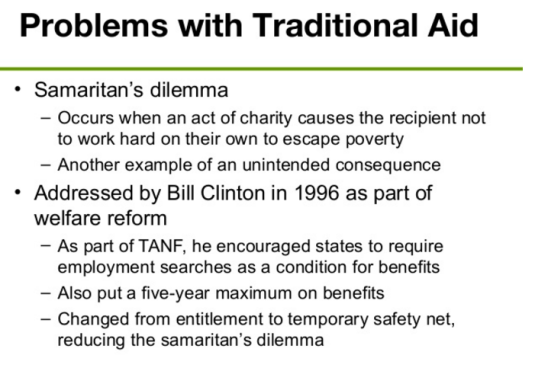
Countless studies show that when comparing the carrot and the stick in welfare reform, the stick is always more effective in reducing poverty and increasing employment.
The typical white family still makes $25,000 more than the typical black one: washingtonpost.com/news/wonkblog/… http://t.co/CEOADLSJdx—
Demos Action (@DemosAction) September 16, 2015
The best solution to child poverty is to move their parents into a job. Simon Chapple is clear in his book last year with Jonathan Boston:
Sustained full-time employment of sole parents and the fulltime and part-time employment of two parents, even at low wages, are sufficient to pull the majority of children above most poverty lines, given the various existing tax credits and family supports.
The best available analysis, the most credible analysis, the most independent analysis in New Zealand or anywhere else in the world that having a job and marrying the father of your child is the secret to the leaving poverty is recently by the Living Wage movement in New Zealand.
According to the calculations of the Living Wage movement, earning only $19.25 per hour with a second earner working only 20 hours affords their two children, including a teenager, Sky TV, pets, annual international travel, video games and 10-hours childcare.
This analysis of the Living Wage movement shows that finishing school so your job pays something reasonable and marrying the father of your child affords a comfortable family life. In the USA this is called the success sequence.
@GarethMorgannz the universal basic income is inferior to the minimum family tax credit
20 Dec 2015 4 Comments
in labour economics, labour supply, politics - New Zealand, poverty and inequality, public economics, welfare reform Tags: Aaron Director, Director's Law, Gareth Morgan, negative income tax, social insurance, universal basic income, welfare state
Gareth Morgan’s universal basic income appears to make everybody better off except those for whom the modern welfare state was established to protect. Examples of these from his online calculator are single mothers and retirees.
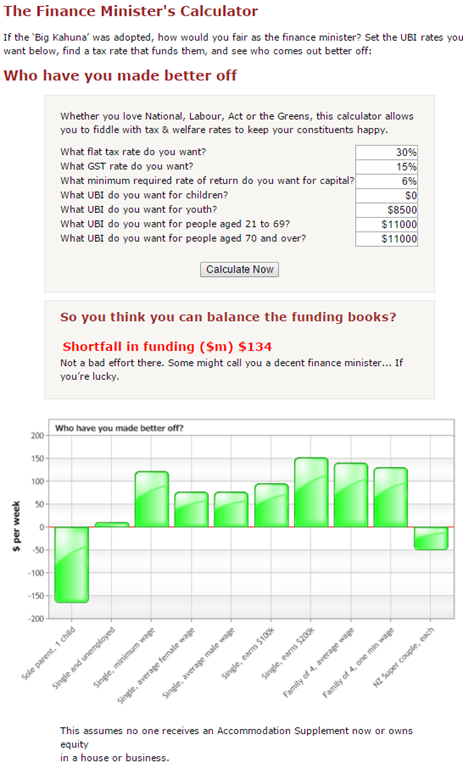
Source: The Big Kahuna – Tax and Welfare.
To stay even just with single mothers blows a good $10 billion hole in the budget deficit according to the online calculator provided by Gareth Morgan. Retirees are still worse off.
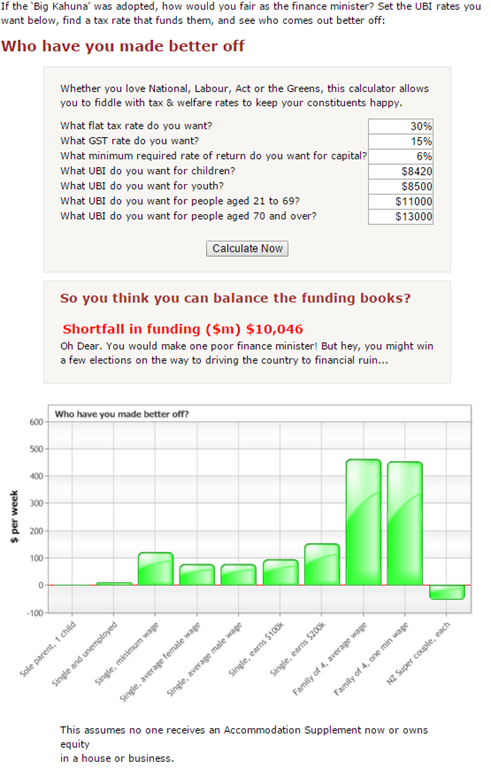
Source: The Big Kahuna – Tax and Welfare.
Central to the package is a comprehensive capital gains tax despite evidence growing with each day that the optimal tax rates on income from capital and on capital gains are zero.
A universal basic income for New Zealand is a long trip to where we are now. There is already a guaranteed minimum family income in New Zealand.
The minimum family tax credit makes sure that a family’s annual income (net income after tax has been deducted) doesn’t fall below $23,036 a year ($443 per week). To qualify, you must work for a salary or wage for at least 30 hours each week as a couple, or 20 hours each week as a single parent, and receive a family tax credit.
The Treasury modelled a Guaranteed Minimum income at the request of the Welfare Working Group in 2010. A guaranteed minimum income of $300 per week – the mean benefit income among those on benefits – would cost $44.5 billion or $52.6 billion if we extended it to super annuitants as a replacement for NZ Superannuation or old age pension. The former could be covered by a flat personal income tax rate of 45.4%; the latter, 48.6%. Full fiscal neutrality would require tax rates of 50.6% and 54.4%.
The universal basic income seems to be a big day out for Director’s Law of Public Expenditure. Director’s Law is public expenditure is used primary for the benefit of the middle class, and is financed with taxes which are borne in considerable part by the poor and the rich.
The universal basic income and a comprehensive capital gains tax seems to cause a lot of economic upheaval but still struggles to make the worse off groups in society even break-even on this throwing of all the cards in the air. Brian Easton put it well the other day when he said:
Many advocates put the UMI forward without doing the sums. Those who do, find that the required tax rates are horrendous or the minimum income is so low that it is not a viable means of eliminating poverty. Among the latter are New Zealanders Douglas, Gareth Morgan and Keith Rankin.
 Utopia, you are standing in it!
Recent Comments