Fact checking Gwyneth Paltrow on $29 of food stamps for a week
26 Apr 2015 Leave a comment
in labour economics, politics - USA, welfare reform Tags: food stamps, Gwyneth Paltrow, Left-wing hypocrisy, welfare state
In another neo-liberal victory, health and welfare spending shares have doubled in the last 50 years
24 Apr 2015 Leave a comment
in income redistribution, politics - USA, Public Choice, public economics Tags: Director's Law, Leftover Left, median voter theorem, neoliberalism, tax reform, welfare state
Annual hours worked, USA, West Germany, Germany and France, 1950-2013
15 Apr 2015 Leave a comment
in economic growth, Euro crisis, fiscal policy, labour economics, labour supply, macroeconomics, politics - USA Tags: annual hours worked, Eurosclerosis, taxation and the labour supply, welfare state
The French and Germans work much less than the Americans
(via: bit.ly/1b2DfWo) http://t.co/S8XwIeLNBr—
Max Roser (@MaxCRoser) April 15, 2015
Max Roser tweeted this chart today showing that French and Germans work far fewer hours than Americans. His measure is annual hours worked divided by the number of persons engaged. Max Roser’s starter shows that French and German annual hours worked in a steady decline since 1950.
My measure below is annual hours worked per American, French, West Germany and German aged 15 to 64. My data shows a different picture. There are stable hours worked per working age American. European hours per worked per working age European fell rapidly up until 1986 or so and then stabilised. Each set of data, my data and Max Roser’s data, requires its own explanation. My explanation is the sharp rises in taxes Europe in the 1970s and 80s.
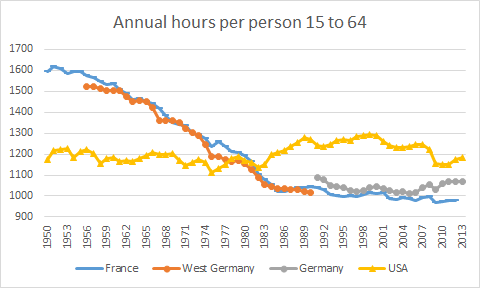
Source:OECD StatExtract and The Conference Board Total Economy Database, January 2014.
Each set of data, my data and Max Roser’s data, requires its own explanation. My explanation is the sharp rises in taxes net welfare state transfers in Europe in the 1970s and 80s.
Source: caramcdaniel.com
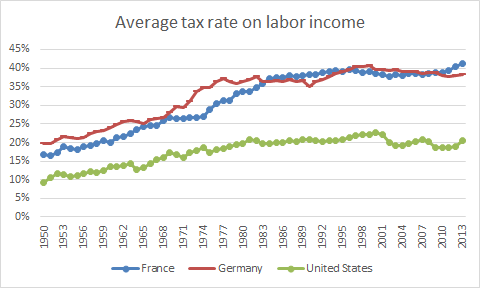
As an illustration, average tax rates on American labour incomes doubled between 1950 in 1980 and then was stable. Labour supply started recover after this point in time as well.
Average tax rates on French and German labour income more than doubled between 1950 to about 1990 and then stopped rising by much after that. At the same time, the fall in hours worked per working age German and French stopped. The average tax rate by that time in Europe was twice that of the USA.
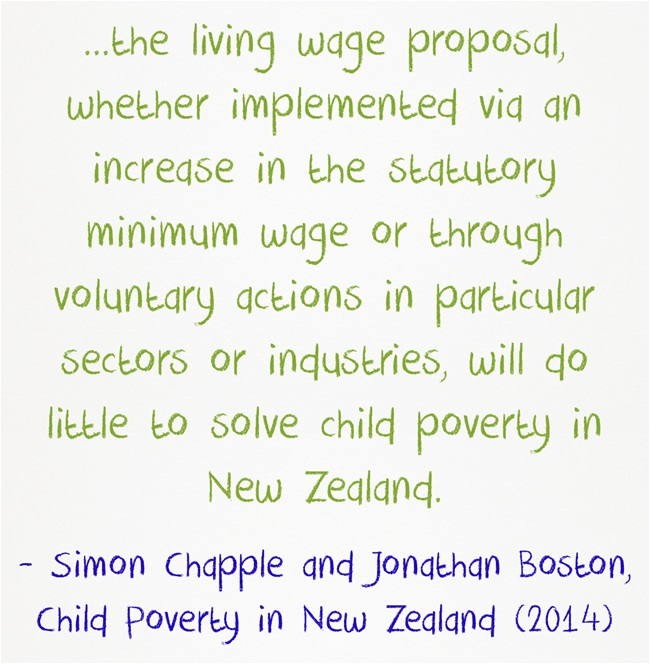
The futility of increasing the minimum wage to reduce poverty
13 Apr 2015 Leave a comment
in labour economics, minimum wage, poverty and inequality, welfare reform Tags: living wage, poverty and inequality, welfare state
The NZ Greens want to introduce food stamps, but only for part of the year?!
12 Apr 2015 Leave a comment
in income redistribution, politics - New Zealand, politics - USA, poverty and inequality, Public Choice Tags: expressive voting, food stamps, Left-wing hypocrisy, rational ignorance, rational irrationality, school breakfast programs, soup kitchens, welfare reform, welfare state
The welfare state has a long history of providing some of its support to the needy in kind rather than in cash. This can range from soup kitchens to public housing as well as food stamps.

In the USA, food stamps provide provide food-purchasing assistance for low- and no-income people living. Food stamps can only be exchanged for food.

Instead of requiring the poor and needy to attend a soup kitchen, they can be given vouchers to buy food at supermarkets and take it home and cook at themselves. These days some sort of debit card system can be used where purchases are restricted to food at supermarkets and other participating retailers.
A close parallel with food stamps, properly understood, is free school breakfast programs. The welfare state is providing in-kind support to hungry children. This is done at school, to ensure that the children eat the meals.
Rather than rely on their parents to spend their welfare benefits and income support on food for their children, the food is given directly to the children when they arrive at school in the morning. In New Zealand, these free school breakfast programs are restricted to schools in low income areas.
There is a Feed the Kids Bill in Parliament sponsored by the Green Party. I have frequently criticised this proposal as it doesn’t provide breakfast to needy children at the weekends and school holidays. They are left to go hungry. Abandoned by their so called social justice champions through lack of imagination and self-awareness.
If children are showing up at school without their breakfast on a regular basis, their parents should reported that the child protection authorities for intervention. This can start with budget advice and assistance with applying for any additional and emergency financial support they are eligible for from Work and Income New Zealand.
 Soup kitchens not only provides people with food, it provides various other assistance to help people to get back on their feet.
If you were proposing a food stamps program in New Zealand because children are going hungry, you’ll be laughed at if you suggested it should only apply the part of the year such as during the school term.
That is precisely what the Greens are doing. The only difference is how they are organised the provision of in-kind support to children, this case, food. Instead of their parents collecting a debit card that can only be used to buy food, the food is eaten by their children at school.
Australia has the most targeted welfare state
10 Apr 2015 2 Comments
in politics - Australia, politics - New Zealand, politics - USA, poverty and inequality, welfare reform Tags: welfare state
In Mexico, most cash-based public social benefits go to households in the highest income quintile, per OECD. http://t.co/xykkPkDVZs—
Catherine Rampell (@crampell) November 24, 2014
Who has the smallest Anglo-Saxon welfare state of them all?
02 Apr 2015 1 Comment
in income redistribution, labour economics, politics - Australia, politics - New Zealand, politics - USA, welfare reform Tags: social insurance, social safety nets, welfare reform, welfare state
I have reanalysed data published by the Peterson Institute on the true levels of social expenditure across the industrialised countries for the Anglo-Saxon countries.
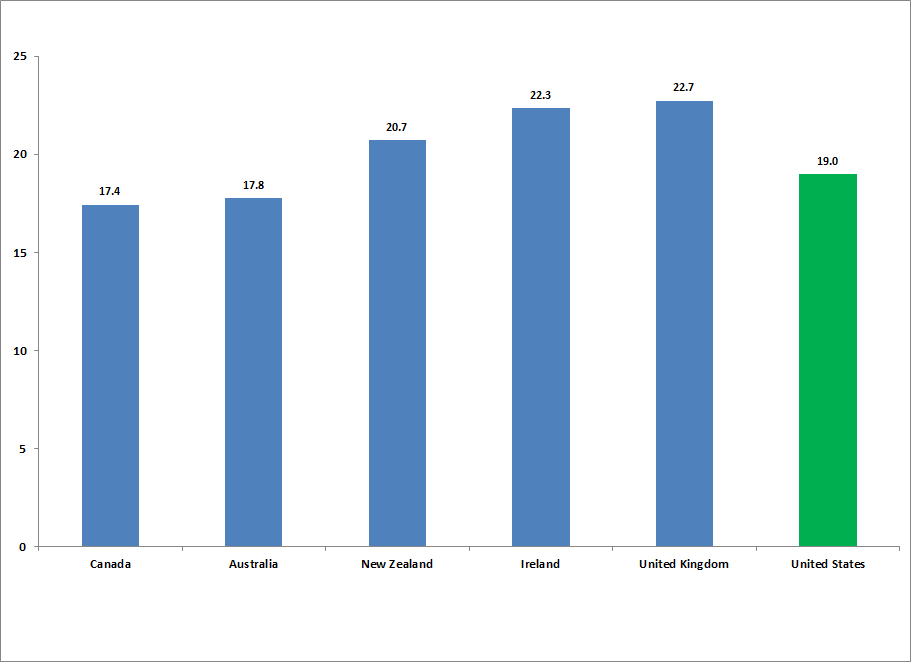
Figure 1: gross public social expenditures in OECD countries, 2011
Source: POLICY BRIEF 15-4: The True Levels of Government and Social Expenditures in Advanced Economies.
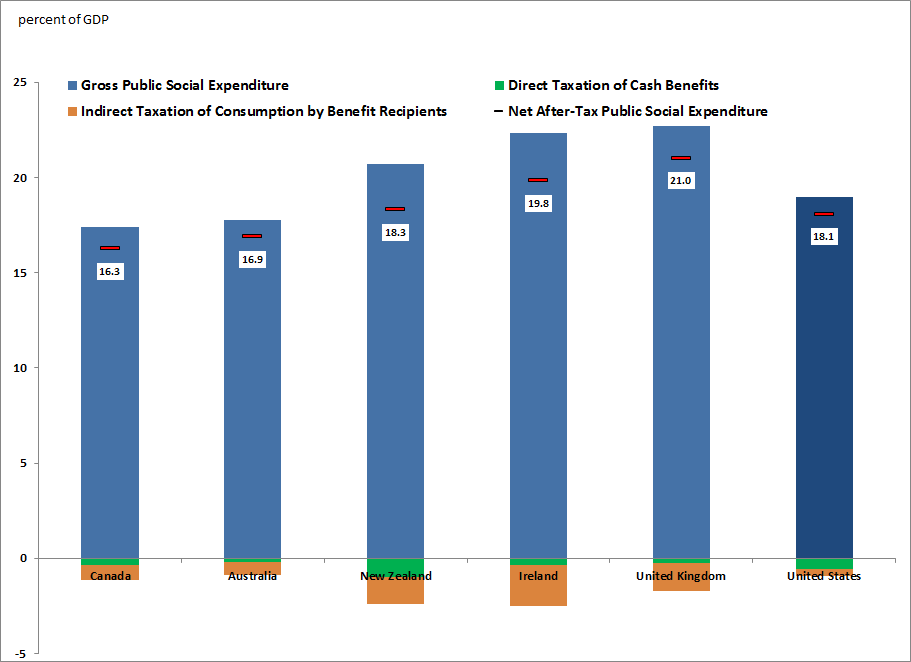
When you just look at gross public social expenditure, New Zealand is in the middle of the pack with the United Kingdom having the largest spending. There are not particularly large differences across social spending in the Anglo-Saxon welfare states.
Figure 2: Gross public social expenditure and the effects of taxation in OECD countries, 2011
Source: POLICY BRIEF 15-4: The True Levels of Government and Social Expenditures in Advanced Economies.
There is not much change when you include the effects of taxation on consumption by benefit recipients.
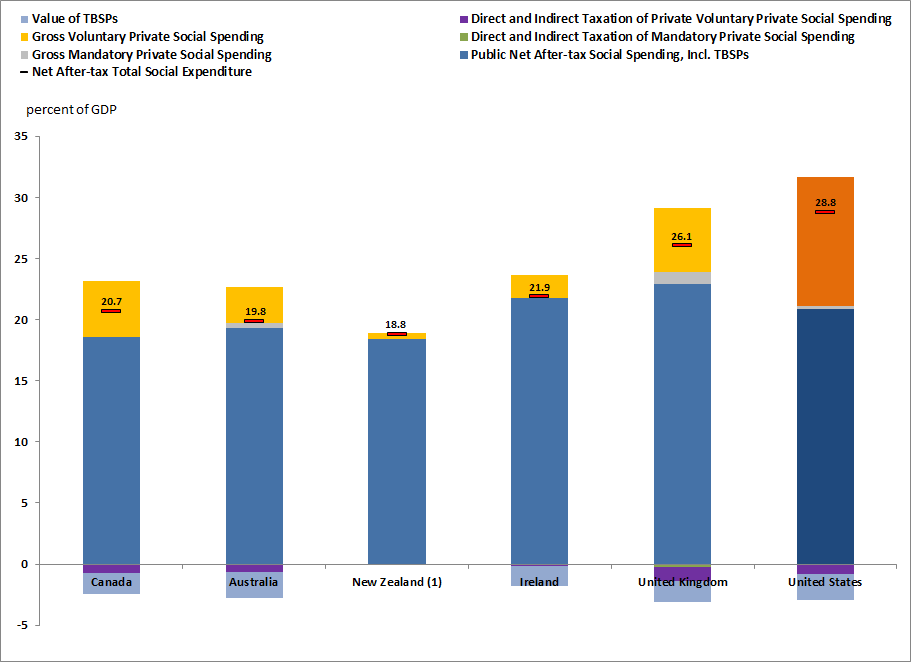
Figure 3: Net after-tax public and private social expenditure in OECD countries, 2011
Source: POLICY BRIEF 15-4: The True Levels of Government and Social Expenditures in Advanced Economies.
When private mandatory social spending is included, such as employer sponsored health cover, there is considerable change with United States leaping to the front and New Zealand dropping to the bottom. The USA has the largest and most expensive is health sector in the world so they are leaping of the front, either because healthcare is expensive in United States or people in the United States are not constrained by government rationing to spend less than they would prefer on their own healthcare. Let’s leave that war of ideas for another day.
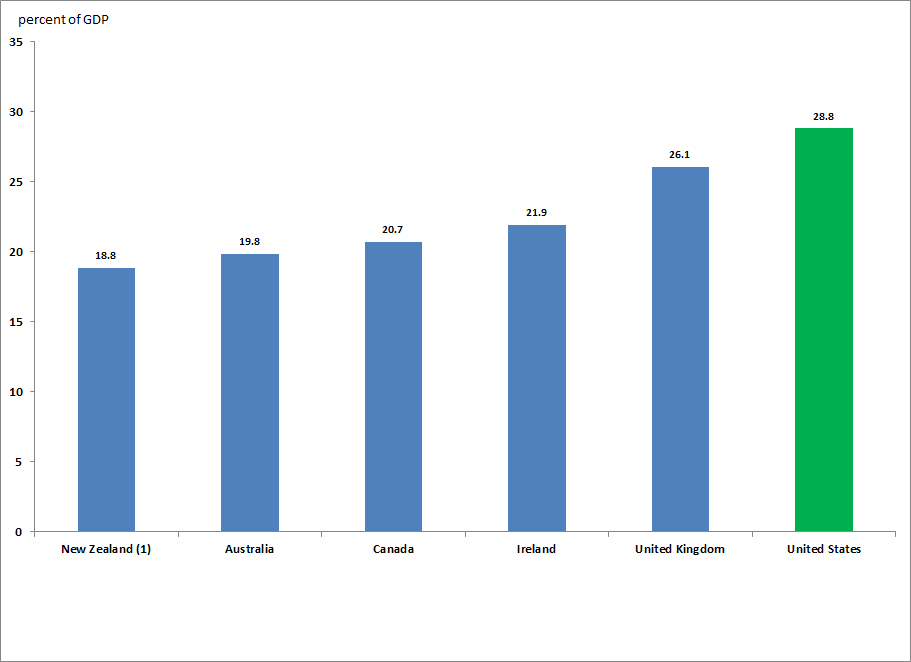
Figure 4: Net after-tax total social expenditures in OECD countries, 2011
Source: POLICY BRIEF 15-4: The True Levels of Government and Social Expenditures in Advanced Economies.
On the face of it, New Zealand has the smallest Anglo-Saxon welfare state while the United States has the largest. A more accurate measure of the relative sizes of these Anglo-Saxon welfare states would require the wisdom of Solomon in measuring waste and underfunding in the respective systems and more trust than you should have in services sector in purchasing power parity adjustments.
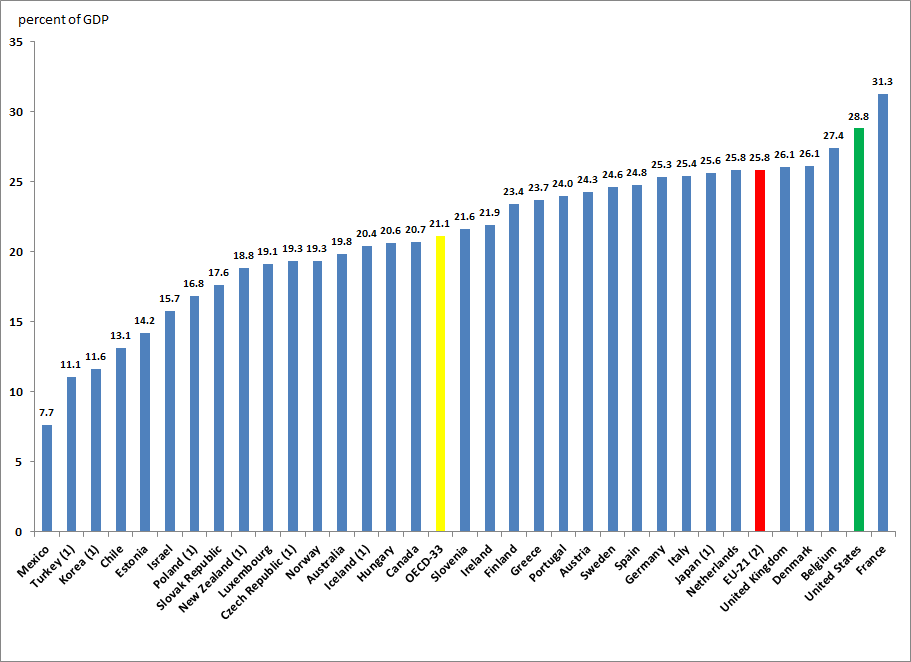
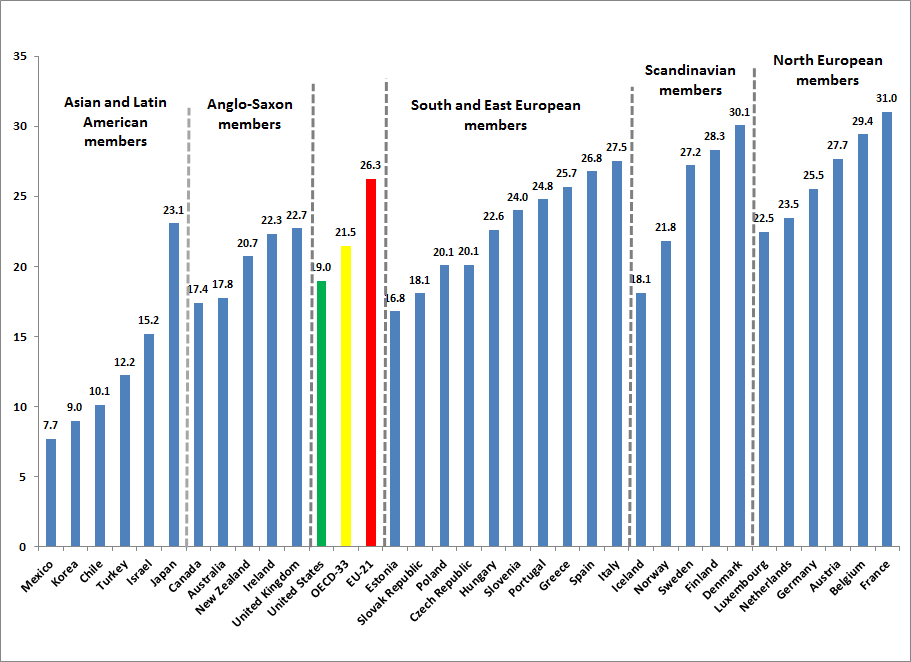
For those that are interested, the OECD-wide gross social spending and net after-tax total social spending are reproduced below in figures 5 and 6.
Figure 5: Net after-tax total social expenditures in OECD countries, 2011
Source: POLICY BRIEF 15-4: The True Levels of Government and Social Expenditures in Advanced Economies.
The Figure 5 data on the OECD wide welfare state sizes shows that when you add private spending, including social spending mandated by law, the US has the second largest OECD social safety net as Kirkegaard said in his Peterson Institute paper:
Taking the full effects of tax systems and social spending from both private and public sources into account, the United States is seen to be devoting more resources toward social purposes than is generally acknowledged. In fact, only the French spend more than Americans, while the alleged welfare-addicted Scandinavians and Europeans spend less on average.
Figure 6: Gross public social expenditures in OECD countries, 2011
Source: POLICY BRIEF 15-4: The True Levels of Government and Social Expenditures in Advanced Economies.
Via The US welfare state and safety net are bigger than you think. But who are they helping? – AEI | Pethokoukis Blog » AEIdeas and POLICY BRIEF 15-4: The True Levels of Government and Social Expenditures in Advanced Economies
NZ is in the middle of the pack in reducing poverty rates through redistribution
16 Mar 2015 Leave a comment
in income redistribution, labour economics, politics - Australia, politics - New Zealand, politics - USA, poverty and inequality, welfare reform Tags: child poverty, welfare state
The figure shows pre-transfer and post-transfer poverty rates among OECD countries (mostly the advanced economies). The former (pre-transfer) are the market-driven poverty rates, before the tax and transfer systems kick in.

Source: OECD, *Poverty thresholds: 50% of median income.

The relative importance of capitalism and the British welfare state in abolishing destitution
24 Nov 2014 Leave a comment

HT: Andrew Newell
The Far Left view of the welfare state
25 Jul 2014 Leave a comment
in income redistribution, rentseeking Tags: bottom 99%, socialism, top 1%, welfare state

HT: Dan Mitchell
The United States’ Big Welfare State
28 May 2014 Leave a comment
in applied welfare economics, politics - USA Tags: growth of government, welfare state

The United States has long had a larger welfare state than most other Western democracies. Surprised? You may not be aware of the new research on “net social spending.”
Net social spending includes not just government expenditures on social programs, but also tax credits for social purposes and, as a debit, government taxation of social benefits. It turns out that many of the so-called “generous” European welfare states tax social benefits at a high rate. Meanwhile, the United States uses the tax code to help the poor, through the Earned Income Tax Credit. We should also include mandatory private social payments, which are not directly paid by the government.
Using the OECD data, I have plotted total net social expenditure over time for 26 rich countries (click the image to zoom in).
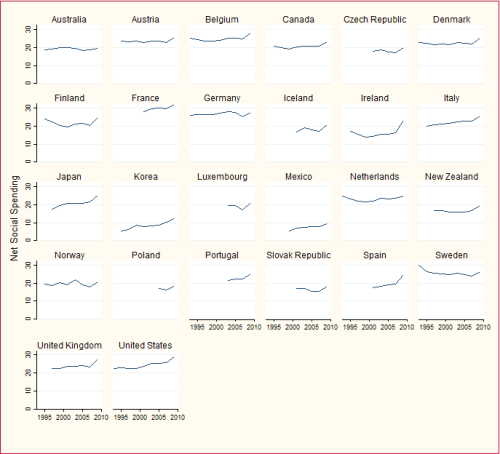
As of 2009, the United States had the second largest welfare state in the world, at 28.8%…
View original post 90 more words
The rise of the Swedish welfare state, Swedosclerosis and Director’s Law
08 Apr 2014 3 Comments
in applied welfare economics, economic growth, macroeconomics, Public Choice Tags: labour supply, Sweden, taxes, welfare state
Sweden is a common example of a generous welfare state that is compatible with a prosperous society. One interpretation of the UN Development Index is you improve your national ranking by becoming more like Sweden.
Assar Lindbeck has shown time and again in the Journal of Economic Literature and elsewhere that Sweden became a rich country before its highly generous welfare-state arrangements were created
Sweden moved toward a welfare state in the 1960s, when government spending was about equal to that in the United States – less that 30% of GDP.
Sweden could afford this at the end of the era that Lindbeck labelled ‘the period of decentralization and small government’. Sweden was one of the fastest growing countries in the world between 1870 and 1960.
Swedes had the third-highest OECD per capita income, almost equal to the USA in the late 1960s, but higher levels of income inequality than the USA.
By the late 1980s, Swedish government spending had grown from 30% of gross domestic product to more than 60% of GDP. Swedish marginal income tax rates hit 65-75% for most full-time employees as compared to about 40% in 1960.
Swedish economists named the subsequent economic stagnation Swedosclerosis:
- Economic growth slowed to a crawl in the 1970s and 1980s.
- Sweden dropped from near the top spot in the OECD rankings to 18th by 1998 – a drop from 120% to 90% of the OECD average inside three decades.
- 65% of the electorate receive (nearly) all their income from the public sector—either as employees of government agencies (excluding government corporations and public utilities) or by living off transfer payments.
- No net private sector job creation since the 1950s, by some estimates!
In 1997, Lindbeck suggested that the Swedish Experiment was unravelling.

Sweden is a classic example of Director’s Law of Public Expenditure. Once a country becomes rich because of capitalism, politicians look for ways to redistribute more of this new found wealth.
Studies starting from Sam Peltzman (1980) showed that government grew in line with the growth in the size and homogeneity of the middle class that became organised and politically articulate enough to implement a version of Director’s law. Director’s law augmented by Gary Becker’s 1983 model of competition among pressure groups for political influence explain much of modern public policy.
Government spending grew in many countries in the mid-20th century because of demographic shifts, more efficient taxes, more efficient spending, shifts in the political power from those taxed to those subsidised, shifts in political power among taxed groups, and shifts in political power among subsidised groups.
The Swedish economic reforms from after 1990 economic crisis and depression are an example of a political system converging onto more efficient modes of income redistribution as the deadweight losses of taxes on working and investing and subsidies for not working both grew. Improvements in the efficiency of taxes or spending reduce political pressure to suppress the growth of the welfare state and thus increase or prevent cuts to both total tax revenue and spending.
After the rise of Swedosclerosis, the taxed, regulated and subsidised groups had an increased incentive to converge on new lower cost modes of redistribution. More efficient taxes, more efficient spending, more efficient regulation and a more efficient state sector reduced the burden of taxes on the taxed groups. Most subsidised groups benefited as well because their needs were met in ways that provoked less political opposition.
Reforms ensued led by parties on the Left and Right, with some members of existing political groupings benefiting from joining new political coalitions.
The Nordic median voter was alive to the power of incentives and to not killing the goose that laid the golden egg. The deadweight losses of taxes, transfers and regulation limit inefficient policies and the sustainability of redistribution.
For example, while tax rates are high in Sweden and the rest of Scandinavia, hours worked in Scandinavia are significantly higher than in Continental Europe.
Richard Rogerson found in Taxation and market work: is Scandinavia an outlier? that how the government spends tax revenues imply different rates of labour supply with regard to tax rate increases.
Rogerson considered that differences in the composition of government spending can potentially account for the high rate of labour supply in Sweden and elsewhere in Scandinavia. Specifically, examining the conditions on which how tax revenue is returned to Swedes as income transfers or other conditional payments is central to understanding the labour supply effects of taxes:
- If higher taxes fund disability payments which may only be received when not in work, the effect on hours worked is greater relative to a lump-sum transfer with no conditions; and
- If higher taxes subsidise day care for individuals who work, then the effect on hours of work will be less than under the lump-sum transfer with no conditions.
A much higher rate of government employment and greater expenditures on child and elderly care explain the high rates of Swedish labour supply.
Swedes are taxed heavily, but key parts of this tax revenue are then given back to them conditionally if they keep working. Policies that significantly cut the total wealth available for redistribution by Swedish governments were avoided relative to the germane counter-factual, which are other even costlier modes of income redistribution.
Director’s Law of public expenditure and the survival of the modern welfare state
14 Mar 2014 4 Comments
in liberalism, Public Choice Tags: Director's Law, economic reform, Gary Becker, Sam Peltzman, welfare state
Sam Peltzman pointed out that most of modern public spending is supported by the median voter – the ‘swinging’ voter. Governments at the start of the 20th century were a post office and a military. At the end of the 20th century, governments are a post office, a larger military and a very large welfare state.
Studies starting from Peltzman in 1980 showed that governments grew in line with the growth in the size and homogeneity of the middle class that was organised and politically articulate enough to implement a version of Director’s Law. George Stigler published an article on this law because Aaron Director published next to nothing for reasons no one understands. Director founded law and economics through teaching at the University of Chicago law school.

Director’s Law of public expenditure is that public expenditure is used primary for the benefit of the middle class, and is financed with taxes which are borne in considerable part by the poor and the rich.
Based on the size of its population and its aggregate wealth, the middle class will always be the dominant voting bloc in a modern democracy. Growth in the size of governments across the developed world took off in the mid-20th century as the middle class blossomed. Peltzman maintained that:
“the leveling of income differences across a large part of the population … has in fact been a major source of the growth of government in the developed world over the last fifty years” because the leveling created “a broadening of the political base that stood to gain from redistribution generally and thus provided a fertile source of political support for expansion of specific programs. At the same time, these groups became more able to perceive and articulate that interest … [and] this simultaneous growth of ‘ability’ served to catalyze politically the spreading economic interest in redistribution.”
After the 1970s economic stagnation, the taxed, regulated and subsidised groups had an increasing incentive to converge on new, lower cost modes of income redistribution.
- Economic reforms ensued, led by parties on the left and right, with some members of existing political and special interest groupings benefiting from joining new coalitions.
- More efficient taxes, more efficient spending, more efficient regulation and a more efficient state sector reduced the burden on the taxed groups.
- Most of the subsidised groups benefited as well because their needs were met in ways that provoked less political opposition from the taxpaying groups.
Sweden, Norway and Denmark could be examples of Gary Becker’s idea that political systems converge on the more efficient modes of both regulation and income redistribution as their deadweight losses grew in the 1970s and 1980s and after. Unlike some of their brethren abroad, more of the Nordic Left and, more importantly, the Nordic median voter were cognizant of the power of incentives and to not killing the goose that laid the golden egg. Taxes on income from capital are low in Scandinavia.
The rising deadweight losses of taxes, transfers and regulation all limit the political value of inefficient redistributive policies. Tax and regulatory policies that are found to significantly cut the total wealth available for redistribution by governments are avoided relative to the germane counter-factual, which are other even costlier modes of redistribution.
An improvement in the efficiency of either taxes or spending reduces political pressure from taxed and regulated groups for suppressing the growth of government and thereby increases total tax revenue and spending because there is less political opposition. Efficient taxes lead to higher taxes.
Improvements in the efficiency of taxes, regulation and in spending reduce political pressure from the taxed and regulated groups in society. This suppressed the growth of government and thus increased or prevented cuts to both total tax revenue and spending since 1980. Economic regulation lessened after 1980 and there were privatisations, but social and environmental regulation grew unabated.
The post-1980 reforms of Thatcher, Reagan, Clinton, Hawke and Keating, Lange and Douglas and others saved the modern welfare state for the middle class. Most income transfer programmes in modern welfare states disproportionately benefit older people. With an aging society, that trend can only continue.
That is why these reforming policies survived political competition, election after election. The political parties on the left and right that delivered efficient increments and streamlined the size of government were elected, and in turn, got thrown out from time to time because they became tired and flabby.
 Utopia, you are standing in it!

Recent Comments